
Introduction
Weld cells still depend on tribal knowledge. Operators re-enter the same part data into three systems. Planners build spreadsheets to guess at demand instead of trusting numbers already in the ERP. Sound familiar?
Every department has its own version of manual busywork, and it adds up fast across a large organization. Enterprise automation connects those disconnected processes end to end—using software, AI, and robotics on the plant floor and in the back office.
The pressure to adopt it is real. Gartner forecasts that 30% of enterprises will automate more than half of their network activities by 2026, up from under 10% in mid-2023, as organizations race to cut costs and scale faster.
This article breaks down what enterprise automation actually means, the four main types, real examples across industries including manufacturing, and how to pick the right approach for your business.
Key Takeaways
- Enterprise automation is an organization-wide strategy, not a single software tool
- Four core types exist: basic automation, business process automation, integration automation, and RPA/intelligent automation
- Automation now covers physical operations too, including robotic manufacturing cells
- The right type depends on process complexity, systems involved, and budget, not on industry trends
What Is Enterprise Automation?
Enterprise automation is the use of software, AI, and connected systems to run business processes across departments with minimal manual intervention. It coordinates work across finance, HR, IT, supply chain, and production floors so information and decisions move without constant human handoffs.
The scope is wide. On one end sit simple tasks like auto-filling a form. On the other are multi-system workflows: a purchase order that triggers inventory checks, supplier notifications, and payment processing automatically.
That same idea reaches the plant floor. A robotic cell can load and unload a CNC machine, pass status data upstream, and keep the next job moving without an operator standing by.
One distinction matters:
- Enterprise automation — the organization-wide strategy and operating model
- RPA, bots, and point tools — components used inside that strategy
Enterprise automation is an operating model you build, not a single product you install. Deloitte describes end-to-end automation as a methodology for automating a full process or value chain, usually with multiple tools working together rather than one platform doing everything.
Many companies still buy one tool, apply it to one workflow, and stop there. That is task automation. Enterprise automation scales the same thinking across the business so departments connect instead of optimizing in isolation.
Why Is Enterprise Automation Important for Modern Businesses?
Without automation, growth exposes every crack in your operations. Data sits in silos. Manual entry introduces errors. Cycle times stretch out. Output becomes inconsistent, especially once volume climbs.
The financial case is hard to ignore. Deloitte's global survey of 479 executives found that organizations past the pilot stage reported an average 32% cost reduction from intelligent automation. One telecom company in the same study scaled automation to roughly 100 processes and saved more than 110,000 hours per month.
The benefits go beyond cost, though. McKinsey surveyed 639 organizations and found that roughly two-thirds of those piloting or scaling automation saw improvements in:
- Quality control and error reduction
- Customer satisfaction
- Employee experience
- Operating expenses

What Breaks Down Without It
Those gains only stick when the underlying process failures get fixed. Manual work doesn't just cost money — it creates bottlenecks that compound:
- Order-to-cash and procure-to-pay cycles stall when data can't move between systems
- Compliance and audit risk rise when manual reporting can't keep pace with volume
- Hiring and procurement freeze behind slow approval chains
- Customer delivery dates slip when output quality varies under load
Plant-Floor Automation Counts Too
For manufacturers, automation increasingly means physical systems as well as software. Robotic machine tending, welding cells, and material handling solve the same core problems — on the plant floor instead of a screen.
A robot that tends a CNC machine across shifts does for production what an RPA bot does for accounts payable: it removes a repetitive human bottleneck.
Types of Enterprise Automation
Enterprise automation isn't one thing. It's a spectrum, ranging from simple rule-based tasks to intelligent, adaptive systems that make decisions on their own. Most organizations end up combining several types, applying each one where it fits best rather than forcing a single tool to do everything.
Basic Automation
Basic automation handles simple, repetitive tasks using fixed triggers: data entry, scheduling, email routing. It's typically low-code or no-code, meaning nontechnical staff can build it without an engineering team.
- Strengths: Fast to deploy, low cost, frees up staff time almost immediately
- Limitations: No system integration, no judgment calls, and it scales poorly once workflows get complex
This is the right starting point for teams new to automation. It's also the wrong choice if your process spans multiple systems or requires any decision-making.
Business Process Automation (BPA)
BPA automates entire multi-step workflows rather than isolated tasks. Think employee onboarding, procurement approvals, or customer service resolution, where a single process touches multiple people and hands off between stages.
BPA runs on dedicated BPM/BPA platforms designed to manage a full workflow end-to-end, not just one screen action. TechTarget notes it works best for high-volume, recurring, time-sensitive work involving multiple people.
- Strengths: Improves consistency and speed across recurring workflows with approval chains
- Limitations: Operates within its own process boundary and struggles to unify data across disconnected systems on its own
Integration Automation
Integration automation connects disparate applications, like your CRM, ERP, and supply chain platform, so data flows automatically between them. The defining feature here is connectivity via APIs or iPaaS platforms, not task sequencing.
Forrester notes that iPaaS tools support both cloud-native and legacy systems, handling scenarios like pulling data from multiple sources, transforming it, and routing it to a target system.
- Strengths: Delivers real-time, unified data across departments running multiple software systems
- Limitations: Requires careful middleware and API planning; can get complex and costly if not scoped correctly
RPA and Intelligent Automation
RPA uses software bots that mimic human actions, like extracting data or filling out forms, by interacting directly with application interfaces. Add AI and machine learning, and you get intelligent automation: bots capable of handling less structured work and making smarter decisions.
Agentic automation is the next step in this evolution. Rather than following a script, agentic systems plan and execute multi-step tasks with more autonomy.
Gartner predicts that by 2028, 15% of day-to-day work decisions will be made autonomously through agentic AI, up from 0% in 2024. The firm also warns that more than 40% of agentic AI projects will be canceled by 2027 due to unclear ROI and integration challenges.
- Strengths: Speed, precision, and continuous uptime on high-volume work; intelligent and agentic variants handle less structured tasks with more autonomy
- Limitations: Needs ongoing governance and maintenance; pure RPA still falters on judgment-heavy work; agentic projects often stall without clear ROI

Real-World Examples of Enterprise Automation in Action
Theory is one thing. Here's where enterprise automation actually shows up across industries.
Finance and back office. Automating invoicing and accounts payable cuts errors and speeds up cash flow. One manufacturer, Atul Limited, implemented automated invoice scanning in 48 days with zero capital investment, reducing misplaced invoices from about 50 per month to zero.
HR. Automated onboarding, resume screening, and payroll processing reduce administrative load. In one McKinsey-documented case, a bot that generated offer letters by pulling data from multiple systems cut processing time by 66% and freed up four full-time employees for higher-value work.
Customer experience. AI chatbots now deliver always-on, personalized responses at scale. Klarna's AI assistant reportedly does work equivalent to 700 employees while cutting average resolution time from 11 minutes to 2 minutes.
Supply chain. Demand forecasting automation reduces stockouts and improves just-in-time delivery. McKinsey found AI-driven forecasting can cut forecast errors by 20-50% and reduce lost sales from unavailability by up to 65%.
Manufacturing and the plant floor. This is where automation gets physical. Robotic machine tending, welding, and material handling cells now do the repetitive work that used to tie up operators for entire shifts.
The robotic machine tending cells GLOBAL builds target one of the fastest payback windows in industrial automation, often in the 12-to-18-month range. The math is straightforward: more parts per shift with fewer direct labor hours.
A robot loads and unloads a CNC machine across breaks and shift changes, extending spindle utilization well beyond a manually loaded machine while operators move into inspection, programming, or process improvement instead of standing at a machine door.
The same approach shows up across other plant-floor cells:
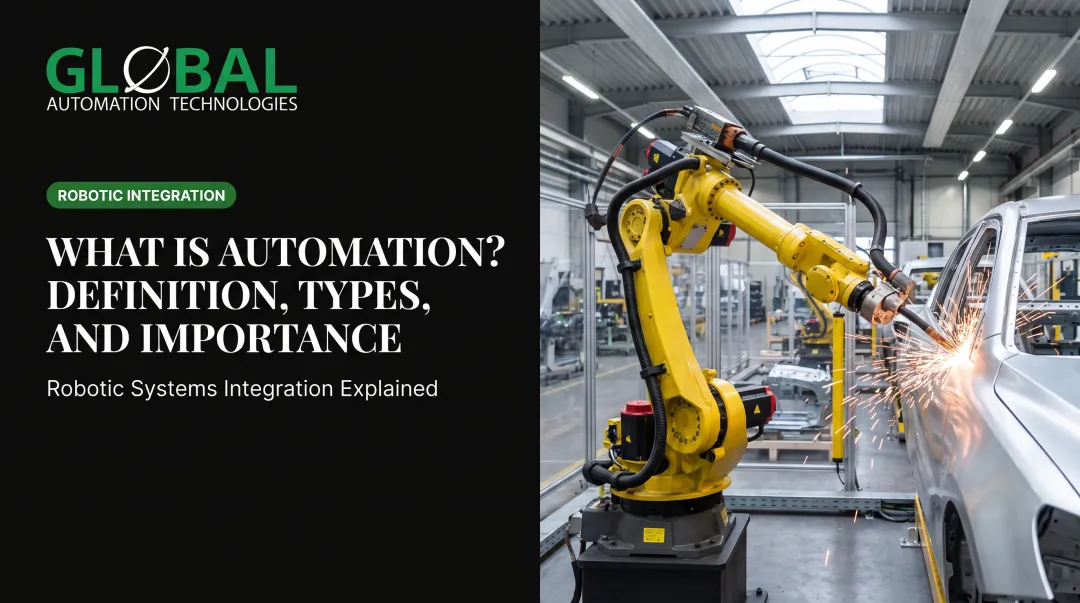
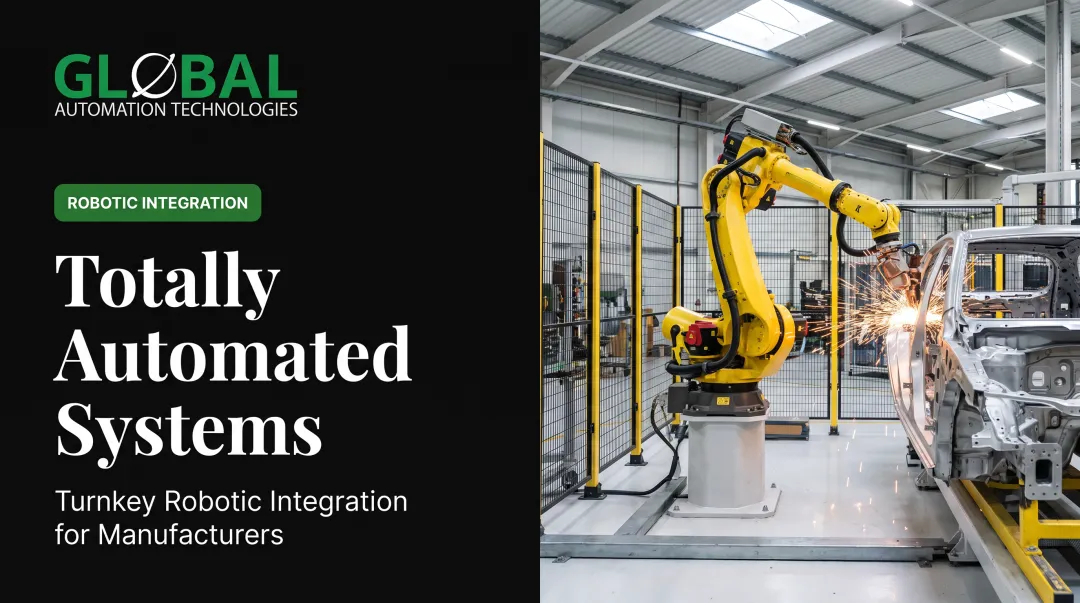
- Robotic welding improves weld consistency and pulls operators out of fume and arc-flash exposure
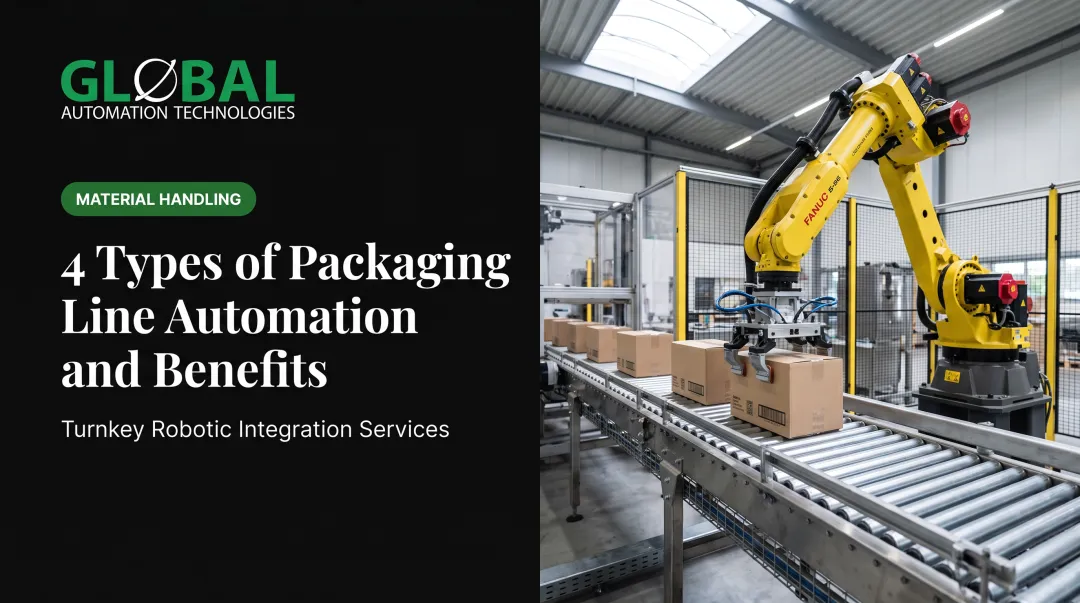
- Material handling systems remove bottlenecks caused by manual part transfer between stations
- AI-assisted offline simulation lets GLOBAL's engineers program and validate cells virtually before install, compressing robot programming timelines from weeks to days
How to Choose the Right Type of Enterprise Automation
The "right" type depends on your needs, constraints, and desired outcomes, not on what's trending in a vendor's pitch deck. Work through these factors before committing.
- Define the outcome you need. Speed, cost reduction, accuracy, and compliance each point toward different automation types.
- Match complexity to the tool. Simple, repetitive tasks fit basic automation. Multi-system workflows call for integration automation, RPA, or intelligent automation (IA).
- Set a realistic ROI timeline. Deloitte found the average payback period for intelligent automation pilots rose from 16 months in 2020 to 22 months in 2021-22. Budget accordingly.
- Assess internal skills. Can your team build and maintain this, or do you need specialized engineering talent or an integration partner?
- Account for integration costs upfront. Price the full path—connectors, maintenance, and change management—not just licenses. The same Deloitte research ranked integrating different solutions (62%) and skill gaps (55%) as top barriers.
What to avoid:
- Choosing the most advanced type when a simpler one gets the job done
- Ignoring ongoing integration and maintenance costs
- Selecting on familiarity or vendor hype instead of actual fit
Conclusion
Enterprise automation spans a wide range, from basic rule-based tasks to intelligent and agentic systems, and each type exists for a reason. None of them is universally "better." They're built for different jobs.
What's changed most in recent years is scope. Automation no longer lives only in office workflows. It runs on the plant floor too, through robotic cells that tend machines, weld parts, and move materials across shifts.
Matching the type of automation to the actual process, rather than chasing the newest technology, is what drives real ROI.
As AI and robotics continue to converge, the strongest automation strategies pair the right technology with the right people to run it. That's the model GLOBAL Automation Technologies has followed since 2009. Its automation solutions build and integrate the robotic cell, while its technical staffing places the controls and mechanical engineers who keep it running—so manufacturers get both the system and the people to operate it.
Frequently Asked Questions
What is industrial automation and what does it do?
Industrial automation uses robotics, sensors, and control systems to automate physical manufacturing tasks like welding, material handling, and machine tending. It's the plant-floor counterpart to enterprise automation, which coordinates software and data across the wider organization.
What is the primary focus of enterprise automation?
Enterprise automation focuses on connecting systems and cutting manual handoffs so work moves faster with fewer errors. Teams spend less time on repetitive tasks and more time on exceptions, decisions, and customers.
What is the difference between RPA and enterprise automation?
RPA is one tool or type within a broader enterprise automation strategy, focused on task-level bots that mimic human actions. Enterprise automation is the organization-wide strategy that connects RPA, integrations, and workflows together.
What is agentic automation, and how does it relate to enterprise automation?
Agentic automation is an emerging, more autonomous evolution of RPA and intelligent automation. Instead of following a fixed script, agentic systems plan and execute multi-step tasks with less human oversight.
How do I choose the best enterprise automation approach for my business?
Start with process complexity, available budget, existing systems, and the technical expertise you have in-house. Simpler processes need less sophisticated tools; multi-system workflows need integration, RPA, or intelligent automation.
What industries benefit most from enterprise automation?
Finance, healthcare, retail, and manufacturing all benefit significantly. Manufacturers apply it directly on the production line through robotic welding, machine tending, and material handling systems.