
Introduction
Manufacturers are running out of room to absorb pressure at the end of the line. Labor is harder to find, costs keep climbing, and customers expect zero defects — problems that upstream automation alone doesn't solve.
The numbers back this up. U.S. manufacturers may need as many as 3.8 million new employees between 2024 and 2033, and 1.9 million of those roles could go unfilled, according to The Manufacturing Institute.
In the same labor research, 65% of manufacturers already call talent retention their top challenge.
End-of-line automation is easy to treat as an abstract concept. On the plant floor, it shows up as throughput, defect rates, and safety incidents. This article covers what end-of-line automation actually is, the advantages it delivers, what happens when it's missing, and how to get real value from it.
TL;DR
- End-of-line automation handles packaging, palletizing, inspection, and material handling before goods ship
- Plants gain higher throughput, tighter quality control, and safer working conditions
- Skipping it creates bottlenecks and uneven quality—even when upstream production runs smoothly
- ROI depends on matching the system to your line and staffing engineers who can run it
What Is End-of-Line Automation?
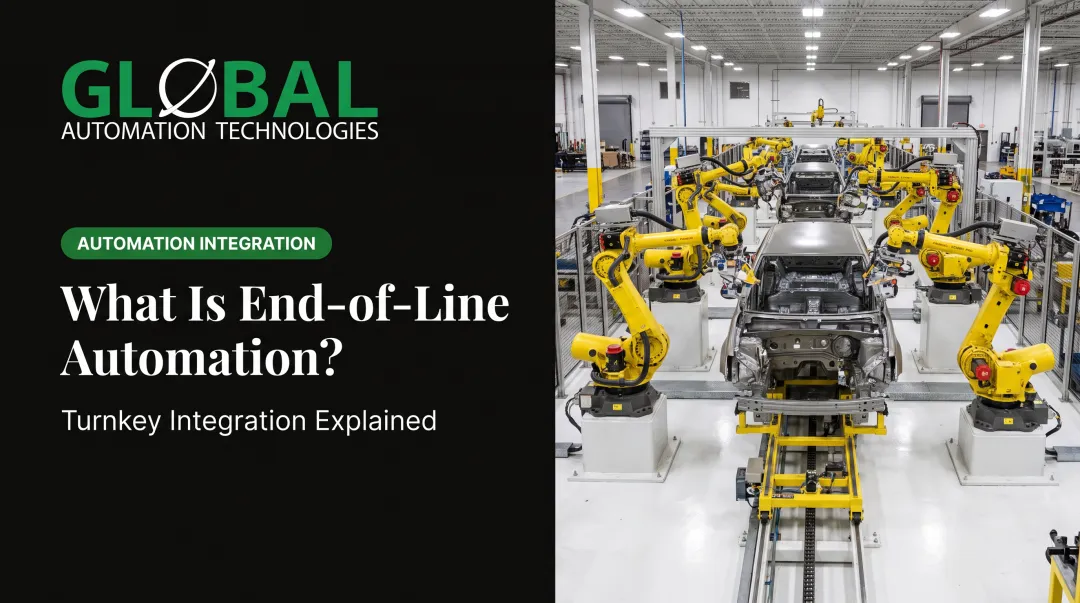
End-of-line automation is the technology deployed at the final stage of a production line to package, inspect, palletize, and prepare finished goods for shipment. It's the last checkpoint before product leaves the building.
You'll typically find it in:
- Automotive components production, often paired with robotic material handling
- Industrial parts manufacturing, where heavy or awkward loads need consistent handling
- Consumer goods lines, where high SKU variety demands flexible packaging and palletizing
The goal is a stable handoff between upstream production and outbound logistics. Without it, scaling production just shifts the bottleneck to the loading dock.
Key Advantages of End-of-Line Automation
The advantages below aren't abstract technology benefits. They're tied directly to KPIs manufacturing leaders already track: cost, throughput, quality, and safety.
Higher, More Consistent Throughput
Automated systems run at fixed cycle times. That removes the variability caused by shift changes, operator fatigue, or manual pacing that inevitably slows a line down toward the end of a shift.
Robotic palletizing and material handling paired with upstream automation keep product moving instead of piling up at the final station.
Consider Wonderful Citrus, which switched from manual to automated palletizing and reported a 15% line-productivity increase. The new system sustains 40 to 50 cases per minute, a pace Modern Materials Handling reported the manual process could never match.

Consistent throughput means:
- Meeting demand spikes without proportional headcount increases
- Fewer missed shipments and more reliable order fulfillment
- Lower overtime costs since output doesn't depend on pushing operators harder
KPIs impacted: units per hour, order fulfillment time, unplanned downtime, labor cost per unit.
This advantage matters most in high-volume, multi-shift operations, or any facility where upstream automation is already outpacing what manual end-of-line labor can keep up with.
Improved Quality Control and Reduced Defects
Automated systems execute the same motion the same way, every single cycle. Vision systems and sensor-based validation can layer on real-time inspection — catching fill accuracy issues, label misalignment, or seal defects before a product ever ships.
That matters because catching a defect at the end of the line is dramatically cheaper than catching it after a customer does. It prevents:
- Downstream rework and scrap
- Product returns and warranty claims
- Compliance failures in regulated industries
GLOBAL's dispensing and sealing systems build this logic in directly. Vision inspection and flow monitoring validate bead width, placement, and continuity in real time, flagging off-spec material before the part moves downstream instead of letting it slip through.
KPIs impacted: defect rate, rework/scrap rate, customer returns, compliance pass rate.
This advantage is most valuable in regulated industries — automotive, pharmaceutical, food — or high-mix production where holding manual consistency across shifts is nearly impossible.
Enhanced Workplace Safety and Reduced Labor Strain
End-of-line work is often the most physically demanding part of the entire process: repetitive lifting, awkward postures, and ongoing exposure to hazards. Robotic palletizing and material handling take over the heavy, repetitive tasks. Robotic dispensing and painting remove operators from fumes and overspray entirely.
The safety case is hard to ignore. In 2021-2022, transportation and material-moving occupations recorded 329,150 DART cases (days away, restricted, or transferred) tied to overexertion and bodily reaction, per BLS data. Manual material handling is a leading driver of workplace injury across manufacturing.
Removing workers from that exposure delivers:
- Lower workers' compensation costs
- Improved retention in physically demanding roles
- Easier recruitment, since safer roles are more attractive in a tight labor market
KPIs impacted: recordable injury rate, workers' comp claims, employee turnover, absenteeism.
This matters most in facilities handling heavy, hazardous, or high-volume repetitive tasks — or anywhere labor shortages are already straining the workforce.
What Happens When End-of-Line Automation Is Missing
Manual end-of-line processes become the bottleneck the moment upstream production or picking speeds up. Every efficiency gain made earlier in the line gets undone at the final step.
Without automation at the end of the line, manufacturers typically see:
- Inconsistent packaging and quality standards that shift by operator or shift
- Higher error and rework rates as manual pacing and fatigue introduce variability
- Reactive firefighting instead of proactive scaling when volume grows
- Labor and injury-related costs that climb year over year
- Production that can't scale without adding headcount at the same rate
None of this shows up cleanly on paper until it's already a problem. A plant can invest heavily in upstream robotics and still lose most of the gains because packaging or palletizing never got upgraded to match.
How to Get the Most Value from End-of-Line Automation
Automation only delivers full value when it's treated as an integrated system, sized correctly and continuously optimized — not installed and left alone.
Three practices separate high-ROI installs from underused equipment:
- Size for upstream capacity, not today's output. A palletizing cell built for current volume becomes a bottleneck the moment production scales. Engineer around where the line is headed.
- Review performance data and act on it. Cycle times, defect rates, and downtime logs only help if someone owns them. Data sitting in a historian improves nothing.
- Pair the system with people who can run it. Full value depends on engineers who can program, commission, and maintain the cell.

GLOBAL Automation Technologies, a Level 5 FANUC Authorized System Integrator, combines automation solutions, services and technical staffing so the equipment and the people running it stay aligned from day one. That pairing is reinforced two ways:
- AI-assisted simulation — model and validate robot programs virtually before deployment, compressing floor programming timelines and catching issues early
- AI-driven predictive maintenance — flag equipment issues before they become unplanned downtime
Treated this way, end-of-line automation keeps compounding returns the longer it runs.
Conclusion
The value of end-of-line automation comes down to three things:
- Consistency in pack-out, labeling, and load quality
- Higher throughput without adding headcount
- Safer handling at the last step before shipment
Those gains build the longer the system runs. Skip this stage, and upstream improvements get lost right before product leaves the facility.
If you are evaluating turnkey robotic end-of-line systems, look for an integrator that can deliver both the cell and the engineers to run it. That combined model—automation solutions alongside engineering services and technical staffing—is what GLOBAL Automation Technologies was built around.
Frequently Asked Questions
What are the different levels of automation used in end-of-line automation?
Most facilities scale in stages: standalone single-task machines, connected multi-machine cells, then fully integrated systems tied into plant-wide controls. Plants usually advance as production needs grow rather than jumping straight to full integration.
What is the ROI for end-of-line packing automation?
ROI depends heavily on production volume and labor costs, so there's no universal number. As a reference point, comparable robotic machine tending cells typically pay for themselves in 12 to 18 months, and well-matched end-of-line systems often follow a similar timeline.
What does end-to-end automation mean?
End-to-end automation spans the entire production or supply chain workflow, from manufacturing through warehousing and delivery. End-of-line automation is more specific: it covers only the final packaging and shipping stage within that broader chain.
What industries benefit most from end-of-line automation?
Automotive, food and beverage, pharmaceuticals, and heavy industry see the biggest gains, thanks to high production volume, strict compliance requirements, or physically demanding manual handling that's hard to staff consistently.
Does end-of-line automation eliminate jobs on the production floor?
It typically shifts workers away from repetitive or hazardous tasks toward oversight, quality, and maintenance roles rather than eliminating positions outright. Given current labor shortages, this reallocation often helps plants fill roles they were already struggling to staff.
How long does it take to implement an end-of-line automation system?
Timelines range from a few weeks for standalone machines to several months for fully integrated systems. Phased implementation and AI-assisted simulation can shorten commissioning time considerably by catching issues before the system ever reaches the floor.