
Both are right. That's the problem.
Manufacturers are stuck juggling disconnected robots, legacy equipment that predates any of it, ERP and MES systems that don't talk to each other, and a shrinking pool of engineers who understand how to connect it all. This guide breaks down what manufacturing integration technology actually means, why it matters, the core technologies involved, and how to pick a partner who can deliver it.
Key Takeaways
- Manufacturing integration connects machines, robotics, software, and people into one coordinated production system.
- Two layers drive results: enterprise/IT (ERP, MES, data) and physical/automation (robots, tooling, controls).
- Robotic systems integration is most often underestimated, yet delivers the fastest, most measurable floor ROI.
- Partners that combine systems engineering with staffing cut deployment risk and speed go-live.
What Is Manufacturing Integration Technology?
Manufacturing integration is the process of connecting machines, control systems, software platforms, and workflows so they function as one coordinated system rather than isolated silos. It exists on two levels:
- Business/IT integration — ERP, MES, SCM, and QMS platforms sharing data across the enterprise.
- Physical/automation integration — robots, PLCs, CNCs, conveyors, and sensors working together on the shop floor.
For most manufacturers evaluating automation today, "integration" in practice means one specific thing: designing, building, and commissioning robotic work cells that plug into an existing line without disrupting production. That's a narrower, more concrete problem than the enterprise-wide vision suggests, and it's the one most companies need solved first.
This isn't a new idea. Computer-Integrated Manufacturing (CIM), a concept NIST described back in 1986, laid the groundwork by linking design, planning, and shop-floor control through shared data. Today's smart-factory integration is CIM's descendant, extended across cyber, physical, and human resources rather than just machines and software.
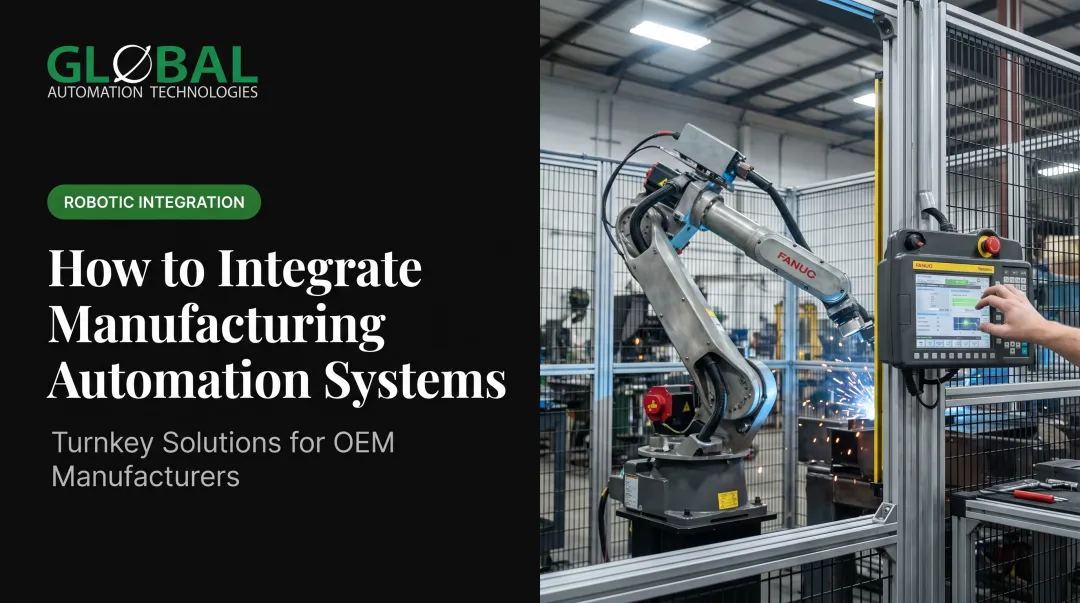
In practice, a robotic machine tending cell has to interface with an existing CNC spindle (door operation and cycle signals), synchronize with a part-feeding conveyor, and tie into the plant's safety system (guarding, light curtains, and e-stops). All three must function as a single unit, not three separate projects bolted together.
The Systems Integrator's Role in Manufacturing Integration
A systems integrator assesses the gaps between what exists and what's needed, designs the integration architecture, implements the robotics and controls, and validates performance before handoff. The role is as much project management as technical execution.
For complex automotive and heavy-industry projects, full turnkey delivery under one roof has become the standard:
- Layout, design, and build
- Programming and validation
- Installation and commissioning
- Training and ongoing support
Splitting these phases across multiple vendors is where most integration timelines fall apart.
Why Manufacturing Integration Technology Matters
Disconnected systems don't just create inconvenience. They create risk, and that risk has a dollar figure attached.
Poor integration hits manufacturers hardest in four places:
- Real-time visibility — Plant managers piece together machine status, throughput, and quality alerts from spreadsheets and gut instinct instead of a unified view
- Process optimization — Connected systems eliminate manual handoffs and expose bottlenecks that lean manufacturing depends on finding
- Quality control at scale — Inspection and monitoring catch defects before parts move downstream, so quality doesn't hinge on which shift is running
- Agility and scalability — Plants can add robots, lines, or product variants without rebuilding the architecture from scratch

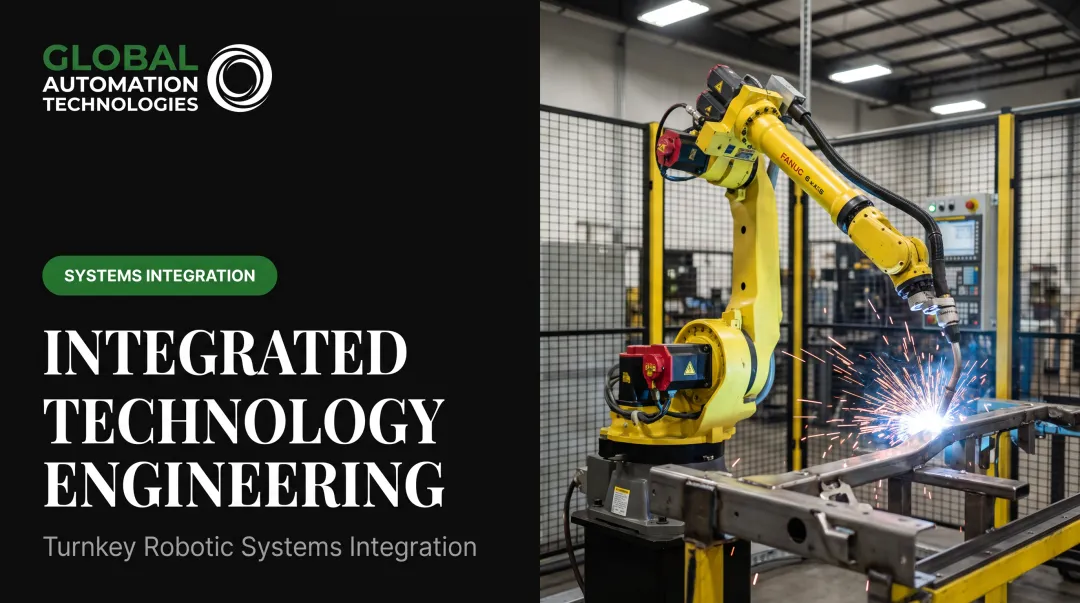
In GLOBAL Automation Technologies' dispensing systems, real-time vision inspection and flow monitoring verify bead width, placement, and continuity on every cycle. The same control discipline shows up in robotic painting, where programmed paths hold film build within specification shift after shift.
The cost of getting this wrong is well documented. Siemens' 2024 downtime analysis found automotive downtime now costs $2.3 million per hour, double what it cost in 2019, with heavy-industry downtime costs rising fourfold over five years.
Hardware alone doesn't close the gap. Deloitte and The Manufacturing Institute project 3.8 million US manufacturing positions will need filling between 2024 and 2033, with as many as 1.9 million potentially going unfilled. Integration only works when trained engineers and operators can run the cell—a perfectly designed line with nobody qualified to staff it isn't a solution.
Types of Manufacturing Integration You Should Know
Not all integration solves the same problem. Understanding which type you actually need saves months of misdirected effort.
Horizontal Integration
Horizontal integration links machines and processes across the factory floor, connecting machining cells, testing equipment, and packaging lines into a single flow. It can also stretch across facilities, letting multiple plants share production data and shift work between sites as demand changes.
Vertical Integration
Vertical integration bridges shop-floor operational data with enterprise systems like ERP or SCM. This is the ISA-95 world: data flowing up from sensors and controls into MES and business systems, and schedules or orders flowing back down. That two-way flow gives leadership end-to-end visibility from the plant floor to the P&L.
Robotic Systems Integration
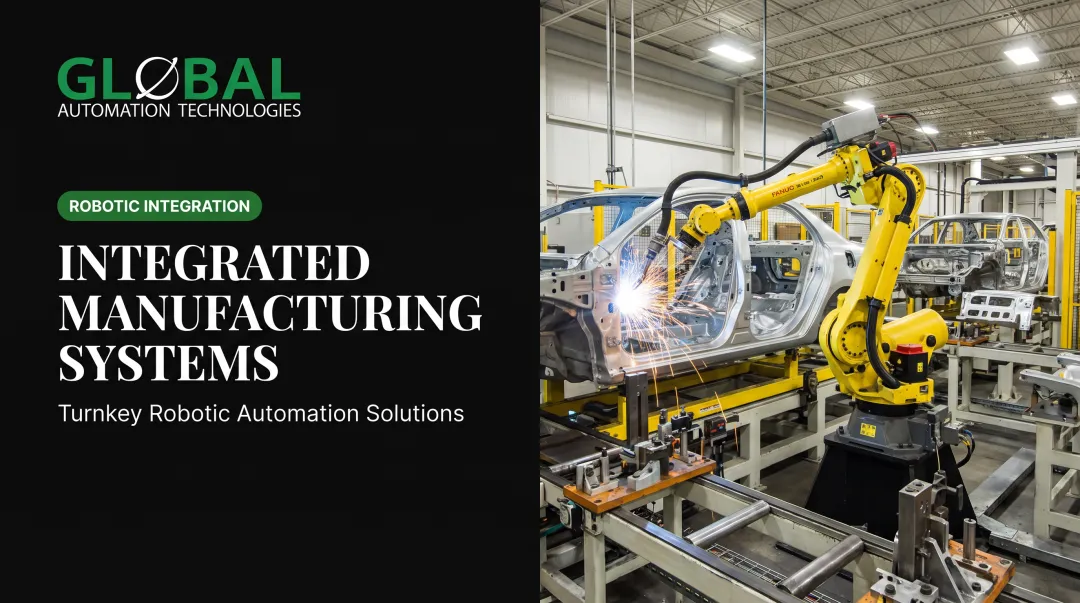
This is the physical layer, and it's the one most manufacturers actually need help with. Robotic systems integration covers welding, dispensing, painting, material handling, machine tending, and assembly—the applications where robots deliver measurable production gains fastest.
| Integration Type | What It Connects | Primary Benefit |
|---|---|---|
| Horizontal | Machines, cells, lines, facilities | Smoother production flow |
| Vertical | Shop floor data + ERP/MES | Enterprise-wide visibility |
| Robotic Systems | Robots, tooling, controls, safety | Direct production gains |
Most manufacturers evaluating automation start here, in robotic systems integration, because it's the layer with the clearest, fastest payback.

Core Technologies Powering Modern Manufacturing Integration
The technology stack behind integration has shifted quickly in the last few years.
Industrial robotics platforms remain the backbone of physical integration. Purpose-built robots, like FANUC's paint-rated models, are engineered for hazardous, high-precision environments. Intrinsically safe designs and internal hose/cable routing through the wrist make them suited for spray booths and dispensing cells where standard robots simply can't operate safely.
AI-assisted simulation and offline programming have compressed programming timelines that used to take weeks into days. Crown Equipment reduced new-part programming from several days to a few hours using offline programming, while another manufacturer cut initial programming time in half.
Engineers model, test, and optimize the robot program in a virtual environment before it ever touches the floor, catching path errors and cycle-time issues while they're still cheap to fix.
AI-driven predictive maintenance shifts maintenance from reactive to proactive. Continuous health assessments monitor equipment and flag issues before they cause unplanned downtime.
Robotic machine tending extends production beyond a single shift and improves spindle utilization, running lights-out between scheduled maintenance windows. These cells typically pay for themselves in 12 to 18 months. Few automation investments hit that payback window this reliably.
IoT sensors, PLCs, and interoperability standards like OPC UA and MQTT round out the stack. These protocols let integration platforms connect multi-vendor equipment without locking a manufacturer into a single ecosystem—critical on plant floors running decades of mixed equipment from different makers.
Choosing the Right Manufacturing Integration Partner
Not every automation vendor can execute a full integration project. Look for these capabilities before you commit:
- Proven turnkey capability: from initial design through commissioning, not just equipment sales.
- Cross-industry problem-solving: partners who have solved similar coordination problems in other verticals often deliver faster, better answers than niche-only firms.
- A track record across countries and verticals: evidence they can handle complexity, not just a single application.
One factor gets overlooked constantly: who runs the system after it's installed? A partner that supplies both the robotic system and the engineers to operate and maintain it closes a coordination gap that trips up many projects.
GLOBAL Automation Technologies, a top-tier Level 5 FANUC Authorized System Integrator, built its model around this gap—turnkey automation solutions, services and technical staffing that recruits controls, mechanical, and project management talent into the customer roles running the cell—specifically for this reason. One call gets you the system and the people qualified to keep it running, instead of juggling a systems vendor and a separate staffing agency after the fact.

Cross-industry range still needs vertical proof. A firm with deep automotive body-shop expertise will not automatically translate that into a data center infrastructure line. Ask for references in your vertical—automotive, heavy equipment, or general industrial manufacturing—rather than settling for generic automation experience.
Frequently Asked Questions
What is manufacturing integration?
Manufacturing integration is the process of connecting machines, robotics, software, and workflows into one coordinated production system. It spans both IT-level data flows (ERP, MES) and physical automation layers (robots, controls, sensors).
What is the difference between manufacturing integration and system integration?
System integration is often the broader, IT-focused term covering ERP, MES, and software connectivity. Manufacturing integration emphasizes the physical automation and robotics layer that connects to those systems.
What is a manufacturing systems integrator?
A systems integrator is a specialist firm that designs, builds, programs, and commissions integrated robotic and automation solutions on a manufacturer's behalf. They typically manage the project from concept through ongoing support.
How long does it take to implement a robotic manufacturing integration project?
Timelines vary significantly by project complexity, so there's no universal number. AI-assisted simulation and offline programming can shorten typical deployment schedules by resolving issues before they hit the floor.
What industries rely most on manufacturing integration technology?
Automotive OEMs and Tier 1 suppliers lead adoption, followed closely by heavy equipment manufacturers. Data center infrastructure producers are an increasingly active vertical as demand for server racks and power systems grows.
How much does manufacturing integration cost, and what is the typical ROI?
Costs vary widely by project scope, robot count, and application complexity. As a benchmark, robotic machine tending cells typically pay for themselves in 12 to 18 months, making them a useful reference point when evaluating ROI on other integration projects.