
Introduction
Walk onto most plant floors today and you'll still find pockets of the old way of doing things: a machine running fine until it isn't, a supervisor finding out about a jam from a phone call instead of a dashboard, quality issues discovered three stations too late. Sensors, PLCs, and analytics platforms are closing those gaps—talking to each other in real time across the entire production line.
The pressure to make that shift is real. One hour of unplanned downtime cost automotive manufacturers $2.3 million in 2024, roughly double what it cost in 2019, according to Siemens' 2024 downtime cost analysis. Factor in quality escapes, safety incidents, and aging equipment that can't talk to newer systems, and delayed connectivity gets expensive fast.
This article breaks down what Industrial IoT actually is, where it delivers the most operational value, and the practical steps manufacturers can take to implement it.
Key Takeaways
- IIoT links sensors, machines, and analytics platforms to give real-time visibility into equipment health, throughput, and quality.
- Predictive maintenance, remote monitoring, and automated inspection deliver the fastest early-stage returns.
- A phased rollout (define goals, audit infrastructure, pilot, then scale) beats a plant-wide leap on day one.
- Cybersecurity and legacy equipment integration are the two obstacles that derail projects that skip planning.
What Is IoT in Industrial Automation?
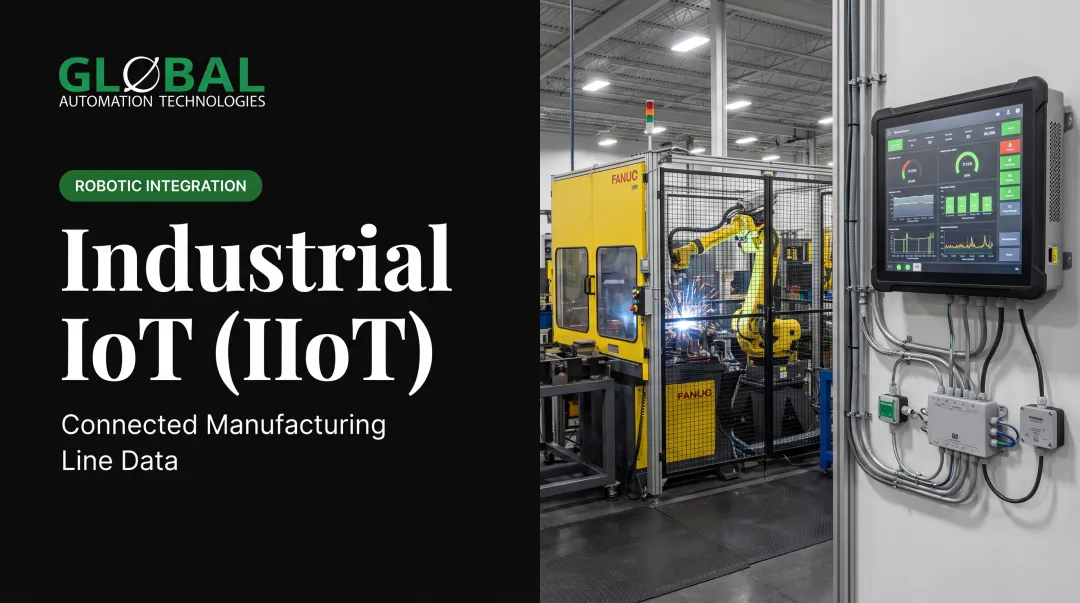
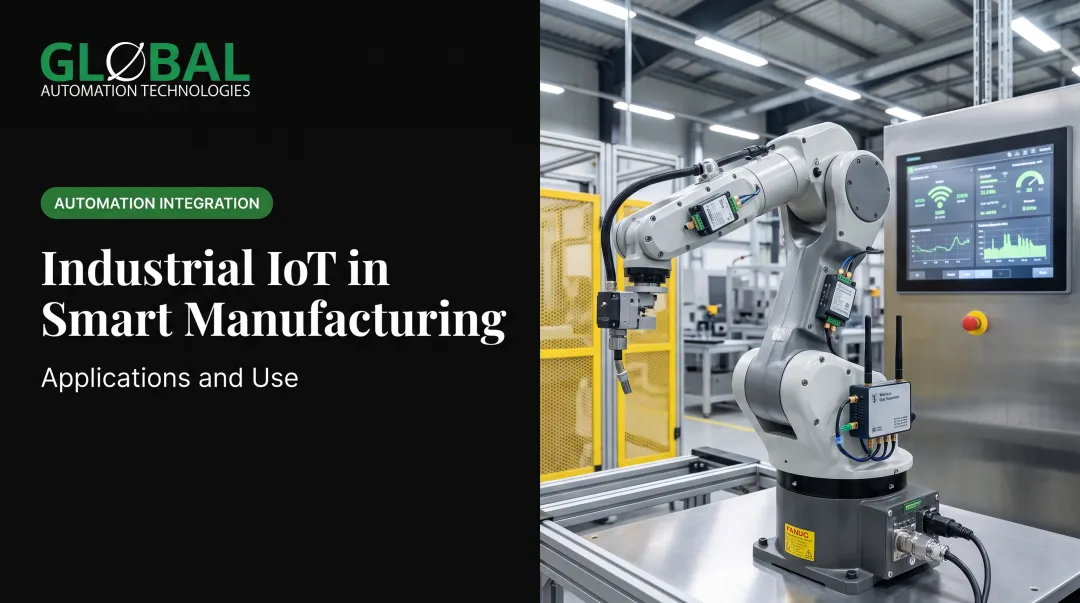
Industrial IoT, or IIoT, is a network of sensors, connected machines, and analytics platforms that continuously collect and exchange data from the production floor. It takes information that used to live in a technician's notebook (vibration readings, cycle times, part counts) and turns it into a live feed anyone in the organization can act on.
That sounds a lot like consumer IoT. In a plant, the consequences are not.
Why Industrial Stakes Are Higher
A smart thermostat glitching is an inconvenience. A PLC losing its connection mid-cycle on a stamping press can halt an entire line or put a worker at risk.
Industrial systems rely on protocols like OPC-UA and Modbus because they need deterministic timing and fault tolerance, not convenience features. Downtime, latency, or a dropped connection means a production stoppage with a dollar figure attached.
The Automation Data Pyramid
Raw shop-floor data doesn't become useful on its own. It flows up through layers:
- Field level: sensors, robots, and actuators generating raw data
- Control level: PLCs executing logic and coordinating equipment in real time
- Plant level: SCADA and MES systems aggregating data across lines
- Enterprise level: analytics platforms turning that data into decisions

Each layer adds context. A vibration reading means little on its own; layered against historical trends and maintenance records at the enterprise level, it becomes a work order before a bearing fails.
Key Benefits of IoT in Industrial Automation
The case for IIoT isn't theoretical anymore. Deloitte's 2025 survey of 600 manufacturing executives found smart-manufacturing programs delivering 10%-20% gains in production output and 7%-20% improvements in employee productivity.
One aerospace manufacturer reported a 10%-15% throughput increase from its program alone.
That efficiency shows up across several specific areas:
- Predictive maintenance — Vibration, temperature, and cycle sensors flag equipment issues before stoppages. GLOBAL Automation Technologies, a Level 5 FANUC Authorized System Integrator, builds the same approach into AI-driven health assessments in its engineering practice.
- Worker safety — Wearables and environmental sensors flag fatigue, heat, or fume exposure in real time. A National Safety Council pilot with Schneider Electric found wearable feedback changed worker posture and behavior and revealed a high-risk workstation no one had flagged.
- Real-time decision-making — Dashboards replace end-of-shift reports with live OEE, throughput, and quality data.
- Asset utilization and traceability — Connected tracking of tools and work-in-progress cuts bottlenecks before they cost a shift.
- Consistent quality control — Vision systems and automated inspection catch defects at the point of creation, not three stations downstream.
Each of these compounds. A plant that fixes downtime also tends to fix quality, because both problems usually trace back to the same blind spots.
Real-World Applications & Examples of Industrial IoT
Abstract benefits are easy to nod along to. Here's what IIoT actually looks like running on a plant floor.
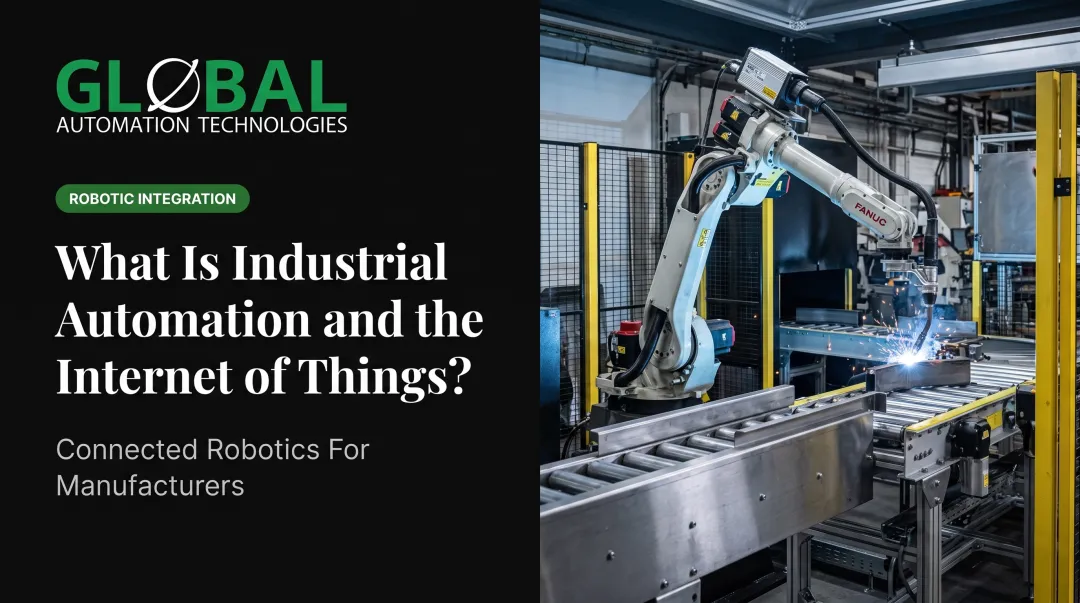
A robotic machine tending cell is the clearest example. Sensors track spindle load, cycle time, and part counts continuously, keeping a CNC or press running unattended for longer stretches while flagging anomalies before they turn into scrap or downtime.
Beyond machine tending, IIoT shows up in several recurring applications:
- Predictive maintenance and analytics: Vibration and temperature sensors on robots and motors catch bearing wear or drift early, cutting emergency repairs and the overtime that comes with them.
- Remote monitoring and control: A plant manager overseeing three facilities can adjust settings from one dashboard instead of driving between sites.
- Asset and inventory tracking: RFID, barcode, and GPS tagging of work-in-progress reduces stockouts and waste tied to lost or misplaced materials.
- Worker and plant safety monitoring: Environmental sensors in welding or painting bays alert teams to unsafe fume or heat levels before they become an incident.
- Automated quality inspection: Real-time vision and flow monitoring catch defects during the process, not at final inspection.
That last point matters more than it sounds. GLOBAL's robotic dispensing systems validate bead width, placement, and continuity during the dispense cycle, so a narrow or discontinuous bead gets flagged before the part leaves the cell.
Catching a sealing defect at final inspection means the part already absorbed paint, assembly labor, and handling costs. Catching it during dispensing means none of that value was wasted.
A Roadmap for Implementing IoT in Industrial Automation
Jumping straight to a plant-wide sensor rollout is how IIoT projects stall. A phased approach gets manufacturers to the same destination with far less wasted spend.
- Define clear objectives and KPIs. Decide upfront whether you're chasing reduced downtime, better safety, or higher throughput. The answer shapes every technology decision that follows.
- Audit legacy equipment and connectivity readiness. Some machines and PLCs are IIoT-ready today; others need a gateway or middleware layer to bridge the gap.
- Choose the right architecture. Decide between edge processing and cloud analytics, settle on communication protocols, and build cybersecurity into the design instead of adding it later.
- Pilot before scaling. Start with one high-impact cell, like a machine tending or dispensing line, to prove ROI before committing to a full rollout.
- Layer in AI-assisted simulation and analytics. Validating robot programs virtually before deployment shortens commissioning and reduces surprises during startup.
- Partner with an integrator who brings people, not just hardware. Connected systems still need engineers to maintain and optimize them. GLOBAL pairs turnkey automation solutions with engineering services and technical staffing, so you get both the system and the engineers to run it from one partner.

Skipping steps rarely saves time. It just moves the cost from planning to firefighting later.
Challenges and Future Trends in IoT Adoption
IIoT adoption isn't without friction, and pretending otherwise sets projects up to fail.
Data security tops the list. More connected devices means a bigger attack surface. Dragos tracked 424 manufacturing ransomware incidents in Q4 2024 alone—70% of all industrial ransomware activity recorded that quarter. Zero-trust segmentation and encryption aren't optional extras anymore.
Legacy system integration trips up almost every plant with equipment older than a decade. Older PLCs and SCADA systems often lack native IIoT compatibility. Gateways or middleware are usually required to translate their data for modern analytics platforms.
Scalability needs to be designed in from the start. Infrastructure that handles ten sensors fine can buckle under a thousand if nobody planned for the data volume.
Two trends are helping manufacturers push through those same barriers:
- AI/ML and digital twins let teams simulate changes on virtual asset replicas before touching real equipment. Aramco's North Ghawar complex used digital twins to drive an 8.44% production increase.
- Edge computing and 5G process data closer to the source, cutting latency so plant-floor decisions stay real-time.
Frequently Asked Questions
What is IoT in industrial automation?
Industrial IoT (IIoT) connects machines, sensors, and control systems so they collect and analyze real-time operational data. Plants use it to raise efficiency, tighten process control, and support faster floor-level decisions.
What is an example of industrial IoT?
A common example is a robotic machine tending cell where sensors track spindle load, cycle time, and part counts to maximize unattended operation. Predictive maintenance sensors on production equipment are another everyday example.
How is industrial IoT different from regular consumer IoT?
IIoT operates under far higher stakes and reliability requirements than consumer devices, using industrial protocols built for deterministic timing. A failure can halt production or endanger workers, not just cause a minor inconvenience.
What are the biggest challenges in implementing industrial IoT?
Cybersecurity risk, legacy system integration, and scalability are the top three hurdles. Each requires planning from the design stage, not a fix after deployment.
How long does it take to see ROI from an industrial IoT implementation?
Timelines vary by application, but automation cells like robotic machine tending typically pay for themselves in 12 to 18 months through reduced labor hours and higher parts-per-shift output.
What industries benefit most from industrial IoT?
Automotive, heavy equipment, energy, and other high-volume manufacturers see the strongest returns. In these plants, uptime, safety, and quality tie directly to profitability, so connected visibility pays off fastest.