
Introduction
Manufacturing facilities face a critical crossroads: skilled welders are increasingly scarce, production demands keep climbing, and quality expectations leave no room for error.
The American Welding Society projects 320,500 new welding professionals will be needed by 2029, while the U.S. Bureau of Labor Statistics reports only 45,600 annual openings for welders, cutters, solderers, and brazers through 2034. That gap is already shaping how plants staff lines, hit throughput targets, and stay competitive.
Choosing between robotic and manual welding now affects labor coverage, cost per part, and whether production stays online. This article gives you a practical framework for when robotic welding, manual welding, or a hybrid approach fits your production requirements.
Key Takeaways
- Robotic welding delivers higher arc-on time than manual work, plus extended-shift capability between scheduled maintenance windows, and consistent weld parameters
- Manual welding excels at complex one-offs, field repairs, and jobs that need real-time adaptability
- Initial robotic system costs range from $105,000 to over $600,000 based on cell complexity
- Production volume, part consistency, and fixture needs drive ROI more than arbitrary batch-size cutoffs
Robotic Welding vs Manual Welding: Quick Comparison
Use this side-by-side view to match process choice to volume, part mix, and labor risk.
| Factor | Robotic Welding | Manual Welding |
|---|---|---|
| Upfront Cost | $105,000–$600,000+ by cell complexity | Low equipment cost; spend is mostly labor |
| Arc-On Time | High duty cycle; continuous programmed paths | AWS: 10%–12% average operator factor (20% best case) |
| Travel Speed | 35–50 IPM standard arc; up to 100 IPM with laser tracking | 12–20 IPM for skilled operators |
| Repeatability | Stable torch angle, speed, amps, volts, and position | Varies with fatigue, distraction, and hand tremor |
| Batch Size Efficiency | Best when geometry and part presentation stay consistent | Better for low-volume or custom, varying geometry |
| Safety Risk | Keeps workers off direct arc, fume, and spatter | Direct exposure to hazards and ergonomic strain |
| Scaling Capability | Multi-shift output; scale by adding cells | Capped by welder supply, overtime, and turnover |
| Skill Dependency | Needs robot programmers and setup techs | Relies on welder skill, experience, and availability |

Note: Assumes consistent part presentation and sound robot programming. Results still vary with joint access, materials, and application complexity.
What is Robotic Welding?
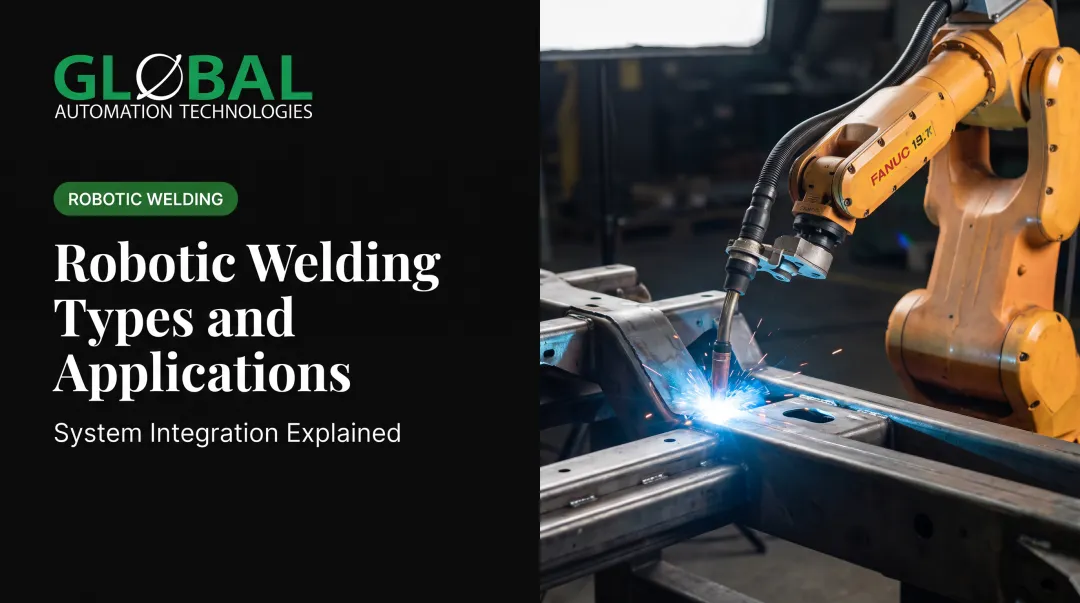
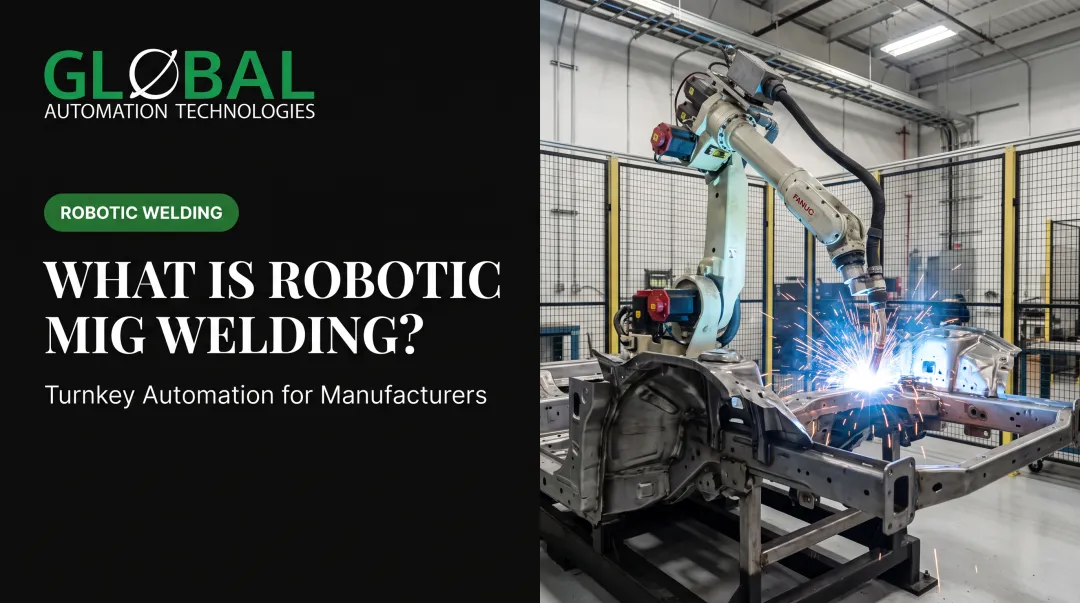
Robotic welding uses programmable automation to execute welding operations with consistent parameters, eliminating human variability in repetitive applications. A robot arm follows pre-programmed paths to create identical welds across thousands of parts, maintaining precise control over torch position, travel speed, wire feed rate, voltage, amperage, and shielding gas flow.
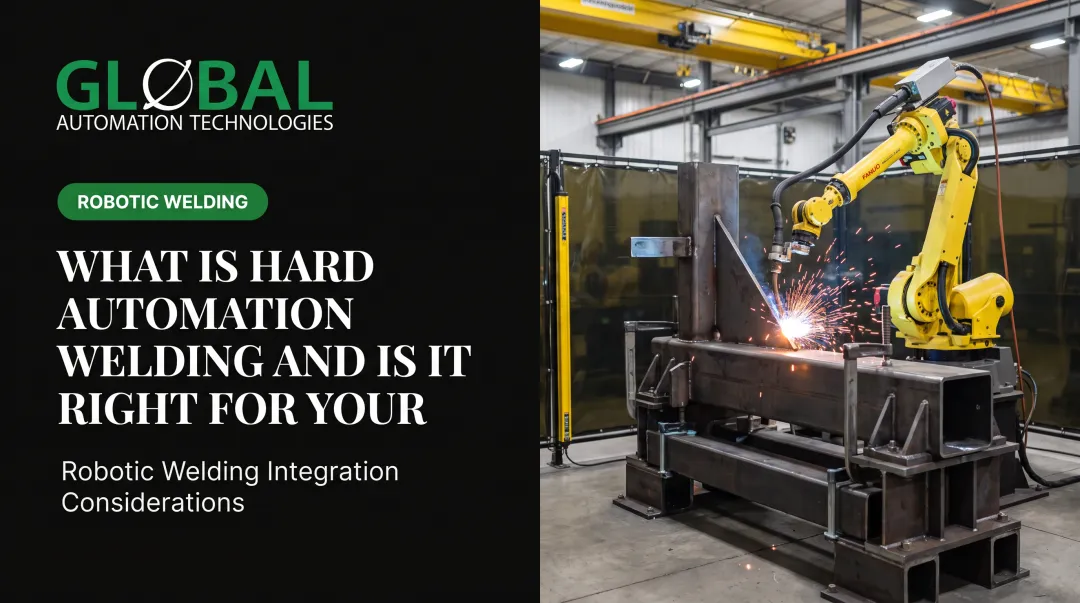
A complete robotic welding cell includes the robot arm, welding power source, wire feeder, engineered fixtures for part presentation, safety guarding, controls integration, and programming software. Success depends on proper integration: vendor welding expertise matters as much as robotics knowledge. The fixture design, part presentation method, and cell layout directly affect cycle time, quality, and overall ROI.
Core Benefits of Robotic Welding
Productivity improves in several ways:
- Triple the arc-on time of many manual cells (per AWS), with results tied to application, cell design, and workflow
- Travel speeds of 35-50 IPM in standard robotic arc welding, and up to 100 IPM with laser tracking, versus 12-20 IPM for skilled manual welders
- Continuous multi-shift output without fatigue, breaks, or shift-change downtime
Quality gains come from repeatability. Robots hold torch angle, contact-tip-to-work distance, amperage/voltage, travel speed, deposition rate, and gas flow steady—variables that drift in manual work as operators tire.
- Identical bead placement on every cycle along the programmed path
- Far less overwelding; AWS notes manual overwelding can use nearly 500% more shielding gas than required
Cost and risk drop as the cell matures:
- Lower labor spend by cutting overtime premiums, excess headcount, and turnover-related hiring cost
- Less rework (FANUC’s Trantech case saw 50–80% fewer process repairs moving from brazing to robotic MIG, with the process change also a factor)
- Tighter wire and gas use through controlled deposition
- Operators removed from arc flash, fumes, spatter, and awkward weld positions
Use Cases of Robotic Welding
Robotic welding fits best when:
- Volume is high enough that repeatability pays back the automation investment
- Part geometry and presentation stay consistent so the robot can access every joint reliably
- The same weld sequence repeats across many identical or similar parts
- The environment is an automotive body shop, heavy equipment line, or other high-volume fab setting
Turnkey robotic welding systems from experienced integrators increasingly include AI-assisted simulation to optimize robot programs before deployment. GLOBAL Automation Technologies, a Level 5 FANUC Authorized System Integrator, uses simulation to reduce programming time from weeks to days, eliminating costly trial-and-error on the production floor and catching potential motion conflicts before the first weld runs.
The same tools now reach beyond mass production:
- Mid-volume runs (about 500–5,000 parts per month) with collaborative robots
- Smaller shops pairing flexible cobots with existing weld staff
- Quick-change fixtures and simpler programming that cut the setup burden that once reserved robots for pure high-volume work
What is Manual Welding?
Manual welding relies on skilled human operators performing welds using various processes—MIG, TIG, stick, and others—by applying training, experience, and real-time judgment to each joint. The welder controls the torch, adjusts travel speed, responds to puddle behavior, and adapts technique based on what they observe in real time.
The welder training path typically includes apprenticeships, vocational programs, and AWS certification. AWS Certified Welder credentials require passing a performance test and document approval, with no fixed education or experience prerequisite. An experienced welder may test immediately, while a newcomer may need several months of practice. The path to proficiency varies widely based on prior experience, training quality, and the complexity of processes being learned.
Core Benefits of Manual Welding
Flexibility keeps manual welding essential in many shops:
- Adjust torch angle, travel speed, and technique on the fly for irregular geometry
- Change amperage, voltage, wire feed, and travel speed mid-weld based on puddle behavior
- Reach confined spaces and awkward angles robots cannot access
- Move between parts, processes, and positions without reprogramming delays
Human judgment still covers conditions that are hard to automate:
- Spot contamination, porosity, or inconsistent fit-up before the arc starts
- Correct course when burn-through, lack of fusion, or other defect signs appear
- Diagnose poor fit-up, surface contamination, or equipment issues on the spot
- Work in field repairs, construction sites, and maintenance jobs outside controlled cells
Upfront costs stay lower in several scenarios:
- No capital spend beyond welding machines and basic tooling
- No integration downtime or production stop during install
- Skilled labor can deploy immediately for urgent production needs
- Better fit for low-volume custom work where automation setup exceeds weld time
Use Cases of Manual Welding
Manual welding is usually the better fit when:
- Building prototypes or one-off parts where fixtures and programming cannot be justified
- Running custom batches under roughly 10 parts with changing geometry or weld requirements
- Doing on-site repairs in plants, on construction sites, or on installed equipment
- Handling assemblies with variable geometry, inconsistent presentation, or joints that need diagnostic judgment
It also stays essential in unstructured environments:
- Construction work with no consistent part presentation, tooling, or fixturing
- Repair jobs that need damage assessment, filler selection, and technique calls on the spot
- Heavy equipment servicing in the field, where one-time repairs rarely justify a robot cell
- Short-run production where setup and programming would take longer than the welds themselves
Those strengths come with a practical constraint: skilled welders are hard to find and keep in many regions. Wage pressure, overtime to cover capacity gaps, and turnover can all disrupt schedule and quality consistency—factors that matter when you weigh manual welding against automation.

Robotic Welding vs Manual Welding: What is Better?
The "better" choice depends on five critical factors: production volume, part consistency, quality requirements, budget (upfront vs. long-term), and labor availability. No universal answer exists. Manufacturers have to evaluate their own production context.
Volume and Batch Size as Decision Drivers
Production volume and part repeatability drive the economic equation more than arbitrary batch-size thresholds. A 2024 university study of truck-body manufacturing found that robots performed better on simple repetitive work and became more cost-effective as volume increased, but humans sometimes outperformed robots and remained superior for complex assemblies.
Key decision inputs include:
- Repeatability of part geometry and presentation: Can parts be fixtured consistently? Do weld joints appear in the same location every time?
- Setup vs. run time: How much programming and fixturing is required relative to the total welding time?
- Changeover burden: How often do different parts run through the same cell? What is the cost of switching between programs?
- Shift requirements: Does production need to run multiple shifts? Can manual labor cover the required hours?
Break-even considerations:
- Manual welding is usually more economical when setup time exceeds run time
- Robotic welding pays off when the same weld sequence repeats across many parts with consistent presentation
- High-mix, low-volume work may fit collaborative robots with simpler programming better than traditional industrial cells
- Lincoln Electric reports touch sensing adds 3–5 seconds per joint, while 2D cameras cut calculation time to tenths of a second. Those cycle-time gaps matter at volume.
Quality and Consistency Requirements
Defect rates and rework costs differ sharply between manual and robotic welding, though industry-wide benchmarks are hard to verify. In a documented FANUC case study, Trantech saw about 30% higher throughput and 50–80% fewer process repairs after moving from manual brazing to robotic MIG welding. The process change itself also influenced those results.
Quality-critical applications strongly favor robotic consistency:
- Automotive OEM body shops requiring identical welds across thousands of vehicles
- Pressure vessels and structural applications with strict code compliance
- High-volume production where even small defect-rate improvements generate substantial cost savings
- Applications where weld-quality verification systems can inspect every part in real time
Custom work benefits from human adaptability:
- One-off fabrication where each weld may differ slightly
- Repair work requiring diagnostic judgment about proper filler metal and technique
- Prototype development where design iterations make programming impractical
- Applications where fit-up variation requires real-time operator adjustment
Cost Considerations: Total Ownership vs. Labor
Robotic system costs in 2025:
- Entry-level collaborative systems: Starting around $105,000 for basic cobot packages including robot, power source, torch, cart, controls, and starter consumables (Hirebotics)
- Pre-engineered industrial cells: $130,000–$250,000 for standardized configurations (CLOOS)
- Custom integrated systems: $250,000–$600,000+ depending on cell complexity, positioner requirements, vision integration, and fixture engineering (CLOOS)
- Complex multi-robot cells: $600,000–$1.2 million+ for coordinated systems with advanced sensing and tooling
Additional robotic system expenses:
- Integration engineering, installation, and commissioning
- Operator and programmer training
- Fixture design and tooling for part presentation
- Facility modifications (power, floor space, safety guarding)
- Ongoing maintenance (consumables, spare parts, periodic service)
Manual welding ongoing costs:
- Welder compensation: BLS reports a $51,000 median annual wage for welders, cutters, solderers, and brazers in May 2024 (wages only, not total compensation)
- Overtime premiums: Typically 50% wage premium when production exceeds regular hours
- Turnover and retraining: Costs of recruiting, onboarding, and bringing new welders to full productivity
- Benefits and overhead: Health insurance, workers' compensation, payroll taxes, and other employer costs
- Variable material waste: Inconsistent deposition and overwelding increase consumable usage
ROI considerations:
Payback timelines vary with production volume, labor costs, material savings, and quality gains. Yaskawa's ROI calculator factors in welders per shift, shifts per day, loaded labor cost, retained staff, cell count, and system budget. It explicitly leaves out throughput gains, scrap reduction, and third-party tooling costs.
Will-Burt reported robotic cells were 3–4 times more efficient than manual welding, adding 240–320 welding hours per week and enabling about $4 million in contract fabrication work.
PMI found its hired cobot likely saved half a normal welder's wage plus overhead and could run three shifts without hiring three welders. Employees still operate and program the system.

The Hybrid Approach
When labor cost and consistency both matter, many shops stop treating the choice as either/or. They put robots on repetitive production welds and keep skilled welders on setup, complex joints, and non-routine work.
Hybrid model benefits:
- Higher welder output: One welder can oversee multiple robotic cells and multiply effective capacity
- Addresses labor shortage: Allows limited skilled labor to cover higher production volumes
- Production continuity: Manual backup capability if robotic equipment fails
- Matched strengths: Robots hold consistency and speed on repeat work; humans handle complexity and problem-solving
Real-world hybrid implementation:
PMI had seven welders but needed nine or ten on some jobs. The company assigned small, repeatable parts to a collaborative robot and reallocated manual welders to larger, more complex parts. The cobot runs three shifts without hiring three additional welders, while employees continue to operate and program the system.
When Manual Welding Still Wins
Choose manual welding when:
- Production volume is low and part geometry varies significantly
- Batch sizes consistently fall below 10 parts per run
- Setup and programming time exceeds total welding time
- Field conditions prevent consistent part presentation
- Repair work requires diagnostic judgment before and during welding
- Prototype development involves frequent design changes
- Complex joint access requires human dexterity
- Capital budget constraints prevent automation investment
Choose robotic welding when:
- High-volume repetitive production with consistent part geometry
- Part presentation can be standardized through effective fixturing
- Quality-critical applications benefit from eliminated human variability
- Labor shortages threaten production continuity
- Multi-shift operation is required but skilled welders are unavailable
- Material waste and rework costs justify automation investment
Match the process to the work: volume, consistency, quality stakes, budget, and available labor decide which side wins on your floor.
Real-World Example: Will-Burt Scales Fabrication Capacity with Robotic Arc Welding
Will-Burt Company, a rural Ohio manufacturer of mobile masts and towers, faced a skilled welder shortage in a small labor market, rising contract fabrication demand, and large weldments that put manual operators in awkward, high-risk positions.
The company adopted FANUC robotic arc welding to add capacity without hiring more welders and to pull employees off large, awkward parts.
Results after implementing robotic welding cells:
- 3-4 times higher efficiency compared to manual welding operations
- 240-320 additional welding hours per week of production capacity
- Approximately $4 million in new contract fabrication work enabled by the added throughput
- Improved employee safety by removing awkward-position welding on large parts
- More consistent quality through repeatable robotic weld parameters
Will-Burt worked with an experienced integrator to design cells for large-part welding, including fixturing, positioning equipment, robot programming, and operator training.
The company now runs robots on large-part production work and keeps manual welding for complex custom jobs and field service. That hybrid model balances throughput with flexibility.
Facing similar production challenges? GLOBAL Automation Technologies designs turnkey robotic welding systems for automotive, heavy equipment, agricultural, aerospace, and general industrial applications.
Our team covers full integration from concept through commissioning, including fixture design, AI-assisted simulation, robot programming, and operator training. Contact us at info@globalat.com or +1 (810) 877-0329 to discuss your requirements.
Conclusion
The right choice depends on production volume, part consistency, quality requirements, labor availability, and business goals—not on which method wins in the abstract.
- Choose robotic welding for high-volume, repetitive work with consistent part presentation—stronger cost control, quality, and scalability.
- Choose manual welding for low-volume custom jobs, field repairs, and complex assemblies that need flexibility and human judgment.
Hybrid cells often deliver both: robots on repeatable seams, skilled welders on high-value or variable work. Collaborative platforms and simpler programming have lowered the barrier to automation, while labor shortages across North American manufacturing keep pressure on staffing.
The useful question is no longer "robot or human?" It is which tasks belong to robots and which stay with welders. Manufacturers who split work that way improve cost, quality, and delivery reliability. If you are mapping that split on your line, GLOBAL Automation Technologies can help scope a robotic welding system and the engineering talent to run it.
Frequently Asked Questions
How much faster is a robotic welder than a human welder?
Robotic arc welding typically runs 35–50 IPM (up to 100 IPM with laser tracking) versus about 12–20 IPM for skilled manual welders. AWS reports cobots can triple manual arc-on time, which drives much higher output on high-volume repetitive work.
How much does a welding robot cost?
Basic collaborative cobot packages start around $105,000; complex custom industrial cells can exceed $600,000. Pre-engineered cells usually fall in the $130,000–$250,000 range, depending on fixturing, vision, and positioners.
When does manual welding still make sense over robotic welding?
Manual welding is still the better fit for low-volume custom work, prototypes, and field repairs that need on-the-spot judgment. It also wins when setup time exceeds weld time or parts cannot be presented consistently for the robot.
What is the typical ROI timeline for robotic welding systems?
ROI varies with production volume, labor rates, quality gains, and material savings. Documented cases (such as Will-Burt’s 3–4x efficiency gains) show strong upside, but payback still hinges on shifts run, loaded labor cost, and scrap reduction for your cell.
Can existing manual welders be retrained to operate robotic welding systems?
Yes. Most experienced welders need about 1–4 weeks to program and run robotic systems, and their process knowledge helps tune parameters. Some cobot users start after roughly 30 minutes of initial instruction.
What maintenance do robotic welding systems require?
Plan on routine consumable changes (contact tips, nozzles, liners), periodic calibration, and preventive service on the robot, positioners, and power source. Predictive maintenance tools can flag issues before they cause downtime.