
Plant managers don't care much about automation in theory. They care about what changes on the shop floor: cycle times, rework rates, safety incidents.
This article breaks down five concrete, outcome-driven reasons manufacturers are saying yes to automated paint lines.
Key Takeaways
- Automated paint lines cut labor, material, and rework costs simultaneously
- Robotic spraying delivers finish consistency manual painters can't match, shift after shift
- Faster color and part changeovers support mixed-model production with less downtime
- Enclosed robotic cells remove workers from VOC and isocyanate exposure
- Integration partner choice often decides how fast the line pays back
What Is an Automated Paint Line
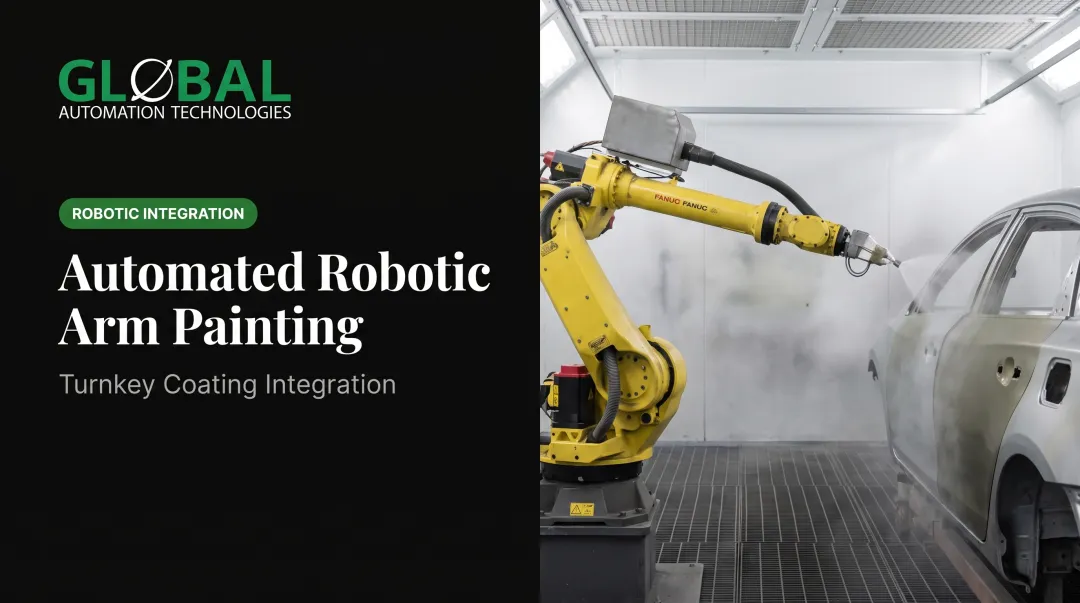
An automated paint line combines robotic arms, spray guns or applicators, sensors, and programmable controls to apply coatings without a human holding the gun. The robot follows a taught or simulated path, at a fixed speed and distance, every single cycle.
You'll find these systems in:
- Automotive body and paint shops, applying basecoat, topcoat, and clearcoat to Class A surfaces
- Tier 1 component painting, covering body-side moldings, grilles, and lamp bezels
- Heavy equipment and industrial finishing lines, including agricultural and construction equipment
- Marine and composite manufacturing, where fiberglass gelcoat requires precise, repeatable application

The payoff is consistent, repeatable output and safer operating conditions for the people who used to hold the gun.
5 Reasons to Say Yes to Automated Paint Lines
These five reasons reflect what operations leaders actually track day to day: cost, quality, waste, flexibility, and workforce safety. Not theoretical automation benefits.
Reason 1: Lower Total Operational Costs
Robots don't need breaks, shift changes, or overtime. A single automated cell can run continuously while eliminating the need for multiple shifts of skilled painters.
Regal Finishing's transition from four manual booths and six painters to one automated system with three operators is a useful reference point. The results, documented by FANUC, included:
- 50% salary savings from headcount reduction
- 125% higher daily throughput on the same footprint
- 10-15% paint-material cost savings
Reduced headcount is only part of the equation. Lower indirect labor (training time, booth prep, and rework correction) compounds those savings further.
ROI timelines: GLOBAL's machine tending cells typically pay for themselves in 12 to 18 months, driven by more parts per shift with fewer direct labor hours. Painting systems involve more variables, such as material costs, booth configuration, and coating type, so payback windows vary more widely. A feasibility study tailored to your line gives a realistic number instead of a generic one.
This reason carries the most weight in high-volume, multi-shift operations, where labor costs compound fastest.
Reason 2: Improve Coating Quality and Consistency
Even a highly skilled painter's hand speed and gun angle drift slightly from part to part. A robot doesn't. It repeats the exact spray path, distance, and gun parameters every cycle.
That repeatability shows up in the numbers. Regal Finishing reported roughly 35% more first-run-good parts after switching to robotic painting, with one production line jumping from 150-175 sellable pieces per shift to 300-350.
Robotic systems like GLOBAL's repeat the same spray path, distance, and gun parameters every cycle, holding film build within the process spec instead of drifting with operator technique and fatigue. That repeatability means:
- Fewer sags and thin spots
- Less touch-up labor
- Fewer rejected parts sent back through the booth
This matters most for OEMs and Tier 1 suppliers holding strict color-match and finish-quality specs. A single out-of-spec panel can stall an entire assembly sequence.
Reason 3: Reduce Material Waste and Environmental Impact
Manual spraying wastes paint. Overspray, inconsistent gun distance, and operator fatigue all push transfer efficiency down. Precise metering and consistent spray patterns mean paint goes where it's needed and stays there.
Electrostatic guns charge paint particles so they're drawn toward grounded parts instead of drifting into the booth's exhaust system. The EPA reports electrostatic spraying achieves 60-90% deposition efficiency in automotive assembly settings, a substantial jump over conventional air spray.
Plural-component proportioners add another layer of control:
- Mix ratios held within 1% accuracy
- Material use reduced by 40-50% on some heavy-equipment jobs, per equipment-maker field data
- Less purge waste between color or material changes

High-cost coatings, such as automotive basecoats, and plants under VOC compliance pressure gain the most here. Every percentage point of transfer efficiency translates directly into lower coating spend and reduced emissions exposure.
Reason 4: Increase Flexibility for Changeovers and New Products
Retooling a manual booth for a new part geometry or color takes real time: reconfiguring fixtures, retraining operators, running trial parts. Reprogramming a robot is faster.
Modern bell-atomizer paint robots can achieve color changes in about four seconds on automotive production lines. That's not a full model changeover, but it illustrates how quickly today's paint robots pivot between finishes.
This flexibility supports:
- Smaller batch runs without a corresponding cost penalty
- Frequent color changes across mixed-model production
- Faster onboarding of new SKUs, since programming a new path is quicker than rebuilding a booth setup
Plants running mixed-model production or regularly onboarding new parts benefit most here. Production planning gets simpler when the paint cell isn't the bottleneck.
Reason 5: Protect Your Workforce and Improve Safety
Manual paint booths expose operators to isocyanates, VOCs, and overspray particulates. NIOSH identifies isocyanates as respiratory and dermal sensitizers, capable of triggering severe asthma attacks with repeated exposure.
Automated cells change that equation. Enclosed, remote-operated robotic booths keep workers outside the direct spray zone, supporting compliance with occupational exposure limits like OSHA's MDI ceiling of 0.02 ppm.
This has a second benefit beyond safety:
- Skilled workers move into quality oversight, robot programming, and maintenance roles
- Painters aren't lost from the workforce; their work just changes
- The plant retains institutional knowledge instead of losing it to attrition
Facilities with hazardous coatings, confined booths, or a history of exposure incidents should weigh this reason the heaviest. Safety upgrades also function as a retention strategy.
What Happens When Paint Line Automation Is Delayed
Sticking with manual painting doesn't freeze your costs in place. It compounds them.
Common consequences include:
- Inconsistent film build, leading to higher rework and rejected parts
- Rising material waste, since manual spray patterns rarely match electrostatic transfer efficiency
- Difficulty scaling during demand spikes—capacity means more shifts and painters, not just programming
- Labor and compliance overhead that automated lines are built to cut
Competitors who automate now gain a quality and throughput edge that gets harder to close every quarter you wait. A line that's 35% more first-run-good keeps outpacing manual lines long after the install date.
How to Get the Most Value from an Automated Paint Line
Automation delivers its best ROI when it's planned properly, not rushed into as a quick retrofit. Layout, robot selection, and process validation all matter before the first robot ever sprays a part.
GLOBAL Automation Technologies, a Level 5 FANUC Authorized System Integrator, builds and integrates the robotic painting system, and through its separate technical staffing can supply the engineers to program, validate, and run it. That matters because a system without the right engineering talent behind it rarely hits its performance targets on schedule.
Key elements of a well-executed rollout include:
- AI-assisted simulation that shortens robot programming from weeks to days by modeling paths before they hit the floor
- Process validation to confirm film build, spray pattern, and cycle time meet spec before full production launch
- Booth and color-change engineering designed around your specific mix of parts and finishes
- Ongoing performance monitoring that tracks film build consistency, cycle time, and uptime after commissioning
- AI-driven predictive maintenance that flags equipment issues before they cause unplanned downtime

Value doesn't stop at commissioning. Keep watching how the system performs and catch drift before it becomes a defect.
Conclusion
The case for automated paint lines rests on three compounding benefits: consistent quality, controlled costs, and a safer workforce. None of these are one-time gains. They compound the longer the system runs.
Automation works best as an ongoing operational strategy, not a single equipment purchase you check off a list. The plants that treat it that way keep widening the gap over competitors still running manual booths.
If you're evaluating whether your paint line is ready for automation, talk to a partner who can assess readiness honestly. Reach out to GLOBAL to get a straightforward readiness assessment.
Frequently Asked Questions
How much does it cost to automate a paint line?
Costs vary widely based on system size, robot count, and booth complexity. ROI usually comes from less paint waste, fewer rejects, and higher throughput, with payback driven by coating type and production volume.
How long does it take to implement an automated paint line?
Implementation typically moves through design and simulation, installation, programming and validation, then commissioning. Timelines depend on booth scope and part complexity, so a project-specific assessment gives the most accurate estimate.
Can robots handle different part shapes, sizes, and colors on the same line?
Yes. Modern paint robots are reprogrammable and can switch spray paths, colors, and part profiles far faster than retooling a manual booth, supporting mixed-model production runs.
Is robotic painting actually safer than manual spray painting?
Yes. Enclosed robotic cells remove operators from direct VOC and isocyanate exposure and eliminate the repetitive-motion strain associated with manual spraying.
What maintenance does an automated paint line require?
Routine tasks include nozzle cleaning, sensor calibration, and robot servicing per manufacturer guidelines. Predictive maintenance tools flag equipment issues early, reducing unplanned downtime.
Which industries benefit most from automated paint lines?
Automotive OEMs, Tier 1 suppliers, and heavy equipment manufacturers see the biggest gains. Aerospace, marine, composite, and appliance producers with high-volume finishing also benefit strongly.