
That pressure is why "turnkey" automation delivery has become the default conversation starter with plant managers and OEM sourcing teams. The word gets used loosely in industrial marketing, though. Its real value shows up in fewer delays, fewer vendor handoffs, and startup outcomes you can actually predict.
This article breaks down what an industrial turnkey project actually involves — and why manufacturers, from automotive OEMs to heavy equipment builders, are leaning on this delivery model more than ever.
TL;DR
- One provider owns design, engineering, procurement, installation, and commissioning through a production-ready handoff
- Core gains: single-point accountability, faster time-to-production, and clearer cost certainty
- Skipping turnkey often means fragmented vendors, hidden costs, and delayed startups
- Best fit when scope is locked early and the provider has real engineering depth plus staffing capability
What Is an Industrial Turnkey Project (Brief Context)
In plain terms, a turnkey project is a delivery model where a single contractor handles every phase — from concept through commissioning — so the client can turn the key and start production.
You'll see this model applied most often in:
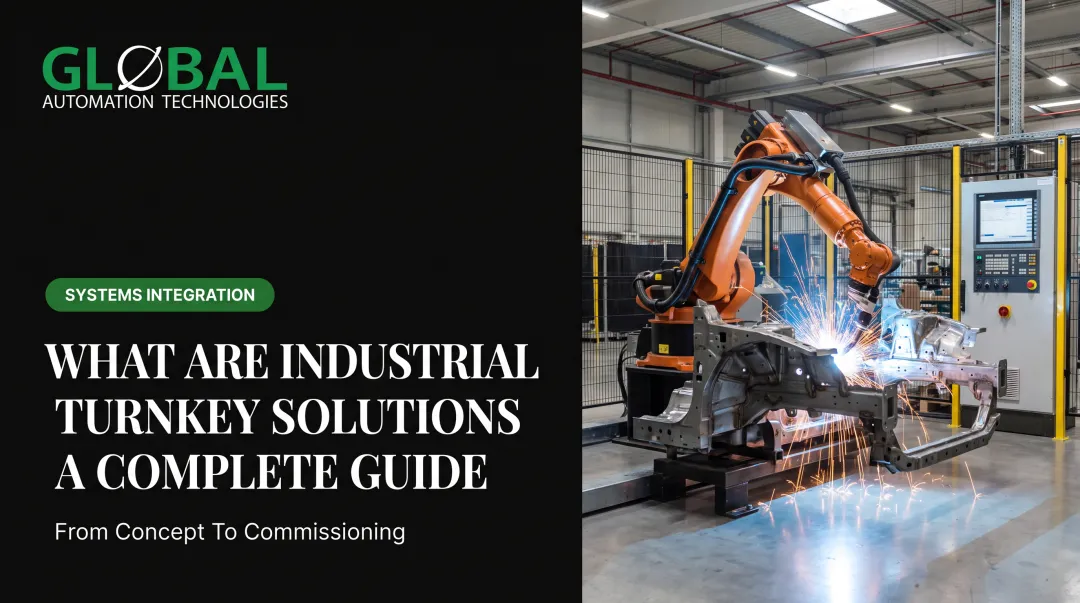
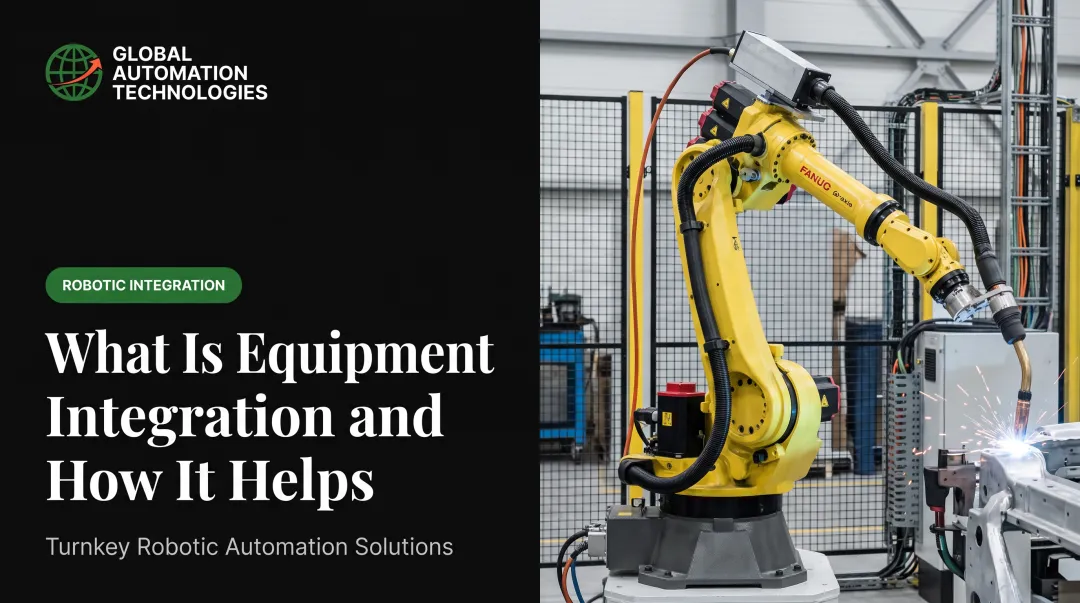
- Robotic welding and assembly cells
- Machine tending systems for CNC, press, or injection molding operations
- Paint and dispensing lines
- Full production line integration for automotive, Tier 1 supplier, and heavy equipment manufacturing
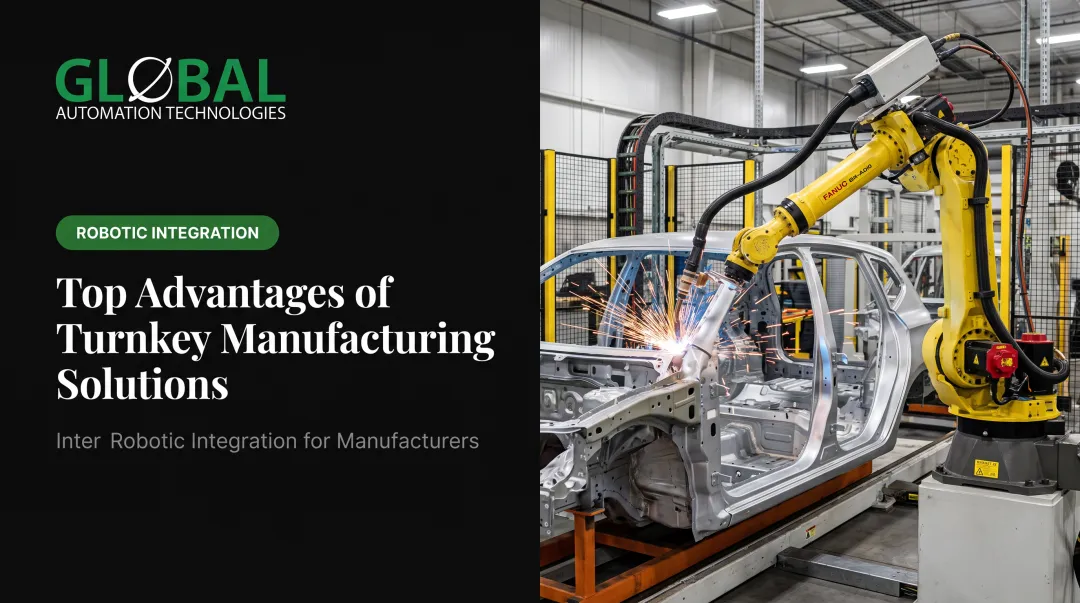
Turnkey delivery is a path to a running, validated production system—not just a procurement label. GLOBAL Automation Technologies, a top-tier Level 5 FANUC Authorized System Integrator, for instance, structures its turnkey scope around that outcome, with every phase under one engagement:
- Process study and feasibility
- Engineering, robot simulation, and controls
- Build and integration
- Installation, commissioning, training, and documentation
The goal is a line that's ready to run.
Key Advantages of Industrial Turnkey Projects
The advantages below tie directly to metrics manufacturers already track: uptime, cost predictability, labor availability, and time-to-first-part. They compound most in complex, multi-discipline projects (robotics, controls, mechanical, staffing) where coordination failures get expensive fast.
Single Point of Accountability
With a turnkey model, one provider owns design, integration, and commissioning. You're not juggling separate mechanical, electrical, and robotics vendors and hoping they talk to each other. When something goes sideways during installation, there's no finger-pointing between contractors : one contract governs the entire scope.
Why this matters: Fragmented vendor models create communication lag and diffused responsibility. A single accountable partner resolves issues faster because there's nowhere for the problem to hide.
The data backs this up. In a study of nearly 600 construction leaders, 48% of U.S. rework was attributed to poor project data and miscommunication among stakeholders (22% from bad data and 26% from poor communication). Respondents also reported losing 35% of their work week to non-optimal activities like chasing information and fixing avoidable mistakes.
Multi-vendor automation projects face the same structural risk, just with robots and controls systems instead of concrete and steel.
This is where GLOBAL's combined model closes a gap most turnkey providers leave open. Because GLOBAL delivers both the robotic system (through its automation solutions and engineering services) and the people to run it (through its technical staffing), clients avoid the common scenario where a system gets installed but nobody on-site is qualified to operate or maintain it.
KPIs impacted:
- Schedule adherence
- Rework hours
- Vendor coordination time
- Startup delay days
It shows up hardest on multi-cell, multi-discipline lines (welding plus machine tending plus inspection), where system interdependencies are high and one bottleneck stalls everything downstream.
Faster Time-to-Production
Turnkey providers run engineering, procurement, and installation in parallel instead of sequentially. That's the core structural advantage. Tools like AI-assisted simulation and offline programming compress the design-to-run timeline before equipment ever touches the shop floor.
Every week of delayed startup is a week of delayed revenue. That hits harder in high-volume automotive and EV manufacturing, where launch dates lock to model-year schedules.
A CII/Pankow study of 212 industrial and light-industrial facilities found integrated delivery models were 36% faster during construction and 102% faster from design through completion than traditional sequential (design-bid-build) methods, holding other variables constant.
Robot-specific simulation tools push this further. GLOBAL's engineers model, test, and optimize robot programs in a virtual environment before writing production code, which cuts programming time from weeks to days and reduces surprises that typically surface during on-floor commissioning.
KPIs impacted:
- Time-to-first-part
- Commissioning duration
- Engineering hours
- Project lead time
Expect the biggest gains on time-sensitive launches: new model changeovers, capacity expansions, or any project with a fixed production start date that finance and operations have already committed to.
Cost Certainty and Risk Transfer
Turnkey contracts typically use fixed or guaranteed maximum pricing, which shifts financial risk from the client to the provider. Bundling design, procurement, and installation under one scope also prevents the cost gaps that show up when equipment from different vendors doesn't play well together.
Hidden costs in traditional multi-vendor projects usually trace back to scope gaps between contractors (nobody explicitly owned the interface, so nobody budgeted for fixing it). A single turnkey scope removes that ambiguity by design.
This matters beyond the project itself. Predictable costs make capital budgeting and ROI calculations far more reliable for plant managers and finance teams building the business case for automation investment.
That business case is getting more urgent. Deloitte's 2025 Smart Manufacturing Survey of 600 manufacturing executives found that 78% allocate more than 20% of their improvement budgets to smart-manufacturing initiatives, and 88% expect that spending to hold steady or grow next fiscal year. Budgets like that need cost certainty to survive internal approval.
KPIs impacted:
- Budget variance
- Change-order frequency
- Total installed cost
- Payback period
Capital-intensive work is where this pays off most: multi-robot cells and full line integration, where scope definition errors carry serious financial exposure.

What Happens When a Turnkey Approach Is Skipped
Managing a complex automation project through fragmented vendors instead of a single turnkey partner produces a predictable failure pattern:
- Inconsistent handoffs between design, integration, and installation teams create unbudgeted rework
- Higher error rates in integration when no single party owns end-to-end validation
- Reactive firefighting during commissioning when compatibility issues surface late
- Rising costs over time from change orders and delayed troubleshooting
- Scaling difficulty when replicating the line at a second plant restarts the same coordination burden
Industry research backs this chain reaction. ISA has pointed out that automation projects often pull together thousands of components from multiple suppliers, while third-party interface details arrive late. That delay compresses the engineering schedule and pushes teams into commissioning shortcuts.
Those shortcuts rarely stay buried. They return as recurring downtime, quality drift, and expensive recovery work on the plant floor.
How to Get the Most Value from a Turnkey Project
Turnkey delivery works best when scope, performance criteria, and success metrics get defined collaboratively before the contract is signed, typically through a front-end planning or feasibility phase.
Before signing anything:
- Run a process study to identify where automation actually delivers ROI, not just where it's technically possible
- Document cycle time targets, existing equipment constraints, and facility limitations
- Get a conceptual design and capital estimate before committing to full engineering
GLOBAL's own consulting practice follows this exact sequence (process analysis, cycle time review, automation opportunity identification, and ROI assessment) specifically to eliminate ambiguity before a client commits capital.
Once scope is clear, vet the provider for more than engineering skill. Post-commissioning support, training, and staffing continuity matter just as much once the line is running:
- Can they support the cell after handover, not only build it?
- Do they offer training so your team can run and maintain the system?
- Can they supply engineering talent if you need staffing continuity on the floor?
A provider that only builds the system leaves you exposed the moment something breaks at 2 a.m.
Don't treat handover as the finish line. Review outcomes against the KPIs you agreed on upfront (uptime, cycle time, defect rate) and keep reviewing them. A turnkey system that hits spec on day one but drifts by month six hasn't delivered the value you paid for.

Conclusion
The real value of an industrial turnkey project is accountability, speed, and cost predictability. Those advantages compound fastest in complex, multi-discipline automation projects where coordination failures get expensive.
When you're evaluating a turnkey partner, look past the equipment. Ask whether they can deliver both the system and the people to run it. That combination, not the system alone, is what determines whether your line is still running smoothly a year after commissioning.
Frequently Asked Questions
What are turnkey projects?
A turnkey project is a delivery model where one contractor handles every phase (design, procurement, construction, and commissioning) so the client receives a fully operational system ready to run.
What are examples of turnkey projects?
Common industrial examples include robotic production cells, welding and paint lines, machine tending systems, and automated material handling. Each is delivered ready-to-operate by a single provider.
What are examples of industrial projects?
In manufacturing, this typically includes robotic welding and assembly lines, machine tending cells, and paint or dispensing systems, delivered as complete, validated systems rather than separate pieces of equipment.
What's the difference between turnkey and EPC contracts?
EPC (Engineering, Procurement, Construction) is a specific contract structure, common in industrial and energy plant projects. "Turnkey" is the broader concept: EPC is often how a turnkey outcome gets contractually structured.
How long does an industrial turnkey robotic automation project take?
Most single-cell or mid-scope robotic automation projects run about 4–9 months from kickoff to commissioning; multi-robot lines can take 9–18 months. Parallel engineering and simulation usually shorten that versus sequential handoffs.
How do I choose the right turnkey automation partner?
Look for proven industry experience, in-house engineering and staffing capability, transparent scope definition upfront, and documented post-commissioning support. Capability claims matter less than a clear scope and a support plan after go-live.