
Introduction
Robots in the plastics industry no longer mean a single arm bolted next to an injection molding press. In 2026, they span machine tending, extrusion support, blow molding, finishing, welding, and AI-guided inspection across the entire production line.
Plastics processors are under pressure. Skilled labor is scarce, margins are tight, and customers demand tighter tolerances than ever. US manufacturers may need 3.8 million new workers between 2024 and 2033, with as many as 1.9 million of those roles going unfilled, according to the Manufacturing Institute.
That gap is exactly why 2026 is a turning point for automation adoption among plastics processors, from small custom molders to large-scale packaging producers. This article covers five practical ways to deploy robots this year, the forces accelerating adoption, and what comes next.
Key Takeaways
- Robots now handle machine tending, finishing, welding, and AI-powered inspection, not just pick-and-place
- Labor shortages are driving even small and mid-sized plastics processors toward automation
- Machine tending cells often pay for themselves within 12 to 18 months
- AI-assisted simulation and predictive maintenance speed programming and cut unplanned downtime
- Matching the right robot type to the job matters as much as the robot itself
5 Ways the Plastics Industry Can Use Robots in 2026
These five applications represent the clearest, most provable ROI cases for plastics processors this year. Each one solves a specific operational problem rather than automation for its own sake.

1. Robotic Machine Tending for Injection & Blow Molding
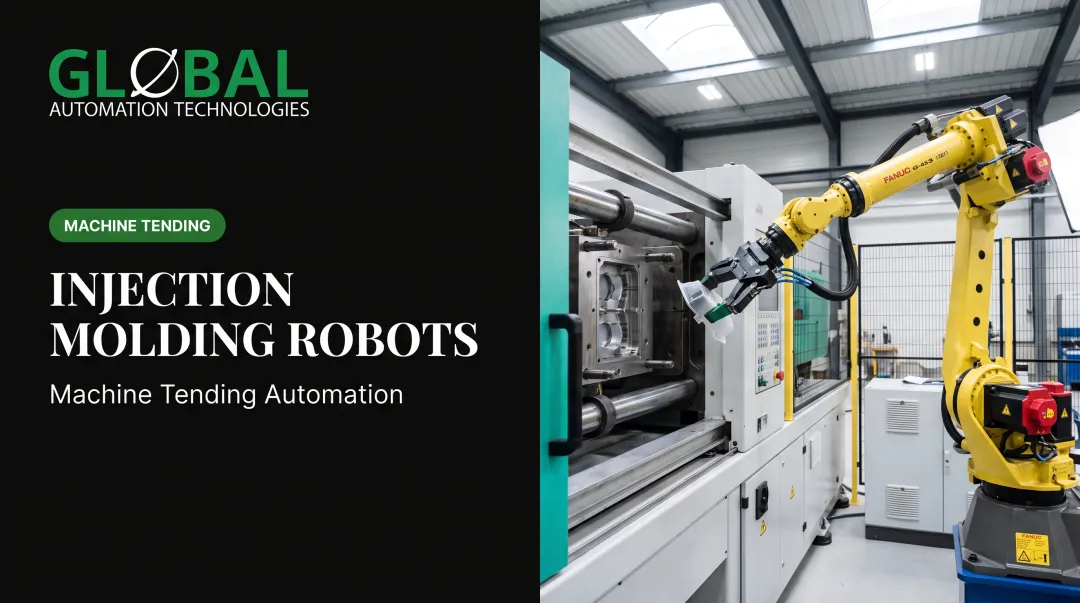
Machine tending is the on-ramp most processors use to start their automation journey. A robot loads inserts, unloads finished parts, and interfaces directly with the molding machine's control system, letting presses run unattended through nights and weekends.
The appeal comes down to press utilization. A press that used to sit idle during shift changes or breaks can now keep cycling, and one robot can repeat a long unload sequence indefinitely without fatigue or attention lapses.
Plastics Technology reports that simple cobot applications in injection molding typically reach ROI within about 12 months, though this is an expert estimate rather than a controlled study, according to Plastics Technology's coverage of cobots in molding.
GLOBAL's own benchmark for machine tending cells lands slightly wider, at 12 to 18 months, driven mainly by higher parts-per-shift output and reduced direct labor hours.
This is why machine tending tends to be the first automation investment smaller processors make:
- No need to redesign the entire production line
- A single robot cell can offset multiple labor shifts
- Cycle time consistency improves almost immediately
- Clean-room capable configurations exist for medical and food-grade parts
For processors facing chronic turnover in repetitive tending roles, this application solves the most immediate pain point first.
2. Robotic Material Handling, Trimming & Secondary Finishing
Once a part leaves the mold, someone still has to trim it, sort it, and get it packaged. Robots now handle degating, deflashing, and part sorting for bottles, caps, and molded components at volumes that would exhaust a manual crew.
Compact and articulated robots are particularly well-suited here because of their small footprint relative to output.
Array Plastics, for example, runs a fleet of linear robots alongside several six-axis units. Those robots handle mold unloading, camera inspection, insert overmolding, cutting, and packing across multiple small and medium injection presses, all within a tight production footprint.
Beyond throughput, there's a human factor. Trimming and deflashing are repetitive, strain-inducing tasks:
- Constant wrist and shoulder motion during degating
- Repeated bending or reaching during sorting
- Long-duration standing at packaging stations
Removing workers from those motions improves output and cuts the physical wear that drives absenteeism and turnover in trimming and packaging roles.
3. Robotic Painting, Coating & Precision Dispensing
Plastic parts increasingly need paint, coating, adhesive, or sealant applied with tolerances that manual spraying simply can't hit consistently. Robots solve this by repeating the exact same path, speed, and gun angle on every single part.
GLOBAL's robotic painting systems, for instance, are engineered to hold film build within specification shift after shift, eliminating the operator-to-operator variability that shows up as inconsistent coverage or costly rework. Systems are programmed around the specific substrate and finish spec, whether that's automotive-style basecoat, fiberglass gelcoat, or general industrial coating.
Material efficiency follows naturally from that precision:
- Consistent spray patterns reduce overspray
- Optimized flow rates in dispensing cut waste on adhesives and sealants
- Fewer rejected parts means less rework downstream
There's a safety dimension too. Paint booths expose workers to isocyanates, VOCs, and overspray particulates, materials that OSHA links to occupational asthma and respiratory irritation. Robotic booths remove people from that exposure entirely.
4. Robotic Welding & Assembly of Plastic Components
Multi-part plastic assemblies (automotive interior consoles, appliance housings) often rely on ultrasonic welding or staking rather than traditional metal joining. Robots bring precision to a process that's easy for manual operators to get slightly wrong.
In one documented ultrasonic welding application, an automated system joined two points on a plastic automotive console simultaneously in under 10 seconds, using energy feedback and depth monitoring to confirm each weld met spec before the part moved on.
This is where six-axis articulated robots earn their keep. Welding heads often need to approach at awkward angles inside tight assembly fixtures, something simpler pick-and-place robots can't manage. A 6-axis arm can rotate the weld horn or the part itself to hit every joint at the correct pressure and angle, cycle after cycle.
5. AI-Powered Vision Inspection & Predictive Quality Control
Vision-guided robots now catch defects while parts are still moving down the line, not after a customer complaint arrives. Cameras paired with AI models check for surface flaws, short shots, warping, or dimensional errors in real time.
When a system flags a problem, it can halt the line or alert a technician before dozens of bad parts pile up downstream. That single change, catching defects at the source instead of at final inspection, is where most scrap and rework savings come from.
This connects directly to a bigger 2026 shift: predictive maintenance. Instead of waiting for a robot or press to fail, AI-driven health monitoring flags early warning signs, whether that's a worn actuator or a drifting sensor, before they cause unplanned downtime.
GLOBAL, which holds Level 5 status in FANUC’s Authorized System Integrator program, builds the same early-detection logic into its deployments for both part quality and equipment health. AI-assisted simulation has also cut robot programming time from weeks to days on many GLOBAL projects, so inspection cells go live faster with fewer surprises during commissioning.
What's Driving Robotics Adoption in the Plastics Industry
Several forces are converging to push plastics processors toward automation faster than in previous years.
- Skilled labor shortage. Global robot installations hit 542,000 units in 2024, with operational stock at 4.664 million—up 9% year over year—per the International Federation of Robotics. Density has more than doubled in seven years as plants struggle to fill repetitive, physically demanding roles.
- Falling cost of entry. Hardware prices have dropped over three decades, and simpler programming means smaller processors no longer need a dedicated robotics engineer to run a cell. Flexible staffing and contract engineering close the remaining talent gap.
- AI and Industry 4.0 integration. AI-assisted simulation lets engineers test and refine robot paths virtually before production, cutting programming and commissioning time. Tighter MES connectivity feeds real-time robot data into quality and scheduling systems.
- Regulatory and safety pressure. Safety standards around chemical exposure in paint booths and hazardous material handling push processors toward robots that remove people from those environments.

How These Trends Are Impacting the Plastics Industry
Robotics adoption is reshaping day-to-day operations, capital planning, and hiring strategy across plastics manufacturing.
Operational Impact
Robotic tending and inspection stabilize cycle times that used to swing based on operator fatigue or shift changes. Fewer manual touchpoints also means fewer unplanned stops for adjustment or rework, keeping presses running closer to their rated output hour after hour.
Business Impact
Faster ROI timelines and reduced scrap are shifting where capital gets spent. Deloitte's 2025 smart manufacturing survey found that 37% of large manufacturers now rank physical automation among their top two investment priorities. That pattern is trickling down to mid-sized processors evaluating their own capital budgets.
Workforce Impact
Automation changes the skill mix a plant needs rather than cutting headcount. Programming, running, and maintaining robotic cells calls for controls engineers, mechanical designers, and commissioning specialists—roles many processors can't fill fast enough on their own.
That gap is what providers like GLOBAL close by pairing the robotic cell with the engineer who knows how to run it.
Future Signals for Robotics in the Plastics Industry
Robotics adoption in plastics will keep accelerating past 2026. Processors should watch for these shifts over the next one to three years:
- Digital twins shrinking commissioning time. AI-assisted simulation already compresses robot programming from weeks to days for early adopters. Full-line digital twins are the logical next step.
- Robots-as-a-service models expanding. Pay-per-use and modular automation arrangements lower the upfront capital barrier that has kept smaller processors on the sidelines.
- Predictive maintenance becoming standard. Tools that flag equipment health issues before downtime hits are now a baseline expectation on most new automation projects.
Conclusion
Machine tending, material handling, painting and dispensing, welding, and AI-powered inspection cover the five most practical robot applications plastics processors can act on in 2026. None of them require betting the whole plant on automation at once.
Processors that move now, even with a single machine tending cell, build a durable edge in cost, quality, and safety as the labor shortage keeps tightening. The robot is only half the equation.
Success depends just as much on the engineers who program, run, and maintain it. That is why pairing automation solutions, services and technical staffing matters—and how GLOBAL Automation Technologies helps plastics manufacturers start small, staff the cell, and scale without betting the whole plant.
Frequently Asked Questions
What robots are used in the plastics industry?
Plastics processors commonly use SCARA robots for high-speed pick-and-place, 6-axis articulated robots for welding and painting, and Cartesian or top-entry robots for mold loading and unloading. The right choice depends on part geometry and cycle speed.
How much does it cost to implement robotic automation in plastics manufacturing?
Costs vary widely by application complexity, but machine tending cells, the most common entry point, often pay back their investment within 12 to 18 months through labor savings and higher output.
Will robots replace human workers in plastics manufacturing?
Robots typically take over repetitive or hazardous tasks like tending, trimming, and painting. Human roles shift toward programming, quality oversight, and maintenance, which usually require more skill, not less.
Should I choose a 3-, 5-, or 6-axis robot for my plastics application?
3- and 5-axis robots suit fixed-orientation tasks like pick-and-place or sorting. 6-axis robots handle complex angles needed for welding, painting, and assembly in tight spaces.
How is AI changing robotics in the plastics industry in 2026?
AI-assisted simulation is cutting robot programming and commissioning time from weeks to days, a shift integrators like GLOBAL already apply on plastics cells. Predictive maintenance tools also flag equipment issues early, reducing unplanned downtime before it happens.
What is the fastest way for a plastics processor to start with automation?
Start with a simple, high-ROI application like machine tending. It requires less redesign than welding or painting cells and typically delivers a fast, measurable payback before you scale to more complex applications.