
Coating selection has never mattered more. Manufacturers now face tighter durability requirements, stricter environmental compliance, and pressure to cut lifecycle costs without sacrificing performance. Pick the wrong chemistry, and you're repainting a structure in five years instead of twenty-five.
This article breaks down the major types of industrial coatings, explains how they differ, and walks through how to match the right coating to a given application.
Key Takeaways
- Industrial coatings protect assets from corrosion, chemicals, abrasion, and UV damage
- Match the coating to substrate, environment, and performance needs—no single best option
- Epoxy, polyurethane, polysiloxane, zinc-rich, and powder coatings solve different problems
- Most premature coating failures start with poor surface preparation
What Are Industrial Coatings?
Industrial coatings are engineered protective and functional layers applied to substrates like metal, concrete, or plastic. Unlike decorative paint, they're built primarily for performance: corrosion resistance, chemical resistance, and abrasion resistance come first. Appearance is secondary.
These coatings do heavy lifting in demanding industrial environments:
- Pipelines and storage tanks — protecting against constant chemical and moisture exposure
- Automotive frames and body panels — resisting road salt, stone chips, and UV degradation
- Structural steel on bridges — withstanding decades of weather cycling and load stress
The financial stakes are real. A 2016 NACE IMPACT study estimated the annual global cost of corrosion at $2.5 trillion — roughly 3.4% of global GDP.
The same study found that existing corrosion-control practices, including protective coatings, could save an estimated 15% to 35% of that figure annually. When coatings fail or are skipped entirely, the bill shows up fast in replaced infrastructure, unplanned downtime, and safety risk.
Types of Industrial Coatings
Industrial coatings aren't one-size-fits-all. Different chemistries are engineered for different substrates, environments, and performance demands, and most real-world protective systems combine several coating types in layers rather than relying on just one.
A typical system might pair a zinc-rich primer with an epoxy intermediate coat and a polyurethane topcoat. Each layer does a specific job.

Epoxy Coatings
Epoxy coatings are two-part systems (resin plus hardener) that cure through a chemical reaction into a hard, chemically resistant film. According to the Bureau of Reclamation's coatings guide, amine epoxies resist alkalis, acids, and solvents effectively, and abrasion-resistant formulations can incorporate hard pigments like silicon carbide for severe wear service.
The catch: epoxies fade and chalk under direct sunlight. That limits them mostly to interior or submerged applications.
Best suited for:
- Tank linings and pipelines
- Submerged steel structures
- Concrete floors in industrial facilities
- Interior structural steel
Strengths: exceptional chemical and abrasion resistance, flexible film-build options.
Limitations: poor UV stability, lower flexibility than some alternatives.
Polyurethane Coatings
Polyurethane coatings serve as durable topcoats, available in two main formulations: aliphatic and aromatic. Aliphatic polyurethanes retain color and gloss in direct sunlight, which is exactly what epoxy can't do. That makes them the go-to exterior topcoat over an epoxy intermediate coat.
Aromatic polyurethanes, by contrast, tend to yellow outdoors but perform well in immersion and buried-pipe service where color retention doesn't matter.
Best suited for:
- Exterior structural steel and bridges
- Marine vessel topsides
- Automotive and equipment finishes
Strengths: excellent weathering and abrasion resistance.
Limitations: higher material cost; isocyanate content demands skilled, controlled application.
OSHA has flagged isocyanate exposure as a serious occupational hazard tied to respiratory irritation and asthma, which shapes how these coatings get applied in practice.
Polysiloxane / Epoxy-Polysiloxane Coatings
These hybrid coatings combine epoxy's corrosion resistance with polysiloxane's weather and UV stability. The real advantage shows up in application: polysiloxanes can go directly over a zinc-rich primer, collapsing a traditional three-coat system into two.
FHWA research on steel bridge coatings found that two-coat systems could often be completed overnight, compared to at least 24 hours for traditional three-coat painting — cutting labor, material handling, and traffic disruption on infrastructure projects.
Best suited for:
- Bridges and marine structures
- Storage tanks and offshore platforms
- Any high-value asset needing long service life with minimal maintenance
Strengths: superior lifecycle value, reduced application time.
Limitations: higher upfront material cost, and color-matching touch-ups can be visible.
Zinc-Rich Primers
Zinc-rich primers pack in high concentrations of zinc dust that corrode sacrificially in place of the underlying steel. This is fundamentally different from barrier coatings like epoxy. Even where the coating gets scratched or damaged, the zinc keeps protecting the exposed steel through galvanic action.
Because this protection depends on direct electrical contact with bare metal, surface prep matters enormously here. Most specifications call for blast cleaning to SSPC-SP 10 (Near-White Metal) or SSPC-SP 5 (White Metal) standards.
Best suited for:
- Bridges and offshore structures
- Power plants and heavily corrosive environments
- Typically applied as a primer beneath epoxy or polyurethane topcoats
Strengths: long-term, self-healing corrosion protection.
Limitations: demanding surface prep, weak acid/alkali resistance.
Powder Coatings
Powder coatings are solvent-free, dry finishes applied electrostatically and cured under heat. Charged powder particles are attracted to a grounded part, then baked in an oven where they melt or crosslink into a finished film.
This process produces virtually no VOC emissions, and overspray can be captured, sieved, and reused. The Powder Coating Institute reports material utilization efficiency of 95% to 98% with proper recovery systems in place, making powder coating the most environmentally efficient common coating option.
Best suited for:
- High-volume metal parts manufacturing
- Automotive components and appliances
- Architectural metal
Strengths: durable, uniform finish, low environmental impact, minimal waste.
Limitations: substrates must tolerate oven heat, and dedicated curing equipment is required.
How to Choose the Right Industrial Coating
Match coating chemistry to your substrate, environment, and performance goals. Cost and familiarity alone rarely produce the best specification.
Weigh these factors before specifying anything:
- Substrate type — steel, concrete, plastic, and aluminum all behave differently
- Environmental exposure — UV, chemical contact, submersion, temperature swings
- Required service life — a few years versus multiple decades changes the decision
- Application method — spray, dip, or electrostatic deposition
- Total lifecycle cost — not just the price per gallon or per part
Common Mistakes to Avoid
Three mistakes account for most coating failures we see across the industry:
- Overspecifying the coating. Choosing a premium polysiloxane system when a simpler epoxy would meet the actual performance need just inflates cost for no benefit.
- Rushing surface preparation. AMPP's CoatingsPro attributes an estimated 75% of coating failures to poor surface preparation, citing analysis from the Materials Analytical Group. No chemistry can fix a dirty or poorly profiled substrate.
- Ignoring application conditions. Temperature and humidity during application directly affect cure quality and adhesion, even when the coating itself is applied correctly.
How Robotic Automation Is Improving Industrial Coating Application
Even the best coating chemistry underperforms if application is inconsistent. Manual spraying introduces variability in film thickness and coverage, and it puts workers directly in contact with hazardous VOCs and isocyanates from polyurethane and epoxy systems.
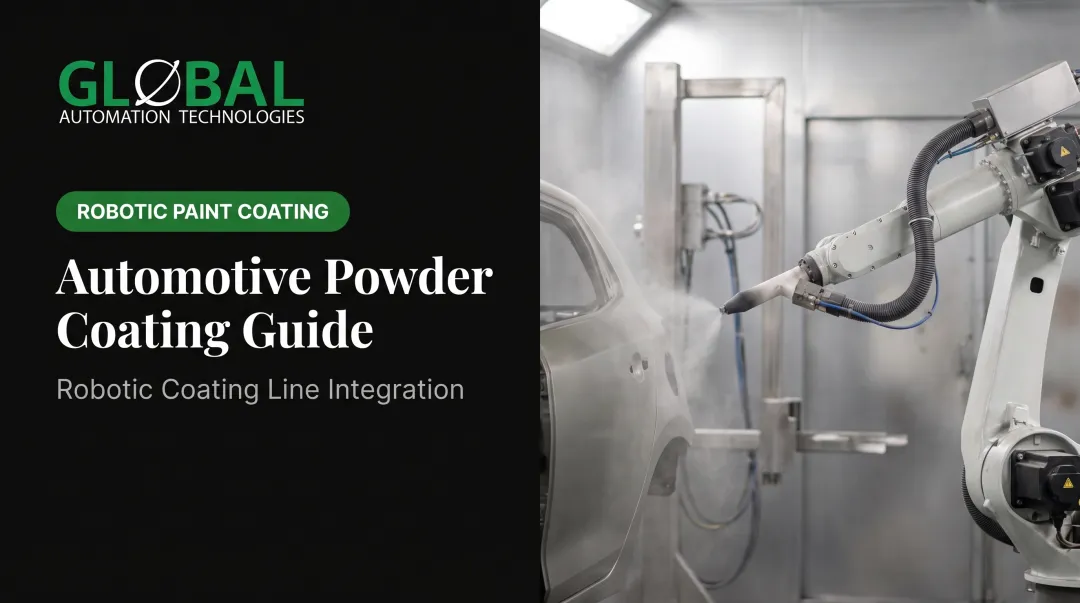
Robotic painting and dispensing systems remove that variability. GLOBAL Automation Technologies, which holds Level 5 status in FANUC’s Authorized System Integrator program, builds these systems around FANUC paint robots designed for hazardous spray environments. Intrinsically safe electrical designs and hollow-wrist cable routing keep hoses and lines protected inside solvent-laden atmospheres.
The results show up in several ways:
- Follows the same programmed path every cycle, holding film build within specification shift after shift instead of varying with operator technique and fatigue
- Cuts overspray and material cost per part with repeatable patterns and higher transfer efficiency
- Keeps operators out of the booth, removing exposure to isocyanates, VOCs, and overspray particulates
- Extends production well beyond a single shift, enabling lights-out running between scheduled maintenance windows, with faster cycle times than manual spray booths
This approach applies across GLOBAL's coating work — from multi-coat Class A automotive finishes to electrostatic powder coating for industrial parts to fiberglass gelcoat application. In each case, the engineering goal is the same: lock in spray parameters and path so every part comes out consistent, shift after shift.
Conclusion
Industrial coatings protect manufacturing, infrastructure, and heavy industry assets from corrosion, chemicals, and wear. Epoxy, polyurethane, polysiloxane, zinc-rich primers, and powder coatings each address different substrate and environmental challenges. No single chemistry fits every job.
Long-term performance depends on pairing the right chemistry with precise, well-controlled application. When manufacturers automate that step with robotic coating systems, they gain consistent film build, less material waste, and keep operators out of hazardous spray environments.
Frequently Asked Questions
What are the different types of industrial coatings?
The main categories are epoxy, polyurethane, polysiloxane, zinc-rich primers, and powder coatings. Each is built for different substrates, environments, and performance needs. Most protective systems stack several types in layers.
What is the 80/20 rule for coating?
It refers to surface preparation accounting for roughly 80% of a coating's long-term success, with application technique and material quality contributing the remaining 20%. Industry data often ties the majority of coating failures—sometimes around 75%—back to poor prep alone.
What is the difference between industrial coatings and regular paint?
Industrial coatings are engineered primarily for protection, with thicker films built for corrosion, chemical, or abrasion resistance. Regular paint is optimized mainly for appearance rather than long-term performance.
How long do industrial coatings typically last?
Lifespan ranges from a few years to more than 25 years depending on coating type, substrate, environment, and maintenance. ISO 12944 durability categories classify systems from "low" (up to 7 years) to "very high" (25+ years).
Which industrial coating offers the best corrosion resistance?
Zinc-rich primers and epoxy-polysiloxane hybrid systems rank among the strongest options, especially in a multi-coat stack. Real-world performance still depends on the full specified system, not one product alone.
Can automation improve the consistency of industrial coating application?
Yes. Robotic coating systems remove human variability from the spray process, hold film thickness to tight tolerances, and cut overspray and material waste versus manual application.