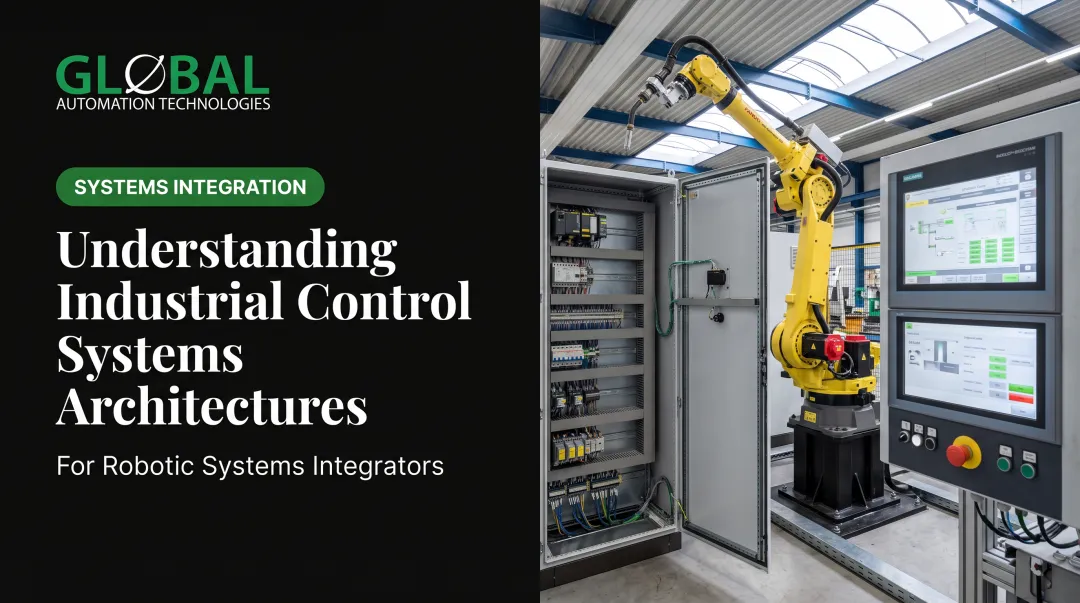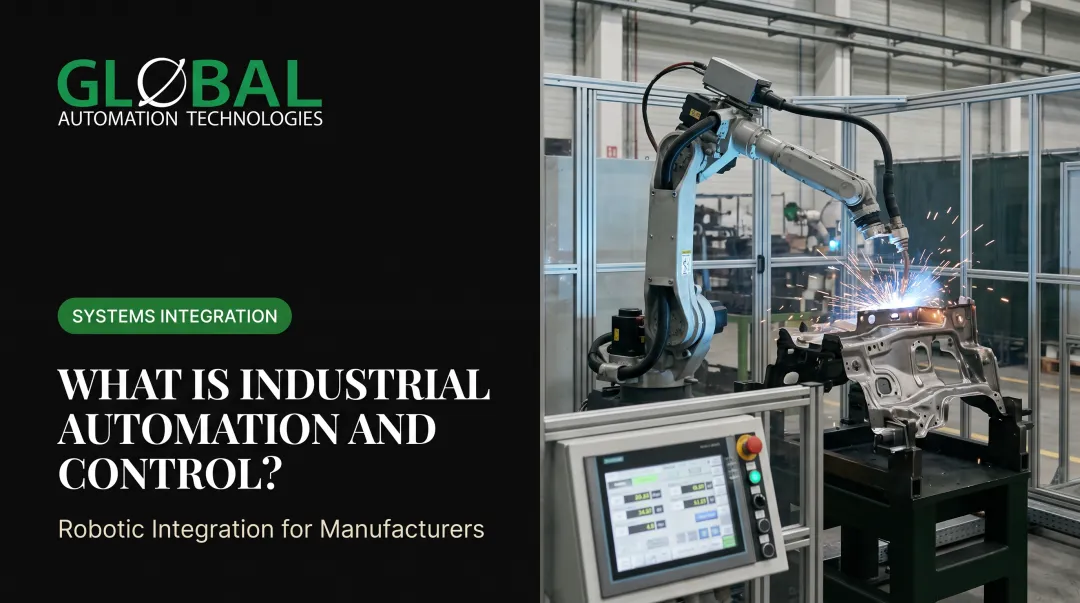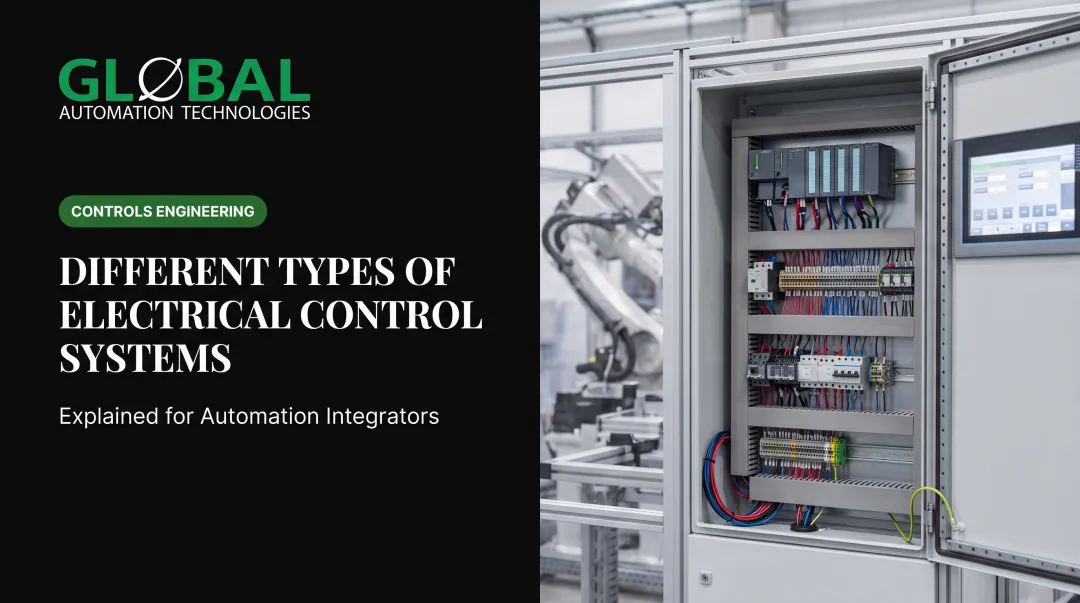

The core tension is simple to state and hard to solve: centralized control versus distributed control. Centralized systems are simple until they aren't. Distributed systems scale well but demand more network expertise. Choosing wrong doesn't just cost money, it costs months.
This guide covers the major architecture types, how layering manages complexity, the components every system needs, and how to pick the right approach before panel layouts get drawn.
Key Takeaways
- Architecture defines how controllers, I/O, networks, and software work together across the line
- Use centralized designs for compact single cells; choose distributed designs for large or growing lines
- Layer real-time control below supervisory planning to protect uptime and reliability
- Your architecture choice drives install cost, fault tolerance, and how easily you scale later
- Simulation and proven design practices cut architecture risk before equipment hits the floor
What Is Control System Architecture?
Control system architecture is the structural framework of controllers, sensors, actuators, networks, and software that governs how a manufacturing system operates. It's the blueprint deciding which controller talks to which device, how data flows, and what happens when something fails.
Core components include:
- PLCs and robot controllers – the processing hardware executing logic
- I/O modules – the interface between physical devices and controllers
- HMIs – operator windows into system status and control
- Industrial networks – the communication backbone (EtherNet/IP, PROFINET, and similar protocols)
- The physical process itself – the machines, conveyors, and robots being controlled
Control Architecture vs. Control Plane Architecture
These terms get confused constantly. Control system architecture refers to the physical and functional arrangement of controllers, I/O, robot cells, safety systems, and supervisory software on your plant floor.
Control plane, by contrast, is a networking term for resource-control and coordination functions within a network topology. It's a subset concept borrowed from IT and telecom, not a synonym for your entire manufacturing control system.
Why Timing Matters
Architecture decisions need to happen before panel layouts and wiring schematics get drawn, not after. Once detailed design locks in centralized wiring or distributed node placement, reversing course means tearing into finished engineering work.
Changes get far more costly once a project moves past design and onto the manufacturing line. That cost curve is why feasibility studies and process reviews happen upfront.
Centralized vs. Distributed Control Architectures
Centralized Architecture
One main panel. Home-run wiring back to a single processor. One program running the show. This works well for compact cells: short wiring runs, low I/O counts, straightforward troubleshooting because everything lives in one cabinet.
Distributed Architecture
Multiple controllers positioned near the equipment they serve, local I/O, and industrial networks (EtherNet/IP, PROFINET) coordinating everything. Best for large, spread-out lines where running home-run wiring back to a central point would mean hundreds of feet of unnecessary cable.
The wiring-time difference is real and documented. A Rockwell case study comparing manual hardwiring against a networked, EtherNet/IP in-cabinet wiring approach found a 66% reduction in wiring time on a like-for-like panel comparison, with separate time studies showing reductions up to 80% in some cases.
A manufacturer that shifted to distributed, machine-mounted I/O using EtherCAT reported 50% less cabling and roughly $4,700 saved per system, plus five technician-days saved in the field.
Fault tolerance differs sharply between the two:
- Centralized: one processor failure can halt the entire line
- Distributed: faults tend to stay isolated to the affected zone, keeping the rest of the line running

The Hybrid Middle Ground
Most real-world lines don't pick one extreme. A centralized line controller managing overall sequencing, paired with distributed I/O nodes near each station, gives you central oversight without home-run wiring nightmares. It's the practical compromise most integrators land on for mid-size to large installations.
Expansion is where this decision really bites later. Adding a station to a distributed system usually means adding a network node. Adding a station to a maxed-out centralized processor can mean a controller swap and a full rewrite.
Layered Control Architecture: Structuring Complexity
Layering separates control functions by speed and scope:
- Real-time layer – servo control, actuator commands, safety interlocks. Milliseconds matter here.
- Coordination layer – cell-level logic, sequencing, part tracking between stations.
- Planning layer – scheduling, production targets, higher-level decision-making.

Why Temporal Separation Matters
Fast control loops can't wait on slow supervisory processes. If your planning software takes a few seconds to recalculate a schedule, that delay should never touch the servo loop positioning a robot arm mid-weld. Separating these layers keeps real-time control deterministic regardless of what's happening upstream.
This separation also isolates faults. A hiccup in a scheduling or planning system shouldn't take down safety-critical low-level control.
In robotic work cells, safety interlocks, motion control, and cell-level coordination need to operate independently while staying synchronized. GLOBAL, a Level 5 FANUC Authorized System Integrator, structures this through PLC-to-robot coordination, intelligent scheduling, buffer stations, and part tracking, so a single robot can serve multiple machines without one slow process stalling another.
Before those layers go live, GLOBAL's engineers use AI-assisted simulation to model and test robot programs. That pre-deployment work cuts programming time from weeks to days and reduces the surprises that typically surface during commissioning.
Key Components Every Control Architecture Must Address
Regardless of centralized, distributed, or hybrid design, four components need deliberate planning:
- Controllers and processing hardware – PLCs, robot controllers, and edge devices that run analytics closer to the source
- Industrial networks – EtherNet/IP remains dominant in North American plants; other industrial Ethernet protocols continue to scale worldwide
- HMI and operator interface design – visibility at each layer, not just a single overview screen
- Safety architecture and interlocks – guarding, E-stop coordination, and machine interfaces that isolate hazards across the full cell
EtherNet/IP builds on standard Ethernet and TCP/IP, with the Common Industrial Protocol carrying control, safety, and motion data. PROFINET's installed base grew by 9.5 million nodes in 2024 alone, a clear signal of how fast industrial networking is expanding.
Robot safety in the U.S. now falls under ANSI/A3 R15.06-2025, the national adoption of ISO 10218. It covers both industrial robots and robot cell applications.
For material handling cells, that often means conveyor-to-robot speed matching, trigger signals, and coordinated E-stop logic. For press tending, it means direct integration with press controls for synchronized, safe pick-and-place.
How to Choose the Right Architecture for Your Production Line
Run through these factors before committing:
- Physical footprint – Concentrated equipment favors centralized control. Spread-out lines favor distributed I/O to avoid excessive cable runs.
- I/O count – Higher point counts shift the economics toward distributed wiring, where shorter local runs offset the added network engineering.
- Fault tolerance needs versus team skill – Distributed systems isolate faults better, but they demand a maintenance team comfortable troubleshooting a network, not just a cabinet.
- Expansion plans – Fixed, single-purpose machines can stay centralized indefinitely. Lines expected to scale or reconfigure benefit from distributed architecture's easier node addition.
A quick comparison:
| Factor | Centralized | Distributed |
|---|---|---|
| Best for | Compact cells | Large, spread-out lines |
| Wiring | Home-run, longer runs | Shorter local runs |
| Fault impact | Line-wide | Isolated to zone |
| Expansion | Harder past capacity | Easier via network node |
Getting this right the first time is where full-scope integration support earns its keep. Architecture mistakes tend to surface only after commissioning, when equipment is bolted down and wiring is finished.
Working with a turnkey integrator such as GLOBAL means the architecture decision accounts for layout, design, build, programming, validation, installation, and ongoing support—not just the initial panel design.
Frequently Asked Questions
What is control architecture?
Control architecture is the structural framework of controllers, networks, sensors, and software that governs how automated equipment operates and communicates. It sets the physical and functional arrangement of the full control system.
What is control plane architecture?
Control plane architecture is the layer that handles coordination, command distribution, and data flow management (a term borrowed from networking). It differs from broader manufacturing control architecture, which includes PLCs, I/O, and robot cells.
Should I choose centralized or distributed control for a new line?
Base the choice on footprint, I/O count, and fault tolerance needs. Compact, concentrated cells generally favor centralized control; large or expanding lines benefit from distributed I/O.
What is the difference between control architecture and layered control architecture?
Control architecture is the overall framework; layered control architecture is a specific structural pattern within it. Layering separates real-time control, coordination, and planning into distinct tiers for reliability.
How does control architecture affect robotic automation projects?
Architecture determines how safety interlocks, motion control, and cell-level coordination interact reliably. Poor architecture choices can create bottlenecks or fault-propagation risks across an entire robotic cell.
Why does architecture planning matter before installation begins?
Architecture changes made after detailed design are far more disruptive and costly than upfront planning. Locking in the wrong framework early often means rewiring or reprogramming after equipment is already installed.