
Many manufacturers still juggle separate vendors for robots, controls, conveyors, and staffing. That approach breeds delays, finger-pointing when something breaks, and downtime nobody budgeted for. This guide covers what material handling systems integrators actually do, the services they provide, and how to pick the right partner for your facility.
Key Takeaways
- A systems integrator delivers one unified working solution, not a pile of standalone equipment
- The strongest integrators put design, project management, and technical labor under one accountable contract
- Cross-industry experience and turnkey capability lower project risk and shorten time to ROI
- Machine-tending automation can pay for itself in as little as 33 weeks in documented cases
What Are Material Handling Systems Integrators?
A material handling systems integrator combines equipment, software, and skilled labor into one cohesive automated (or semi-automated) system. Rather than selling you a robot, the integrator builds and validates the entire cell (mechanical design, controls, safety guarding, and commissioning) as a single deliverable.
That's a different job than what an equipment manufacturer does. According to the Material Handling Institute, OEMs generally focus on their own product lines, while integrators design and manage complete solutions across mechanical equipment, software, installation, and ongoing support.
The practical difference for you:
- OEM: Sells the robot or conveyor. You handle the rest.
- Integrator: Owns design, procurement, installation, and support as one point of contact.
This single-accountability structure matters most when something goes wrong. With multiple vendors, a failed handoff between the robot supplier and the controls contractor can stall a project for weeks while everyone points elsewhere. An integrator eliminates that gap entirely.
Robotic Material Handling (RMH) Explained
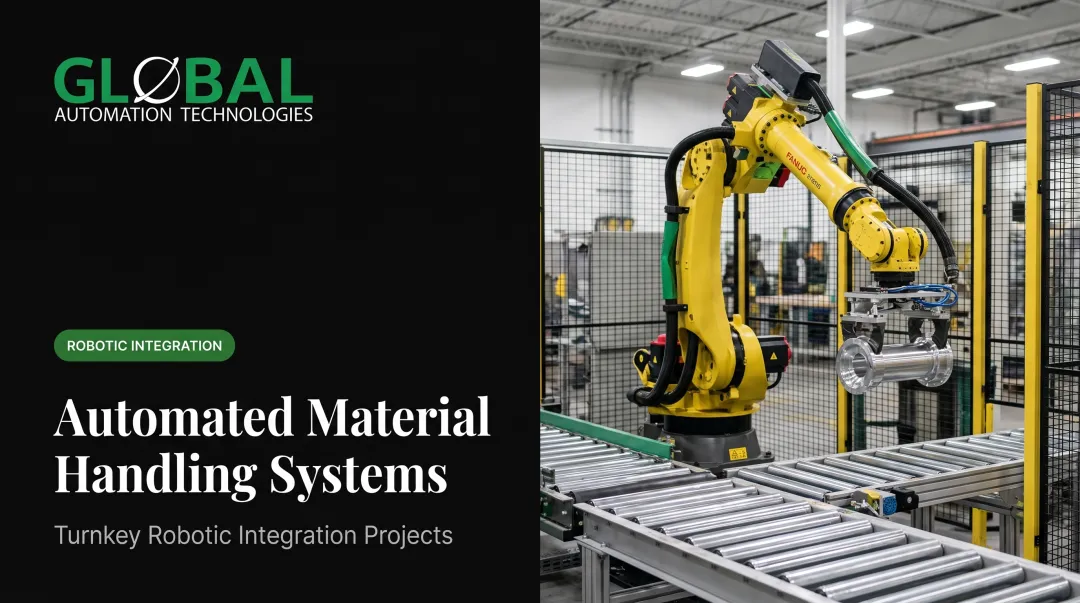
RMH systems use robotic arms and automated equipment to move materials with minimal human intervention. Common applications include:
- Machine tending: loading and unloading CNC machines, presses, and injection molding equipment
- Part transfer: moving components between production stages with controlled positioning
- Palletizing/depalletizing: case stacking, layer building, and pallet-pattern creation
- Pick-and-place and vision-guided handling: for parts ranging from small components to heavy assemblies
FANUC's material handling robots span a load range from 0.5 kg to 2,300 kg, from small precision parts up to heavy castings in automotive and heavy equipment plants (FANUC).

A typical automotive example: a robot picks, orients, inspects, and loads a part into a CNC machine, running unattended through shift changes.
Why Manufacturers Rely on Integrators Instead of DIY
Most manufacturing teams simply don't have the internal bandwidth to run multi-vendor coordination, controls architecture, and simulation validation at the same time, on top of their regular jobs.
The talent shortage makes this worse. More than 65% of manufacturers in NAM's Q1 2024 outlook survey named attracting and retaining talent as their top business challenge. Deloitte projects US manufacturing could need roughly 3.8 million new employees through 2033, with close to half potentially going unfilled.
Integrators close that gap with capacity and with an applications-based approach in-house teams rarely build:
- Solutions proven in one industry often translate to another: a machine-tending fix in automotive can transfer to a heavy-equipment plant with similar CNC constraints
- Integrators bring cross-industry experience across verticals, not just one customer's history
- In-house teams rarely see enough projects to build that same library of solutions
Core Services Provided by Material Handling Systems Integrators

System Design & Engineering
Before any equipment gets ordered, a good integrator runs a needs analysis, evaluates your facility layout, and builds CAD or simulation models to validate throughput. This step catches problems on a screen instead of on your production floor.
AI-assisted simulation tools are increasingly part of this process. They let engineers test robot programming and cycle times virtually before writing a single line of production code. A Siemens customer case study documented a 30% cut in onsite commissioning time when simulation was used up front.
GLOBAL Automation Technologies uses AI-assisted robot simulation to model and optimize programs before deployment, which the company reports cuts robot programming time from weeks to days.
Project Management & Vendor Coordination
A true integrator acts as the single point of contact managing timelines, subcontractors, and lead times across every supplier involved. You call one number for status updates instead of chasing three vendors.
That coordination typically covers:
- Schedule alignment across equipment, controls, and facility trades
- Lead-time tracking and change-order control
- Single-threaded accountability for budget and delivery milestones
Installation, Commissioning & Training
This phase covers the physical build-out, live-system testing, SOP development, and training for operators and maintenance staff. Process discipline from an experienced integrator matters most when the design hits the plant floor.
GLOBAL handles this handoff directly. Instead of delivering a finished system and walking away, GLOBAL pairs automation solutions, services and technical staffing so manufacturers get both the equipment and the engineers to run it under one contract. A well-built cell still depends on the team keeping it running.
Post-Installation Support
Strong post-install programs usually include:
- Predictive maintenance and remote monitoring
- Phased scalability planning as production needs grow
- AI-driven equipment health assessments that flag developing issues before they cause unplanned downtime
Benefits of Partnering with a Material Handling Systems Integrator
Partnering with a material handling systems integrator pays off in throughput, labor cost, and safer floors. In one FANUC case study, Swivellink's ROBODRILL tending system delivered a 33% increase in production efficiency after integration.
Cost and efficiency gains typically come from:
- Fewer bottlenecks between production stages
- Lower direct labor costs on repetitive tasks
- Optimized energy usage in automated equipment versus manual processes
Safety gains show up just as clearly in the data. BLS recorded 502,380 musculoskeletal disorder cases involving at least one day away from work across US private industry in 2021–2022. A NIOSH-affiliated study found industrial robots reduced MSD risk factors in small manufacturers, though it could not establish a firm injury-rate reduction.
Even without a universal injury-reduction percentage, pulling workers off repetitive lifting, heavy part transfer, and awkward palletizing is a tangible win.

Real-World Examples of Material Handling Systems Integration
Machine tending in automotive/Tier 1 manufacturing: A robot loads and unloads CNC machines, handling part orientation and inspection while running unattended through breaks and shift changes. Spindles keep cutting instead of sitting idle, and operators move to higher-value inspection and process work.
Pick-and-place and palletizing cells: Robots transfer parts between conveyors, fixtures, and outbound pallets, using vision guidance when orientation varies. That steadies line flow, cuts manual handling, and keeps upstream machines fed without waiting on operators.
Those gains show up in full-shift metrics, not just robot motion time. In the Swivellink case cited earlier, CNC cycle time actually increased by 20 seconds per part. Total shift-level cycle time still dropped by 1 minute 30 seconds through reliability and consistency gains, delivering a 33-week ROI.
Payback calculations need to look at total production output, not robot speed alone. Machine-tending cells commonly pay for themselves within 12 to 18 months.

How to Choose the Right Material Handling Systems Integrator
The integrator you pick shapes cycle time, uptime, and how fast you can scale. Use these criteria to separate partners who fit your plant from vendors who only deliver hardware.
Experience & Industry Fit
Look for a track record across verticals relevant to you: automotive, heavy equipment, aerospace, or general industrial manufacturing. Ask for case studies and references matching your project's scope and complexity, a practice A3 explicitly recommends.
Breadth of Solutions & Technology Independence
Prioritize integrators who can give unbiased recommendations rather than pushing one brand regardless of fit. That said, depth on a single platform has real advantages too. A Level 5 FANUC Authorized System Integrator, for example, brings deep certification and engineering fluency on one of the most widely deployed robot platforms in heavy manufacturing.
Full Turnkey and Talent Capability
Evaluate whether the integrator handles layout, design, build, programming, and validation, and provides access to engineering talent for ongoing operation. GLOBAL's model of pairing 700+ FANUC robots installed with contract, contract-to-hire, and direct-placement staffing is a useful benchmark for what a combined offering looks like in practice.
Post-Installation Support & Scalability
Confirm the integrator offers:
- Predictive maintenance and remote diagnostics
- Operator and maintenance training with documented SOPs
- Phased expansion planning so your system can grow with production demand
Support quality often tracks with how rigorously the integrator is vetted. A3's certification program requires an onsite audit, personnel assessment, and safety training renewed every two years. Use that cycle as a checkpoint when you compare shortlisted partners.
Frequently Asked Questions
What exactly are RMH systems?
Robotic Material Handling (RMH) systems are automated equipment (robotic arms, machine tending cells, and similar tools) that move, load, or transfer materials with minimal manual labor. They cover applications from machine tending to palletizing and part transfer.
What are real-world examples of material handling system integration?
Common examples include robotic machine tending cells that keep CNC machines running unattended through shift changes, and vision-guided pick-and-place or palletizing cells that move parts between conveyors, racks, and outbound pallets. Both cut labor dependency and improve consistency.
How long does a typical material handling integration project take?
Timelines vary significantly by scope. A single robotic cell might take a few months, while a full production line overhaul can run well over a year. A feasibility study is the best way to get a realistic schedule for your specific project.
What industries use material handling systems integrators most?
Automotive, heavy equipment, aerospace, agriculture, and general industrial manufacturing are the primary users. Food and consumer goods, along with automotive OEM plants, have also seen strong recent adoption.
How much does a material handling integration project cost?
Costs depend heavily on system complexity, scale, and the number of robots or cells involved. Getting a needs assessment or feasibility study from an integrator is the most reliable way to get an accurate quote.
What is the difference between a systems integrator and an equipment manufacturer?
An equipment manufacturer (OEM) builds specific hardware, like a robot arm or conveyor. An integrator combines multiple technologies (hardware, software, and controls) into one cohesive, application-driven system.