
Add rising safety expectations and relentless throughput targets, and automation cells stop being a "nice to have." They become the decision that determines whether a plant hits its numbers.
This guide covers what automation cells are, the types available, real-world applications, costs, and how to pick the right partner to build one. GLOBAL Automation Technologies has spent 17+ years integrating automation systems, having installed 700+ FANUC robots worldwide — the insights here come from that hands-on experience.
Key Takeaways
- Automation cells package robots, safety barriers, controllers, and tooling into one self-contained workstation
- Pre-engineered (turnkey) cells speed deployment; custom cells fit unique processes and plant constraints
- Machine tending cells typically pay back investment in 12–18 months
- Integrator choice drives results as much as the robot hardware itself
What Is an Automation Cell?
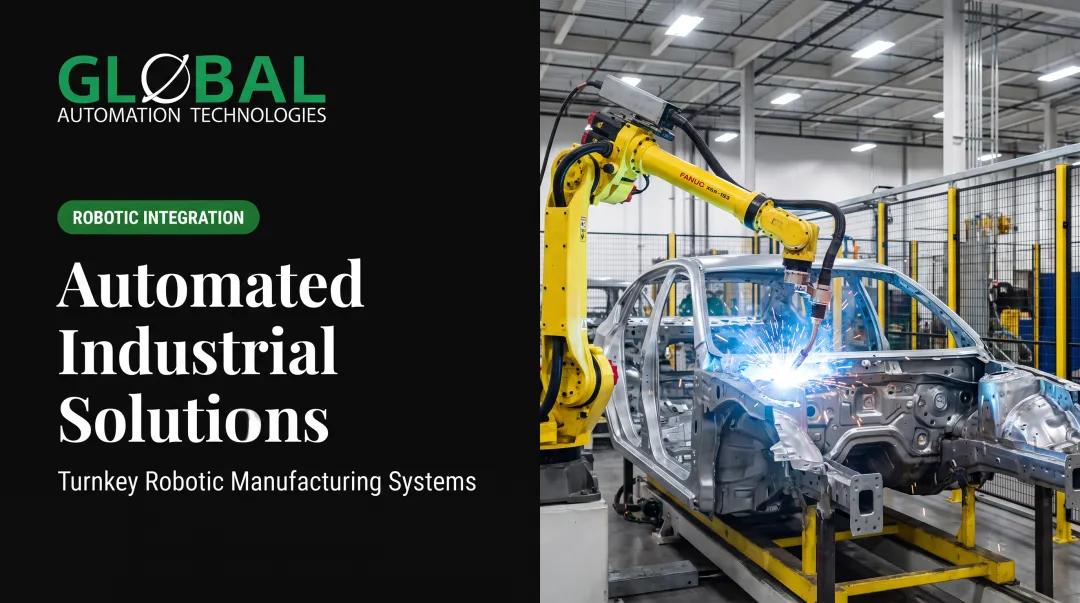
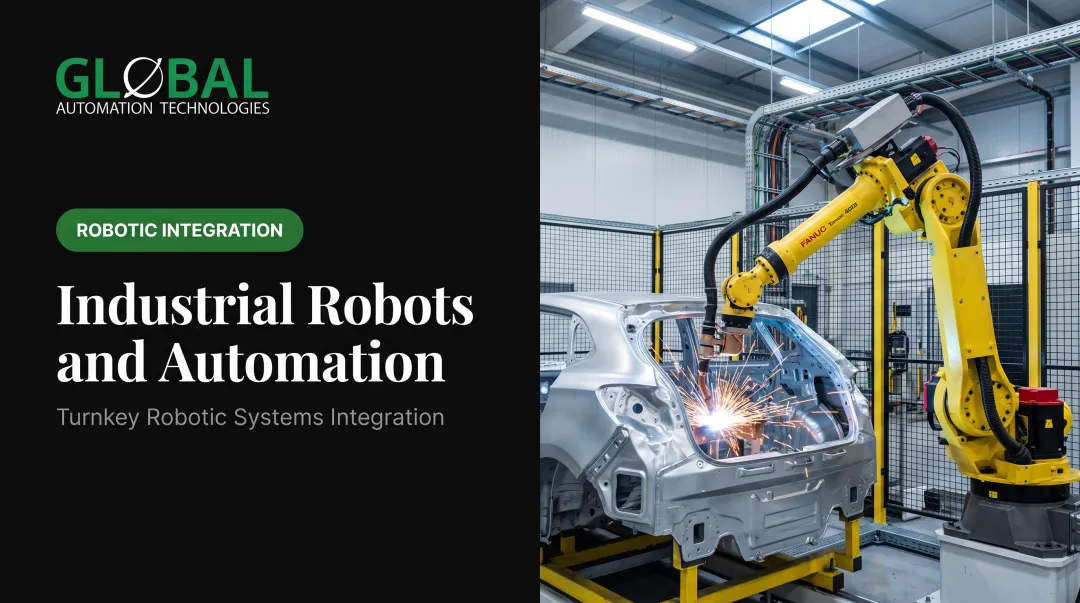
An automation cell is a complete, enclosed system built around one job: a robot (or robots), a controller, safety devices, and application-specific tooling working together for unattended production. It's the difference between owning a robot and owning a working solution.
A standalone robotic arm can't run itself. A cell can. That's the core distinction.
Essential components of an automation cell:
- Industrial robot (payload and reach matched to the application)
- Controller and controls integration
- Safety system — fencing, light curtains, emergency stops, presence-sensing devices
- Application-specific tooling (grippers, fixtures, or vision systems)

Per OSHA's Technical Manual, a robot system also typically includes power sources, sensors, and sequencing I/O interfaces — the connective tissue that lets the cell run without a human babysitting it.
Cells aren't limited to one robot. Multi-robot cells maximize floor space and throughput, particularly in high-volume automotive and heavy-equipment plants.
As a Level 5 FANUC Authorized System Integrator, GLOBAL builds each cell around a FANUC robot, engineering the tooling, fixtures, and part staging around the specific part geometry and cycle time required.
AI-assisted simulation now lets engineers model and validate an entire cell layout virtually before a single piece of steel gets ordered. GLOBAL uses this approach to cut robot programming time from weeks to days, catching interference and cycle-time issues before they become expensive startup surprises on the floor.
Types of Automation Cells
Pre-Engineered (Turnkey) Cells
These are standardized systems built for faster deployment and a lower entry cost than fully custom builds. Automation World notes pre-built systems can be available almost immediately, though many still need custom programming before they're production-ready.
Best fit for:
- Light assembly work
- Deburring and finishing
- Standard arc welding on repeatable part families
Custom-Engineered Cells
When part size, cycle complexity, or process irregularity rules out a standard system, custom engineering is the practical path. GLOBAL's machine tending work, for example, is predominantly custom. Cells are built around equipment layout, part geometry, gripper design, and machine interface rather than pulled off a shelf.
Tradeoffs are real:
- Longer lead times
- Higher upfront engineering cost
In return, the cell matches your production requirements. You don't force your process into someone else's design.
Classification by Function
Cells are also grouped by function:
- Machine tending
- Welding
- Palletizing
- Assembly
- Dispensing and painting
- Vision-guided inspection
Most plants end up running several types side by side.
Core Automation Cell Applications Manufacturers Rely On
Robotic machine tending loads and unloads CNC machines during breaks, shift changes, and overnight. That extends unattended operation and pushes spindle utilization closer to 100%
. FANUC's Swivellink case study documented a 33% jump in production efficiency, with output rising from 100 to over 150 parts per shift. These cells typically pay back in 12-18 months.
Robotic painting and dispensing cells remove operators from isocyanate and VOC exposure while improving consistency. GLOBAL's painting systems hold film build within specification shift after shift, which cuts overspray and material cost per part. Dispensing cells validate every bead in real time:
- Vision inspection checks bead width, placement, and continuity
- Flow monitoring catches off-spec material delivery mid-cycle
- Bad applications stop before parts move downstream
One documented FANUC painting case saw daily throughput improve roughly 125%, with first-run-good parts up about 35%.
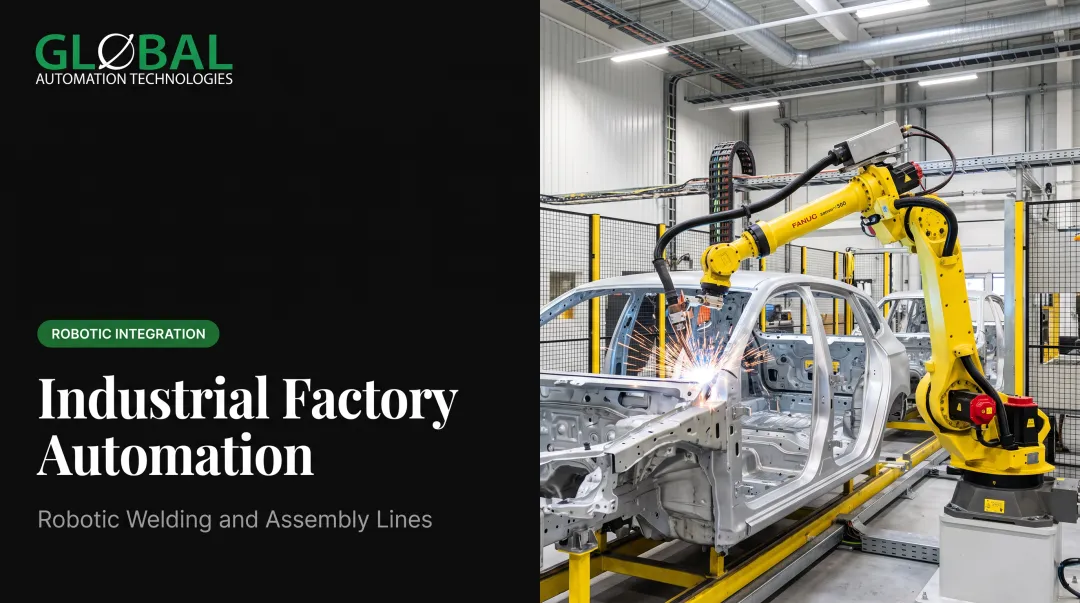
Welding and assembly cells run enclosed and at full robotic speed, without the pace restrictions required when humans share the workspace. A FANUC welding case at Trantech reported 30% higher throughput and up to 80% less rework. Great Lakes Stainless cut weld time on large assemblies from three hours to 15 minutes.
Palletizing and material handling cells reduce manual lifting injuries while scaling case-per-hour output. Zippy Ice doubled bagging speed from 10 to 20 bags per minute after adding a robotic palletizing cell, per FANUC's case documentation.

Key Benefits of Implementing Automation Cells
Automation cells deliver value across four fronts:
- Throughput and uptime: Safety barriers let robots run at full speed, unattended, around the clock, with no human-pace restrictions.
- Worker safety: Operators move out of hazardous zones, away from repetitive strain tasks and chemical exposure.
- Consistency: Reduced human variability means fewer defects and tighter tolerances shift after shift.
- Faster ROI: Machine tending cells commonly pay back in 12-18 months, driven by higher spindle utilization and fewer direct labor hours per part.

Payback windows vary by application: welding and painting ROI depends heavily on part mix and volume, but machine tending remains the most consistently documented fast-payback application.
What Does an Automation Cell Cost? (And What Drives the Price)
Cost varies widely based on robot payload, application complexity, and whether you're buying turnkey or custom. As a reference point, Automation World reports a complete robotic welding cell (robot, systems, and integration included) runs $120,000 to $500,000+. The range depends on whether you choose a traditional or collaborative robot platform.
Major cost drivers:
- Robot brand, model, and payload capacity
- Safety systems (fencing, light curtains, e-stops, scanners)
- Vision or inspection add-ons
- Integration engineering hours
- Installation and commissioning
Ongoing costs don't stop at installation. Budget for maintenance, programming updates, and the operators or engineers who'll actually run the cell day to day. A cell without a trained operator is an expensive paperweight.
Because pricing depends so heavily on part geometry, cycle time, and robot count, most integrators (GLOBAL included) quote through a feasibility study rather than a flat rate card. If you're budgeting early, treat the welding-cell range above as a rough proxy and expect painting, multi-robot, or vision-heavy cells to land higher.
How to Choose the Right Automation Cell Partner
Not all integrators deliver the same thing. Before signing a contract, check for these four things:
- True turnkey delivery: layout, design, build, programming, validation, installation, and training under one contract, not scattered across three vendors
- Cross-industry experience: an integrator who's solved welding problems in automotive can often apply the same fix to a heavy-equipment line
- Combined automation solutions, services and staffing: one call gets you both the robotic cell and the engineers who commission and run it, not a finished system and a manual
- AI-assisted simulation and predictive maintenance: ask how a vendor validates cell layouts before install and whether they monitor equipment health to catch failures early
That third point matters more than it sounds. A great robot with no one trained to run it just sits there. GLOBAL puts both under one roof: automation solutions, services and staffing. The same team can supply controls engineers, PLC programmers, and commissioning engineers who embed on your floor to launch and support the cell.
Frequently Asked Questions
How much does an automation robot cost?
Robot cost depends on payload, brand, and application, but the robot itself is only one piece of total cell cost. Safety systems, tooling, vision, and integration engineering typically add up to far more than the robot's price tag alone.
What is an automated manufacturing cell?
It's an enclosed workstation combining a robot, controller, and safety systems, built to autonomously complete a specific manufacturing task like welding, tending, or palletizing without constant human oversight.
What are two types of automation?
Fixed (hard) automation handles high-volume, repetitive tasks with limited flexibility. Flexible (programmable) automation, like robotic cells, adapts to different parts and processes through reprogramming rather than retooling.
What are the five levels of automation?
There's no single universal standard here; models vary by source. McKinsey, for example, describes a four-stage maturity model running from low maturity to fully optimized operations, rather than a fixed five-level scale.
How long does it take an automation cell to pay for itself?
Machine tending cells commonly pay back in 12-18 months, driven by higher spindle utilization and reduced labor hours per part. Payback for welding and painting cells varies more by application and part volume.
What safety measures are required around automation cells?
Physical barriers, light curtains, emergency stops, and presence-sensing scanners are standard. OSHA requires a risk assessment at every stage (design, integration, operation, and maintenance) to determine the right combination of safeguards.