
Introduction
Building a single aircraft fuselage can require thousands of precisely placed holes, each one within a tolerance measured in microns. A wing spar might weigh over 5,000 pounds and still need flawless composite layup, panel after panel.
Manual labor built aircraft this way for decades. Holding that level of consistency across a full production run, shift after shift, is a different challenge entirely.
That gap is exactly why aerospace manufacturers keep turning to robotics. The aerospace robotics market is projected to grow from $4.03 billion in 2026 to $11.75 billion by 2034, according to Fortune Business Insights. That 14.30% compound annual growth rate reflects how central automation has become to building aircraft and spacecraft.
This article covers where robots are already at work on aerospace lines, the robot types manufacturers rely on, the benefits driving adoption, real examples from Boeing, Airbus, SpaceX, and Lockheed Martin, and what to look for in an automation partner for aerospace-grade projects.
Key Takeaways
- Aerospace robotics is headed for an $11.75 billion market by 2034, up from roughly $4 billion in 2026
- Drilling, painting, welding, composite layup, and inspection dominate robotic work on aerospace lines
- Robots deliver micron-level precision, remove workers from hazardous tasks, and help offset a shrinking skilled-trades workforce
- Boeing, Airbus, SpaceX, and Lockheed Martin all run robots in production—wins and setbacks worth studying
- An integrator with engineering depth and staffing support cuts long-term risk on aerospace-grade projects
Key Applications of Robots in the Aerospace Industry
Aerospace robots are almost always high-precision articulated arms, built for tasks that are repetitive, hazardous, or beyond what a human hand can reliably repeat thousands of times a shift. Five application areas dominate the modern aerospace line.
Drilling and Fastening
Aircraft skins need thousands of holes drilled to tight tolerances before fasteners ever go in. Robots equipped with vision systems locate each hole location, drill it, and often verify the result before moving to the next one. Electroimpact's mobile drilling systems, for example, hold hole-diameter tolerances of ±25 microns and drill at roughly 11 holes per minute on fuselage stack-ups.
That said, automation isn't automatically faster. Airbus ran into slow, unoptimized automated wing drilling on the A350-900 in 2012, a reminder that software tuning matters as much as the hardware itself.
Painting, Sealing, and Finishing
Painting large airframes means working in booths full of isocyanates, hexavalent chromium, and solvent fumes, exposures that NIOSH has flagged as a real occupational hazard in aircraft paint shops. Robotic painting cells with expansive work envelopes and secondary encoders remove people from that environment entirely.
The financial case is strong too. Vendor data reported by Aviation Week shows one large aircraft-painting robot cutting labor cost by up to 80% and paint use by as much as 30%. GLOBAL's own FANUC-based painting systems hold film build within specification shift after shift, which translates directly into less overspray and less wasted material on aerospace-grade coating runs.
Welding and Material Joining
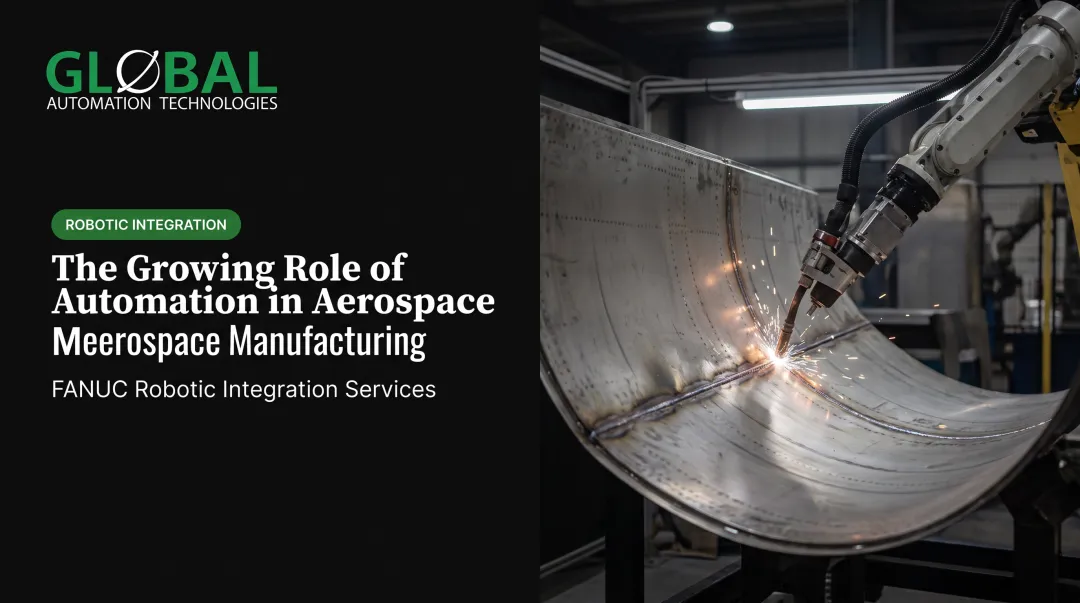
Titanium and nickel alloys are unforgiving materials to weld by hand. Robotic welding holds a consistent arc, travel speed, and heat input that produces stronger, more repeatable joins than manual work allows. That consistency matters more now than ever: the American Welding Society projects 320,500 new welding professionals will be needed in the U.S. by 2029, with over 157,000 current welders approaching retirement.
That same arc-control discipline transfers across industries. A welding approach proven on an automotive line can stabilize an aerospace cell just as effectively, because the underlying physics does not change by sector.
Composite Layup and Material Removal
Automated fiber placement (AFP) machines lay composite tape across fuselage sections and wing skins that can weigh over 5,000 pounds, at speeds no manual crew can match. Robotic milling and trimming then remove excess material, shaving weight without compromising structural integrity.
These systems now handle primary structure work—wing spars over 100 feet long, wide-body fuselage sections, and nacelles—that used to require far more manual labor per part.
Assembly, Inspection, and Machine Tending
Three tasks round out the production floor:
- Assembly — repetitive fastening and part-mating that support lean flow
- Non-destructive testing — ultrasonic C-scan and vision to catch cracks and delamination early
- CNC machine tending — loading and unloading so spindles keep running beyond a single shift, between scheduled maintenance windows

Types of Robots Used in Aerospace Manufacturing
Most aerospace lines run on heavy-payload six-axis arms from manufacturers like FANUC and KUKA. These handle drilling, painting, and material handling on large airframe components where reach and payload matter as much as precision. Collaborative robots, or cobots, are increasingly used for tasks like coating and fastening where they work alongside human technicians without full safety cages.
FANUC’s vision-guided systems and vibration control are built for the tight tolerances fuselage and wing work demand. GLOBAL, a Level 5 FANUC Authorized System Integrator, uses the platform across its aerospace-adjacent projects.
Robot selection ultimately comes down to the part:
| Robot Type | Typical Payload | Best Suited For |
|---|---|---|
| FANUC M-810/190-20B | 190 kg | Aerospace heavy machining, laser work |
| KUKA KR 1000 titan | Up to 1,300 kg | Large airframe handling, heavy tooling |
| Cobots (various) | Typically under 35 kg | Coating, fastening near human workers |
A robot sized for a small electronic bracket assembly won't have the reach or payload to handle a wing skin, so work envelope and payload requirements drive most integration decisions before brand even enters the conversation.
Benefits of Robots in Aerospace Manufacturing
The case for aerospace automation comes down to four measurable advantages.
Productivity: Robots run around the clock, limited by maintenance windows—not shift changes or fatigue.
GLOBAL's machine tending cells, for instance, typically pay for themselves in 12 to 18 months through more parts per shift and fewer direct labor hours.
Precision and quality assurance: Micrometer-level repeatability with built-in vision and AI inspection supports a near zero-defect process. That standard is non-negotiable on load-bearing aircraft structures.
Worker safety: Automation pulls people out of the highest-risk jobs:
- Chemical exposure in paint booths
- Heavy lifting on large airframe sections
- Confined-space work inside fuselage cavities
- Working at height on wings and tail sections
That list alone explains why safety teams push for automation as much as production managers do.
Cost savings and flexibility: Automation eases the skilled-labor shortage by cutting training time and clearing production bottlenecks. Many cells also switch between sanding, washing, and polishing without major retooling when volumes shift across aerospace programs.
Real-World Examples: Aerospace Robotics in Action
Theory is one thing. Production floors tell the real story, wins and setbacks included.
Boeing's Fuselage Automated Upright Build (FAUB) system drilled and installed roughly 50,000 fasteners on 777 fuselage sections. Boeing phased it out in 2019 after reliability issues, a useful reminder that even major aerospace primes hit real integration challenges with automation.
Airbus ran into a different kind of friction on the A350 XWB. Drilling robots for wing and composite fuselage assembly launched slower than expected because of software tuning issues, a snag the team worked through over time.
SpaceX points the same direction on spacecraft. Its job postings list automated and robotic welding roles supporting Starship production, evidence that robotic joining is showing up even in fast-moving launch programs.
Lockheed Martin applies robotics to coatings instead of fasteners or welds. A robotic paint system lays down the F-35's low-observable coating, precision work that is hard to match by hand at scale.
In all four programs, manual, labor-intensive steps are giving way to automated, repeatable production, commercial and defense alike.

Choosing the Right Automation Partner for Aerospace-Grade Robotics
Aerospace projects don't just need a robot bolted to the floor. They need an integrator who can deliver the system and the engineers who program, validate, and maintain it for years after commissioning. That second part gets overlooked far too often.
GLOBAL Automation Technologies built its business model around exactly that gap. The company pairs automation solutions and engineering services with technical staffing under one roof. Manufacturers get the robotic cell and the controls engineers from one point of contact—no juggling separate vendors who never talk to each other.
Capabilities that transfer well to aerospace work:
- AI-assisted simulation models and tests robot programs before code hits the floor, cutting programming time from weeks to days
- AI-driven predictive maintenance flags equipment issues early, protecting aerospace schedules from unplanned downtime
- Cross-industry engineering applies a welding fix proven on an automotive line to an aerospace line without starting from scratch
As a Level 5 FANUC Authorized System Integrator with a proven global base of robotic deployments, GLOBAL brings automotive and heavy-industry techniques into aerospace-grade projects. Tolerances are tighter there, and the stakes are higher.
Frequently Asked Questions
What is an aerospace robot?
An aerospace robot is a specialized industrial robot, typically an articulated arm, engineered to meet the precision, scale, and hazard demands unique to aircraft and spacecraft manufacturing. It differs from standard industrial robots mainly in payload, reach, and tolerance requirements.
What are the main benefits of using robots in aerospace manufacturing?
The main benefits are precision, worker safety, productivity, and cost savings. Robots hold micrometer-level tolerances, remove people from hazardous tasks, run nearly continuously, and reduce labor costs on high-volume repetitive work.
Which robot brands are commonly used in aerospace applications?
FANUC and KUKA are the two most common brands in aerospace manufacturing, known for high-payload six-axis arms suited to drilling, painting, and large airframe handling. Both offer vision-guided systems built for tight aerospace tolerances.
Are collaborative robots (cobots) used in aerospace manufacturing?
Yes, cobots are increasingly used for coating and fastening tasks alongside human workers, especially where flexibility matters more than raw payload. They work without full safety cages, which suits smaller, more variable tasks.
How much does it cost to implement robotic automation in aerospace manufacturing?
Costs vary by payload, tooling, and application complexity—a drilling cell and a painting cell differ widely in scope. Many systems pay for themselves in 12 to 18 months through labor and material savings, especially machine tending cells.
What does the future of robotics in the aerospace industry look like?
Expect more AI-driven visual inspection that catches defects earlier in production, expanded predictive maintenance on factory equipment, and continued growth in both manufacturing-floor automation and space-based robotics.