
Get the panel design wrong, and the consequences show up fast: unplanned downtime, safety incidents, and integration delays that push start-of-production dates back by weeks. Manufacturing downtime isn't cheap — automotive plants alone have reported losses exceeding $2 million per hour of lost production, according to a 2023 Siemens report.
This guide breaks down what automation control panels actually are, the components inside them, the different panel types used across factory floors, and how to choose a partner who can build one that won't leave you troubleshooting at 2 a.m.
Key Takeaways
- Control panels centralize PLCs, HMIs, and safety devices so robots, conveyors, and machinery run as one system
- Strong panel design shortens robot cycle times, speeds commissioning, and protects plant-floor safety
- Match the job to one of four panel types: PLC/industrial, motor control, robotic control, or hazardous-area
- NEMA/IP ratings and UL 508A compliance decide whether a panel survives its environment—or fails early
- Turnkey integrators deliver panel design with programming, commissioning, and long-term support in one scope
What Is an Automation Control Panel?
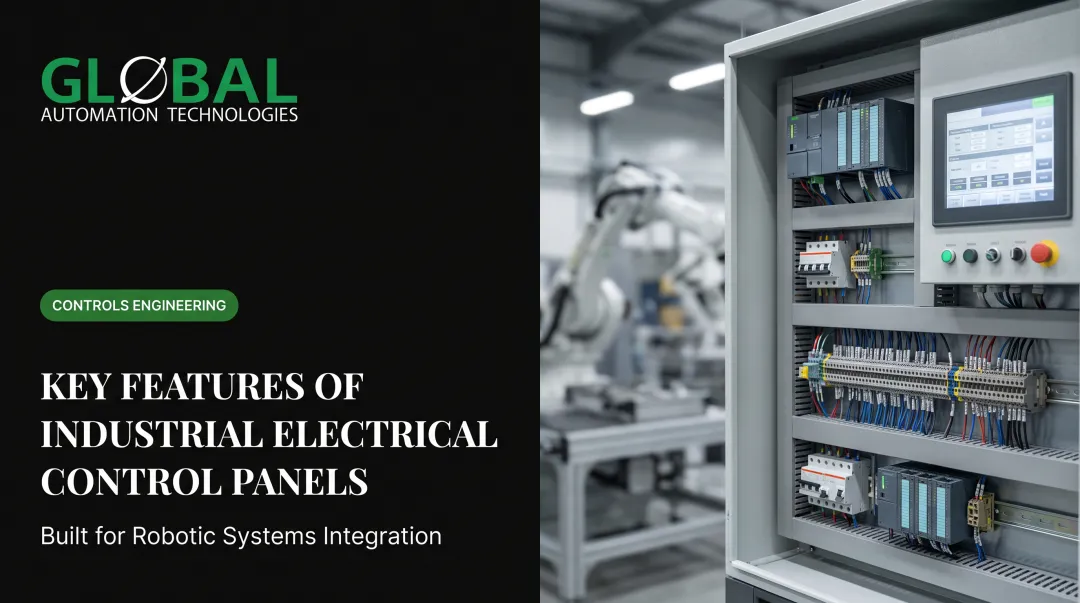
An automation control panel is a centralized enclosure housing the electrical and control components that govern machinery, robots, and production equipment. Think of it as mission control for a work cell: it receives data from sensors and inputs, processes that data through logic controllers, and sends commands to actuators, motors, and robotic systems.
The National Electrical Code, as cited by UL, defines an industrial control panel as an assembly of at least two power-circuit or control-circuit components. But a true automation panel goes further than that baseline definition.
Automation Panel vs. Basic Electrical Panel
A basic electrical panelboard simply divides incoming power into branch circuits. It doesn't think, adjust, or respond.
An automation control panel does all three, because it includes:
- Programmable logic controller (PLC) that executes decision-making logic
- HMI for operator visualization and control
- I/O modules that translate real-world signals into actionable data
That programmable intelligence is what separates automated operation from manual, breaker-flipping electrical distribution.
These panels are critical plant infrastructure. They directly affect uptime, safety, and product quality. You'll find them running:
- Automotive assembly lines
- Machine tending cells
- Material handling systems
- Robotic welding and paint booths
- Dispensing and sealing operations
Anywhere a machine must decide faster than a human can react, an automation control panel is doing the work.
Key Components of an Automation Control Panel
Every panel, regardless of application, is built from three functional groups: control and communication hardware, power and protection devices, and physical infrastructure.
Control & Communication Components
The PLC is the core decision-making hardware. It continuously scans inputs, processes programmed logic, and controls outputs in a repeating cycle — this is the same input-scan-process-output loop that runs every automated line on the floor.
The HMI gives operators a window into that process. Through it, they monitor system status, adjust parameters, and pull diagnostics without opening the panel door.
I/O modules handle the translation work between the physical world and the PLC:
- Convert sensor signals (proximity switches, photo eyes, pressure sensors) into data the PLC can read
- Convert PLC commands back into signals that drive actuators, valves, and motors
- Can be local to the controller, distributed across the cell, or hazardous-location rated
Power & Protection Components
Protection hardware keeps a single fault from taking down an entire production line:
- Circuit breakers and fuses provide branch-circuit overcurrent protection against overloads and short circuits
- Relays and contactors let small control signals safely switch large motor loads on and off
- Transformers step voltage up or down so every component gets the power it's rated for
Motor overload relays protect against damaging heat buildup, but they can't clear a short circuit or ground fault on their own. Breakers and fuses handle that job.
Physical Infrastructure
Terminal blocks organize wiring into a structured hub. That layout matters when a technician is tracing a fault at 11 p.m. during a shift change — clean terminals beat a rat's nest of spliced wire every time.
The cabinet enclosure protects everything inside from dust, heat, moisture, and vibration. Enclosure selection isn't cosmetic — it's governed by NEMA and IP ratings:
| Rating | Protection Level |
|---|---|
| NEMA 1 | Indoor use, protects against falling dirt |
| NEMA 4 | Indoor/outdoor, windblown dust, hose-directed water |
| NEMA 4X | NEMA 4 protection plus corrosion resistance |
| IP54 | Dust-protected, splashing water from any direction |
| IP65 | Dust-tight, water jets from any direction |
Source: NEMA enclosure type standards
A washdown-heavy dispensing line and a dry machine tending cell have completely different enclosure needs. Specifying the wrong rating either wastes money on unnecessary protection or leaves components exposed to conditions they weren't built for.

Types of Automation Control Panels Used in Factory Automation
Panel selection isn't one-size-fits-all. The right type depends on the process, the environment, and how fast parts need to move through the cell.
PLC/Industrial Automation Panels
These combine a programmable controller, I/O, and usually an HMI to run programmed operations across a production line. You'll find them in welding, painting, dispensing, and assembly cells where the process follows repeatable logic.
Motor Control Panels
Built around motor starters, overload relays, and variable frequency drives (VFDs), these panels manage speed, torque, and protection for electric motors. VFDs in particular allow precise control over AC motor speed, useful for conveyor lines that need to match robot cycle times.
Robotic Control Panels
These integrate the robot controller, safety interlocks, and I/O specifically for coordinating robotic cells. In a machine tending application, for example, the panel synchronizes the robot with the CNC machine's door, part staging, and safety circuit in real time.
Safety & Hazardous Area Panels
Engineered for explosion-proof or hazardous environments. Think paint booths handling flammable solvents or chemical processing lines. These panels typically fall under UL 698A or UL 1203 requirements, which govern equipment for hazardous classified locations. A standard NEMA 4X cabinet is corrosion-resistant, but that rating alone doesn't make it explosion-proof.
Choosing between these types comes down to one question: what is the panel actually controlling, and under what conditions?
How Automation Control Panels Power Robotic Factory Automation
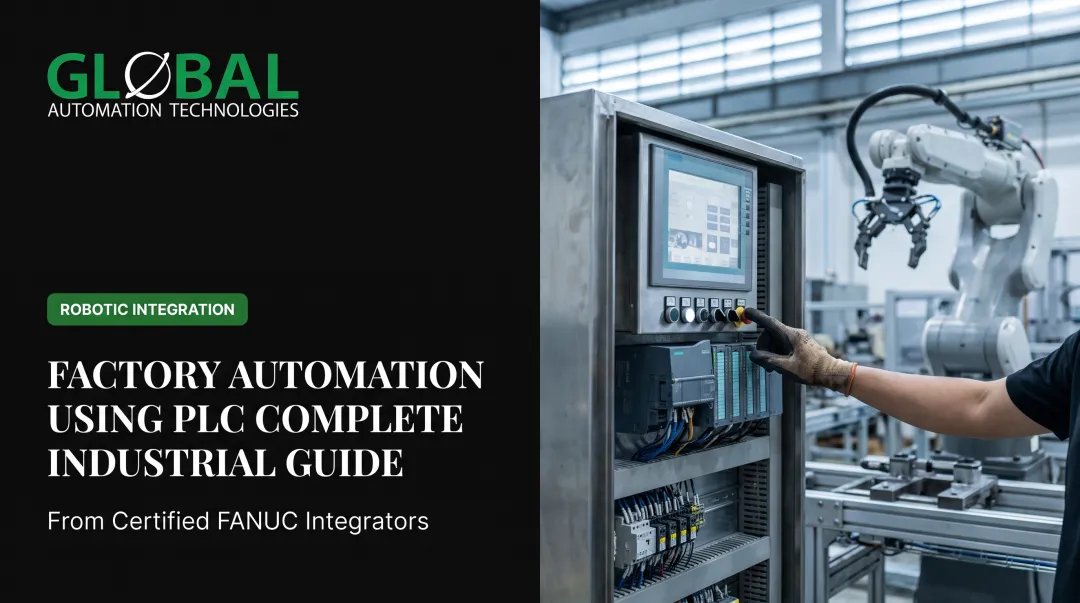
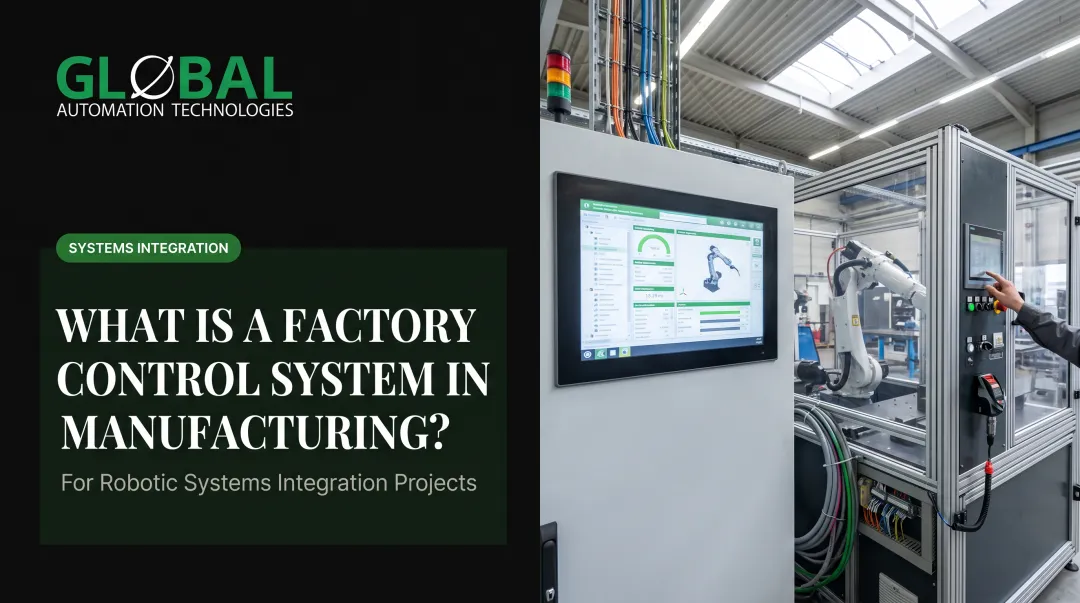
In a robotic work cell, the control panel is the conductor keeping every instrument in the same tempo. It synchronizes the robot controller, safety systems, and peripheral equipment (conveyors, sensors, end-of-arm tooling) into one coordinated system that behaves like a single machine.
Panel design has a direct, measurable effect on:
- Cycle times: poorly sequenced I/O adds unnecessary delay between robot moves
- Uptime: clean fault handling means faster recovery when something trips
- Commissioning speed: how quickly a system can be validated and handed off to production
Those outcomes depend on how tightly the panel ties robots to the rest of the cell.
At GLOBAL Automation Technologies, control panel design is built into turnkey delivery of every robotic system—spanning layout, build, programming, and commissioning. Controls engineers own the full PLC link between robots and conveyors:
- Speed matching across the line
- Trigger signals for handoffs and peripherals
- E-stop coordination across the cell
The line runs as one system, not a set of neighboring machines.
GLOBAL also uses AI-assisted simulation to model and test robot programs before code runs on the plant floor. That approach has cut programming and startup time from weeks to days on automotive, heavy equipment, and general industrial projects.
As a Level 5 FANUC Authorized System Integrator, GLOBAL tunes panel and controls architecture to how FANUC controllers, safety I/O, and vision systems like iRVision communicate. Protocols are designed in from day one.
Benefits of a Well-Designed Automation Control Panel
A panel engineered correctly the first time pays dividends long after commissioning ends. Plants usually see the return in three places:
- Isolate faults in minutes with centralized control, clear HMI diagnostics, and labeled I/O
- Keep workers out of hazardous zones through protected enclosures and remote or automated operation
- Cut long-term cost exposure by preventing unplanned stops and the repair, quality, and safety costs that follow
Downtime is never cheap. Siemens reported that a lost production hour can range from $39,000 in consumer goods manufacturing to more than $2 million in automotive. Predictive maintenance and condition-based monitoring built into the panel's diagnostics from day one give plant teams time to act before a failure becomes a line stop.
Choosing the Right Partner for Your Automation Control Panel Project
Building panels and delivering a working automation system are different jobs. Use these checks to tell which partner you're hiring.
Turnkey Capability vs. Panel Fabrication Alone
Ask whether the provider handles the full lifecycle:
- Design and simulation — validating cycle times and process parameters before building anything
- Panel build and controls programming — writing the actual PLC and robot code, not just wiring to a spec someone else wrote
- Installation and commissioning — proving the system out in your live production environment
- Training and ongoing support — equipping your team to run it after launch

A panel shop builds to a specification. A turnkey integrator creates the specification, builds it, and stands behind it.
Platform and Standards Experience
Confirm hands-on experience with the robots, PLC platforms, and safety standards your industry requires—automotive, heavy equipment, aerospace, and similar environments. A safety architecture that works in an automotive body shop will not automatically transfer to a hazardous chemical dispensing line.
Why GLOBAL Pairs Automation Solutions, Services and Technical Staffing
Many integrators deliver a finished panel and step away. GLOBAL Automation Technologies pairs its automation solutions, services and technical staffing that places controls engineers, PLC programmers, and robotics technicians in your facility on contract, contract-to-hire, or direct-hire terms.
When the commissioned system needs a controls engineer six months later, you are not starting a search from scratch. You call the same partner that designed the architecture.
Frequently Asked Questions
What is an automation control panel?
An automation control panel is the centralized hub of PLCs, HMIs, and control hardware that governs automated machinery and robotic systems on a factory floor. It processes sensor data and issues commands to motors, actuators, and robots.
What are the three types of control systems in automation?
- Open-loop: Adjust outputs without measured feedback
- Closed-loop: Compare a measured signal to a target and self-correct
- Distributed: Spread control functions plant-wide instead of one controller
What are examples of automation control panels?
Common examples include PLC/industrial automation panels, motor control panels, VFD panels, and robotic control panels. Each governs a different piece of the manufacturing process, from motor speed to robot-to-conveyor coordination.
Where can I find an automation control panel?
You can source panels from dedicated panel shops or through full-service automation integrators. GLOBAL Automation Technologies builds panels as part of complete robotic system delivery, so you get a validated, production-ready cell rather than a standalone box.
How much does a factory automation control panel cost?
Cost varies widely based on complexity, component count, enclosure rating, and whether the panel stands alone or is part of a larger robotic cell. Request a project-specific quote rather than relying on a general estimate.
What certifications should an industrial control panel meet?
Look for UL 508A compliance, which covers industrial control panels for general use up to 1,000 volts. Enclosure ratings, NEMA for North American specs and IP codes internationally, should also match your facility's environmental conditions.