
The machines on a plant floor determine far more than just output. They set the pace of production, the consistency of part quality, the safety of the workforce, and ultimately the cost per vehicle that rolls off the line. Get the equipment mix wrong, and everything downstream suffers.
This article breaks down the 10 essential machines every automotive plant relies on, why each one matters, and how manufacturers decide which combination fits their production line best.
Key Takeaways
- Automotive plants depend on robotics, CNC machining, forming, and inspection equipment working in sync, not isolation
- Each machine category solves a distinct problem: speed, precision, safety, or consistency
- Automotive equipment market set to grow from $31.99B in 2025 to $41.70B by 2030 (5.4% CAGR, MarketsandMarkets)
- Right equipment choice depends on volume, precision needs, and budget—not the most advanced option
What Is Automotive Manufacturing Equipment and Why It Matters
Automotive manufacturing equipment covers the machinery, robotics, and tooling used to turn raw steel, aluminum, and plastic into vehicle components and finished vehicles. This isn't confined to one corner of the plant.
It spans body shops, paint shops, powertrain and machining lines, and final assembly, each stage relying on machines built for that job.
Toyota notes that a car is made up of more than 30,000 parts. Coordinating that many components at production speed simply isn't possible with manual labor alone.
Without the right equipment in place, plants run into predictable problems:
- Inconsistent part quality from process variation between shifts or operators
- Unplanned downtime when machines aren't matched to the workload
- Higher scrap rates from poor tolerance control
- Increased safety risk for workers handling repetitive, heavy, or hazardous tasks manually

Spray painting, heavy lifting, and repetitive welding carry real physical risk. Much of this equipment exists to pull workers out of those hazards without slowing production.
The 10 Essential Machines Used in Automotive Manufacturing
No single machine builds a car. Each one below plays a specific, non-interchangeable role somewhere on the line, and most modern plants run all ten simultaneously across different stations.
Industrial Robots for Welding, Assembly, and Material Handling
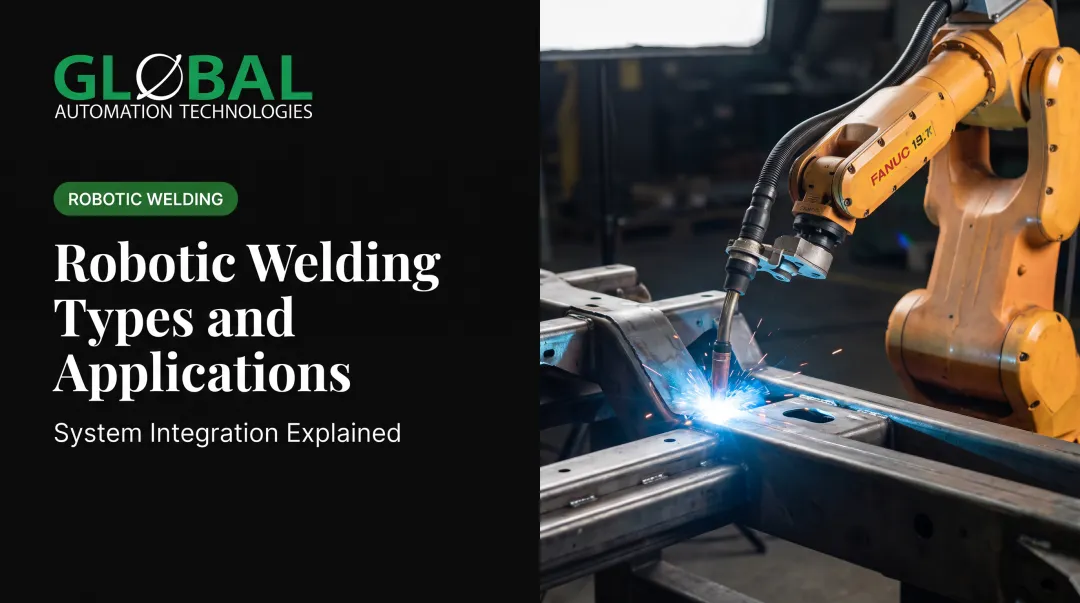
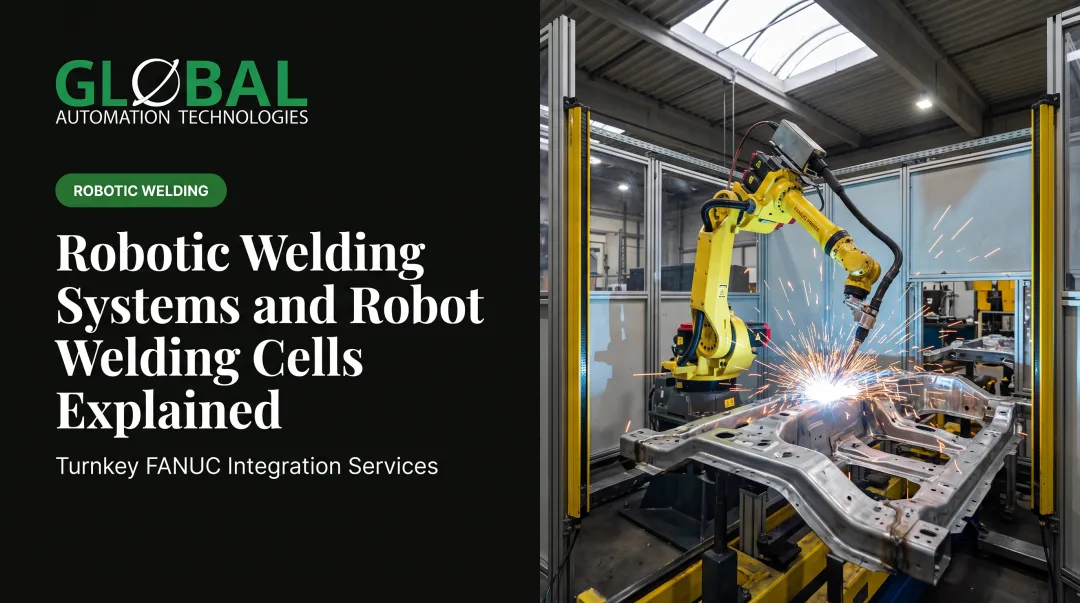
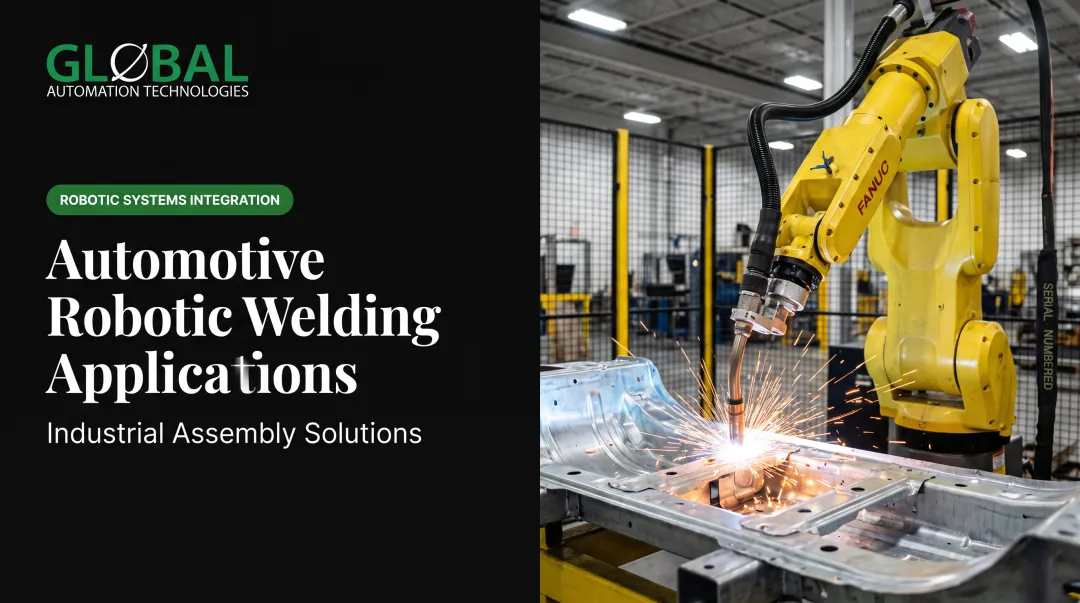
Robotic arms handle spot welding, part transfer, and sub-assembly work with speed and repeatability no manual crew can match over a full shift. A single automotive line typically runs multiple robot types side by side: welding robots at the body shop, handling robots moving parts between stations, and bin-picking robots pulling components from bulk storage.
Integrators like GLOBAL Automation Technologies have built a proven global base of robotic deployments, primarily on FANUC platforms built for high-precision, high-volume environments. That footprint spans welding stations, part transfer, bin picking, and nearly every other physical touchpoint on a modern line.
CNC Machining Centers and Lathes
CNC (Computer Numerical Control) machines cut, drill, mill, and turn metal to exact tolerances under programmed instruction. Engine blocks, transmission housings, and suspension components all pass through CNC processes before assembly.
What sets CNC apart is runtime that stretches well beyond a single shift. Paired with robotic machine tending, these machines extend spindle utilization well beyond what a manually loaded machine can achieve. Plants that add tending automation to their CNC lines typically see payback in 12 to 18 months, driven by more parts per shift and fewer direct labor hours spent on repetitive loading.
Stamping Presses
Stamping presses shape flat sheet metal into body panels, structural components, and reinforcements using high-tonnage force. Doors, hoods, fenders, and floor pans all start as flat blanks before a press gives them shape.
Manufacturers choose stamping lines specifically for throughput. On standardized, high-volume parts, a press line can outproduce nearly any alternative forming method, which is why stamping still handles the bulk of body-panel production decades after its introduction.
Robotic Painting and Coating Systems
Robotic painting systems apply consistent coatings at high speed while keeping workers out of spray booths entirely. That matters because overspray exposes painters to isocyanates, VOCs, and particulates that manual booths struggle to fully control.
Modern robotic paint systems, including those integrated by GLOBAL, hold film build within specification shift after shift. That repeatability:
- Reduces overspray and material waste
- Lowers cost per part through better transfer efficiency
- Eliminates the variability that comes with a human hand holding the gun
Conveyor Systems and Material Handling Equipment
Overhead and floor conveyors move parts, sub-assemblies, and full vehicles between workstations continuously, keeping the entire plant moving at a fixed takt time. Without this connective layer, every other machine on this list would be an isolated island.
Material handling automation also takes manual lifting out of the equation for many repetitive transfer tasks. NIOSH has long recommended mechanical handling systems like conveyors, slides, and hoists specifically because manual handling contributes so heavily to workplace musculoskeletal injuries.
Injection Molding Machines
Injection molding machines melt plastic and inject it into precision molds to produce bumpers, trim pieces, dashboards, and interior panels. Once a mold is qualified, these machines crank out identical parts with minimal post-processing required.
Their real advantage is complexity at volume. A dashboard with dozens of integrated features would be nearly impossible to produce economically any other way, which is why injection molding dominates interior and exterior trim production across nearly every OEM.
Laser Cutting Machines
Laser cutters use focused, high-powered beams to slice sheet metal into precise shapes for body and structural parts. Compared to mechanical cutting dies, lasers cut complex geometries faster and waste less material along the way.
Laser blanking also skips the die-preparation and reconditioning that mechanical stamping requires. That makes it a strong fit for lower-volume runs, model changeovers, and parts with intricate contours that don't justify a dedicated die.
Welding Jigs and Fixtures
Jigs and fixtures hold body panels and components in precise alignment while robotic or manual welding takes place. It sounds like a supporting role, but fixture accuracy directly determines the dimensional consistency of every body-in-white shell produced on that line.
GLOBAL, which holds Level 5 status in FANUC’s Authorized System Integrator program, builds custom fixtures as part of its robotic welding integration work. Tooling is engineered around specific part geometries, weld requirements, and production rates — not treated as a client afterthought. Get the fixture wrong, and no amount of robot precision fixes it downstream.
Automated Inspection and Vision Systems
Vision-based inspection systems check dimensional accuracy, surface defects, and weld or bead quality as parts move down the line. This replaces manual spot-checks with continuous, camera-driven verification at production speed.
On dispensing processes specifically, real-time bead and flow monitoring verifies bead width, placement, and continuity as material is applied, catching thin beads or missed paths before the part ever reaches the next station. That inline catch prevents scrap from propagating further down the line and cuts the cost of downstream rework.
Robotic Machine Tending Cells
Machine tending cells automatically load and unload parts into CNC machines, enabling extended, lights-out operation between scheduled maintenance windows and pushing spindle utilization higher than manual loading ever could. This is the same technology referenced earlier in the CNC section, but it deserves its own line because of how much engineering goes into a well-built cell.
This category increasingly pairs with AI-assisted simulation tools, which model and optimize robot paths before a cell ever touches the shop floor. That shift is cutting robot programming time from weeks down to days for many integrators, GLOBAL included.
How Automation and Robotics Are Transforming These Machines
Every machine above is getting smarter, and two shifts in particular are driving that change.
AI-assisted simulation now lets engineers optimize robot paths and cycle times virtually, long before installation day. Rather than debugging a robot cell live on the floor while production waits, teams model the entire process first.
They catch interference issues, cycle bottlenecks, and reach problems on a screen instead of the shop floor. That means faster startups and fewer surprises once the cell goes live.
AI-driven predictive maintenance is the second major shift. Health assessments built into modern robotic systems flag wear or failure risk before it turns into unplanned downtime.
Equipment fails eventually, but it doesn't have to fail without warning. Catching a degrading component during a scheduled check beats discovering it mid-shift.
Robotic adoption in automotive shows how central this shift has become. The International Federation of Robotics reported roughly 1 million operational robots working in car factories worldwide as of its 2023 report, and that figure has only grown.
A few practical outcomes of this shift:
- Robot programming that once took weeks now often takes days
- Maintenance teams shift from reactive fixes to scheduled interventions
- Engineers optimize cycle times before a single physical part is produced
None of this replaces skilled engineers. It changes what they spend their time doing, moving effort from reactive troubleshooting toward proactive system design.
How to Choose the Right Machines for Your Production Line
There isn't a universal answer here. The right mix of machines depends on your production volume, part complexity, available budget, and how much flexibility future model changes will demand.
Key factors to weigh:
- Production speed needs — throughput targets should dictate press tonnage, cycle times, and robot count, not the other way around
- Precision and tolerance requirements — powertrain components demand tighter control than interior trim
- Integration with existing line systems — new equipment has to talk to your current PLCs, conveyors, and controls architecture
- Workforce skill availability — advanced automation is only as good as the team that can program, run, and maintain it
- Total cost of ownership — upfront price rarely tells the whole story once maintenance and downtime are factored in

Common mistakes worth avoiding:
- Over-investing in advanced automation that your production volume doesn't actually justify
- Underestimating integration and training costs when budgeting a project
- Choosing equipment based on familiarity with a brand rather than fit for the application
Staffing belongs in the same decision. More manufacturers want one partner for both the system and the engineers who run it, instead of buying equipment from one vendor and hiring talent through another.
GLOBAL addresses that directly: one call gets you the robotic system and the controls, mechanical, or project management engineers who know it inside out, through full integration or standalone technical staffing.
Conclusion
No single machine runs an automotive plant. Robots, CNC systems, stamping presses, painting cells, and inspection equipment each solve a distinct production problem. Pull any one of them out, and the chain breaks.
Knowing what each machine does, and where it fits on the line, leads to smarter equipment decisions. Manufacturers evaluating new automation should look for turnkey partners that cover layout, design, build, programming, and ongoing support.
Piecing equipment and talent together from separate vendors adds handoffs and delay. A partner that delivers both the robotic system and the engineers to run it keeps the project under one roof from day one.
Frequently Asked Questions
What equipment is used in automotive manufacturing?
Automotive plants rely on industrial robots, CNC machines, stamping presses, injection molding machines, conveyors, and inspection systems. These work together across body, paint, and assembly stages rather than in isolation.
What is CNC used for in automotive manufacturing?
CNC stands for Computer Numerical Control, a computer-guided machining process used to cut, drill, and turn metal parts to precise tolerances. It's most commonly used for engine and transmission components.
What is the most important machine in a car manufacturing plant?
There isn't one "most important" machine. Robots and CNC systems are foundational, but stamping presses, painting systems, and inspection equipment are equally critical depending on the production stage.
How much does automotive manufacturing equipment typically cost?
Costs vary widely by machine type, scale, and complexity. ROI is often a better gauge than sticker price alone—machine tending cells, for example, often pay back in 12 to 18 months.
What is a robotic machine tending cell?
It's a robotic system that automatically loads and unloads parts into CNC machines. That setup supports longer runs beyond a single shift and higher machine utilization than manual loading.
How is automation changing automotive manufacturing?
AI-assisted simulation now lets engineers optimize robot programming before installation, cutting setup time significantly. Predictive maintenance tools also flag equipment issues early, before they cause unplanned downtime.