
That gap between "coated" and "correctly coated" comes down to one number most people treat as an afterthought: dry film thickness (DFT). Get it right, and you get corrosion resistance, impact strength, and a finish that holds its color for a decade. Get it wrong, and you get brittleness, early rust, or a warranty claim.
This guide covers standard thickness ranges, how to measure them, the standards that govern them (ASTM, ISO, Qualicoat), and what actually happens when a part comes out of the oven too thin or too thick.
TL;DR
- Single-coat DFT is typically 1.0–4.0 mils (25–100 µm)—always confirm on the powder’s TDS
- Too thick: brittleness, cracking, porosity; too thin: weak corrosion resistance and hiding
- Measure thickness after cure with magnetic, eddy current, or ultrasonic gauges
- ASTM D7091, ISO 2178/12944, and Qualicoat defer limits to the product spec or coating class
- Consistent film build depends on gun voltage, powder flow, spray distance, and part geometry
What Powder Coating Thickness Represents
Powder coating thickness refers to the cured dry film thickness (DFT), measured in mils or microns. The conversion is exact: 1 mil = 25.4 microns, since a mil is defined as one-thousandth of an inch.
Here's the part that trips people up: thickness isn't a fixed constant. It's a derived outcome, shaped by:
- The powder's chemistry and design (each manufacturer sets its own target range)
- How the powder is applied
- The geometry and material of the part being coated
Per ASTM D7091, there's no single "correct" DFT for all powder coatings. The standard requires the governing product or project specification to set minimum and maximum thickness. It doesn't hand you a universal number.
That's why one PPG thermoset powder is tested at 1.0–2.0 mils, while an Axalta fluidized-bed thermoplastic calls for 250–400+ microns. Same category, wildly different targets.
Factors That Influence Thickness in Real-World Operation
Spec sheets say one thing. Shop floors often deliver another. The gap comes from a handful of variables:
- Application method: Electrostatic spray builds film differently than fluidized bed dipping, which typically produces heavier, abrasion-resistant coatings
- Particle size: The ideal range is roughly 12–80 microns. Larger particles fall out of the spray unevenly; smaller ones clog equipment and cause orange peel
- Substrate temperature and geometry: Parts heated above the powder's melt point during cure tend to build excess film
- Operator technique: Voltage, flow rate, and gun distance drive most shift-to-shift variability
- Faraday cage effect: Powder is less attracted to deep recesses and inside corners, leaving those areas thin even when flat surfaces look perfect
That last point matters more than most people expect. A part can pass a spot-check on its face and still have dangerously thin coverage tucked inside a channel or bracket fold.
Range of Powder Coating Thickness and Standards
There's no single "correct" thickness for powder coating. The right number depends on the powder product, the application type, the environment, and whether you're running a single coat or a two-coat system.
Nominal Operating Ranges by System
| System Type | Typical Range | Source Example |
|---|---|---|
| General-purpose single coat | 1.0–4.0 mils (25–100 microns) | Manufacturer TDS-dependent |
| Architectural aluminum (Qualicoat) | 60 microns min. (~2.4 mils), class 1/1.5/2 | Qualicoat 2025 Specifications |
| Two-coat powder system (class 1/2) | 110 microns min. (~4.3 mils) | Qualicoat 2025 Specifications |
| Heavy-duty fluidized bed | 250–400+ microns (~10–16 mils) | Axalta thermoplastic TDS |

Where Failure Risk Rises
Every powder has its own ceiling and floor, but the pattern holds across products:
- Too thick: curing stress builds, film porosity rises (around 7–8 mils on one high-temp PPG product), and impact/flexibility resistance drops
- Too thin: hiding power weakens, corrosion protection thins, and color or corrosion tests start failing
Don't copy a thickness number from one product's TDS onto another. Check the technical data sheet for the specific powder, and cross-reference the coating class when the job falls under Qualicoat, AAMA 2605, or ISO 12944.
How Powder Coating Thickness Is Measured and Controlled
Thickness is a quality checkpoint, verified during and after production.
Measurement Methods
The right gauge depends entirely on the substrate:
- Magnetic induction gauges — for non-magnetic coatings on ferrous substrates like steel, per ISO 2178
- Eddy current gauges — for non-ferrous substrates like aluminum, per ISO 2360
- Ultrasonic pulse-echo — for non-metallic substrates (wood, plastic, MDF) or multi-layer systems, capable of reading anywhere from 8 microns to 7.6mm

Pre-cure readings can predict final thickness, but they require correlation factors specific to the powder. Post-cure DFT remains the industry reference point for acceptance testing.
Application Control Parameters
Three levers govern deposited thickness:
- Gun voltage — affects how strongly powder is attracted to the part
- Powder flow rate — controls volume of material delivered
- Gun distance and travel speed — affects buildup consistency across a surface
A repeatable test protocol helps catch problems early. Coat a test panel, measure multiple points (Qualicoat calls for at least five distinct areas per surface), and track min, max, and average. Pay close attention to edges and recesses, where the Faraday cage effect hits hardest.
Manual spray still introduces shift-to-shift variability. Two operators running the same gun on the same part can produce different film builds depending on hand speed, distance, and fatigue late in a shift.
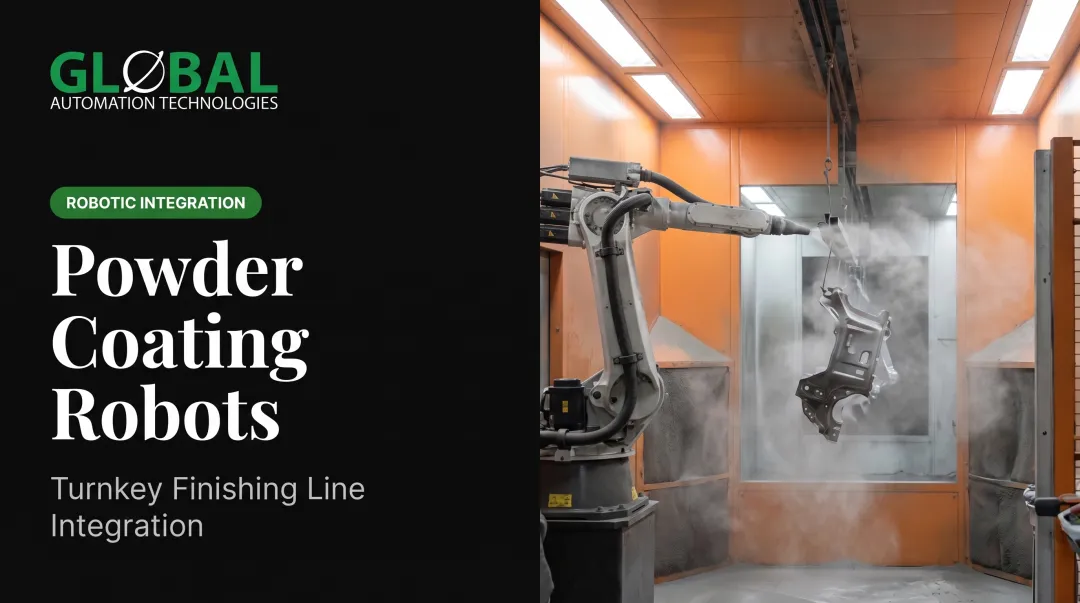
Robotic painting and powder systems remove that guesswork. Programmed, repeatable spray patterns hold film build within specification instead of relying on operator judgment.
GLOBAL Automation Technologies, a Level 5 FANUC Authorized System Integrator, builds these systems on FANUC paint robot platforms, engineering electrostatic powder application for uniform coverage, edge-buildup control, and improved first-pass transfer efficiency. For manufacturers scaling production, especially in heavy equipment and industrial metal fabrication where corrosion-resistant finishes carry real warranty stakes, that consistency also means less overspray and lower material cost per part.
Implications of Incorrect Thickness and Common Misconceptions
Getting thickness wrong doesn't just hurt appearance. It shortens the part's service life.
Too thick:
- Internal curing stress builds during bake, sometimes trapping volatiles and creating porosity
- Film becomes brittle and prone to cracking at welds and bends
- Impact resistance and flexibility drop even though more material was applied
Too thin:
- Corrosion protection weakens, letting the substrate rust prematurely
- Hiding power falls off, leaving visible substrate or uneven color
- Salt spray testing fails faster than the spec requires
Excess thickness doesn't add durability. Past a product's safe ceiling, it actively works against flexibility and adhesion.

Two Misconceptions Worth Killing
"Thicker is always more durable." Not true. Every powder has a ceiling built into its chemistry. Push past it and you get porosity and cracking, not extra protection.
"Lab-tested nominal ranges apply everywhere." A range validated on a flat test panel doesn't automatically hold on a part with deep recesses, dissimilar metal thicknesses, or unusual thermal mass. Geometry and substrate change real-world results, even when the spray settings stay identical.
Conclusion
Powder coating thickness is a governing performance parameter that determines whether a finish protects a part for ten years or fails at ten months. Getting the specification right, measuring it correctly after cure, and controlling it consistently during application are three separate disciplines that all have to work together.
No published number replaces engineering judgment. Balance the applicable standard, the powder manufacturer's data sheet, and the actual geometry of the part in front of you—that matters more than hitting a figure copied from a different job.
Frequently Asked Questions
How much will 1 lb of powder coating cover?
Coverage depends on target thickness and transfer efficiency, typically ranging from 60–130 square feet per pound at standard mil ranges. Check the manufacturer's coverage calculator for your specific powder and application method.
What is the standard thickness of powder coating?
Most general-purpose applications fall between 1.0–4.0 mils (25–100 microns), though architectural and industrial systems often run higher. The correct number always comes from the specific powder's technical data sheet.
How do I check mil thickness of powder coating?
Use a magnetic induction gauge for steel substrates, an eddy current gauge for aluminum, or an ultrasonic gauge for non-metallic substrates. Measurements should be taken post-cure for accurate acceptance testing.
Is powder coating strong?
Yes. Within its correct thickness range, it delivers strong impact, chip, and corrosion resistance. Applied too thick, it becomes brittle and loses flexibility rather than gaining protection.
Can powder coating be too thick?
Yes. Exceeding a powder's safe ceiling causes internal curing stress, porosity, and cracking instead of added durability. Each powder product has its own documented maximum, not a universal limit.
What happens if powder coating is too thin?
Thin coatings leave inadequate corrosion protection, weak hiding power, and early substrate exposure. They're also more likely to fail salt spray and color testing during quality checks.