
Here's the catch: many of those CNC machines, production lines, and control systems are mechanically sound but electronically obsolete. Replacing them outright costs a fortune and shuts down production for months. Many manufacturers are stuck between machines that still run and budgets that can't stretch to full replacement.
This guide covers what retrofitting actually means, the signs your equipment is ready for one, how retrofit compares to buying new, the step-by-step process, and how a partner like GLOBAL Automation Technologies executes these projects from assessment to startup.
Key Takeaways
- Retrofitting upgrades controls, automation, or mechanical systems while keeping the original machine frame intact
- FANUC estimates retrofits typically cost 33% to 50% of a comparable new machine
- Obsolete parts, missed tolerances, and connectivity gaps are the clearest signals it's time to act
- Projects range from a two-week control swap to a multi-month rebuild with robotic integration
- Combining a control retrofit with robotic tending or dispensing is a common project scope
What Is Machine Retrofitting?
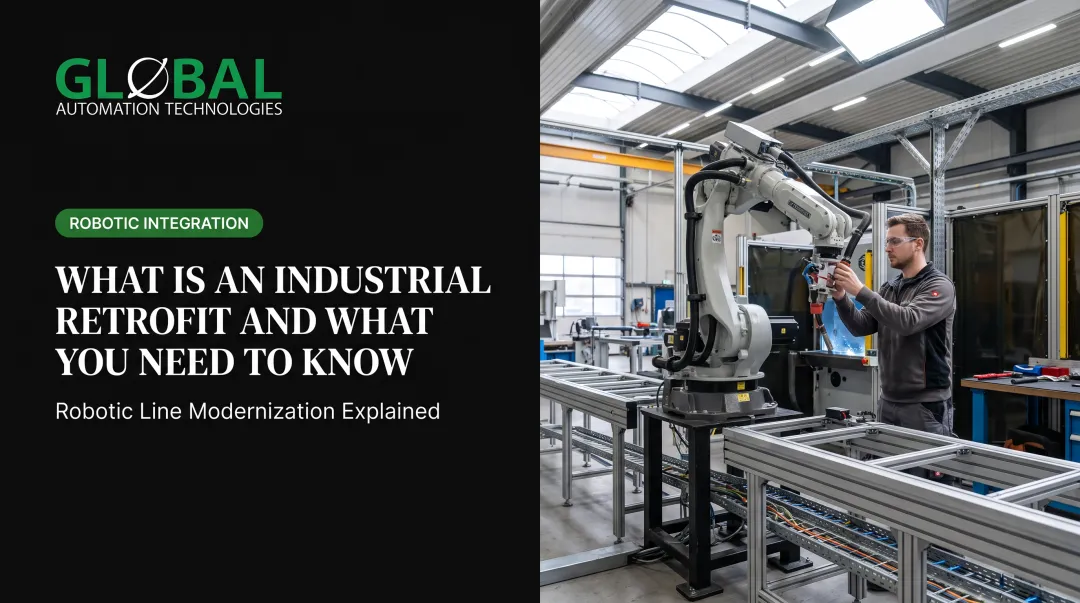
Machine retrofitting means upgrading the control, electrical, automation, or mechanical systems of an existing machine while preserving its original structure. Instead of scrapping a multimillion-dollar asset, you modernize the parts that have gone obsolete and keep the frame, ways, and spindle that still work fine.
Typical retrofit components include:
- CNC controls and PLCs
- Servo motors, drives, and amplifiers
- Sensors and feedback devices
- HMIs and operator panels
- Safety systems and guarding
- Robotic tending or handling equipment
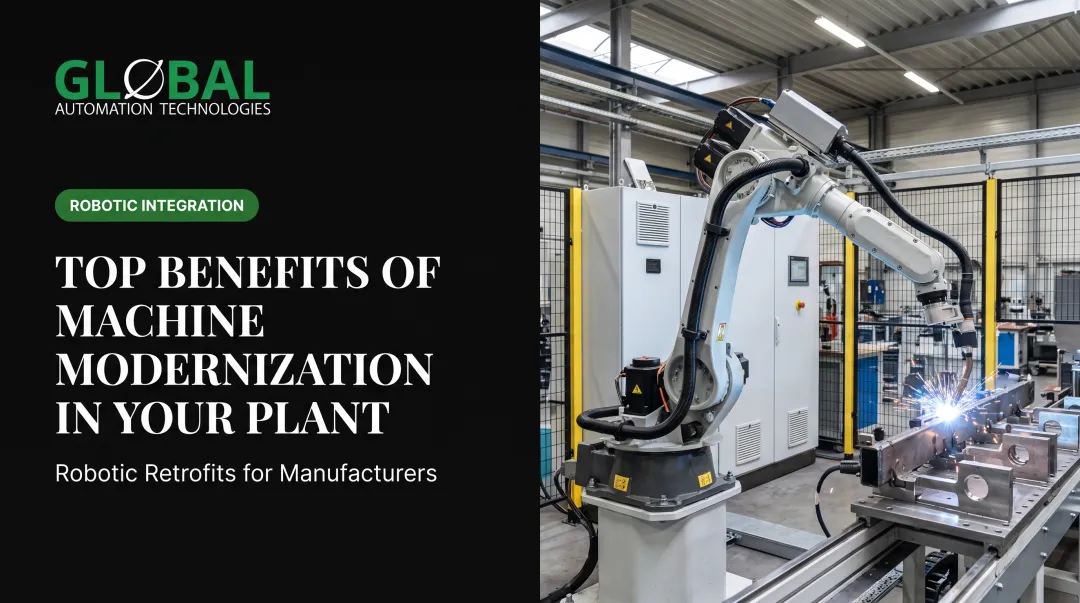
Retrofitting isn't limited to CNC machine tools. Robotic work cells, paint and dispensing lines, and entire production lines qualify too. If the mechanical backbone is solid but the electronics or automation layer is holding you back, retrofitting is often the smarter path.
Common Types of Retrofitting Techniques
Most retrofit projects fall into four categories:
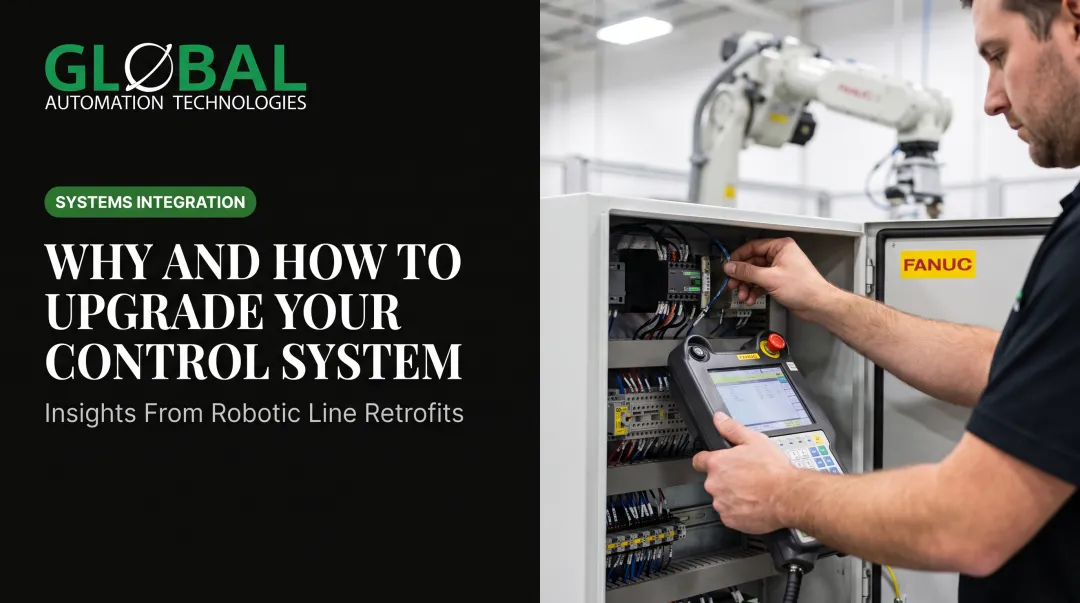
- Control system retrofits - replacing an outdated CNC or PLC with modern hardware and software
- Mechanical retrofits - addressing motors, spindles, ballscrews, and drives that show wear
- Automation retrofits - adding robotic loading, unloading, or machine tending to an existing cell
- Connectivity retrofits - installing IIoT sensors and real-time monitoring for Industry 4.0 initiatives
These rarely happen in isolation. A four-machine retrofit documented by Modern Machine Shop combined new CNCs, drives, motors, bearings, and cable carriers in a single shutdown. The electrical and mechanical systems were too intertwined to separate. In our own project work, pairing a new CNC control with a robotic tending cell is a natural way to extend running beyond a single shift, lights-out between scheduled maintenance windows.

Signs Your Machine Is Ready for a Retrofit
Some machines announce it themselves. Others need a closer look.
Obsolete control systems. When spare parts for your CNC, PLC, or drives get discontinued or prices spike, you're on borrowed time. Frequent unplanned downtime is usually the first symptom.
Inability to meet new production demands. If the machine can't hold tighter tolerances, run higher-mix parts, or keep up with the throughput your business now requires, the control system—not the frame—is often the limiting factor.
Competitiveness and connectivity gaps. A machine that can't network with newer equipment or feed data into a monitoring system leaves you blind to the predictive maintenance and Industry 4.0 initiatives your competitors are already running.
These warning signs show up in the data, too. A 2020 Plant Engineering maintenance survey of 171 respondents found aging equipment was the leading cause of unscheduled downtime at 34%, ahead of mechanical failure at 20%. If your maintenance team is spending more time firefighting than fixing, that's a signal worth acting on.
Retrofit vs. Replace: Comparing Costs, Downtime, and ROI
The economics usually favor retrofitting, but not always. Here's how the two options compare on cost, downtime, and ROI.
Cost: FANUC's own guidance puts a CNC retrofit at roughly one-third to one-half the price of a comparable new machine. That's before accounting for the tooling, fixturing, rigging, and foundation work a brand-new install typically requires.
Downtime: Retrofit projects generally take weeks. New machine procurement and installation can take months once you factor in lead times, rigging, and facility disruption.
Training: Operators who already know a machine's layout adapt faster to an upgraded control than they would to an entirely new system with a different footprint and workflow.
ROI: Lower capital outlay and shorter downtime usually mean faster payback than a full replacement. Extending a sound machine 10–15 years often returns more value per dollar when you don't need a larger platform.
When replacement makes more sense:
- Mechanical frame is worn beyond economical repair
- Required capacity exceeds what the base structure can support
- Total upgrade cost approaches new-machine pricing once mechanical work is included
| Factor | Retrofit | Buy New |
|---|---|---|
| Cost | ~33-50% of new machine price | Full purchase price plus install |
| Downtime | Weeks | Months |
| Training | Minimal, familiar layout | Longer ramp-up curve |
| Lifespan extension | 10-15+ years typical | Full new service life |
| Best fit | Mechanically sound, electronically outdated | Frame worn or undersized for new demands |
The Machine Retrofit Process: From Assessment to Startup
A retrofit isn't a one-and-done part swap. It follows a defined sequence.
- Comprehensive assessment. Engineers evaluate mechanical condition (guides, ballscrews, geometry), electrical systems (panels, wiring, motors), and current automation maturity to confirm the machine is a good retrofit candidate.
- Define clear objectives. Teams lock in targets such as higher throughput, new part capability, improved safety, or Industry 4.0 connectivity. Those goals shape every technical decision that follows.
- Engineering, simulation, and design. Engineers plan and model the new control architecture and any robotic integration. AI-assisted simulation validates the design and robot programming before anyone touches a wrench, which shortens engineering timelines.
- Installation, wiring, and commissioning. Technicians install new components, integrate automation and sensors, and test the system against defined tolerance and performance standards before handover.
- Training and ongoing support. Operators learn the new controls and HMIs, and teams set up predictive maintenance monitoring to flag issues before they cause downtime.

Timelines vary widely. A simple control swap might take a few weeks. A full rebuild with robotic integration can run several months. Either way, build the schedule around your planned downtime windows, not the other way around.
Modern Retrofit & Upgrade Technologies to Consider
Not every retrofit looks the same. A few technology categories show up in nearly every modern project.
CNC and control upgrades. Modern controls bring adaptive feed control, faster data processing, and touchscreen interfaces that are easier to use and easier for younger operators to learn.
Robotic automation retrofits. Adding robotic machine tending, painting, or dispensing to an existing line extends running beyond a single shift and lifts throughput.
Robotic machine tending cells typically pay for themselves within 12 to 18 months, driven by continuous spindle utilization through breaks, shift changes, and runs that extend well beyond a single shift between scheduled maintenance windows. On the painting side, robotic systems hold film build within specification shift after shift, removing the operator variability that comes with manual spraying.
Sensors, IIoT, and real-time monitoring. Adding connectivity to a legacy machine unlocks predictive maintenance and process visibility that older equipment can't provide alone.
AI-driven predictive maintenance. AI-based health assessments monitor systems continuously and flag potential issues early. Maintenance teams can intervene before a breakdown stops the line, protecting the value of the retrofit investment long after startup.
Why Partner with GLOBAL Automation Technologies for Your Retrofit Project
Retrofitting works best when the same team that designs the system also knows how to run it. That's the gap GLOBAL was built to close.
GLOBAL delivers a retrofit through distinct, separately scoped offerings:
- Automation solutions: engineering, building, and commissioning the retrofit itself
- Technical staffing: placing controls engineers, robot programmers, and project managers on-site to run and maintain it afterward
That combination means a manufacturer gets both the upgraded system and the people who understand it, without hiring a separate integrator and then scrambling to staff it.
What GLOBAL brings to a retrofit project:
- 17+ years of automation experience across a proven global base of robotic deployments
- Level 5 FANUC Authorized System Integrator (highest tier), and #1 purchaser of FANUC robots among North American integrators in 2025
- Full turnkey capability: layout, design, build, programming, validation, installation, commissioning, and training
- AI-assisted simulation and predictive maintenance tools that reduce risk and speed up startup
If you're weighing a retrofit against a full replacement, contact GLOBAL for a machine or line assessment before you commit either way.
Frequently Asked Questions
What is retrofit equipment?
Retrofit equipment refers to upgraded components (controls, motors, sensors, or automation) added to existing machinery to extend its life and performance. It avoids the cost and disruption of full replacement.
What are the different types of retrofitting techniques?
Most projects draw from four categories: control retrofits (CNC/PLC), mechanical retrofits (motors, ball screws, drives), automation retrofits (robotic tending), and connectivity retrofits (IIoT sensors and monitoring). Many jobs combine more than one.
What is CNC retrofitting?
CNC retrofitting replaces or upgrades a machine's numerical control system plus related wiring, motors, and drives. The goal is better accuracy and expanded machining capability without replacing the machine tool itself.
How much does a machine retrofit typically cost compared to a new machine?
Retrofits often run about 33% to 50% of a comparable new machine's price, per FANUC estimates. Final cost depends on scope, so a site assessment is the reliable way to price the work.
How long does a machine retrofit take?
Timelines range from a few weeks for a simple control swap to several months for a comprehensive rebuild with robotic integration. Scope and mechanical condition are the biggest factors in duration.
Can robots be added to an existing production line during a retrofit?
Yes. Robotic machine tending, painting, and dispensing cells can be integrated into existing lines during a retrofit to boost throughput and remove operators from hazardous or repetitive tasks.