
That disconnect creates real problems. Operators check five different screens to diagnose one line stoppage. Maintenance teams react to breakdowns instead of preventing them. Quality issues surface on the plant floor long after the root cause occurred upstream.
The stakes are significant. A typical business loses about $125,000 for every hour of unplanned downtime, according to ABB's 2023 Value of Reliability survey. An eight-hour outage runs close to $1 million.
This guide breaks down what integrated controls and information actually mean, why they matter, and how manufacturers apply them in real production environments. We'll also look at how the right partner brings the systems and the engineering talent together under one roof.
Key Takeaways
- Integrated controls unify PLCs, robots, SCADA, and HMIs into one operational view
- Connected systems cut downtime, speed decisions, and lower plant operating costs
- Real integration takes both the right architecture and engineers who understand it
- AI-assisted simulation and predictive maintenance enable smarter, more autonomous control
What Are Integrated Controls and Information?
Control refers to the hardware and software that govern physical processes: PLCs, robot controllers, servo drives, and motion controllers. These systems execute logic and issue commands in real time.
Information is the data layer sitting above it. It includes SCADA, MES platforms, and analytics tools that give operators and engineers visibility into what the control layer is actually doing.
The NIST glossary defines an industrial control system as one that governs manufacturing, product handling, and distribution through a combination of electrical, mechanical, and software components. That's the control side. Integration is what happens when that control layer and the information layer start sharing data continuously, instead of sitting in separate silos.
Automation, control, and integration aren't the same thing.
- Automation executes a task: a robot welds a joint, a conveyor moves a part
- Control regulates and directs that task: timing, force, position, sequencing
- Integration connects systems through shared data so a vision quality flag can trigger a robot to reject a bad part downstream
Rockwell Automation describes this concept as an "Integrated Architecture": one control platform, standard design framework, and interoperable connectivity that scales from a single machine to an entire facility.
The Building Blocks of an Integrated System
Every integrated system is built from four layers:
- Field devices: sensors and actuators that act as the eyes and hands of the system, collecting data and executing physical commands
- Controllers: PLCs, robot controllers, and motion controllers that process logic and issue instructions
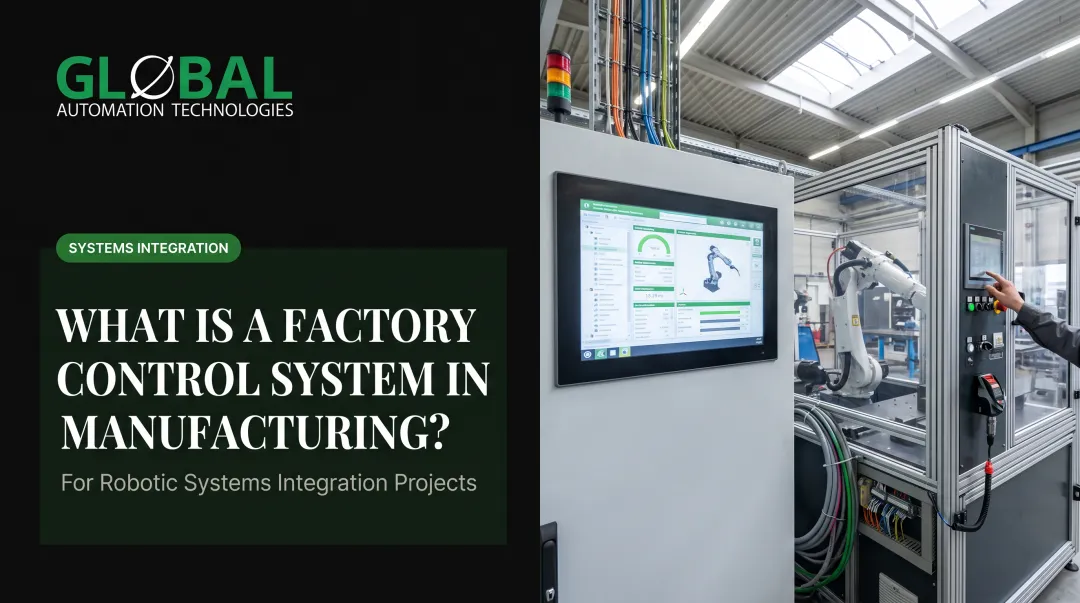
- Supervisory and information layer: SCADA, MES, and HMIs that give operators a unified, plant-wide view instead of isolated screens
- Communication network: the backbone protocols (EtherNet/IP, PROFINET, OPC-UA) that let every device on the floor talk to every other device, regardless of vendor

Without that fourth layer, you don't have integration. You have a collection of expensive machines that happen to sit in the same building.
The Benefits of Integrating Controls and Information
When control data and business information flow freely, the payoff shows up fast and in measurable ways.
- A single unified dashboard replaces a dozen disconnected screens, so operators spot bottlenecks the moment they start—not an hour later at shift review
- Robotic machine tending cells extend production beyond a single shift, enabling lights-out running between scheduled maintenance windows, and commonly pay for themselves in 12 to 18 months
- Aggregated data from connected controllers feeds predictive maintenance models, letting teams fix equipment on their schedule instead of the machine's
- Integrated safety interlocks and automated shutdowns work across connected systems rather than in isolated pockets, in line with the updated ANSI/A3 R15.06-2025 standard
Downtime cost alone makes the case. Unplanned downtime runs roughly $125,000 per hour for a typical manufacturer. For automotive operations, Siemens puts that figure closer to $2.3 million per hour, double the 2019 number. Integrated systems catch problems before they cascade into full stoppages.
From Systems to Solutions: How GLOBAL Connects Controls, Information, and People
Building an integrated system is only half the equation. Someone still has to run it, maintain it, and troubleshoot it when something drifts out of spec.
GLOBAL Automation Technologies built its business around that gap. The company pairs automation solutions, services and technical staffing under one roof. Manufacturers get the integrated system and the engineers who understand its controls and information flow, without coordinating between two separate vendors.
Post-commissioning, the engineers on the plant floor already know how the system was designed and built. They bring that institutional knowledge with them, not a generic grasp of PLCs and robots in the abstract.
AI-Assisted Simulation and Predictive Maintenance
GLOBAL's engineers use AI-assisted simulation to model, test, and optimize robot programs in a virtual environment before any code runs on the actual production floor. That shift has cut robot programming time from weeks to days.
The result: faster startups, fewer surprises during commissioning, and less disruption for the customer's production schedule.
On the maintenance side, GLOBAL applies AI-driven predictive maintenance health assessments that continuously monitor equipment condition. These tools flag developing issues early, before they become unplanned stoppages. Here the information layer shapes control-side decisions in real time, rather than only reporting problems after the line is down.
Turnkey Integration Across the Plant Floor
GLOBAL's turnkey process runs end-to-end:
- Process study and conceptual layout
- Engineering and design
- Robot simulation and offline programming
- Build, controls integration, and SCADA/IoT connectivity
- Installation and commissioning
- Training, technical documentation, and ongoing support with health assessments

GLOBAL is a Level 5 FANUC Authorized System Integrator (the highest authorization tier) and was #1 purchaser of FANUC robots among North American integrators in 2025. The team has built a proven global base of robotic deployments, developing practical experience integrating controls and information in demanding manufacturing environments.
Real-World Applications Across Industries
Integrated controls and information show up differently depending on the industry, but the underlying principle stays the same: connect the floor to the data.
Automotive and EV manufacturing. Robotic welding, machine tending, and painting cells run coordinated through shared control and information systems to support high-volume production. Common integrated cells include:
- Welding, machine tending, and painting coordinated on shared controls
- EV battery work: adhesive dispensing, parts handling, and inspection
- Performance data feeding predictive maintenance so likely failures get flagged before parts are swapped on a fixed schedule
Heavy equipment and industrial manufacturing. Production line modernization combines PLCs, robotics, and MES-style data capture to improve throughput and catch quality issues earlier. Torque values, serial numbers, and process parameters log automatically instead of being tracked by hand.
Data center infrastructure manufacturing. As demand for AI data-center hardware grows, robotic assembly integrated with information systems is showing up in server rack, enclosure, and power distribution component production. GLOBAL is expanding into this area, drawing on its assembly automation background.
Common Challenges in Integrating Controls and Information
Integration delivers real value, but it isn't plug-and-play. Three challenges come up constantly.
Legacy equipment compatibility. Older PLCs and controllers often lack modern communication protocols. Bridging that gap usually requires middleware or a targeted retrofit rather than a full rip-and-replace.
Cybersecurity exposure. Connecting more systems means expanding the attack surface. Dragos documented 1,693 ransomware attacks against industrial organizations in 2024, an 87% jump year over year. Manufacturing was hit hardest of any sector. Integration plans need security built in from the start, not bolted on afterward.
Talent gaps. Few engineers are equally fluent in both controls hardware and information systems. The Manufacturing Institute projects a net need for 3.8 million manufacturing employees between 2024 and 2033, with roughly half of those roles at risk of going unfilled without action on the skills gap.
This is where a staffing partner earns its keep. GLOBAL's technical staffing places controls engineers, PLC programmers, and commissioning engineers on contract, contract-to-hire, or direct-hire terms, closing the gap in weeks instead of months.
Frequently Asked Questions
What are integrated controls?
Integrated controls are hardware and software (PLCs, sensors, HMIs, robots) working together as one coordinated system rather than standalone components. Data flows between them in real time instead of staying siloed on individual machines.
Is integrated automation the same as control?
No. Automation refers to executing a task, while control refers to regulating and directing that task. Integration is what ties both together by sharing information across systems in real time.
What is an example of an integrated control system?
A common example is SCADA, PLCs, and robotics coordinated on one platform with real-time data exchange, such as a robotic welding line where quality data automatically triggers process adjustments upstream.
What are the main components of an integrated control system?
The four core components are field devices (sensors/actuators), controllers (PLCs, robot controllers), the HMI/SCADA supervisory layer, and the communication network connecting them all.
How much does it cost to integrate control systems?
Costs vary based on scope, number of controllers involved, and legacy compatibility issues. Most manufacturers see the investment pay back through reduced downtime and higher throughput within 12 to 18 months.
What industries benefit most from integrated control systems?
Automotive and EV manufacturing, heavy equipment, data center infrastructure, and general industrial manufacturing see the strongest returns, largely due to high production volumes and complex, multi-step processes.