
This guide breaks down what a PLC actually does, how to evaluate the companies selling PLC-based automation, a look at the major hardware players, and where automation solutions, services and staffing fit into your decision. It's written for plant managers, engineering leaders, and procurement teams at automotive, heavy equipment, and industrial manufacturing companies who need to make a call soon, not "someday."
Key Takeaways
- PLCs remain the backbone of industrial automation, and demand for controls skills keeps climbing alongside robotics and IIoT adoption
- Pick a PLC automation partner for technical depth, brand relationships, and service that continues past commissioning
- Firms that pair automation solutions, services and staffing solve equipment and workforce gaps in one relationship
What Is a PLC and Why Does It Matter for Industrial Automation?
A Programmable Logic Controller (PLC) is a ruggedized industrial computer built to run control logic for machinery on the plant floor. It scans inputs from sensors and switches, processes programmed logic, and fires outputs like motors, valves, and actuators, repeating that cycle in milliseconds without fail.
That reliability is why PLCs still dominate manufacturing control. They deliver:
- Precision in repetitive tasks like part positioning or torque control
- Repeatability across thousands of cycles without drift
- Flexibility to reprogram logic as products or lines change
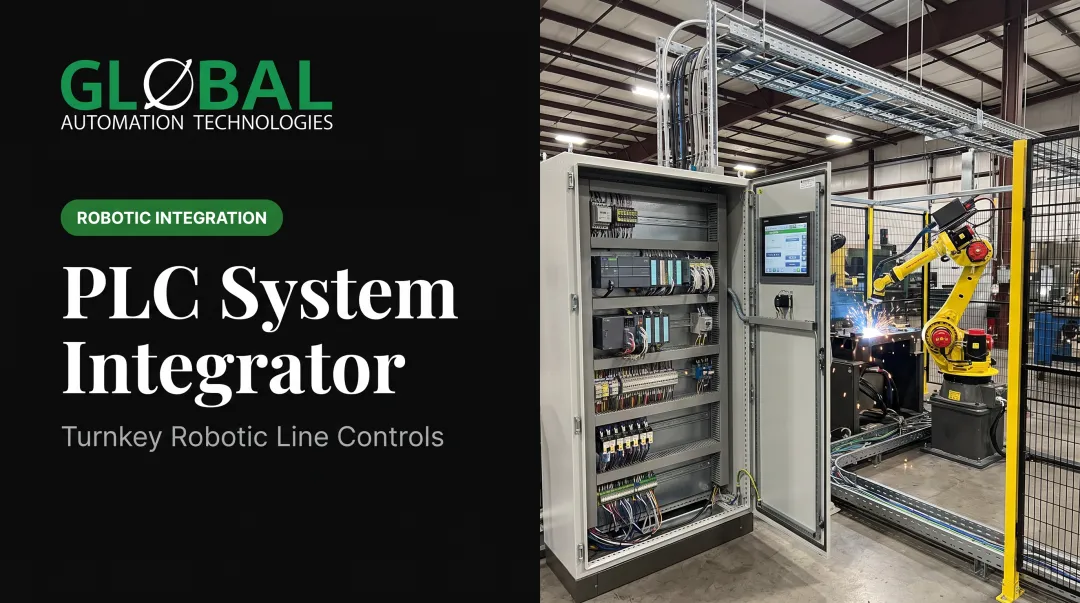
PLCs rarely work alone. They typically integrate with HMIs for operator interaction, SCADA for plant-wide visibility, and robot controllers to form a complete automation ecosystem.
Are PLCs Still in Demand?
Short answer: yes, and the labor market backs it up:
- Deloitte and The Manufacturing Institute estimate a net need for 3.8 million US manufacturing workers between 2024 and 2033
- As many as 1.9 million of those roles could go unfilled due to skills gaps
- 69% to 72% of manufacturers report moderate-to-significant difficulty hiring across OT, engineering, and related technical domains, per Deloitte's 2025 Smart Manufacturing survey
Even as AI and IIoT layer on top of traditional control systems, someone still has to program and maintain the PLC underneath.
Where PLCs Fit Within a Robotic Automation Cell
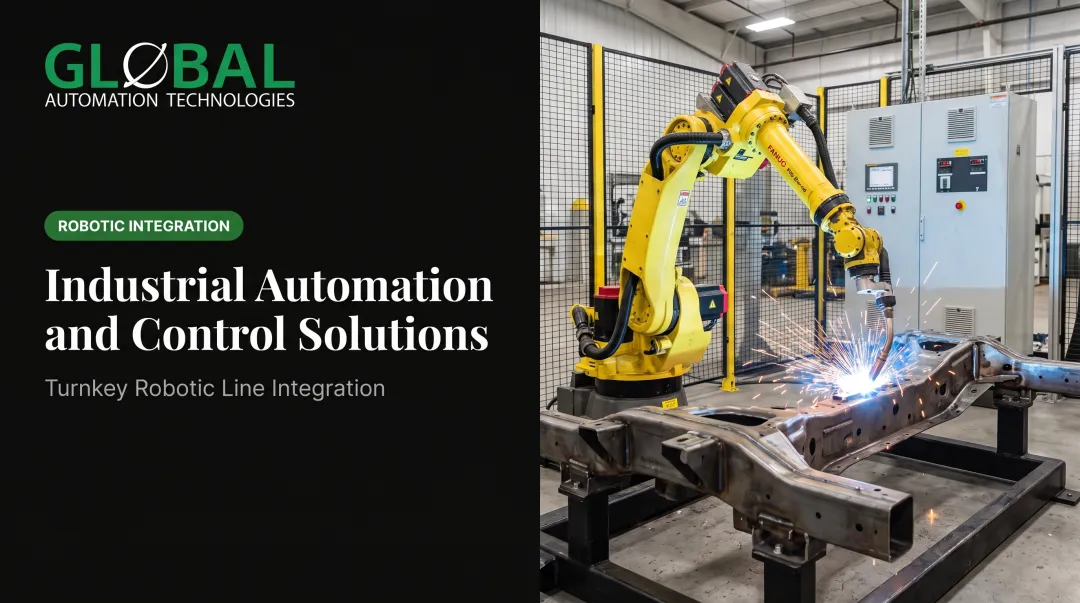
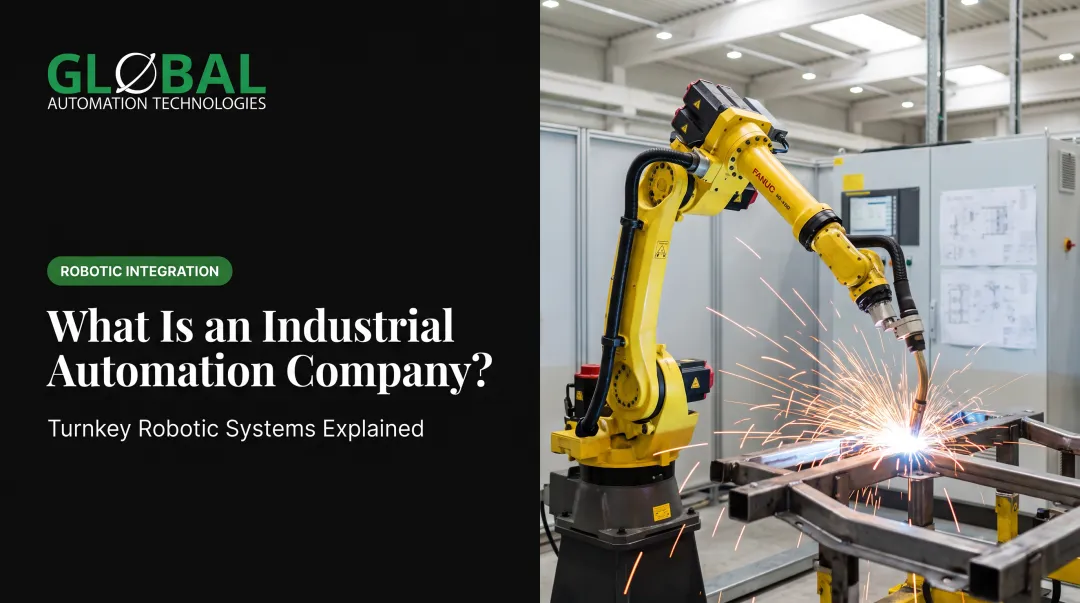
In a typical robotic cell, the PLC and the robot controller split responsibilities. The PLC usually governs safety interlocks, cell sequencing, and coordination between machines. The robot controller (FANUC's R-50iA, for example) handles the robot's own motion and path execution. Newer interfaces let the PLC issue robot commands directly through standardized protocols, blurring the line further.
This is exactly the layer GLOBAL's integration teams work in daily. In machine tending cells, engineers program the robot to open doors, load and unload parts, close doors, and trigger the machine cycle. Surrounding PLC logic handles sequencing and interlocks for the whole cell. Getting that handoff right is what separates a smooth startup from weeks of troubleshooting on the floor.

How to Evaluate an Industrial PLC Automation Company
Choosing a PLC automation partner isn't about who has the biggest catalog. Look for these five things.
1. Technical depth across platforms. Engineers should be fluent in multiple PLC ecosystems, not locked into one brand, so they can design and troubleshoot whatever architecture your facility already runs.
2. Manufacturer partnerships. Established relationships with hardware makers mean faster access to parts and fewer supply delays when something fails at 2 a.m.
3. Full-service capability. A real partner covers the whole lifecycle:
- Consultation and feasibility studies, including ROI and capital-requirement analysis
- Engineering, design, and offline robot simulation before anything hits the floor
- Build, installation, programming, and commissioning
- Training, documentation, and ongoing support after launch
GLOBAL structures its turnkey projects this way, and the simulation step matters more than it sounds. Testing program behavior before deployment catches problems while they're still cheap to fix.

4. Industry-specific experience. A track record in your vertical, whether that's automotive body shops or heavy equipment assembly, reduces integration risk because the integrator has already seen your failure modes.
5. Talent availability. Can the company also staff the engineers who'll run this system in year three? This is where most integrators fall short. GLOBAL's staffing division places Controls Engineers, PLC Programmers, Mechanical Designers, and Project Managers on contract, contract-to-hire, or direct-hire terms. The same relationship that builds your cell can also keep it staffed.
Top Industrial PLC and Automation Companies to Know
| Company | Known For | Best Fit For |
|---|---|---|
| Siemens | SIMATIC S7-1200/S7-1500 lines, TIA Portal engineering environment, strong global support | Facilities wanting scalable, diagnostics-heavy control across multiple sites |
| Rockwell Automation (Allen-Bradley) | ControlLogix/CompactLogix, Studio 5000 Logix Designer | North American plants standardizing on the dominant regional PLC platform |
| ABB | AC500 modular family with an "any module, any CPU" design | Process manufacturers needing flexible hardware configurations |
| Mitsubishi Electric | MELSEC iQ-F, compact and cost-effective | Smaller machine-level applications with tight budgets |
| Schneider Electric | EcoStruxure Control Expert, Modicon M340/M580 | Facilities prioritizing IoT-forward, cloud-connected control |

Hardware is only half the equation. Once you've picked a PLC brand, someone still has to design, program, and commission it into a working robotic cell.
That's where a systems integrator like GLOBAL comes in—deploying these controllers into welding, painting, dispensing, or machine tending applications, not just supplying the box.
Emerging Trends Shaping PLC Automation
Three shifts are changing what "PLC automation" means day to day.
- IIoT and cloud connectivity: Deloitte's 2025 Smart Manufacturing survey of 600 executives found 57% use cloud, 57% use analytics, and 46% use IIoT. PLCs now feed plant-wide systems instead of running as isolated islands.
- AI for predictive maintenance: McKinsey documented a production-operator copilot that cut unscheduled downtime by up to 90% and maintenance labor by a third. GLOBAL uses AI-driven health assessments to flag equipment issues before they cause downtime.
- Cybersecurity requirements: As PLCs get networked, standards like NIST SP 800-82 and ISA/IEC 62443 are baseline expectations for any facility exposed to external networks.

Why Manufacturers Choose an Integrated Solutions and Staffing Partner Like GLOBAL
Most automation firms pick a lane: they either build systems or they place engineers. GLOBAL does both under one roof, which means a single call can get you the robotic cell and the people who'll run it.
What that dual model delivers:
- 17+ years in operation, with offices in 4 countries and projects across 22 countries
- Level 5 FANUC Authorized System Integrator, deploying FANUC robotics in automotive and heavy industry environments
- AI-assisted simulation that can cut robot programming from weeks to days and reduce startup surprises
- Flexible staffing — contract, contract-to-hire, or direct-hire Controls Engineers, Mechanical Engineers, and Project Managers, with or without a systems build
For a plant manager weighing a dozen vendor pitches, that combination removes a real headache: you're not signing one contract for the hardware and another for the headcount to run it.
Frequently Asked Questions
What is a PLC for automation?
A PLC is an industrial controller built to automate machinery and processes with high reliability. It runs reprogrammable logic that scans inputs, executes control decisions, and drives outputs continuously.
Is PLC still in demand?
Yes. Manufacturers still rely heavily on PLCs even as IIoT and AI grow. Hiring data shows ongoing difficulty filling OT and engineering roles tied to these systems.
How do I choose the right PLC brand for my facility?
Consider your existing infrastructure, environmental conditions, scalability needs, and industry-specific requirements. A facility already standardized on Allen-Bradley, for instance, usually gains little from switching brands mid-fleet.
Can a systems integrator help with both PLC hardware and staffing?
Yes. Integrated firms like GLOBAL provide both the automated system and the engineering talent—contract or direct-hire—needed to operate and maintain it long-term.
What industries rely most heavily on PLC automation?
Automotive manufacturing leads in quantified adoption, with US automotive robot installations up 10.7% to 13,700 units in 2024. Heavy equipment and data center infrastructure manufacturers also rely heavily on PLC-driven automation.
How long does it take to see ROI from a new PLC-driven automation system?
Robotic machine-tending cells from partners like GLOBAL typically pay for themselves in 12 to 18 months, driven by higher parts-per-shift output and reduced direct labor. Actual payback depends on your cycle times and labor costs.