
Introduction
Factory floors are under more pressure than ever. Labor shortages, rising quality expectations, and demand for output that runs beyond a single shift are pushing manufacturers to rethink how products get built.
Automated assembly uses robots, control systems, and sensors to join, fasten, or build components into finished products with minimal manual intervention. It's become the default path for plants that need higher throughput without headcount they can't hire.
This guide covers what automated assembly is, the systems behind it, the benefits and tradeoffs, and how to evaluate a partner before you commit capital. For automotive, industrial, and heavy equipment manufacturers, that groundwork comes before the purchase order.
Key Takeaways
- Automated assembly builds products with little to no manual labor using robots, PLCs, and sensors
- Three system types exist: fixed, programmable, and flexible, and most plants blend all three
- Machine tending cells typically pay back in 12 to 18 months
- Robotic painting holds film build within specification shift after shift, removing operator-to-operator variability
- Choose partners that deliver turnkey integration and the engineering talent to run the system
What Is Automated Assembly?
Automated assembly is the use of robotics, control software, and sensors to join, fasten, or build components into a finished product, replacing repetitive manual labor with machine-driven precision. It covers everything from screw-driving and part insertion to dispensing and inline inspection.
Two nearby terms get mixed in often enough that the distinctions matter.
How Automated Assembly Differs from Related Terms
Automated test assembly covers functional and quality checks built into a line—not the physical joining work. A station might verify torque, run a functional check, or confirm electrical continuity. It's a checkpoint inside the process, not the process itself.
Automated manufacturing is the broader umbrella: machining, finishing, packaging, and inspection. Automated assembly is the subset focused on combining parts into a final product. NIST frames it the same way—machine tending, material transport, and inspection fall under manufacturing, while assembly is the joining step within it.
From Ford's Line to Industry 4.0
The concept isn't new. Henry Ford introduced the moving assembly line at his Highland Park plant in 1913, cutting Model T build time to roughly 90 minutes. Programmable logic controllers and industrial robots arrived in the 1970s and 80s, giving plants the ability to reprogram rather than rebuild.
Today's lines run on AI-assisted simulation and Industry 4.0 connectivity. The scale is enormous. The International Federation of Robotics reports 4.66 million industrial robots operating worldwide in 2024, up 9% year over year.
On the plant floor, this translates into a station-by-station sequence where machines, not people, handle the repetitive joining, fastening, and inspection work, while operators shift into oversight, programming, and exception-handling roles.

Types of Automated Assembly Systems
Not every product needs the same automation approach. Three main categories exist, and each fits a different production profile.
Fixed (Hard) Automation
Purpose-built equipment designed for one high-volume product run at sustained identical output. Dedicated transfer lines in engine assembly are the classic example. Unit costs are low once running, but changing the product means rebuilding the line.
Programmable Automation
Reprogrammable machinery suited to batch production, where changeover takes hours or days rather than minutes. CNC-controlled or robot-driven batch lines fall into this category. They handle planned product changes well, but they are not built for constant switching.
Flexible (Soft) Automation
Software-driven systems that switch between product variants with near-zero downtime. High-mix electronics lines and multi-model automotive assembly rely on this approach, where the "changeover" is really just a new program loaded into the controller.
Which Type Fits Your Line?
Match volume, variety, and changeover needs to the profile that fits each part of your line:
| Factor | Fixed Automation | Programmable Automation | Flexible Automation |
|---|---|---|---|
| Production volume | Very high | Medium to high | Low to medium |
| Product variety | One product | Batches, low variety | High mix |
| Changeover time | Line rebuild required | Hours to days | Minutes or less |
Most real-world factories mix types on the same platform. A body shop might run fixed welding transfer lines beside flexible robotic cells for trim variants.
Key Components & Technologies Powering Automated Assembly
Automated assembly runs on a handful of interconnected technologies. Each plays a specific role in the sequence.
Industrial Robots
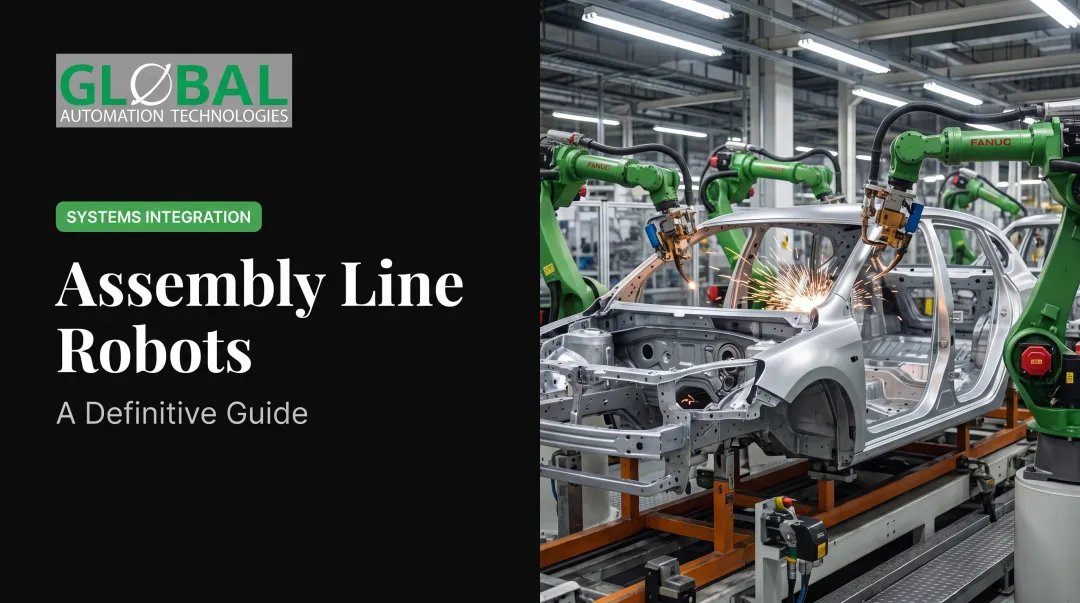
Robotic arms are the workhorses of automated assembly, handling welding, dispensing, machine tending, and pick-and-place work. FANUC robots are a common industry choice, built for the precision and durability needed in hazardous environments like paint booths and welding cells.
GLOBAL Automation Technologies, a Level 5 FANUC Authorized System Integrator, deploys these robots across the full range of applications assembly automation typically requires.
Control Systems (PLCs & Software)
PLCs act as the coordination layer, syncing sensors, actuators, and robots in real time. What's changed recently is programming speed. AI-assisted simulation now lets engineers model and test robot programs before a single line of code runs on the floor.
GLOBAL applies this approach to compress robot programming timelines, catching errors in a virtual environment instead of discovering them mid-commissioning.
Sensors & Vision Systems
Proximity sensors, torque sensors, and machine vision handle the detection work: confirming part presence, verifying alignment, and flagging defects before a part moves downstream.
Vision-guided systems can:
- Locate and identify parts regardless of orientation, eliminating rigid fixturing
- Pick randomly from unstructured bins
- Verify component presence and position before the next operation begins
- Track parts on moving conveyors without stopping the line
Material Handling (Conveyors, AGVs, AMRs)
Conveyors, AGVs, and AMRs move parts between stations and keep the sequence flowing.
Predictive maintenance tools now sit on top of this equipment. AI-driven health assessments flag developing issues before they cause an unplanned stop, protecting both uptime and maintenance budgets.

Benefits of Automated Assembly
The case for automated assembly comes down to three measurable outcomes: throughput, quality, and safety.
Higher Throughput, Less Downtime
Automated assembly cells keep running through breaks and shift changes, extending production between scheduled maintenance windows. Robots present parts, drive fasteners, and pass assemblies downstream without waiting on a manual load cycle — more completed units per shift without adding stations.
The same pattern shows up next to the assembly line. Machine tending cells extend spindle utilization by cutting idle time between loads, so machining and assembly stay in step instead of bottlenecking each other.
Tighter Quality Control
Repeatable motion plus inline checks cuts defect rates and rework. On assembly cells, that usually means consistent torque and angle on every fastener, vision confirmation that the right component is in the right orientation, and traceability data tied to each unit before it leaves the station.
Related processes in the same plants show how tight the window can get:
- Robotic painting holding film build within specification shift after shift, removing operator-to-operator variability
- Robotic dispensing that repeats the same programmed path, with vision guidance and downstream inspection that catch off-spec material before the part moves on
Improved Workplace Safety
Automation pulls people out of the highest-risk steps. In assembly, that includes repetitive fastening, heavy part lifts, and reach into pinch points or press zones.
In finishing areas tied to the same production flow, robots also remove operators from spray booths and the exposures that come with them:
- Isocyanates, a leading cause of occupational asthma in manual spray work
- VOCs from solvent carriers
- Overspray particulates that build up in the lungs over time
Powder coating goes further by keeping workers out of high-voltage electrostatic spray zones entirely. Fewer hands in harm’s way — on the assembly cell and beside it — means fewer incidents without slowing the line.
Challenges to Consider Before Automating
Automated assembly isn't a plug-and-play decision. Three challenges come up consistently.
Upfront Investment and ROI Timeline
McKinsey reports that manufacturers can expect automation payback periods of 1 to 3 years. Robotic machine tending cells tend to land on the faster end, typically paying for themselves in 12 to 18 months through increased spindle utilization and reduced direct labor hours.
Legacy Integration and Skill Gaps
New robotic cells still need to talk to existing PLCs, conveyors, and plant networks. Standardized communication protocols matter here, and so does operator retraining. Someone still has to run and maintain the system once it's live. Training and documentation should be part of the project scope, not an afterthought bolted on later.
Reliability and Maintenance Risk
Equipment will fail eventually. AI-driven predictive maintenance monitors systems continuously and flags developing issues early, so emergency repairs become scheduled work instead of unplanned downtime.
Choosing the Right Automated Assembly Partner
Picking a partner is as important as picking the technology. Strong partners cover the full project lifecycle, supply the talent to run what they build, and can prove results at scale.
Turnkey Capability, Not Just Equipment
Look for a partner covering the full lifecycle:
- Process study and feasibility — ROI assessment and conceptual design
- Engineering and design — layout, controls, and vision integration
- Build and integration — cell construction, tooling, and robot integration
- Installation and commissioning — on-site deployment and startup validation
- Training and documentation — so your team can run the system confidently
- Ongoing support — health assessments and long-term technical backing

Why Systems Integration and Staffing Should Be Paired
A robotic cell is only as good as the engineers who run it. GLOBAL Automation Technologies built its business around pairing automation solutions, services and technical staffing. You get both the system and the engineers to run it from a single source, rather than coordinating two separate vendors.
Track Record Is a Real Evaluation Criterion
Ask how long a partner has been doing this, and at what scale. GLOBAL brings 17+ years in operation, a proven global base of robotic deployments, and hands-on experience in automotive, heavy industry, and general industrial manufacturing. If you're evaluating a capital investment in automated assembly, contact GLOBAL for an automation assessment before you finalize a plan.
Frequently Asked Questions
What is automated test assembly?
Automated test assembly means functional and quality checks built into the line, separate from physical joining. Examples include torque checks or electrical verification stations—not the assembly work itself.
What does automated assembly mean?
Automated assembly uses robots, control systems, and sensors to perform assembly tasks with minimal human involvement. Machines handle repetitive joining, fastening, and inspection station by station.
What is an example of automated manufacturing?
Automotive body welding lines, robotic machine tending in CNC operations, and automated PCB assembly are all common examples. Assembly is the joining subset within this broader manufacturing category.
What's the difference between automated assembly and manual assembly?
Automated assembly delivers faster, more consistent cycle times with lower labor needs. Manual assembly depends on operator skill and varies more run to run. Both can hit quality targets, but automation removes fatigue-driven inconsistency.
How much does it cost to automate an assembly line?
Costs vary widely by scope, part complexity, and tooling. The robot itself is often only about a third of total project cost. A practical benchmark is payback: machine tending cells typically break even in 12 to 18 months.
Which industries use automated assembly the most?
Automotive, electronics, heavy equipment, and increasingly data center infrastructure manufacturing lead adoption. Automotive alone accounts for roughly a quarter of global industrial robot installations.