
But here's the problem: hundreds of vendors sell conveyors, robots, and "turnkey" systems, and most manufacturers can't tell them apart until a project goes sideways. Some companies build hardware. Others integrate systems. A rare few also staff the engineers who actually run the equipment day-to-day.
This guide breaks down the equipment categories, what separates one manufacturer from another, and how to pick a partner that delivers both the system and the people to keep it running.
Key Takeaways
- Assembly line manufacturers range from single-component suppliers to full turnkey integrators
- AI-assisted simulation cuts robot programming time from weeks to days
- Machine tending cells typically pay for themselves in 12–18 months
- Partners that combine automation solutions, services and technical staffing deliver both the automation and the engineers to run it
- Automotive, heavy equipment, and data center manufacturers share the same core automation needs—handling, tending, welding, and assembly
What Are Assembly Line Equipment Manufacturers?
Assembly line equipment manufacturers design, build, and integrate the machinery that moves and assembles products through a production line. That includes conveyors, robotic arms, tooling, sensors, and the control software that ties it all together.
Not every manufacturer does the same job. The industry generally splits into three tiers:
- Component makers: supply a defined product like a conveyor, sensor, or fixture, without owning the full production outcome
- System integrators: combine components into a working cell, handling mechanical design, controls, robot programming, and safeguarding
- Turnkey providers: take single-point responsibility for the entire project, from design through installation, training, and handoff
Most manufacturers today blend classic mechanical equipment with robotics, AI-assisted programming, and predictive maintenance software.
A smaller group, including GLOBAL Automation Technologies, pairs that integration work with a technical staffing division. Clients get the robotic system plus the controls engineers, PLC programmers, and technicians to run it. Most firms pick one lane. Few do both under one roof.

Types of Assembly Line Equipment You'll Encounter
Conveyor Systems
Belt, roller, chain, and overhead conveyors move parts and materials continuously through a line. Common setups include:
- Roller conveyors for heavier loads, often without power
- Belt conveyors for lighter parts and high-speed transfer
- Chain-driven roller systems for pallets and large assemblies
Robotic Workstations
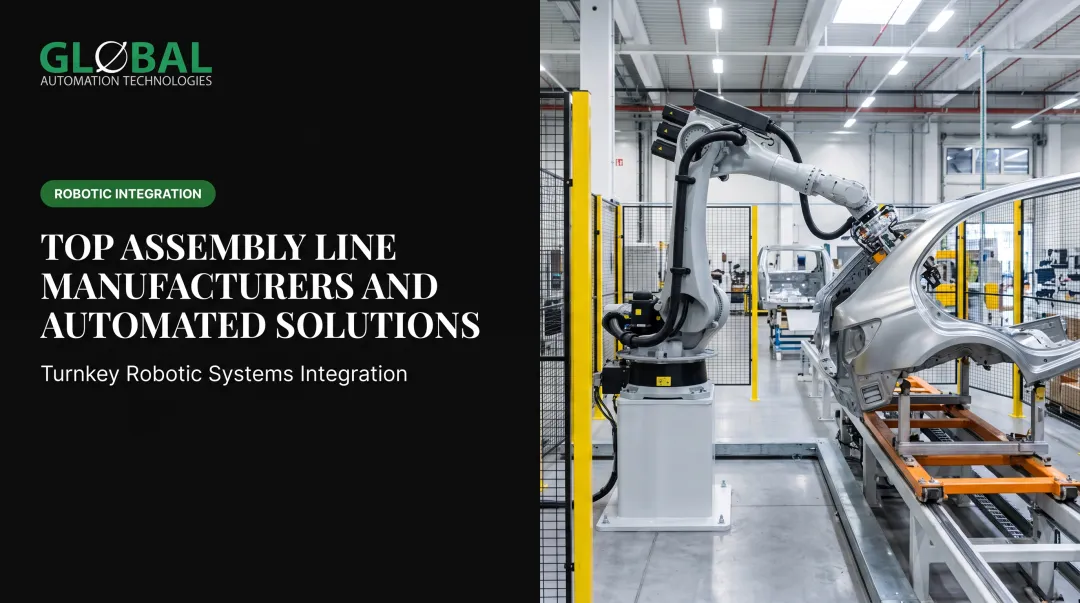
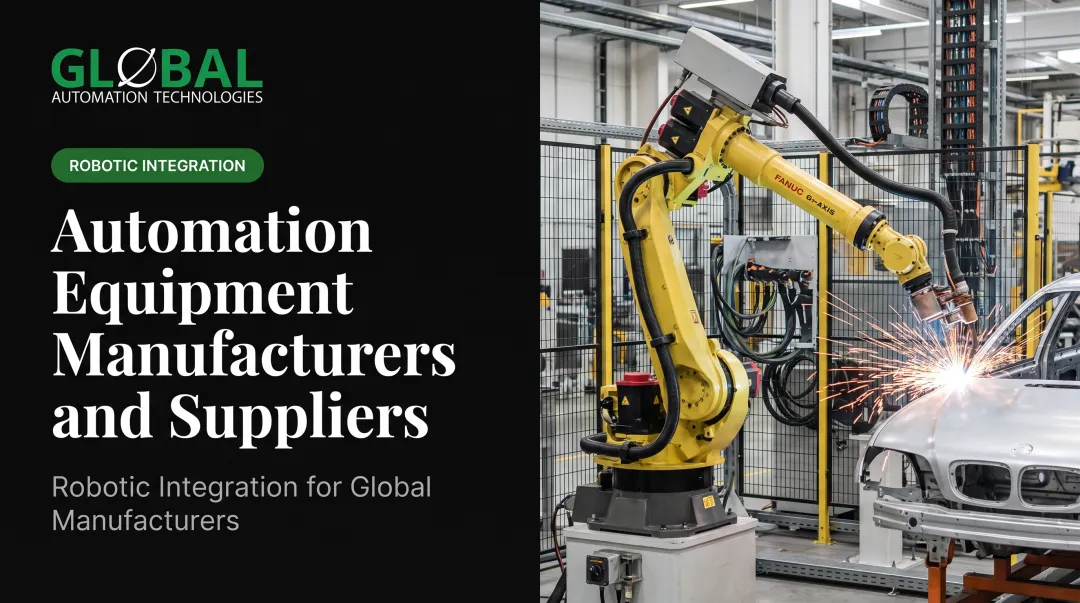
Articulated robots handle welding, dispensing, painting, and machine tending. These jobs are repetitive, hazardous, or demand precision beyond steady human consistency. GLOBAL, which purchased more FANUC robots than any other North American integrator in 2025, for example, primarily deploys FANUC robots for these applications, including:
- Automotive basecoat, topcoat, and clearcoat painting with film build held within specification
- Structural adhesive and seam sealer dispensing with real-time bead-width and continuity validation
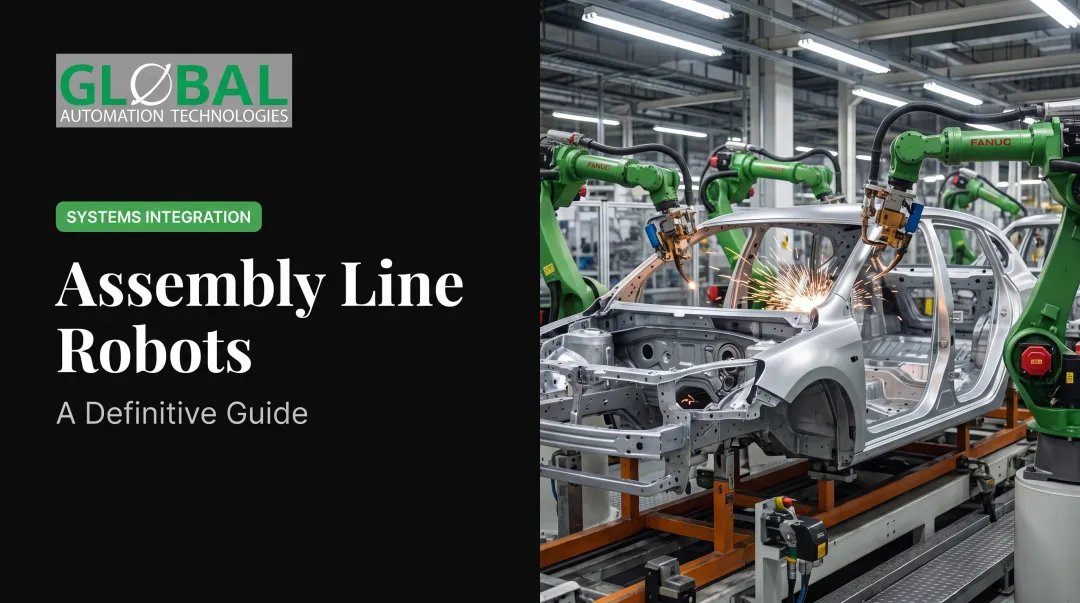
- Multi-robot coordinated welding cells with adaptive path correction

Automated Assembly and Fastening Machines
Soldering stations, torque tools, and automated fastening equipment dominate electronics and appliance assembly, handling bolt tightening, nut running, and component insertion with recorded torque data for traceability.
Inspection and Quality Control Tools
Vision systems and sensors catch defects in-line before parts move downstream. Flow monitoring during dispensing, for instance, checks bead placement and continuity in real time rather than relying on post-process inspection.
Safety and Support Equipment
Guarding, light curtains, and ergonomic station layouts protect workers around automated cells. That matters because OSHA notes many robot-related incidents happen during programming, maintenance, or setup—not normal operation.
Packaging and End-of-Line Systems
Case erectors, sealers, labelers, and palletizers close out the line. They package finished goods, apply labels, and stage pallets so product moves cleanly from final assembly to shipping.

Key Benefits of Working with a Modern Equipment Manufacturer
A modern automation partner does more than ship hardware. The real gains show up in faster startups, higher equipment utilization, and safer, more consistent production.
Faster Startups
AI-assisted simulation lets engineers model, test, and optimize robot programs before writing a single line of production code. This has shifted programming timelines from weeks to days, shortening overall commissioning schedules. Siemens reports a virtual commissioning case that cut commissioning time by 70% using a similar simulation-first approach.
Higher Throughput and Utilization
Machine tending cells keep equipment running through breaks, shift changes, and overnight — hours that would otherwise sit idle. That extended utilization is why these cells typically pay for themselves in 12 to 18 months, driven by higher output and reduced direct labor hours per part.
Improved Safety and Consistency
Robotic painting removes operators from spray booths entirely, eliminating exposure to:
- Isocyanates
- Volatile organic compounds (VOCs)
- Overspray particulates
OSHA lists these as recognized hazards in painting and coating environments. Automation removes the exposure risk by keeping people out of the booth.
Repeatable spray patterns also cut the variability of manual application, supporting uniform film build on every part.
How to Choose the Right Assembly Line Equipment Manufacturer
Choosing an assembly line equipment partner shapes production capacity for years. Use these criteria to separate full-service integrators from vendors who only ship hardware.
Evaluate Turnkey Capability
Look for a partner who owns the entire process:
- Layout and process study
- Conceptual and mechanical design
- Robot simulation and controls programming
- Build, installation, and commissioning
- Operator training and documentation
- Ongoing technical support

A partner who stops at "build and ship" leaves you managing integration risk alone.
Check Cross-Industry Experience
A manufacturer that has solved welding challenges in automotive can often adapt that same problem-solving lens to aerospace, heavy equipment, or data center infrastructure. Applications transfer even when industries don't.
Ask About Talent and Staffing Support
This is where most vendors fall short. GLOBAL pairs its engineering services (robot simulation, controls, commissioning) with a technical staffing that supplies controls engineers, robotics technicians, and project managers on contract, contract-to-hire, or direct-hire terms.
One call gets you the system and the people to operate it, a structure most pure-play integrators simply don't offer.
Assess Technology Sophistication
Prioritize vendors using AI-assisted simulation and predictive maintenance health assessments. These tools flag equipment issues before they cause unplanned downtime, protecting both production schedules and maintenance budgets.
Confirm Track Record and Scale
Ask directly:
- How many years has the company operated?
- How many robots has it sold or integrated?
- How many countries has it worked in?
GLOBAL has 17+ years in operation, 700+ FANUC robots installed, and project experience across 22 countries. Compare those credibility markers against any vendor you evaluate.
Request References Specific to Your Volume and Complexity
A system built for high-volume automotive welding won't necessarily suit low-volume, high-mix aerospace assembly. Ask for references matching your production profile, not just generic success stories.
Industries That Rely on Assembly Line Equipment Manufacturers
Several manufacturing sectors depend on assembly line equipment partners for uptime, precision, and flexible capacity.
Automotive OEMs and Tier 1 suppliers run high-volume welding, assembly, and dispensing lines where uptime and precision aren't optional. Applications span body shop welding, paint and sealing, and final assembly fastening with full traceability.
Heavy equipment and commercial vehicle manufacturers need large-format material handling and machine tending. Pemamek's 2024 robotic welding station development reflects growing demand for flexible robotic welding in heavy fabrication, where part sizes and mix vary more than in automotive.
Emerging sectors are catching up fast. Data center infrastructure manufacturers building server racks, enclosures, and power distribution equipment face rising demand as electrical infrastructure investment accelerates nationwide.
Providers already strong in material handling, welding, and assembly can extend into this work without a long sector-specific track record.
Frequently Asked Questions
What is assembly line manufacturing?
Assembly line manufacturing is a sequential production process where products move through workstations, each adding a component or completing a task until the product is finished.
What companies use the assembly line?
Automotive OEMs and Tier 1 suppliers are the heaviest users. Electronics, food processing, heavy equipment, and appliance manufacturers also rely on sequential production methods.
How much does assembly line automation equipment cost?
Costs vary widely based on production volume, part complexity, robot count, and required tooling or vision systems. Most integrators run a feasibility study first, then quote based on your specific throughput and quality requirements.
How long does it take to install a new assembly line system?
Timelines depend on part variability, custom tooling, and controls integration. AI-assisted simulation can shorten the programming phase from weeks to days, which helps compress the overall install schedule.
What's the difference between a systems integrator and an equipment manufacturer?
An equipment manufacturer supplies individual machines or components. A systems integrator combines those pieces into a working, validated production cell, and a turnkey integrator extends that scope through installation, training, and handoff.
Can assembly line equipment be reconfigured for new products?
Yes, if it was designed modularly. Flexible conveyor and cell designs support reconfiguration, but how far you can go depends on how the original system was engineered.