
Beyond filling labor gaps, automation is reshaping how plants approach safety and cost control. Robots absorb the dirty, repetitive, and hazardous tasks that drive turnover and injury claims, while delivering the consistency that quality teams have chased for years.
The demand data backs this up. North American companies ordered 36,766 robots worth $2.25 billion in 2025, a jump of 6.6% in units and 10.1% in revenue over the prior year, according to the Association for Advancing Automation. General industry, not automotive, led that growth.
TL;DR
- Process automation deploys robots, sensors, and controls so physical production tasks run with far less manual labor
- Plants ease labor shortages, stabilize quality, and clear throughput bottlenecks on the floor
- Weigh ROI/payback timeline, safety impact, and integration complexity before you buy
- Eight manufacturing automation categories dominate plant-floor decisions heading into 2026
Overview of Process Automation in the Manufacturing Industry
Process automation, in a manufacturing context, refers to robots, sensors, and industrial controls that handle repetitive physical tasks on a production line. This differs from software-only robotic process automation (RPA) or business process management (BPM) tools, which automate digital office workflows—not physical parts on a conveyor.
US manufacturing faces a real labor gap. Deloitte and the Manufacturing Institute project plants could need 3.8 million new workers between 2024 and 2033, with roughly 1.9 million roles potentially going unfilled without intervention, according to Deloitte's 2024 workforce analysis.
Reshoring is compounding that pressure. Plants are moving toward automated cells that don't depend on a fully staffed shift to run.
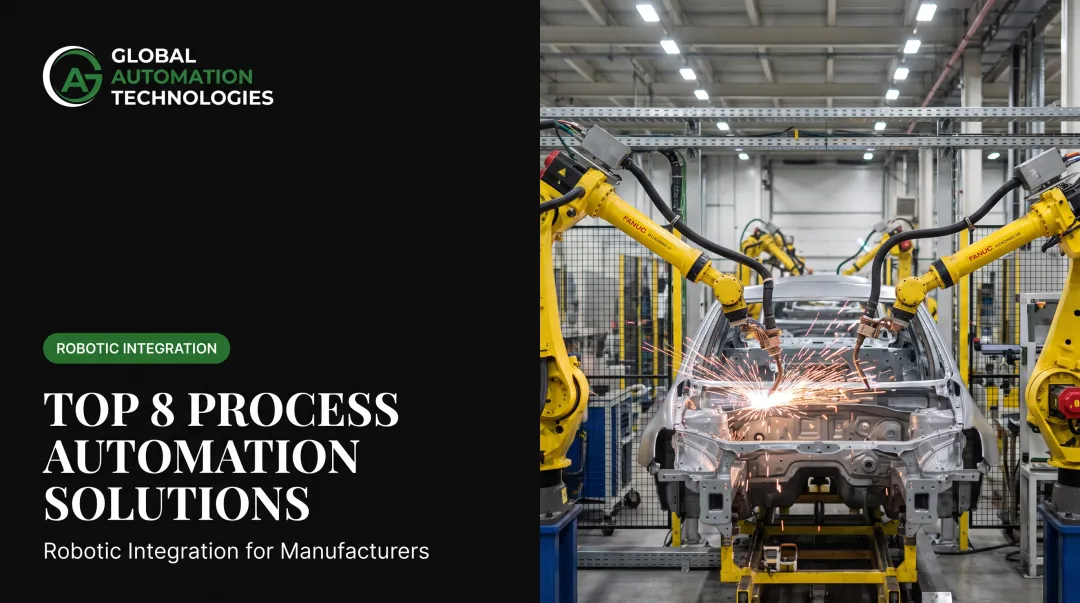
Below are the eight process automation solutions manufacturers are actually deploying on their lines this year, not just talking about at trade shows.
Top 8 Process Automation Solutions for Manufacturing in 2026
Each solution below covers typical use cases, the primary operational benefit, and a key decision factor—ROI timeline, safety impact, or integration complexity.

Solution 1: Robotic Welding Automation
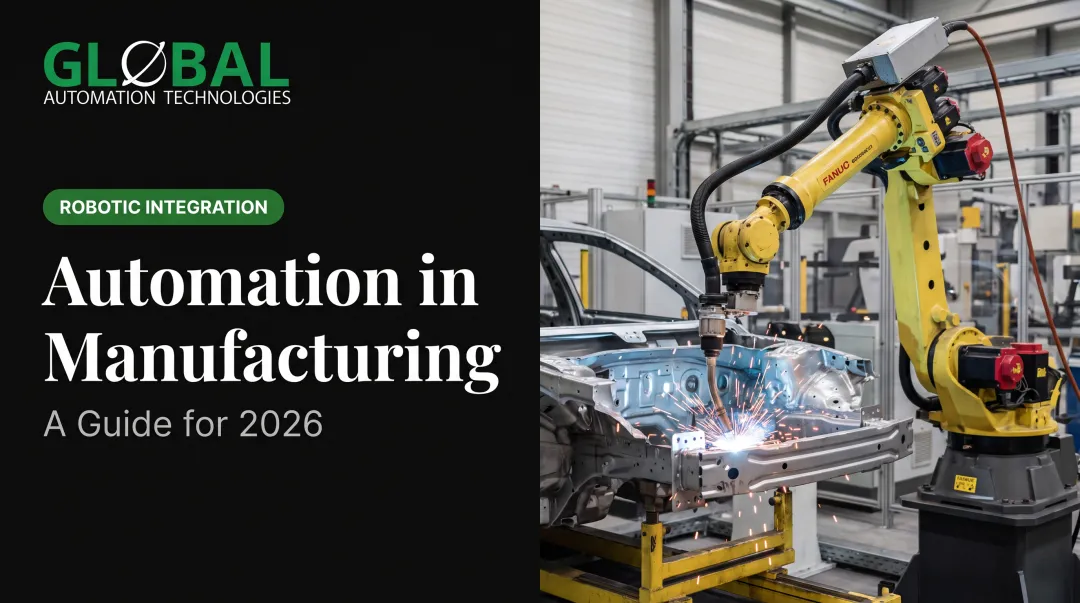
Robotic arc and spot welding cells have been the backbone of high-volume production for decades, delivering welds that don't degrade in quality on the 400th part like a tired operator might.
What makes today's cells stand out is seam tracking paired with AI-assisted simulation. Vision-guided seam tracking adjusts the weld path in real time as part geometry shifts.
Offline simulation lets engineers test and refine programs before they touch the production floor, which cuts changeover time.
| Category | Details |
|---|---|
| Typical Use Cases | Automotive body-in-white, chassis, heavy equipment frames |
| Key Benefit | Improved weld consistency and reduced rework |
| Typical ROI Timeline | A few months to two years, depending on production volume and system complexity |
Solution 2: Robotic Machine Tending
Machine tending robots load and unload CNC machines, presses, and injection molding equipment, keeping spindles running through breaks and overnight shifts when no operator is on the clock.
Well-designed tending cells raise spindle utilization dramatically because the robot never needs a bathroom break. Integrators building these systems typically see them pay for themselves in 12 to 18 months, based on the straightforward math of more parts per shift with fewer direct labor hours.
| Category | Details |
|---|---|
| Typical Use Cases | CNC machining, stamping, injection molding |
| Key Benefit | Higher spindle utilization and extended operation between scheduled maintenance windows |
| Typical ROI Timeline | 12 to 18 months |
Solution 3: Robotic Material Handling
Pick-and-place and part-transfer robots move components between stations, replacing the manual handling that causes both bottlenecks and back injuries.
Vision-guided systems, using tools like camera-based bin picking, let robots locate and orient parts that arrive in random positions. That flexibility reduces downtime from misaligned parts and takes operators out of repetitive lifting tasks that drive manual-handling injury claims.
| Category | Details |
|---|---|
| Typical Use Cases | Part transfer, loading/unloading, line-to-line movement |
| Key Benefit | Fewer handling injuries and faster cycle times |
| Integration Complexity | Varies by part variability; virtual commissioning can cut debugging time from weeks to days |
Solution 4: Robotic Painting & Coating Systems
Robotic spray systems dominate automotive and heavy equipment finishing lines, where consistency and finish quality can't depend on an operator's steady hand.
Precision robotic painting systems follow the same programmed path every cycle, holding film build within specification shift after shift while cutting overspray and material waste. That repeatability matters beyond cost.
NIOSH identifies isocyanates, a common paint ingredient, as a severe respiratory and skin irritant capable of triggering occupational asthma. Removing operators from the booth eliminates that exposure entirely.
| Category | Details |
|---|---|
| Typical Use Cases | Automotive body paint, heavy equipment finishing |
| Key Benefit | Consistent film build and reduced paint waste |
| Safety Impact | Removes operators from hazardous VOC and isocyanate exposure |
Solution 5: Robotic Dispensing & Sealing
Automated dispensing systems apply adhesives, sealants, and gaskets with a precision manual application simply can't match, especially along complex 3D joint geometries.
Real-time validation sets these systems apart. Vision inspection checks bead width, placement, and continuity, while flow monitoring confirms material volume, catching a starved or missed bead before the part ever reaches the next station.
| Category | Details |
|---|---|
| Typical Use Cases | Adhesive bonding, gasket sealing, encapsulation |
| Key Benefit | Fewer downstream defects and reduced rework |
| Technology Enabler | Real-time vision and flow-rate monitoring |
Solution 6: Robotic Assembly Automation
Assembly robots handle fastening, press-fit, and multi-part joining tasks that used to require dedicated stations and skilled operators for each product variant.
Flexible tooling and quick-change end-effectors let one cell run multiple product variants without a full retool. That flexibility is what makes robotic assembly viable for plants that can't dedicate a separate line to every SKU.
| Category | Details |
|---|---|
| Typical Use Cases | Component assembly, fastening, sub-assembly integration |
| Key Benefit | Higher throughput with reduced unit-to-unit variation |
| Best Fit For | High-mix, high-volume production environments |
Solution 7: Robotic Inspection & Vision-Based Quality Automation
Machine vision inspection systems now catch defects in real time, on the line, instead of after a part has already traveled three stations downstream.
AI-assisted defect detection reduces reliance on manual visual checks, which are inherently inconsistent across shifts and fatigue levels. These systems flag surface flaws, dimensional errors, and weld inconsistencies earlier, before scrap costs compound.
| Category | Details |
|---|---|
| Typical Use Cases | Surface defect detection, dimensional checks, weld/seam inspection |
| Key Benefit | Earlier defect detection and reduced scrap |
| Technology Enabler | AI-assisted vision systems and predictive analytics |
Solution 8: Robotic Palletizing & Packaging Automation
End-of-line robots that palletize, case-pack, or stack finished goods keep shipping moving without a crew working overtime to hit a truck deadline.
Palletizing automation supports high-volume throughput beyond a single shift at the point in the line where fatigue-related errors and repetitive-strain injuries are most common. Optimized pallet patterns, tuned to each SKU mix, also cut load-stability issues that manual stacking often introduces.
| Category | Details |
|---|---|
| Typical Use Cases | Case packing, palletizing, stacking, load stabilization |
| Key Benefit | Consistent throughput with minimal labor dependency |
| Best Fit For | High-volume distribution and shipping operations |
How to Choose the Right Process Automation Solution for Your Facility
The most common mistake is chasing the newest trend instead of matching automation to an actual production bottleneck. A close second: underestimating how complex changeover will be once a system is live.
Weigh these factors before signing off on any project:
- ROI/payback timeline — A shorter payback frees capital for the next line improvement faster
- Safety impact — Removing workers from hazardous or repetitive tasks lowers injury costs and turnover
- Integration complexity — Poor fit with existing lines means delays, rework, and budget overruns
- Access to engineering talent — A system without skilled hands to run and maintain it becomes an expensive paperweight

That last point trips up more manufacturers than they expect. Buying a robotic cell from one vendor and staffing it through another often creates a knowledge gap. Nobody fully understands the system, and small issues turn into extended downtime.
Conclusion
The right automation partner fits your operational reality, not the latest robotics headline. Before signing a contract, evaluate ongoing support, scalability across product lines, and total cost of ownership, not just the sticker price on the cell.
GLOBAL Automation Technologies has spent 17+ years building turnkey robotic systems, with a proven global base of robotic deployments across welding, painting, dispensing, machine tending, material handling, and assembly applications.
As a Level 5 FANUC Authorized System Integrator, GLOBAL pairs its automation solutions and engineering services with technical staffing, so you get both the system and the engineers who know how to run it. If you're weighing which of these eight solutions fits your line, reach out for a consultation.
Frequently Asked Questions
What are process automation solutions?
Process automation solutions include robotics, sensors, controls, and software that automate repetitive manual or physical tasks. In manufacturing, this typically means robotic welding, handling, or inspection cells rather than office software.
What industries benefit most from process automation solutions?
Automotive OEMs, Tier 1 suppliers, and heavy equipment manufacturers see the biggest gains from high-volume, repetitive production needs. Aerospace, agriculture, and data center infrastructure manufacturers are close behind.
How much does industrial process automation cost?
Cost varies with cell complexity, robot count, and tooling. Focus on payback instead of sticker price alone—many machine tending and handling cells return investment in 12 to 18 months.
How long does it take to implement a robotic automation cell?
Timelines depend on part complexity, safety validation, and controls integration, but AI-assisted simulation has compressed robot programming from weeks down to days in many recent projects.
What is the difference between industrial process automation and robotic process automation (RPA)?
Industrial process automation uses physical robots to handle materials on a factory floor. Software RPA automates digital tasks like data entry or invoice processing in an office environment. They solve entirely different problems.
How do I know which process is the best candidate for automation?
Look for tasks that are high-volume, repetitive, hazardous, or quality-critical. If a job is dirty, dull, dangerous, or prone to inconsistent output between operators, it is a strong automation candidate.