
Manufacturers often understand what a robot does or what a SCADA dashboard shows them. Far fewer understand the PLC sitting between the two, quietly coordinating everything. That gap causes real problems: mismatched equipment, slow troubleshooting, and automation cells that never quite hit their promised ROI.
This guide breaks down what a PLC actually is, how it works, how it powers robotic work cells, and what to look for in a partner who can build one for your floor.
Key Takeaways
- PLCs are ruggedized industrial computers that scan inputs, run logic, and update outputs to control machinery in real time
- PLCs act as the coordination layer linking sensors, robots, HMI/SCADA systems, and production equipment
- Choose fixed PLCs for stable I/O needs; pick modular designs when you expect future expansion
- PLC-driven robotic cells, especially machine tending setups, often pay for themselves in 12 to 18 months
What Is a PLC in Factory Automation?
A PLC is an industrial computer built to store and execute instructions, monitor inputs, and control outputs for machinery and processes. It's the digital brain behind conveyor lines, robotic cells, packaging equipment, and nearly every automated process on a modern factory floor.
Unlike a standard office computer, a PLC has to survive conditions that would kill consumer-grade electronics within a week: constant vibration, electrical noise, temperature swings, and dust.
Siemens' S7-1500 systems, for example, are tested against IEC 61131-2-derived conditions, including vibration and shock ratings up to 15 g for 11 ms and operation down to -30°C on certain modules. That's hardware built for a welding cell or machine shop, not a server room.
This ruggedness is why PLCs, not general-purpose PCs, remain the standard for direct machine control.
How a PLC Works: The Input–Process–Output Cycle
Every PLC runs the same basic loop, over and over, thousands of times per minute:
- Input scan – The PLC reads every connected sensor, switch, or button. Is the door closed? Is the part present? What's the tank pressure?
- Program execution – It runs the programmed logic against those inputs, following the rungs of a ladder diagram or equivalent code.
- Output update – Based on the logic results, it fires the appropriate outputs: energize a motor, open a valve, trigger an alarm.

Then it starts over, in milliseconds.
Picture a pressure sensor on a valve. The sensor feeds a digital "high/low" or analog "variable pressure" signal into the PLC as an input. The program compares that reading against a setpoint. If pressure exceeds the limit, the PLC sends an output signal that repositions the valve.
Digital I/O handles simple on/off signals. Analog I/O handles continuously variable data like pressure, temperature, or flow rate, often through modules supporting 4 to 32 points each.
Types of PLCs: Fixed, Modular, and PAC
Not every application needs the same hardware. The choice usually comes down to three categories:
| Type | Best fit | Trade-off |
|---|---|---|
| Fixed/embedded | Small, bounded machines with a known I/O count | Compact and affordable, but limited room to grow |
| Modular | Lines expecting future expansion or process changes | Higher upfront cost, but easier to scale and troubleshoot module-by-module |
| PAC (Programmable Automation Controller) | Complex, data-intensive, multi-discipline control | More processing power and PC-like capability, but often more than a simple cell requires |
A compact fixed controller might offer 12 to 48 embedded I/O points with limited expansion slots — fine for a single standalone station. A modular platform, by contrast, lets you add expansion racks as the line grows, which matters if you're planning to add stations or robots down the road.
Core Components of a PLC-Based Automation System
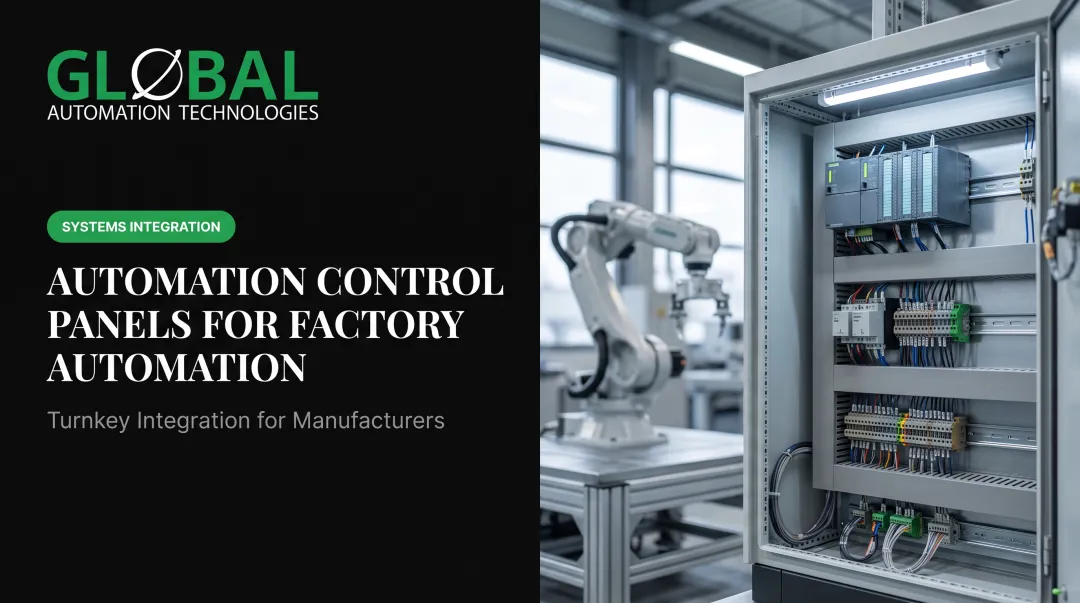
The PLC doesn't operate alone. It's the hub of a broader control architecture that includes:
- HMI (Human-Machine Interface) – gives operators a screen to monitor and adjust the process
- SCADA – provides plant-wide visibility and historical data across multiple PLCs and lines
- Sensors and actuators – the physical eyes, ears, and hands wired directly into PLC I/O
- Industrial networks – protocols like EtherNet/IP, PROFINET, and Modbus TCP/IP that let controllers, robots, and I/O devices exchange data reliably
Each piece feeds data to or receives commands from the PLC, forming one connected control system rather than a collection of standalone devices.
PLC Programming Languages and Software Platforms
PLCs are programmed using standardized IEC 61131-3 languages, each suited to a different type of logic:
- Ladder Logic – Most common language; mimics relay wiring diagrams and is easiest for electricians and technicians to read
- Structured Text – Text-based language closer to traditional programming; better for complex math and data handling
- Function Block Diagram – Graphical blocks connected by logic flow; useful for process control applications
- Sequential Function Chart – Step-and-transition structure for sequential and state-driven machine processes

Which environment you use depends heavily on your hardware brand. Allen-Bradley systems run on Studio 5000 Logix Designer, Siemens controllers use TIA Portal (STEP 7), and Omron systems run on Sysmac Studio. This matters at the purchasing stage: switching PLC brands later often means retraining your team on an entirely different software environment.
AI-assisted programming is moving into mainstream PLC tools. Siemens connected its Industrial Copilot to TIA Portal in 2024, so engineers can generate structured-control code inside the platform. That shortens logic development. Simulation-based commissioning is a separate step: it proves the code works before startup, rather than only speeding up how fast you write it.
Key Benefits of PLC-Driven Factory Automation
Efficiency and Consistency
PLCs eliminate the variability that comes with manual operation. A task programmed once runs the same way every cycle, which shortens cycle times and keeps output predictable shift after shift.
No single productivity percentage applies to every deployment; gains depend on the process. Documented case studies still point the same way: tighter, more repeatable cycles.
Quality and Worker Safety
Removing manual variability also reduces defects tied to human error. PLC-controlled automation can take workers out of genuinely hazardous roles.
Automation is not automatically safe. NIOSH has documented 41 robot-related fatalities in the U.S. between 1992 and 2017. Safety benefits only show up with proper guarding, risk assessments, and safety-rated controls, not from installing equipment and hoping for the best.
Flexibility and Data Value
Other practical advantages include:
- PLCs can be reprogrammed for new products or process changes without ripping out hardware
- Modern PLCs feed operational data upstream into SCADA and predictive maintenance systems
- Upstream data supports smarter scheduling, fewer surprise breakdowns, and better long-term decisions
PLCs and Robotics: Building Complete Automation Cells
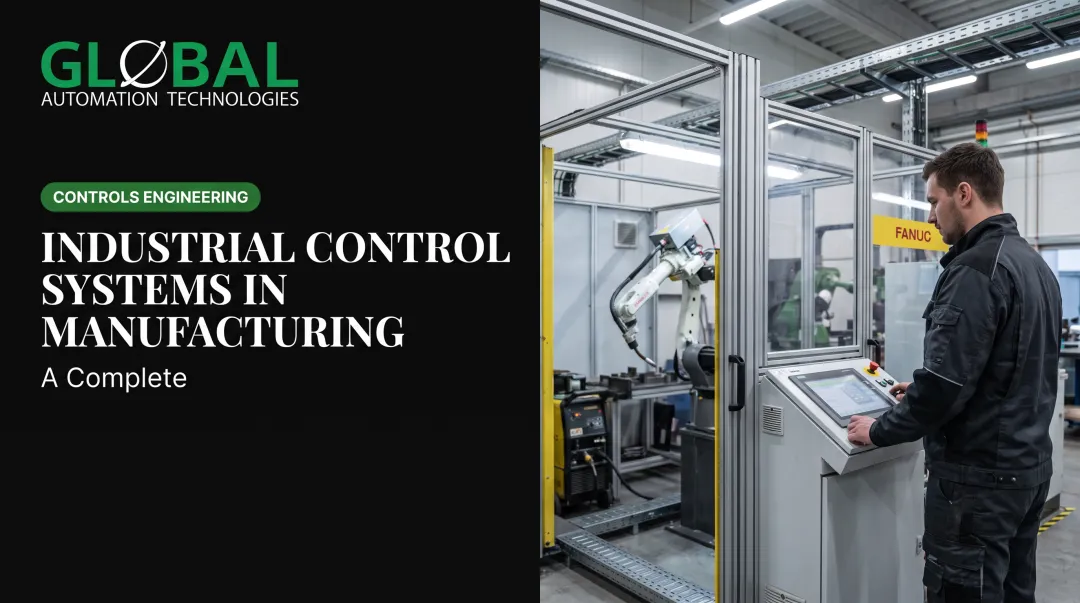
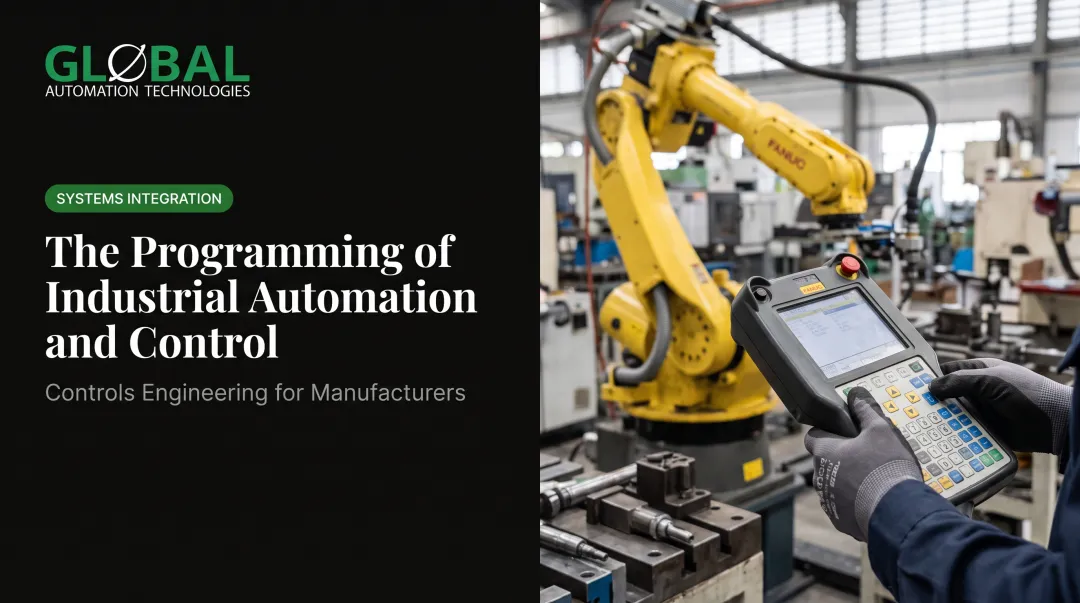
In most modern robotic work cells, the PLC acts as the cell controller. It synchronizes robot movement, conveyor speed, safety interlocks, and sensor feedback into one coordinated sequence. FANUC robot controllers communicate with the PLC over networked interfaces to trigger pick/place, load/unload, or dispensing actions at the exact moment the cycle calls for it.
Machine Tending in Action
Take robotic machine tending as an example. The PLC continuously monitors machine status and signals the robot to load or unload the next part the instant conditions are met:
- Spindle cycle complete
- Door clear
- Part present
This tight coordination is what drives higher spindle utilization and longer unattended runtime. At GLOBAL Automation Technologies, we've seen machine tending cells like this typically pay for themselves in 12 to 18 months, largely because the machine keeps running through breaks, shift changes, and overnight hours instead of sitting idle waiting for an operator.
Painting and Dispensing Applications
Robotic painting and dispensing cells lean on the PLC differently. Here, it manages real-time flow monitoring and dispensing-bead checks, and it guides the robot along a repeatable programmed path. Full film-build and coating-coverage verification happens through downstream inspection, with robotic spot repair as needed, rather than live in the booth. That same PLC-managed control loop is what keeps film build within specification shift after shift and spray patterns repeatable.
Simulating Before You Build
Virtual commissioning lets teams prove out cell logic before hardware hits the floor. A Rockwell Automation case study on an automotive facility using Emulate3D software reported installation and commissioning time cut by up to 50%, with an estimated five months saved in project lead time.
That's a single documented case, not a guaranteed universal outcome, but it illustrates the value of testing logic virtually before it touches the floor. At GLOBAL, we use AI-assisted simulation to model and validate PLC-robot logic before deployment, which has moved our own programming timelines from weeks down to days and cut down on costly on-floor surprises.
After the cell is live, that same data stream supports AI-driven predictive maintenance. Health-assessment tools monitor PLC and robot signals continuously and flag developing issues before they cause unplanned downtime.
Choosing the Right Automation Partner for Your PLC-Driven Factory
Not every integrator is equipped to handle both the controls side and the robotics side equally well. Check these points before you sign a contract:
- Multi-platform experience – Has the partner worked across different PLC brands and robot platforms, or only one?
- True turnkey capability – Do they handle layout, programming, commissioning, and training, or just the mechanical install?
- Combined integration and staffing – Can they place controls engineers on-site after go-live, or will you scramble for talent six months later?
- Post-installation support – Do they offer ongoing troubleshooting, predictive maintenance monitoring, and contract or direct-hire engineers when your team is stretched thin?

That combined model, building the system and supplying the people to run it, is what GLOBAL Automation Technologies is built around. As a Level 5 FANUC Authorized System Integrator that pairs turnkey automation solutions and engineering services with technical staffing, GLOBAL gives you one partner who owns both the code and the talent that keeps the cell running years later.
Frequently Asked Questions
What is a PLC in factory automation?
A PLC is a ruggedized industrial computer that monitors inputs and controls outputs based on programmed logic. It's what automates machinery and processes on a factory floor in real time.
What is the difference between a PLC and a PAC?
A PAC combines PLC-level reliability with more processing power and PC-like capabilities. It handles complex, data-intensive applications more efficiently than a standard PLC.
Can PLCs work together with industrial robots on a production line?
Yes. PLCs commonly act as the cell controller, coordinating robot actions, conveyor movement, and safety systems within a robotic work cell as one synchronized process.
How long does it typically take to deploy a PLC-controlled automation system?
Timelines vary widely by project complexity, guarding requirements, and brownfield integration challenges. AI-assisted simulation and offline programming can cut commissioning time by up to half on some projects.
Which industries rely most heavily on PLC-based factory automation?
Automotive, heavy equipment, and general industrial manufacturing lean on PLC-driven automation the most, with growing adoption in EV production, aerospace, and packaging.
Do I need both a PLC and a SCADA system in my factory?
Yes, in most cases. The PLC handles real-time equipment control while SCADA provides plant-wide monitoring and data visibility. They work together rather than replacing one another.