
Introduction
Walk onto a modern factory floor and you'll notice something: the machines aren't just running, they're talking. Sensors report spindle health. Dashboards flag quality drift before a bad part ever ships. Downtime gets predicted, not just discovered.
But most plants aren't there yet. Many manufacturers still run legacy equipment with production data trapped in silos. PLCs don't talk to ERP systems. Quality data lives in a spreadsheet. Maintenance logs go unchecked until something breaks.
That gap is exactly what industrial IoT (IIoT) integration solves. This article covers what IIoT integration means, why it matters on the plant floor, the core components and common pitfalls, and how to implement it without a costly false start.
Key Takeaways
- IIoT integration unifies machines, sensors, and controls into one data layer that drives real plant decisions
- Unplanned downtime costs manufacturers a median of $125,000 per hour, making predictive maintenance a top-value use case
- Legacy equipment isn't a blocker — most machines can be retrofitted with gateways instead of replaced
- Starting with one use case (like machine tending) beats connecting an entire plant at once
What Is Industrial IoT Integration?
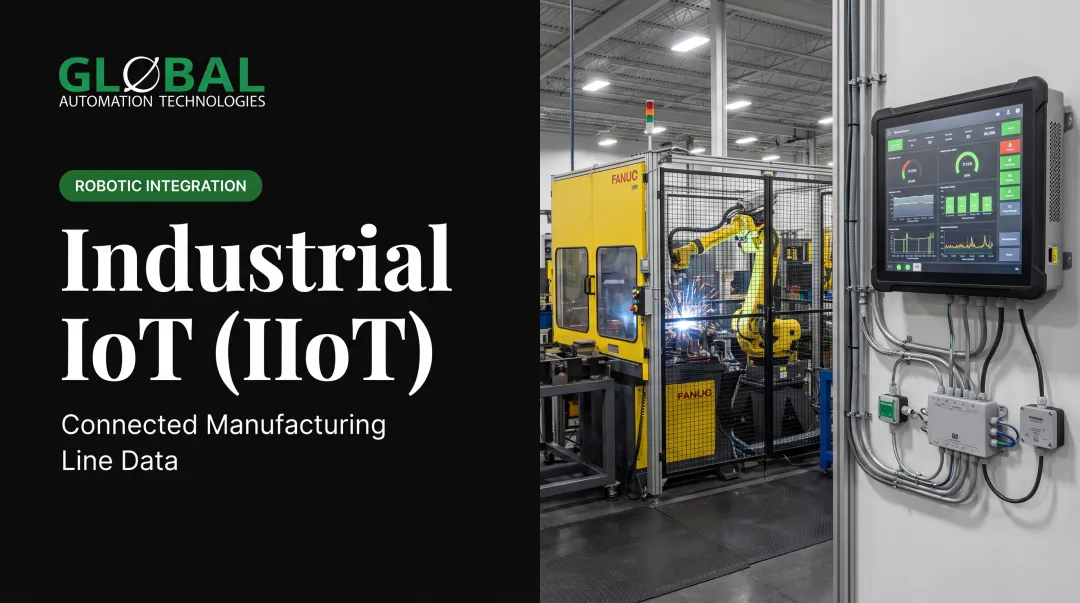
Industrial IoT integration is the process of connecting industrial machines, sensors, PLCs, and control systems into a unified data and software layer. That layer captures production data in real time, analyzes it, and feeds it back into decisions on the floor and in the front office.
Connectivity alone isn't integration. A sensor bolted onto a conveyor and streaming vibration data to a local screen is connected. It's not integrated until that data flows into an MES, ties into ERP inventory records, or triggers an alert a maintenance engineer actually acts on. Integration is what turns raw sensor output into a decision.
IIoT integration also isn't just about new equipment alone. Most projects involve connecting machines that have been running for 15, 20, even 30 years. A retrofit gateway can pull signals off an older PLC without replacing it, so "integration" is as much about bridging the old as adding the new.
IIoT vs. Consumer IoT vs. Industry 4.0
These three terms get used interchangeably, but they're not the same thing.
| Category | Focus | Reliability/Security Needs | Example |
|---|---|---|---|
| Consumer IoT | Convenience devices | Low-stakes if it fails | Smart thermostat, doorbell camera |
| Industrial IoT (IIoT) | Production-critical systems | Downtime = lost revenue, safety risk | Sensor on a stamping press |
| Industry 4.0 | Strategic operating model | Encompasses IIoT plus more | Digital twins, AI-driven business models |
The International Society of Automation frames IIoT as a subset of the broader IoT world, specifically applied to manufacturing equipment and processes. Industry 4.0 is the bigger umbrella: it includes IIoT plus cyber-physical systems, digital twins, and data-driven business models.
That distinction matters on the plant floor: a huge share of the equipment IIoT projects need to connect predates modern industrial networking entirely.
More than 70% of North American manufacturing equipment is over 20 years old, according to IndustryWeek's 2025 reporting on the Manufacturing Leadership Council. That's not a barrier to integration. It's the actual starting point for most projects.
Why Industrial IoT Integration Matters in Manufacturing
On the plant floor, Industrial IoT integration shows up as fewer surprises, less scrap, and safer operations:
- Catch failures before they stop the line
- Spot bottlenecks in real time, not in next week's meeting
- Stop defects at the source instead of at final inspection
- Pull operators out of hazardous spray and chemical zones
- Scale a fix from one cell to the whole facility
Predictive maintenance. Sensor and AI-driven data can flag bearing wear, motor degradation, or hydraulic pressure drift before a machine fails outright.
The financial case is stark. ABB's 2023 Value of Reliability survey of over 3,200 plant-maintenance decision-makers found a median unplanned-downtime cost of $125,000 per hour. One missed alert can wipe out a quarter's maintenance budget in an afternoon.
Production efficiency and uptime. Real-time visibility means a plant manager catches a line imbalance or a creeping bottleneck the moment it happens, not during next week's production meeting.
Quality control. Continuous monitoring catches defects at the source instead of at final inspection, when scrap or rework has already eaten into margin. In dispensing, inline vision and flow-monitoring check bead width, placement, and continuity at the point of application, while in painting, vision guidance orients parts and full finish inspection with any robotic spot repair happens downstream rather than live in-booth.
Worker safety. In processes involving isocyanates, VOCs, or overspray, OSHA documents real health risks — skin irritation, occupational asthma, respiratory issues. Remote monitoring and robotic automation let operators run these processes from outside the hazard zone entirely.
Faster, plant-wide decisions. A unified data layer across machines and lines makes it possible to scale a fix from one cell to an entire facility, or from one plant to five, without reinventing the process each time.
Key Components of an Industrial IoT Integration Architecture
Think of the IIoT stack in five layers: sensors and devices, connectivity, edge computing, cloud/analytics, and the application layer where data becomes a decision.

Sensors, Actuators & Legacy Equipment
Sensors capture the physical world: vibration, temperature, cycle counts, current draw. Actuators act on commands sent back down from the system. The tricky part is older equipment that was never built with digital output in mind.
That's where retrofit gateways come in. They tap into existing signals or add lightweight sensors externally, bridging a legacy machine into the broader IIoT system without replacing the PLC. This is the single most common reason integration projects stall out on paper but succeed in practice: teams assume old equipment needs replacing when it usually just needs a bridge.
Connectivity & Communication Protocols
Standardized protocols are what let a 2005 PLC and a 2024 robot controller speak the same language. The major ones:
- OPC UA — vendor-neutral, secure data exchange across platforms
- MQTT — lightweight publish/subscribe messaging, ideal for moving shop-floor data to the cloud
- PROFINET — industrial Ethernet with real-time device communication
- EtherNet/IP — Ethernet-based protocol built for smart manufacturing
- Modbus — older but still widely used for connecting legacy devices
Without a shared protocol layer, every machine becomes its own island: exactly the silo problem IIoT integration is meant to solve.
Edge Computing & Cloud Analytics
Edge devices pre-process data close to the source, filtering noise and reducing the bandwidth needed to send everything to the cloud. Only the meaningful signals move upstream.
Cloud platforms handle the heavier lifting: historical trend analysis, cross-plant comparisons, and the AI/ML models that turn aggregated data into predictions.
Predictive maintenance alerts and quality-anomaly detection are generated here. This is also where AI-assisted simulation and equipment health assessments do their work.
Application Layer
The application layer is where processed data reaches people and systems that act on it. That includes operator dashboards, MES and ERP connections, automated work orders, and closed-loop controls that adjust a cell without waiting on a manual review.
If the lower layers collect and refine signals, this layer turns them into a decision on the floor.
Common Challenges in Industrial IoT Integration
No integration project is friction-free. The recurring obstacles fall into three buckets.
Legacy equipment and interoperability. Decades-old machines often lack any digital interface at all. Retrofit gateways expose the data those machines already generate, so full equipment replacement is rarely required.
Cybersecurity risk. Connecting operational technology (OT) to IT networks expands the attack surface. NIST's SP 800-82 Rev. 3 guidance outlines OT-specific security countermeasures, and Fortinet's 2025 OT security report found that half of surveyed organizations had experienced at least one OT cybersecurity incident.
Network segmentation into defensible zones is the standard first line of defense.
Data overload without context. Collecting sensor data means nothing if it isn't tied into ERP or MES systems, or if there's no one qualified to interpret it. Plenty of plants end up with dashboards nobody looks at: a data graveyard instead of an actionable system.
Real-World Examples of Industrial IoT Integration
Theory is fine, but this is where IIoT integration proves itself on the floor.
Machine tending. Sensors monitoring spindle utilization and equipment health let CNC and press-tending cells run unattended for longer stretches. GLOBAL Automation Technologies, a Level 5 FANUC Authorized System Integrator, builds these cells with vision systems and intelligent part-tracking logic to keep spindle utilization as close to continuous as possible.
Machine tending cells like these typically pay for themselves within 12 to 18 months, measured against increased parts-per-shift output versus reduced direct labor hours.
Robotic painting and dispensing. In dispensing, inline vision and flow-monitoring check bead width, placement, and continuity before a part moves downstream, flagging a missed or under-applied bead at the point of application instead of letting a defect travel through five more stations. In painting, robots follow the same programmed path every cycle, holding film build within specification shift after shift rather than varying with operator technique.
Predictive maintenance. AI-driven health assessments monitor robotic systems continuously and flag developing issues before unplanned downtime hits. Plants get advance notice of wear, so failures do not show up as surprise line stops.
Worker safety. Remote monitoring and automation pull operators out of spray booths, press cells, and high-heat zones. Production keeps running without exposing people to isocyanates, VOCs, or crush hazards.
These examples map onto four broad IIoT application categories, all of which show up on a typical plant floor:
- Asset monitoring/tracking — real-time visibility into equipment condition and location
- Predictive maintenance — catching wear before it becomes failure
- Process/quality control — inline detection of defects and deviations
- Worker safety — removing people from hazardous zones through remote monitoring and automation
How to Successfully Implement Industrial IoT Integration
Trying to connect an entire plant at once is the fastest way to blow a budget and a timeline. A better approach:
- Start with one use case. Machine tending or predictive maintenance are common starting points because the ROI is measurable and fast. Phased rollouts reduce risk and prove value before you scale.
- Partner with an integrator who understands both sides. IIoT integration isn't a pure IT project. It requires someone fluent in the mechanical and robotics side and the data and software side.
- Plan for the people, not just the technology. Connecting systems is half the job. Someone still has to run, maintain, and continuously optimize that equipment day to day.
The second and third points map directly onto how GLOBAL Automation Technologies is set up. Its automation solutions and engineering services work builds and connects the physical layer: robotic cells, controls engineering, robot programming, machine vision, and the edge connectivity that feeds signals up into the plant's MES, ERP, and SCADA systems. GLOBAL supplies that robotic, controls, and connectivity layer rather than the IIoT analytics platform itself.
Its technical staffing then places the controls and mechanical engineers who keep it running long after commissioning ends. One relationship covers both the system and the people to operate it.
AI tools are accelerating this further. GLOBAL's engineers use AI-assisted simulation to model, test, and optimize robot programs virtually, compressing programming timelines from weeks to days. AI-driven predictive maintenance tools flag equipment issues before they turn into costly downtime.
Frequently Asked Questions
What does IoT integration mean?
IoT integration is the process of connecting devices, sensors, and systems into a unified platform so data can be collected, analyzed, and acted on, rather than sitting isolated in separate systems.
What does industrial IoT mean?
Industrial IoT (IIoT) applies IoT concepts to manufacturing settings specifically, with far stricter reliability, security, and equipment lifecycle requirements than consumer-grade IoT devices.
What is an example of industrial IoT?
Common examples include a sensor-equipped robotic machine tending cell that tracks spindle utilization in real time, and a predictive maintenance system that flags a failing bearing before it stops production.
What are the 4 types of IoT applications?
In manufacturing, the four common categories are asset monitoring/tracking, predictive maintenance, process/quality control, and worker safety.
Do older machines need to be replaced for industrial IoT integration?
No. Most legacy machines can be connected through retrofit gateways or by tapping existing digital signals, without replacing the PLC or the machine itself.
How is industrial IoT different from regular factory automation?
Automation executes a task, like a robot performing a weld. IIoT integration adds the data layer on top: monitoring, analyzing, and optimizing that automated process in real time.