
Introduction
Robotic material removal uses industrial robots with cutting, grinding, or abrasive tooling to shape, trim, deburr, or finish parts—removing excess material with controlled force and repeatable paths.
Manual grinding and trimming still dominate many plants. Operators lean into weld beads for hours, finish quality drifts shift to shift, and injury risk stays high. A robot holds the tool (or the part) and repeats the same path at the same force, cycle after cycle.
This guide is for manufacturing engineers, plant managers, and automation buyers in automotive, heavy equipment, and industrial manufacturing who are weighing robotic cutting, grinding, deburring, and finishing against quality, safety, and throughput goals.
"Robotic material removal" often gets used as a catch-all, but it covers several distinct processes—cutting, grinding, deburring, deflashing, and polishing—each with its own tooling and control requirements.
Below, we'll cover what the process is, how it works, where it fits in production, and when it isn't the right call.
Key Takeaways
- Robots with specialized EOAT cut, grind, deburr, deflash, or polish parts at consistent production quality
- Manual finishing drifts with fatigue—uneven pressure creates gouges, burrs, and costly rework
- Force control, tooling, and fixturing matter far more than bolting a tool onto a robot arm
- Highest-value uses: automotive trim/deflash, weld grinding, casting finish, and post-machining deburr
- Low volume, heavy stock removal, or highly variable parts often favor non-robotic methods
What Is Robotic Material Removal?
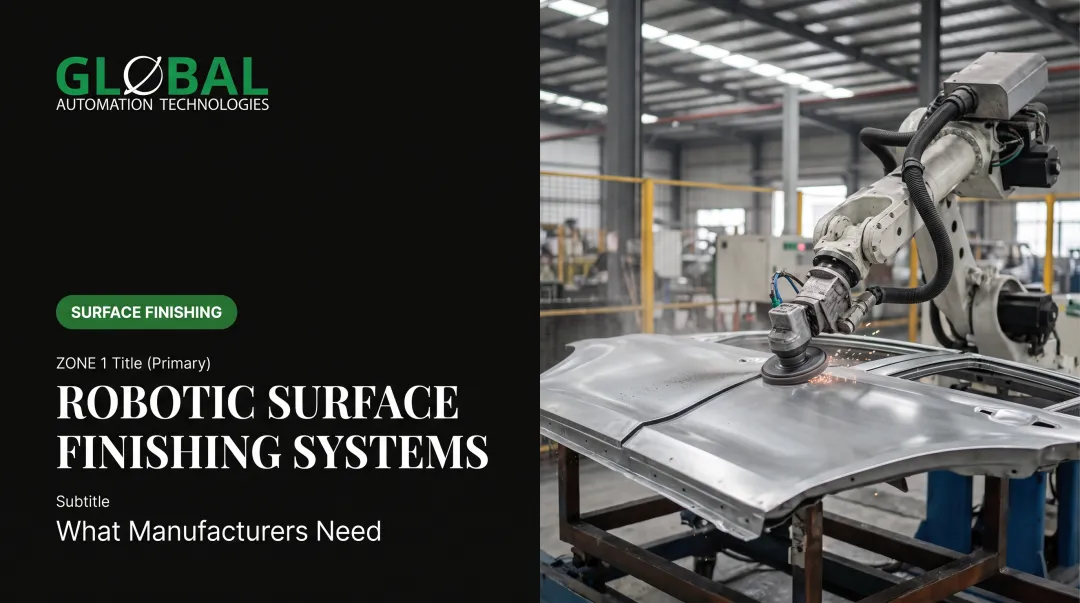
Robotic material removal means fitting an industrial robot with a cutting, grinding, sanding, or trimming tool, or having the robot hold the part against a stationary tool. The robot strips away excess material to reach a target shape, dimension, or finish.
The goal isn't complicated: repeatable material removal within tolerance, regardless of who's running the shift or how many hours into it they are.
This differs from robotic material handling or welding. Handling moves parts from one point to another. Welding joins two pieces together. Material removal actually changes the part's geometry or surface, cutting it down, smoothing it out, or stripping away what shouldn't be there.
Types of Robotic Material Removal Processes
Four distinct process families fall under this umbrella, each demanding different tooling:
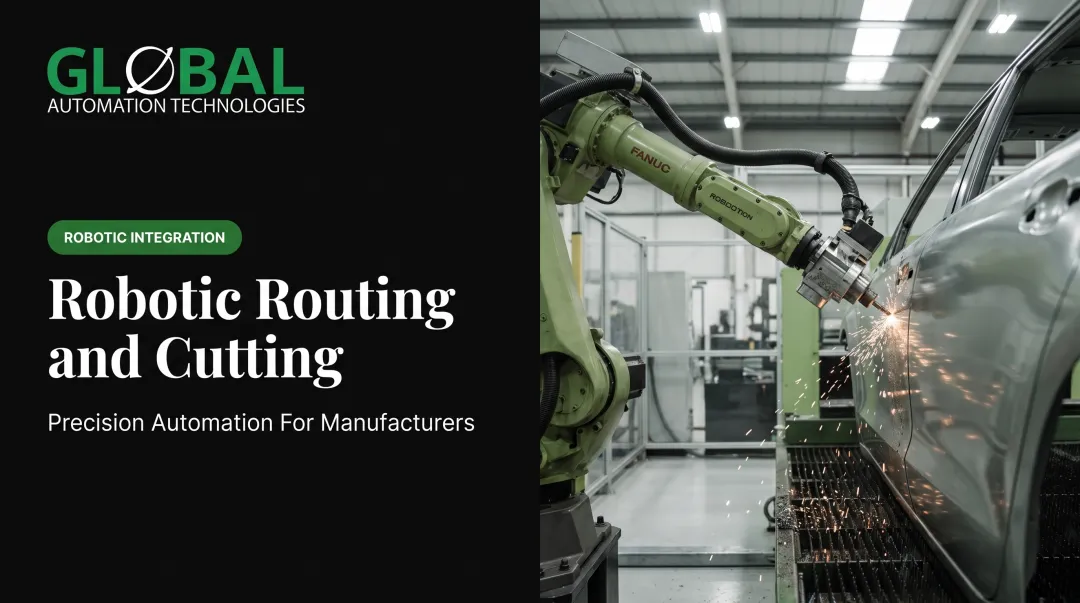
- Cutting: Waterjet, laser, plasma, or router-based trimming shapes or separates parts, such as automotive interior trim or composite panel cutting for aerospace structures
- Grinding: Abrasive wheels or belts remove weld beads and casting flash, or shape metal stock down to dimension
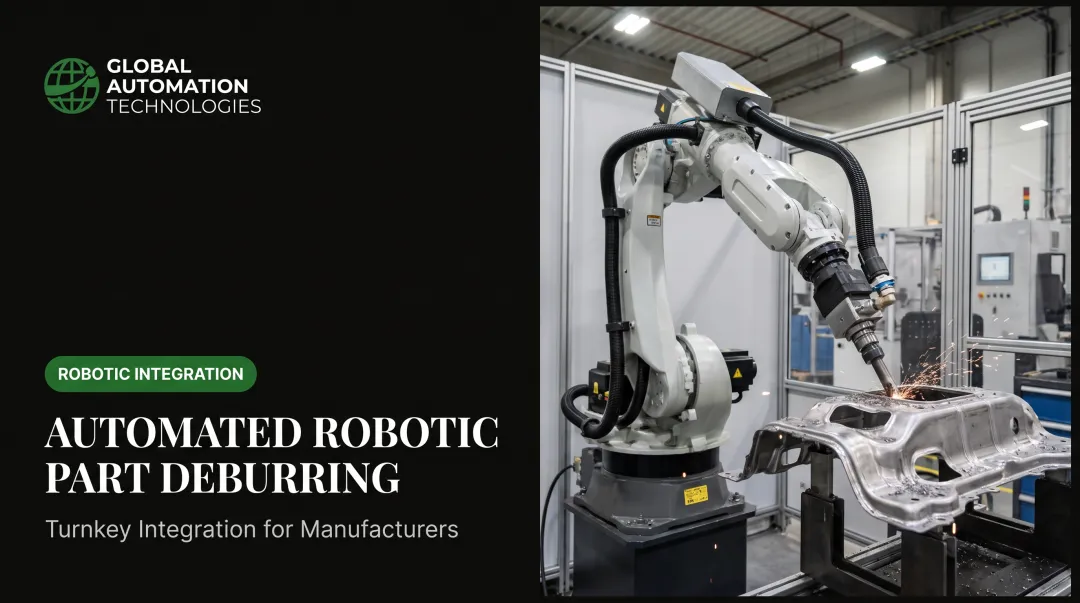
- Deburring and deflashing: Strips sharp edges or excess flash left behind after machining, molding, or die casting
- Polishing and sanding: Refines surface finish to meet cosmetic requirements or functional specs, like sealing surfaces

Mixing these up during project scoping is a common mistake. A grinding tool won't deliver a polished finish, and a polishing head won't touch a weld bead. Matching tooling to the specific removal task comes first, not as an afterthought.
Why Manufacturers Rely on This Process
Two forces drive adoption: fewer people want the dirty, repetitive finishing jobs, and manufacturers need consistent quality at volume.
One automation executive quoted by The Fabricator pegged labor turnover in high-mix, high-variability finishing work at 40% to 80%, a figure that reflects just how hard it is to keep people in these roles (The Fabricator, 2025).
Manual removal fails in predictable ways:
- Fatigue-driven inconsistency, where pressure varies hour to hour and shift to shift
- Gouges and burrs from uneven contact, leading to rework or scrap
- Strain injuries from repetitive motion and vibration exposure
- Bottlenecked throughput when finishing can't keep pace with upstream production
Adoption here isn't regulatory-mandated the way machine guarding is. It's operationally preferred. Plants choose it because it solves a real production problem.
Safety concerns accelerate the decision too. One occupational health study found 71% of full-time pneumatic grinder users reported vascular complaints tied to vibration exposure (CDC/NIOSH-hosted research). That's a strong incentive to move that work off human hands entirely.
How Robotic Material Removal Works (Conceptual Flow)
Strip away the automation jargon, and the process is straightforward. A robot moves a tool, or the part itself, through a programmed path, while a control system manages force, speed, and tool contact to remove a targeted amount of material.
Here's what feeds into it:
- Input: A raw or partially finished workpiece, a fixture or part-presentation method, and a defined removal target (stock amount, edge break, or surface finish spec)
- Core action: The tool contacts the material at controlled force and speed, shearing or abrading away excess material along the programmed toolpath
- Control layer: Force compliance devices, servo spindles, and vision or sensor feedback maintain consistent pressure and adjust automatically for part variation
- Output: A part at target dimension, edge condition, or finish, ready for painting, assembly, or inspection

Three steps turn that concept into a working cell.
Step 1: Programming and Path Planning
Toolpaths are built offline using CAD-to-path software or AI-assisted simulation, then validated virtually before anything touches the shop floor. Simulation-based programming has compressed what used to take weeks into days, letting engineers model and adjust before committing robot time to trial and error.
This isn't unique to material removal. The same offline validation approach applies across welding, painting, and machine tending cells alike.
Step 2: Fixturing and Part Presentation
Most parts weren't designed with automated handling in mind. The part gets secured using simple locators, corners, or custom fixtures that hold it steady enough for consistent robot contact.
Compliance devices often absorb positioning variation that slips through, adjusting force in real time rather than requiring perfect part placement every cycle.
Step 3: Controlled Removal and In-Process Verification
The robot executes the programmed path with real-time force and speed control, removing material to spec. Many cells add in-line vision or probe checks immediately after, confirming the part meets target before it moves downstream. That catch stops problems from compounding into a batch of rework.
Where It's Applied and Key Factors That Affect Performance
Robotic material removal shows up in three system types:
- Standalone finishing cells built for grinding, deburring, or polishing at high throughput
- In-line CNC machine-tending setups, where removal runs as one step in a larger production sequence
- Cobot cells for lower-volume or high-mix work that still needs consistent edge and surface quality
It typically enters the production lifecycle at three points:
- Post-casting or molding — deflashing
- Post-welding — weld grinding or shaving
- Post-machining — deburring and edge break
What Triggers the Investment
Plants typically automate material removal for one of these reasons:
- High part-to-part variability from manual finishing driving quality complaints
- Labor shortages that leave finishing stations understaffed or turning over constantly
- New line launches, where building the process right from day one beats retrofitting later
- Rework and scrap costs that have gradually grown large enough to justify the capital
Material hardness, part geometry, and stock removal volume all shape which tool and cycle time make sense for a given job. An aluminum casting and a hardened steel weld bead aren't solved the same way.
Matching Equipment to the Task
Force control, spindle RPM and torque, and abrasive strategy all need to match the specific removal task, not just the general process category. Get this wrong and consumable costs climb fast.
A 3M case study on robotic finishing of aluminum molds found matched abrasive tooling cut cycle time from 32 hours (two operators, two days) to 10 hours, while reducing disc consumption from 15 discs to just 3 (3M robotic finishing case study, 2021). That's the kind of gap that shows up directly on a P&L.

Equipment match is only half the equation. Safety and regulatory constraints shape the cell design just as directly:
- Dust and fume extraction systems, sized to the specific process
- Spark containment for grinding and cutting operations
- Combustible dust handling protocols for materials like aluminum, where fine particulate presents an explosion risk
Common Issues, Misconceptions, and When It May Not Be the Right Fit
Bolting a grinding tool onto a robot arm doesn't guarantee consistent results. Force control, fixturing, and tool matching actually determine repeatable quality. The arm is just the delivery mechanism.
This ties into a related misconception: robot precision versus process capability. A robot repeats a programmed path exactly, every time. But removal quality still depends on how well the tooling and part variation are handled.
A robot can execute a flawless path against a warped casting and still produce an inconsistent part. The input material wasn't consistent to begin with.
When robotic material removal isn't the right fit:
- Low-volume or one-off parts — programming and fixturing costs outweigh labor savings
- Extremely heavy stock removal — often better handled with CNC machining
- Highly variable or undefined parts — reliable fixturing needs substantial upfront engineering
One warning sign: skipping process characterization. If nobody defines target force, RPM, or feed rate before the robot goes in, the assumption is that the robot alone will fix quality problems inherited from upstream. It won't. A robot executing an undefined process just produces undefined results, faster.
Conclusion
Robotic material removal spans cutting, grinding, deburring, deflashing, and polishing, all built around the same goal: removing material consistently and safely at production scale.
But the robot is only part of the equation. Force control, fixturing, and tooling determine whether a cell actually hits tolerance, shift after shift. Understanding the process matters as much as understanding the arm.
An integrator that brings both the robotic system and the engineering support to run it closes that gap. GLOBAL Automation Technologies, which holds Level 5 status in FANUC’s Authorized System Integrator program, builds cells around process characterization, tooling selection, fixturing design, and offline simulation before a robot ever touches a part. The same engineering discipline applies whether the application is welding, dispensing, or material removal. That approach helps manufacturers skip the trial-and-error costs of figuring these systems out alone.
Frequently Asked Questions
What is robotic material removal used for?
Robotic material removal covers cutting, grinding, deburring, deflashing, and polishing to hit a target dimension or surface finish. Automotive, heavy equipment, and metal fabrication plants use it most for weld cleanup, casting finishing, and post-machining edge work.
What's the difference between robotic grinding and robotic deburring?
Grinding removes larger amounts of material—such as weld beads or casting flash—to shape a part. Deburring only knocks off small sharp edges left after machining or casting, with lighter contact and far less stock removal.
Can collaborative robots (cobots) perform material removal tasks?
Yes. Cobots handle high-mix, lower-volume, or space-constrained sanding and grinding jobs well, especially where quick changeover matters more than raw speed. Traditional industrial robots still handle high-force, high-volume production better.
How much does a robotic material removal system cost?
Cost depends on cell scope, end-of-arm tooling, force-compliance hardware, and integration complexity. Payback often falls between under a year and a few years, driven by labor savings and less rework.
What industries rely most on robotic material removal?
Automotive and Tier 1 suppliers, heavy equipment and foundries, aerospace composites makers, and general metal fab shops use it most. Weld grinding and casting finishing are the highest-volume applications.
Is robotic material removal safer than manual finishing?
Yes. It keeps operators off repetitive strain, vibration, and airborne dust. Force and finish stay consistent across every shift—quality manual finishing rarely holds that late in a long day.