
This guide walks you through a systematic approach to designing material handling systems that optimize flow, reduce operating costs, improve workplace safety, and support production goals. You'll learn the proven principles, equipment selection criteria, layout strategies, and validation methods that turn fragmented material movement into integrated manufacturing flow.
Key Takeaways
- Balance MH design around lower handling cost, higher throughput, safety, and room to change later
- Use the MHI 10 Principles to guide planning, ergonomics, space use, automation, and life-cycle cost
- Match equipment to load capacity, flow rates, part geometry, cycle times, and production needs
- Cut travel and backtracking—one case trimmed lead time 17–33% by removing unnecessary moves
- Validate with simulation and phased rollout so costly errors never reach the floor
Understanding Material Handling Systems
Material handling systems move, store, protect, and control materials and products throughout manufacturing and distribution. That scope matches how the Material Handling Industry (MHI) defines the discipline.
Scope within manufacturing:
Production systems span raw material receiving, in-process movement between operations, work-in-process storage, and finished goods preparation. Distribution systems focus on warehousing, order fulfillment, and outbound logistics. Related work, different design priorities.
System components:
- Unit load design (pallets, containers, batch sizing)
- Transport equipment (conveyors, industrial vehicles, automated guided vehicles)
- Storage systems (racking, automated storage/retrieval)
- Control software (PLC integration, traffic management, MES coordination)
- Operator interfaces (workstations, HMI panels, pick-to-light)
Performance relationship:
Material flow directly affects cycle times, WIP levels, quality outcomes, and throughput.
NIST research on automotive and aircraft manufacturing found WIP wait time can exceed actual process time by multiples. One automotive model logged 56.1 WIP days plus 72.8 WIP-downtime days. An aircraft model reached 359.9 WIP days plus 459.5 downtime days.
Material movement and staging need the same measurement discipline as the processes they feed.
The Material Handling System Design Process
Step-by-Step Design Approach
Effective material handling design follows eight steps:
- Analyze requirements – production volumes, part mix, process sequences, cycle times, space constraints, existing infrastructure
- Define objectives – minimize handling cost, maximize throughput, ensure safety, maintain flexibility
- Establish constraints – budget limits, floor space, ceiling height, building structure, existing equipment, workforce capabilities, timeline
- Develop concepts – explore alternative configurations and equipment types
- Evaluate alternatives – compare options against objectives and constraints
- Select solution – choose the configuration that best balances competing priorities
- Validate design – simulate, prototype, or pilot-test before full implementation
- Implement – install, commission, train, and verify performance

Timing and Integration
When you run this process matters as much as how you run it. Material handling design should happen concurrently with or right after process planning, and before you lock facility layout.
Wait until production equipment is installed, and handling solutions get forced into leftover space. Those inefficient flow patterns often stick for years.
Requirements Analysis
Document these inputs before you develop concepts:
- Production volumes: Peak and average throughput, seasonal patterns, and growth projections—size equipment for realistic demand, not theoretical capacity
- Part mix: Dimensions, weights, orientations, fragility, and special handling needs; a few high-volume parts vs. many low-volume SKUs changes equipment selection
- Process sequences: Map the path each part family follows and look for ways to arrange equipment in process order to cut backtracking
- Cycle times: Time at each operation and in transit between them; flag where material movement creates bottlenecks
- Space and infrastructure: Floor area, ceiling height, column spacing, floor loading capacity, and any existing conveyors or flow equipment
Objective Setting and Constraint Identification
Balance competing goals:
- Cost minimization: Lower capital investment and operating expenses
- Throughput maximization: Higher production rates and equipment utilization
- Safety: Eliminate manual lifting and hazardous handling
- Flexibility: Accommodate future product changes and volume growth
Document hard constraints before developing concepts:
- Budget ceiling
- Available floor footprint and vertical clearance
- Building structural limitations
- Existing equipment that must remain in place
- Workforce skill levels and training capacity
- Project completion deadline
Core Design Principles for Effective MH Systems
The Material Handling Institute's 10 Principles provide the foundation for system design decisions. Use them as design-review gates throughout your project.
1. Planning Principle
Establish clear objectives and functional specifications before selecting equipment. Define what materials move, where they go, when they move, and how they'll be handled. Avoid the common mistake of choosing equipment first and then trying to make it fit your application.
2. Standardization Principle
Use standard equipment, containers, and methods to simplify training, reduce spare-parts inventory, and improve flexibility. Prefer common solutions over custom ones whenever standard equipment will meet the requirement.
3. Work Principle
Minimize unnecessary movement by reducing travel distances, eliminating redundant handling steps, and combining operations where feasible. A 2021 textile manufacturing case reduced material travel from 1,440 m to 970 m per bag by rearranging equipment to follow process sequence.
4. Ergonomics Principle
Design tasks and equipment around human capabilities to reduce fatigue, prevent injuries, and improve productivity. Apply NIOSH lifting guidelines. The Revised NIOSH Lifting Equation recommends a Lifting Index of 1.0 or lower for two-handed lifting tasks. Engineering controls (lift assists, powered equipment) are more effective than administrative controls (task rotation, training).
5. Unit Load Principle
Design around appropriately sized unit loads that balance handling efficiency with production batch requirements. Don't force process batches to equal material handling batch sizes—right-size each independently and coordinate them through scheduling.
6. Space Utilization Principle
Maximize cubic space usage through vertical storage, overhead transport, and compact equipment. Calculate storage density (pallets per square foot) and throughput per square foot. Vertical space is often underutilized in facilities with adequate ceiling height.
7. System Principle
Integrate all handling and storage activities into a cohesive system with coordinated controls, shared data, and synchronized operations. Isolated equipment decisions create interfaces that require manual intervention and slow overall flow.
8. Automation Principle
Automate handling tasks where ROI justifies investment, safety improves, or labor availability constrains operations. One documented AGV case compared about $53,000 (€49,000) for two AGVs against roughly $86,000 (€79,200) in annual prior-technology cost and calculated an 8-month payback. That figure excluded electricity and maintenance, so treat it as a directional example rather than a benchmark for every facility.
9. Environment Principle
Consider energy consumption, waste generation, and environmental impact. Rising energy costs and expanding sustainability reporting make these factors part of the design decision, not an afterthought.
10. Life Cycle Cost Principle
Evaluate total cost of ownership including purchase price, installation, operation, maintenance, energy consumption, and eventual disposal—not just initial capital cost. A cheaper conveyor that requires frequent repairs and consumes more energy may cost more over its service life than a higher-quality alternative.

Equipment Selection and Integration
Equipment Categories and Applications
Conveyors (belt, roller, overhead):
- Best for: Fixed-path continuous flow between operations
- Applications: Assembly lines, paint systems, packaging
- Considerations: Layout rigidity, bottleneck propagation, accumulation requirements
Industrial vehicles (forklifts, pallet trucks, tuggers):
- Best for: Flexible routing of varied loads
- Applications: Warehouse transport, work-in-process movement, cross-facility transfer
- Considerations: Aisle width requirements, operator training, pedestrian traffic
Automated guided vehicles (AGVs) and autonomous mobile robots (AMRs):
- Best for: Reprogrammable routes, automatic line replenishment, unstaffed shifts
- Applications: WIP delivery, finished-goods staging, cross-docking
- Considerations: Floor condition, traffic management, charging infrastructure, route complexity
Cranes and hoists:
- Best for: Heavy loads, vertical movement, precise placement
- Applications: Machining cells, assembly stations, mold changes
- Considerations: Building structure, headroom, load capacities, safety systems
Robotic handling systems:
- Best for: Precise manipulation, hazardous environments, integration with production operations
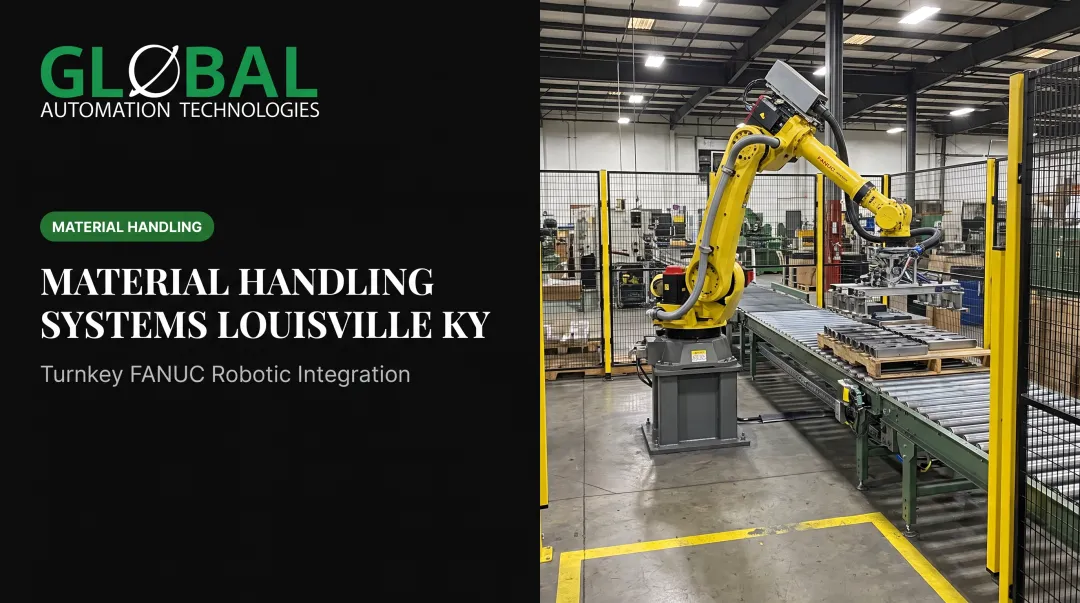
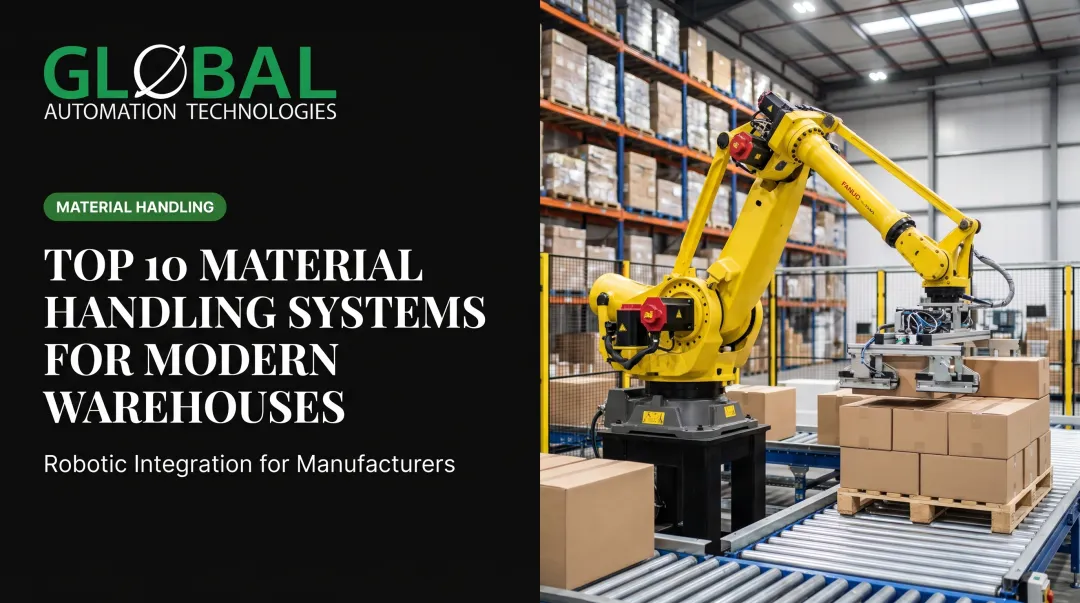
- Applications: Pick-and-place, palletizing, machine tending, vision-guided bin picking
- Considerations: Part geometry, cycle times, end-of-arm tooling, safety guarding
Automation Level and ROI
Manual handling: Lowest capital cost but highest labor exposure and variability. Appropriate for low-volume, high-variety operations where flexibility matters more than speed.
Semi-automated (human-operated equipment): Reduces physical strain while maintaining human decision-making. Fits operations with moderate volume and variety.
Fully automated (AGVs, robotic cells): Highest capital cost, but it eliminates repetitive manual tasks and enables unattended operation.
Deloitte's 2025 survey of 600 manufacturing executives reported average gains of 10%–20% in production output and 7%–20% in employee productivity from smart manufacturing initiatives. Treat those figures as broad technology results, not material-handling-specific ROI.
No universal payback period exists. Compare alternatives using:
- Installed cost (equipment, integration, controls, installation)
- Labor displaced or redeployed
- Utilization by shift
- Energy and maintenance costs
- Downtime risk
- Product or route volatility
- Floor modifications required
- Safety validation
- Residual value

Integration with Production Processes
Material handling equipment must interface cleanly with production machinery:
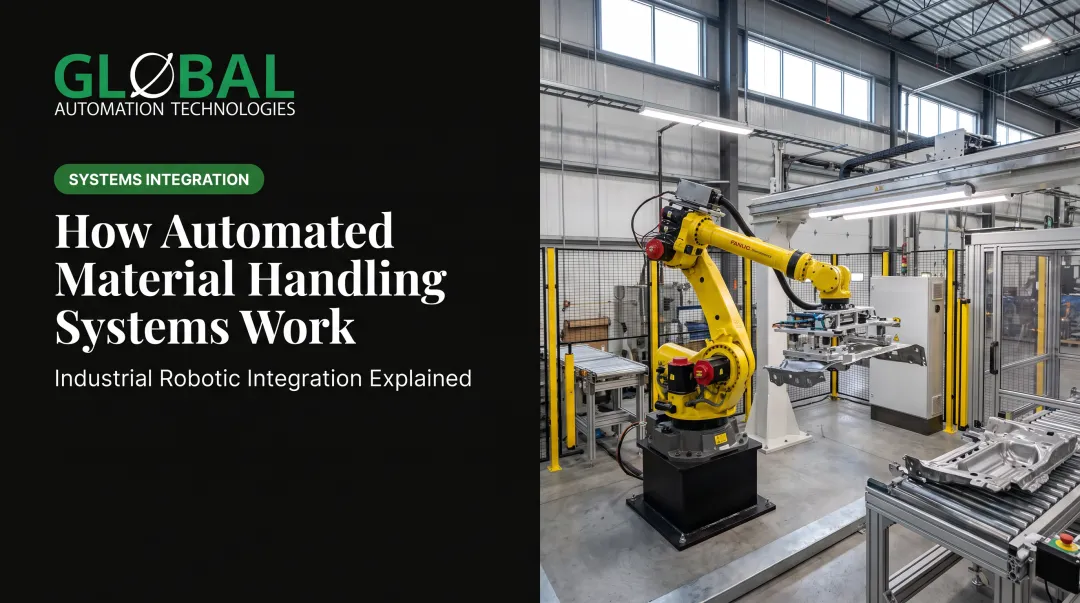
- Automatic loading/unloading: Robots or conveyors feed parts directly into CNC machines, presses, or molding equipment, synchronizing material arrival with machine cycles
- Buffer storage at workstations: Staging tables, gravity lanes, or powered queues decouple upstream and downstream operations
- Control system integration: Communication between MH equipment PLCs, production equipment controllers, and manufacturing execution systems (MES) coordinates operations
For example, robotic machine-tending cells combine part loading, machining, inspection, and unloading in one coordinated sequence. One robot can serve multiple machines with scheduling, buffer stations, and part tracking so spindles keep running during transfers—raising utilization instead of leaving machines idle for parts.
Layout Design and Workflow Optimization
Flow Pattern Analysis
Choose flow patterns based on process sequences:
- Unidirectional: Straight-line or L-shaped flow for simple sequential processes
- U-shaped: Start and end at the same location to minimize material travel
- Serpentine: Back-and-forth routing within a constrained footprint
- Cellular: Group similar parts or operations to reduce handling
Use from-to chart analysis:
Map material movements between all operation pairs. Count trips, or weight each path by volume, then prioritize shrinking the highest-traffic distances first.
Look for backtracking—parts moving against the primary flow direction—and rearrange operations to eliminate it.
A 2021 manufacturing layout case reported 16.66%-33% lead-time reduction after minimizing backtracking and material travel distance.

Zoning and Segmentation Strategies
Establish functional zones with appropriate MH infrastructure:
- Receiving/inspection: Dock doors, staging area, quality-check stations
- Raw material storage: Racking, retrieval equipment, inventory control
- Production floor: Conveyors, AGV routes, workstation staging
- WIP staging: Buffer storage between operations
- Finished goods: Packing, palletizing, accumulation conveyors
- Shipping: Dock staging, loading equipment, outbound verification
Apply product segmentation:
Group similar parts to cut extra handling steps. High-volume parts should flow through dedicated, optimized paths. Low-volume parts can share flexible equipment with longer changeover times.
Consider production velocity:
Position high-volume items near primary flow paths. Place low-volume or slow-moving items in secondary locations where longer travel times don't bottleneck the entire facility.
Aisle Design and Space Utilization
Aisle width requirements:
OSHA requires sufficient safe clearance at aisles, docks, doorways, turns, and passages, but provides no universal numerical width. Size aisles from the chosen vehicle, load dimensions, turning geometry, traffic pattern, and protective fields.
Example equipment specifications:
- Counterbalanced forklifts: Toyota Core IC Cushion models navigate 12-ft aisles; right-angle stack dimensions vary by model and load
- Reach trucks: Toyota reach trucks can navigate aisles as narrow as 7 ft, depending on model and load size
- AMRs: MiR250 default operational corridor is 1,450 mm; two robots passing require 3,000 mm
Always use manufacturer turning-radius data and add clearance for the actual load, not generic aisle-width rules.
Vertical space usage:
- Mezzanines for elevated storage or assembly
- Overhead conveyors to free floor space
- High-bay racking where ceiling height permits
Storage density versus accessibility:
High-density systems (drive-in racking, deep lanes, automated storage/retrieval) reduce footprint but may increase retrieval time. Balance density against access frequency: fast movers need quick retrieval, while slow movers can sit in deeper storage.
Material Flow Simulation
Once the physical layout is drafted, simulation confirms whether material will actually move as planned. It models flow, predicts throughput, flags bottlenecks, and tests alternate configurations before anything is installed.
Required inputs:
- Part routings and process sequences
- Processing times at each operation
- Batch sizes and transfer quantities
- Equipment speeds and capacities
- Demand patterns and production schedules
Simulation benefits:
- Predict system performance under realistic operating conditions
- Identify bottlenecks before equipment is purchased
- Test "what-if" scenarios (volume changes, equipment failures, layout modifications)
- Reduce costly design errors and accelerate commissioning
AI-assisted simulation tools can accelerate design validation by rapidly testing multiple configurations and automatically optimizing parameters, cutting engineering time from weeks to days. This reduces the risk of discovering flow problems during installation when fixes are most expensive.
Implementation and System Validation
Phased Implementation
Pilot testing reduces risk. Test new material handling systems in one production area before full-scale rollout. This allows you to:
- Validate equipment performance against design specifications
- Refine controls programming and sequencing
- Train operators on a manageable scale
- Identify integration issues while they're still easy to fix
- Build confidence before committing to facility-wide deployment
Commissioning typically moves through five stages:
- Equipment installation: Mechanical assembly, electrical connections, safety systems
- Controls programming: PLC logic, robot programs, HMI screens, alarm handling
- System integration: Communication between material handling equipment, production equipment, and MES
- Operator training: Normal operation, changeovers, troubleshooting, safety procedures
- Performance verification: Test against design specifications before acceptance

Validation Criteria
Establish measurable acceptance criteria before implementation:
- Throughput rates: Parts per hour, pallets per shift, loads per day
- Cycle times: Time from operation to operation, load-to-unload duration
- Handling accuracy: Positioning errors, damaged parts, misfeeds
- Safety metrics: Near-misses, guarding effectiveness, ergonomic improvements
- System uptime: Mean time between failures, availability percentage
Compare actual performance to design targets. If gaps exist, identify the root cause: wrong design assumptions, improper equipment configuration, or incomplete operating procedures. Document corrective actions and verify they close the gap.
Safety and Ergonomics Considerations
Safety and ergonomics belong in the layout, equipment spec, and controls design—not as a late checklist. The goal is simple: cut injury risk, keep throughput stable, and make day-to-day work sustainable for operators.
Manual Handling Risks
The Bureau of Labor Statistics reported 946,290 DART cases from overexertion, repetitive motion, and bodily conditions across private industry in 2023-2024. That equals a rate of 44.7 cases per 10,000 FTE, with a median of 24 days away from work.
These figures cover all private industry, but manufacturing still drives a large share through repetitive lifting, awkward postures, and forceful exertions. Treat those exposures as design inputs, not training problems alone.
Prefer engineering controls first:
- Lift assists and powered equipment (hoists, lift tables, vacuum lifters)
- Repositioned workstations and adjustable fixtures
- Conveyors, diverters, and other powered transfer paths that limit manual carries
- Ergonomic tools and fixtures at the point of use
- Robotic pick-and-place, palletizing, or transfer where lifts stay heavy or highly repetitive
Use administrative controls only as backup:
- Task rotation to vary physical demands
- Team lifting for heavy or awkward loads
- Training on proper lifting techniques
- Relief staffing during high-volume periods
OSHA ranks engineering controls as most desirable because they remove the hazard instead of depending on perfect worker behavior.
Ergonomic Design Guidelines
Apply the Revised NIOSH Lifting Equation when manual lifts remain in the process. It factors load weight, hand locations, travel distance, asymmetry, frequency and duration, and coupling quality.
NIOSH targets a Lifting Index or Composite Lifting Index of 1.0 or lower. Above that, redesign the task with engineering controls before you rely on procedure or PPE.
Workstation design basics:
- Set work surfaces at heights that fit the operator (adjustable where crews change)
- Keep parts and tools inside easy reach zones
- Orient parts to face the operator so bending and twisting drop out of the cycle
- Add anti-fatigue mats for standing work
Safety Systems for Material Handling Equipment
Once people are out of the worst lifts, safeguard the equipment that moves the load.
Conveyor safety: OSHA requires suitable guards where conveyors pass over work areas or aisles. Design lines with:
- Emergency stop buttons reachable along the conveyor length
- Guarding at pinch points, nip points, and rotating components
- Lockout/tagout provisions for maintenance
- Clearance above and around the conveyor path
- Inspection access and maintenance platforms
AGV and AMR safety:
- Collision-avoidance sensors and protective fields
- Audible or visual warnings while the vehicle moves
- Traffic management to prevent vehicle-to-vehicle conflicts
- Pedestrian separation or marked crossing zones
- Emergency stop capability
Robotic handling safety:
- Physical barriers and light curtains that separate operators from robot motion
- Controlled-access gates with interlocks
- Reduced-speed zones near operator interfaces
- Emergency stops within easy reach
- Risk assessments per ANSI/RIA R15.06
On hoists and cranes, install load limiters, mark rated capacities on the equipment, and post signage for restricted areas, required PPE, and safe operating steps.
Frequently Asked Questions
What are material handling systems?
Material handling systems are integrated solutions of equipment, controls, and procedures that move, store, and manage materials through production and distribution while optimizing efficiency, safety, and cost. They span receiving, in-process movement, storage, and shipping.
What are the 10 essential principles of material handling?
The MHI principles are planning, standardization, work minimization, ergonomics, unit load optimization, space utilization, system integration, automation, environmental impact, and life cycle cost. Apply them as design-review gates throughout your project.
What are the different types of material handling systems?
Systems are categorized by function: storage systems (racking, AS/RS), transport systems (conveyors, AGVs, forklifts), and manipulation systems (robots, cranes). Most facilities combine multiple types selected based on part characteristics, throughput requirements, and flexibility needs.
What are common examples of MHE?
Common equipment includes forklifts, pallet jacks, conveyor belts, overhead cranes, automated guided vehicles, industrial robots, reach trucks, and storage racks. Selection depends on load size, travel distance, flexibility requirements, and automation level.
How do you calculate ROI for material handling automation?
Compare total cost of ownership (purchase, installation, maintenance, energy) against labor savings, productivity gains, quality improvements, and safety benefits over the equipment's service life. Payback periods vary by application, so validate assumptions with pilot testing and simulation.
What role does simulation play in MH system design?
Simulation validates designs before implementation by modeling material flow, predicting throughput, identifying bottlenecks, and testing alternative configurations. It reduces costly design errors and accelerates commissioning by catching problems while they're still easy and inexpensive to fix.
Material handling system design depends on your production requirements, space, budget, and growth plans. Start with clear objectives, evaluate alternatives rigorously, validate before committing, and implement in phases.
The result is manufacturing flow that supports your production goals instead of constraining them.
For complex projects involving robotic automation, vision-guided systems, or multi-equipment integration, GLOBAL Automation Technologies, which holds Level 5 status in FANUC’s Authorized System Integrator program, can accelerate design, reduce risk, and deliver systems that hit performance targets.