
Introduction
Manual inspection can't keep up with modern production speeds. A line running parts every few seconds doesn't leave time for a human eye to catch a missing hole, a bad weld, or a bead gap before the part moves downstream. That's the gap machine vision closes.
Cameras and processors now handle the checking that used to fall on inspectors, faster, more consistently, and without fatigue. A3, the trade association for automation, reports in its 2019 industry overview that machine vision outperforms human inspection on speed, accuracy, and repeatability for quality checks and measurement tasks.
This article breaks down what machine vision systems actually are, walks through how they're designed step-by-step, and covers where they deliver the most value on real production floors. You'll get a practical framework for evaluating a vision system for your own line, not just theory.
Key Takeaways
- Vision systems combine camera, lens, lighting, processor, and software so equipment can inspect, measure, and guide robots
- Effective design follows a clear path: define requirements, select components, test, refine, deploy
- Leading industrial uses include welding, dispensing, painting, machine tending, and robot guidance
- System cost hinges on lighting and integration labor as much as camera price
- A partner with both systems integration and engineering talent cuts deployment risk
What Is a Machine Vision System and How Does It Work?
Machine vision is the combination of hardware and software that lets industrial equipment capture an image, process it against a rule set or trained model, and act on what it finds. Cognex describes the operating sequence as a chain: illumination, image acquisition, processing and feature extraction, then decision-making — with that decision triggering whatever the integrator has configured downstream.
In plain terms:
- Capture – A camera takes a picture of the part under controlled lighting.
- Process – Software compares the image against defined rules (or an AI model) to check for the feature, defect, or position being measured.
- Act – The system outputs a pass/fail signal, a measurement, or coordinate data that tells a PLC, reject gate, or robot arm what to do next.
That third step separates machine vision from a security camera. The system decides in real time and changes what happens on the line.
Core Components That Make Up a Vision System
Five elements have to work together:
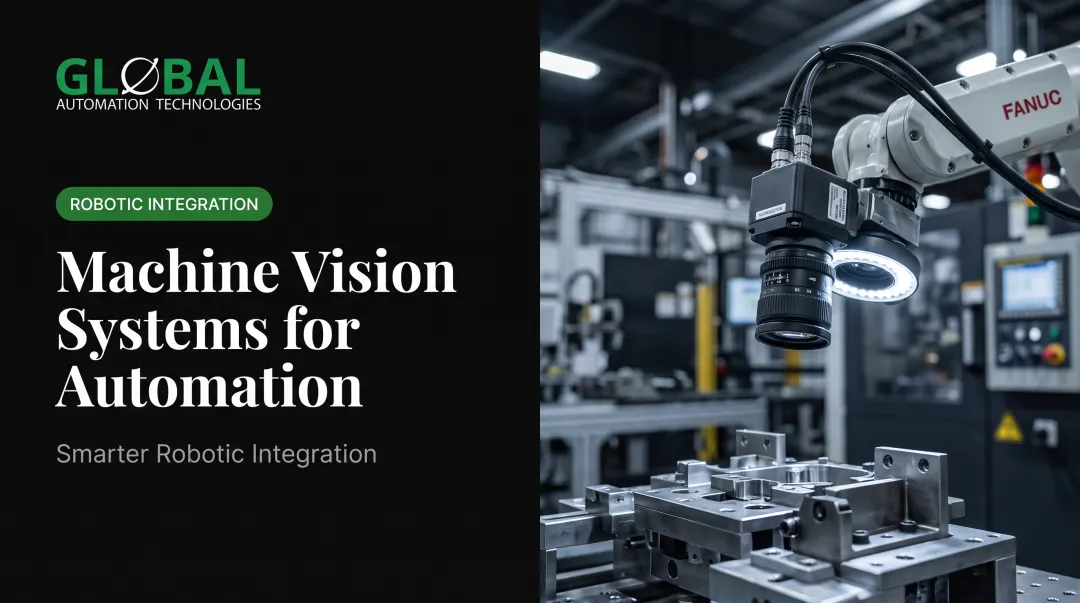
- Camera/sensor – Monochrome for brightness sensitivity; color when hue is the inspection feature. Area scan grabs a full frame for discrete parts; line scan captures continuous material (coil, film, pipe) one row at a time.
- Lens – Focal length, working distance, and sensor size set field of view and sharpness. A wrong lens leaves software with a blurry image no tuning can fix.
- Lighting – Often the make-or-break variable. Geometry, wavelength, intensity, and timing decide whether a feature is even visible to the camera. Cognex calls lighting the highest-leverage factor—and the one most often treated as an afterthought.
- Processor and software – Smart cameras bundle sensor and processor for single-station jobs; PC-based systems handle multiple cameras and heavier loads. Software ranges from rule-based algorithms to AI/deep learning models trained on sample images.
- I/O and communications – Pass/fail signals, measurements, or coordinates go to PLCs, reject gates, and robot controllers so the decision actually moves the line.
These components aren't independent. Swap in a higher-resolution camera and you may need a new lens, different lighting geometry, and more processing power to handle larger image files. Vision systems get engineered as one unit, not assembled from a parts catalog.
Designing a Machine Vision System: A Step-by-Step Process
Every vision project starts with two documents, written before anyone orders hardware. A requirements specification defines exactly what the system must detect or measure. An acceptance test uses real sample parts to define what "working" looks like.
Step 1: Define the Image Type and System Architecture
Decide whether the application needs monochrome or color, and 2D or 3D imaging. Then choose the architecture: smart camera, PC-based system, embedded processor, or robot-integrated vision, based on volume and complexity. A single-station inspection job has very different needs than a robot-guided bin-picking cell.
Step 2: Calculate Camera and Lens Specifications
Field of view, resolution, and working distance all need to match the smallest feature the system must catch. Basler's selection guide walks through this logic:
- Verify the lens mount
- Match the image circle to sensor size
- Calculate focal length from field of view and working distance
- Confirm the lens can resolve detail down to the sensor's pixel size
A simplified example: if the smallest defect you need to catch is 0.5 mm across, your per-pixel resolution must be finer than that feature, not merely adequate for the overall field of view.
Step 3: Design and Test Lighting
This is consistently the hardest part of the job. Lighting geometry interacts differently with every surface, texture, and material, so a setup that works on a shiny weld bead may fail completely on a matte plastic housing. Expect iteration here.
Step 4: Run Feasibility Testing With Real Parts
Before committing to a full build, test the imaging setup against actual production samples, including the ugly ones, not just perfect parts. Design flaws caught at this stage cost a fraction of what they cost after installation.
Step 5: Implement, Deploy, and Train
The final stage covers build, installation, factory and site acceptance testing, and operator training. This is where the handoff between design and production either goes smoothly or creates weeks of troubleshooting.
A turnkey integrator earns its keep here: the same team that engineered the vision logic also builds, commissions, and trains operators on the cell.
Types of Machine Vision Systems Used in Industry
Manufacturers generally choose from six system categories:
- Standalone component systems – Camera, lens, lighting, and processor sourced separately for maximum flexibility
- Smart cameras – All-in-one units for simpler, single-station checks
- Embedded vision – Sensor, processor, and software built directly into the device or machine
- Modular suites – Pre-configured packages that scale across multiple stations
- Application-specific systems – Purpose-built for a narrow task, such as code reading or gauging
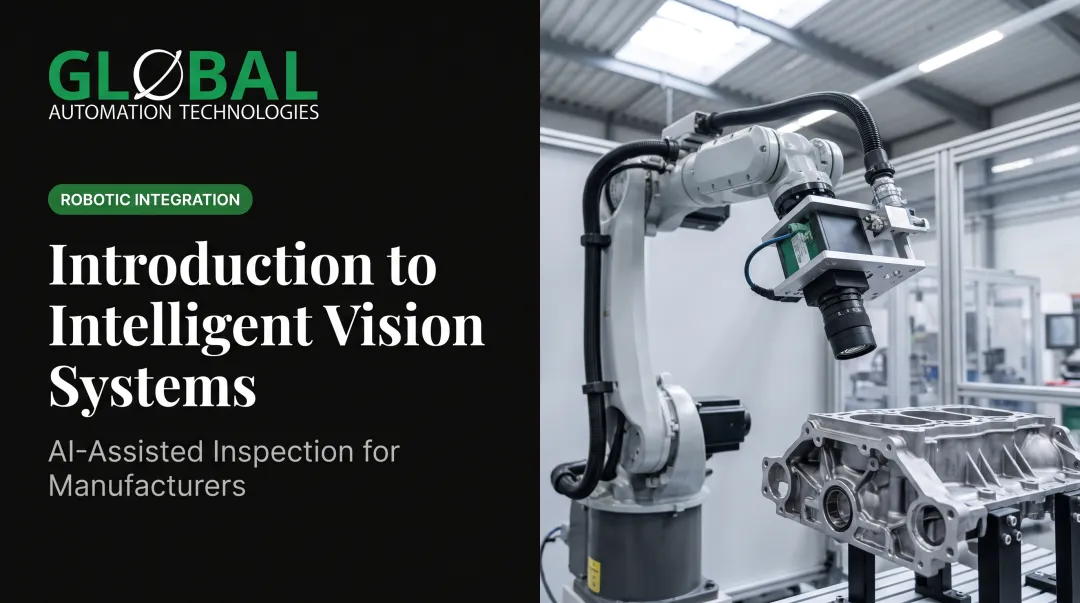
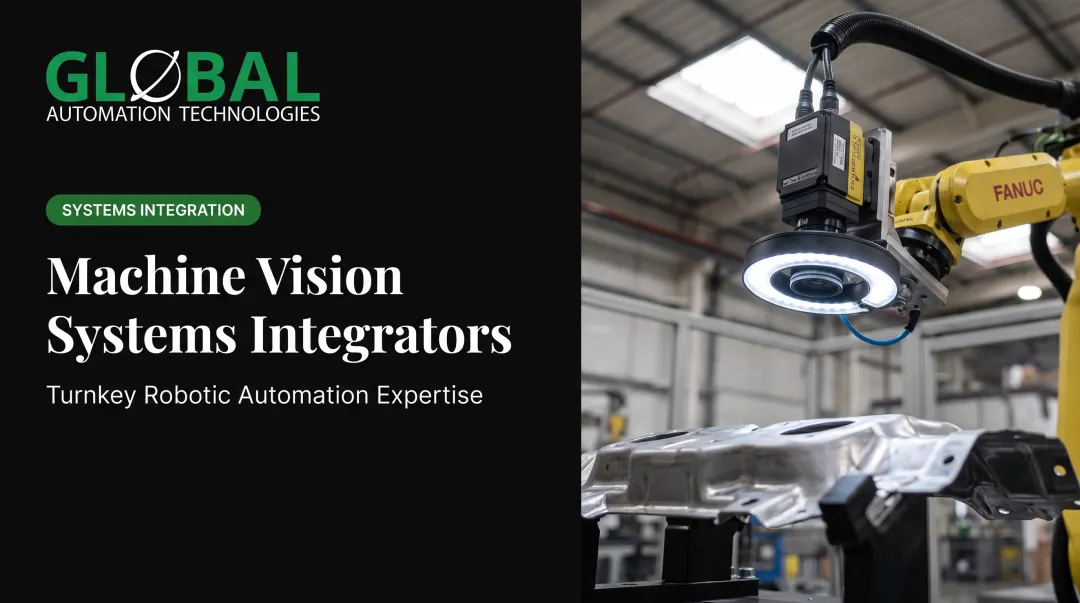
- Robot-integrated vision – Cameras mounted on or near a robot arm, feeding it real-time position data
Which category fits depends on production volume, budget, and how many synchronized camera views the job needs.
Vision-Guided Robotics
Instead of fixed tooling that assumes a part sits in one known pose, a camera on or near the robot feeds real-time X/Y/Z and orientation data. The robot can locate, pick, and place parts on the fly—even when they arrive at random angles in a bin—which is why vision guidance is now routine in bin-picking and machine tending cells.
Industrial Applications of Machine Vision Systems
Vision systems now touch nearly every stage of industrial production. Four applications stand out.
Quality Control and Defect Detection
Real-time inspection catches material or dimensional defects before a part moves to the next station, instead of at final audit when rework costs multiply.
A3 documented an automotive cell that inspected 100% of 60,000 V6 valve covers per year, checking seven holes, inserts, and flatness within a 35-second cycle. That is full coverage, not spot-checking.
Dispensing lines apply the same principle. GLOBAL's dispensing systems combine vision inspection with flow monitoring to verify bead width, placement, and continuity in real time, catching off-spec material or a missed path before the part advances.
Robot Guidance for Material Handling and Machine Tending
Parts don't always arrive in the same position. Vision lets robots locate and verify parts with variable positioning rather than depending on rigid fixturing. In machine tending cells, that means higher spindle utilization and longer unattended stretches. Machines keep running through breaks, shift changes, and overnight instead of waiting on a human loader.
Welding and Dispensing Verification
In welding, vision typically covers:
- Part identification before the torch starts
- Seam location and adaptive path correction for part-to-part variation
- Post-pass weld quality verification
That reduces the fixturing burden and catches defects while they're still cheap to fix.
Painting and Coating
Here vision earns its keep on the front end—locating and orienting parts so the robot follows the same programmed spray path every cycle. That path repeatability, not a live in-booth camera reading the finish, is what holds film build within specification shift after shift, cutting overspray and wasted material. GLOBAL's robotic painting systems are engineered for that consistency across automotive topcoat, powder coating, and gelcoat applications, a level of repeatability manual spraying can't match pass after pass. Full finish inspection, with robotic spot repair where needed, happens downstream rather than live during the spray.
Camera placement, lighting, and robot programming need to be designed together as one system. Retrofit a camera onto an existing cell later, and you usually fight lighting or mounting geometry that was never planned for vision.
How Much Does a Machine Vision System Cost?
Industrial vision camera prices vary widely — resolution, frame rate, and interface type (GigE, USB3, CoaXPress) all move the number. Entry-level cameras for simple presence checks often land in the low thousands of dollars, while high-resolution units for micron-level gauging or high-speed line scan work can run well into the five-figure range.
The camera is one line item on a much longer invoice. Total system cost typically includes:
- Lens matched to the required field of view and resolution
- Lighting hardware, often custom-configured for the application
- Processor or PC-based controller, plus software licensing
- Integration and engineering labor, frequently the largest cost driver of all
That last point catches a lot of buyers off guard. The camera might be the cheapest part of the system once engineering time for lighting design, mounting, calibration, and robot integration gets factored in.
Framing the Investment as ROI
Evaluate cost by payback period, not camera sticker price. Vision-equipped automation cells that catch defects earlier and cut inspection labor often pay for themselves within 12 to 18 months — the same window common on robotic machine tending cells. Faster inspection, less scrap, and fewer rework hours drive breakeven far more than the camera line item alone.

Choosing the Right Machine Vision and Automation Integration Partner
A vision system rarely fails because the camera was wrong. It fails because of a gap between the team that designed it and the team that has to run it every day.
Full turnkey capability closes that gap. When every stage happens under one roof, critical configuration details don't get lost in translation:
- Layout and design
- Build, programming, and validation
- Installation, commissioning, and training
AI-assisted simulation is changing the timeline math too. Engineers can now model, test, and optimize robot programs before any code touches the production floor, compressing programming timelines from weeks to days and flagging conflicts before commissioning stoppages. Predictive maintenance tools built on the same foundation help flag equipment issues before they turn into unplanned downtime.
That continuity is where GLOBAL Automation Technologies differs from a typical integrator. GLOBAL keeps turnkey automation systems, engineering services, and technical staffing under one company.
The same organization that engineers a vision-guided welding or dispensing cell can supply the controls engineers who keep it running after commissioning. Institutional knowledge stays intact from build through daily operation.
Built on 17+ years of experience across automotive and heavy industry, GLOBAL operates primarily on FANUC's iRVision platform as a Level 5 Authorized System Integrator. Vision is treated as one piece of a complete robotic cell, not a bolt-on afterthought.
If you're scoping a vision-guided project, GLOBAL's team can walk through feasibility before you commit to hardware.
Frequently Asked Questions
How does a vision system work?
It captures an image under controlled lighting, processes it against defined rules or a trained model, and outputs a decision: pass/fail, a measurement, or position data. That output then triggers whatever equipment sits downstream, from a reject gate to a robot arm.
How much does a vision camera cost?
Camera prices vary by resolution, frame rate, and interface type, with high-resolution or line scan units costing more than entry-level models. Total system cost depends on lens, lighting, processing, and integration labor as much as the camera itself.
What's the difference between machine vision and computer vision?
Computer vision is the broader field of visual analysis and image processing. Machine vision applies that field to specific industrial tasks, adding engineered lighting, optics, and production-line decision-making that a general computer vision algorithm doesn't need.
Can machine vision systems work with any robot brand?
Most major industrial robot controllers, including FANUC, ABB, KUKA, and Yaskawa, support vision integration through standardized instructions or vendor-specific vision options. Calibration and interface work between the camera and robot coordinate frame is still required regardless of brand.
How long does it take to design and deploy a machine vision system?
Timelines vary by complexity, but most projects run several weeks to a few months from requirements definition through deployment. AI-assisted simulation has compressed the programming phase from weeks down to days.
What industries benefit most from machine vision automation?
Automotive OEMs, Tier 1 suppliers, and heavy equipment manufacturers are the leading adopters, primarily for quality inspection and robot guidance applications. Aerospace and general industrial manufacturing follow closely, especially where part variability demands consistent inspection.