
Introduction
A line goes down at 2 a.m. Nobody knows why. By the time a technician traces it back to a sensor that lost communication with the PLC, three hours of production are gone.
Every plant manager has lived some version of this story: stoppages, inconsistent quality, and near-miss safety incidents. They all trace back to the same root cause: controls that were never properly integrated.
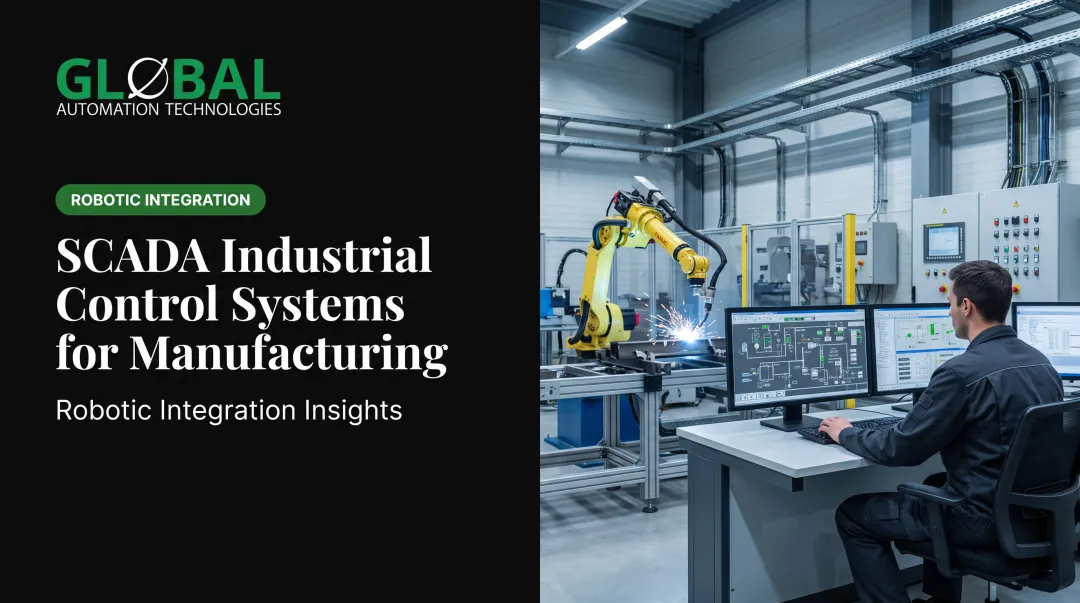
As manufacturers add robots, sensors, and data systems to their floors, Industrial Control Systems (ICS) become the nervous system holding the operation together. This guide covers what ICS are, the major system types, how they power robotic automation, and what to look for in an integration partner.
Key Takeaways
- ICS stack PLCs, DCS, SCADA, sensors, and actuators so plants can monitor and control production automatically
- Unplanned downtime costs range from $39,000 to over $2 million per hour, depending on the industry
- ICS keep robotic cells coordinated—syncing robots, safety systems, and machine tools as one unit
- Machine tending cells typically pay for themselves in 12 to 18 months
- An integrator that delivers both the system and the engineers to run it lowers long-term execution risk
What Are Industrial Control Systems in Manufacturing?
Industrial control systems are the combined hardware and software that automatically monitor and control equipment, machinery, and processes across a facility. According to NIST's glossary definition, this category includes SCADA systems, distributed control systems (DCS), and PLC-based local control.
Not every automated machine qualifies as a control system, though. There's a real difference:
- Fixed-sequence automation runs the same programmed steps regardless of conditions — think of an old-school timer-based conveyor
- True control systems use real-time feedback loops, constantly measuring conditions and adjusting output to match a target
That feedback loop is what separates a control system from a machine that just repeats motions blindly.
The Control Architecture Hierarchy
Manufacturing control architecture follows a layered structure, often described using the ISA-95 model:
- Field level — sensors and actuators that touch the physical process
- Control level — PLCs and DCS units executing logic in real time
- Supervisory level — SCADA and MES systems aggregating data across lines
- Business level — ERP systems handling planning and logistics

Getting this architecture wrong is expensive. Siemens research found that unplanned downtime costs range from $39,000 per hour in consumer goods facilities to over $2 million per hour in automotive plants. That gap between industries shows exactly why sound control architecture isn't optional for high-volume production.
As manufacturers add robotics, EV production lines, and data center component manufacturing, ICS complexity has accelerated. That growth raises the bar for engineers who can integrate field devices, PLCs, SCADA, and higher-level systems without breaking the production schedule.
Types of Industrial Control Systems
Most facilities don't rely on a single control system type. They layer several together, each handling a different scope of the operation.
Programmable Logic Controllers (PLC)
PLCs are ruggedized, machine-level controllers built for discrete tasks. They're the workhorse behind:
- Robotic cell I/O and sequencing
- Conveyor control and speed matching
- Packaging equipment and part counting
PLCs execute logic close to the machine, which is why they're the default choice for robotic work cells that need fast, reliable local control.
Distributed Control Systems (DCS)
A DCS is a network of controllers spread across a large, continuous process such as chemical processing or refining. It gives centralized visibility while keeping control local at each node.
DCS is not the same thing as PCS. DCS is the physical, networked hardware architecture. PCS is the strategy for managing process variables (temperature, pressure, flow) that a DCS or PLC carries out. One is the hardware; the other is the approach it runs.
SCADA Systems
SCADA sits a layer above PLCs and DCS. It aggregates data from multiple lines or sites so operators get one view for monitoring and reporting.
NIST describes SCADA as a system where a control center collects field-site data and can initiate remote actions. That model fits operations spread across several buildings or geographies.
Process Control Systems (PCS)
PCS keeps variables like temperature, pressure, and flow within setpoints through closed-loop feedback. Plants implement it on PLC or DCS hardware depending on whether the process is discrete or continuous.
Core Components and How the Control Loop Works
Strip away the acronyms, and every control system runs on the same four building blocks:
- Sensors/transmitters — measure temperature, pressure, position, or flow
- Controllers — interpret sensor data and calculate the needed correction
- HMIs — give operators visibility and manual override capability
- Final control elements — valves, actuators, and motors that physically act on the process
The Basic Control Loop Cycle
The loop itself follows four repeating steps:
- Measure the process variable using a sensor
- Compare the reading to the setpoint
- Calculate the correction needed (often using PID logic)
- Adjust the final control element and repeat

Proper tuning matters more than most people realize. Push the proportional response too hard, and the system oscillates. Dampen it too much, and you get sluggish response with overshoot in the other direction.
Getting that balance right is often the difference between a smooth-running line and one that constantly hunts for stability.
Stable loops are only part of the picture. Modern ICS also connect upward into MES and ERP systems, plus IIoT devices, so plants get visibility beyond the individual control loop. Deloitte's 2025 smart manufacturing survey found data analytics investment at 40% and IIoT investment at 27% among manufacturers planning upgrades over the next two years.
How Industrial Control Systems Power Robotic Automation
In a robotic manufacturing cell, ICS is what makes a robot, a CNC machine, safety sensors, and an HMI act as one coordinated system instead of a collection of isolated equipment. Without that integration layer, you just have expensive machines that happen to sit near each other.
Machine Tending
Robotic machine tending uses integrated controls to extend production beyond a single shift and push spindle utilization higher. Robots keep CNC machines running through breaks, shift changes, and lights-out windows between scheduled maintenance — hours that traditionally sat idle waiting for a human operator.
The math favors automation: more parts per shift with fewer direct labor hours. GLOBAL Automation Technologies designs and integrates these cells, and machine tending applications like these typically pay for themselves in 12 to 18 months. Gains come from higher throughput, tighter consistency, and labor redeployed to inspection and process improvement rather than repetitive loading.
Robotic Painting
Painting is a control-heavy application. Holding film build within specification shift after shift doesn't happen by bolting a gun onto a robot arm — it comes from controlling every variable in the process: spray pattern, path programming, booth airflow, and repeatable motion across every part and shift.
That level of precision reduces overspray, cuts paint waste, and lowers material costs per part — savings that compound fast in high-volume automotive paint shops.
Dispensing and Bead Applications
Robotic dispensing cells build vision inspection and flow monitoring directly into the control system, checking three things on every pass:
- Bead width against specification
- Bead placement along the programmed path
- Bead continuity, flagging gaps or interruptions
If something's off-spec, the system catches it before the part moves downstream — not after it's buried three stations deep in the process.
Safety-Critical Control Functions
Interlocks, E-stops, and zone monitoring remove operators from direct exposure to isocyanates, VOCs, and overspray particulates in paint and coating environments. FANUC's intrinsically safe robot designs, paired with booth airflow management and E-stop coordination built into the PLC logic, keep people out of the hazard zone entirely.
AI-Assisted Simulation and Predictive Maintenance
Modern control architecture now includes AI-assisted tools. GLOBAL uses simulation to model and test robot programs in a virtual environment before any code touches the plant floor — compressing programming timelines that once took weeks down to days. On the maintenance side, AI-driven health assessments continuously monitor equipment to flag issues early, before they turn into unplanned downtime.

Key Benefits of Industrial Control Systems
The case for investing in solid control architecture comes down to three measurable outcomes.
Throughput and uptime. Fewer upsets and faster cycle times mean equipment can run closer to capacity, supporting production that extends well beyond a single shift between scheduled maintenance windows. Deloitte's 2025 survey found manufacturers running smart-manufacturing initiatives reported 10% to 20% higher production output and 10% to 15% of previously unlocked capacity.
Quality and consistency. Tighter control over process variables reduces scrap and improves first-pass yield. When a robot delivers the same load position and cycle every single time, variability caused by operator fatigue simply disappears.
Safety and compliance. Automated alarms, shutdown logic, and condition monitoring remove reliance on human reaction time in hazardous environments — a meaningful difference when the alternative is a person standing next to a press or spray booth.
These gains compound. Better uptime supports better quality. Better safety reduces the disruptions that eat into throughput. The three outcomes reinforce each other as one integrated system.
Choosing the Right Industrial Control Systems Integration Partner
Not every integrator can take a project from concept to production. When evaluating partners, look for turnkey capability across the full lifecycle:
- Layout and engineering design, including offline robot simulation
- Controls programming (PLC and robot code)
- Physical build and mechanical integration
- Validation, installation, and commissioning
- Training and ongoing support after launch
Why Staffing Matters as Much as Solutions
One factor manufacturers often overlook: who runs the system after commissioning? A partner that combines automation solutions, services and technical staffing means you get both the control system and the engineers to operate it, under one relationship instead of two separate vendor calls.
GLOBAL Automation Technologies built its model around exactly this gap. Alongside turnkey automation solutions and engineering services, GLOBAL's technical staffing recruits controls, mechanical, and project management talent into the customer roles that run these systems — so the team that builds the system and the people who keep it running share the same firsthand knowledge of what the equipment requires.
As a Level 5 FANUC Authorized System Integrator with 17+ years of experience and a proven global base of robotic deployments, GLOBAL backs that model with cross-industry work in automotive, heavy equipment, and data center infrastructure manufacturing.
Frequently Asked Questions
What are manufacturing control systems?
Manufacturing control systems are the hardware and software that monitor, regulate, and coordinate equipment and processes so production stays consistent, safe, and efficient.
What is the difference between PCS and DCS?
PCS refers to the overall strategy of managing process variables through feedback control. DCS is the physical, networked hardware architecture used to execute that control across large or geographically dispersed processes.
What are the 4 types of manufacturing control systems?
The four primary types are PLCs (machine-level control), DCS (distributed process control), SCADA (supervisory monitoring across sites), and PCS (the overall discipline of regulating process variables).
What are examples of manufacturing control systems?
Examples include PLC-driven robotic work cells, DCS-managed chemical or refining plants, SCADA-monitored multi-site operations, and PCS-regulated temperature or pressure processes in continuous manufacturing.
How do industrial control systems integrate with robotic automation?
ICS synchronizes robot controllers, sensors, and safety systems so robotic cells (such as machine tending or painting) run as one coordinated unit instead of separate equipment reacting independently.
How much does it cost to implement an industrial control system?
Cost depends on scope, robot count, and process complexity. Most manufacturers start with a feasibility study, then judge spend against ROI drivers like less scrap, higher throughput, and reduced downtime—often with payback in the 12–18 month range for well-scoped cells.