
The American Welding Society projects that the industry will need 320,500 new welding professionals by 2029, with roughly 80,000 positions to fill annually through that period, according to AWS workforce data. That gap shows up on the shop floor as inconsistent manual welds, welder fatigue, and rising exposure to heat, fumes, and arc radiation.
Robotic MIG welding has become the go-to answer. This article breaks down what it is, how it works, its real benefits, and how to figure out if it fits your operation.
Key Takeaways
- Robotic MIG welding automates GMAW with a robotic arm, wire feeder, and power source for consistent, high-speed welds
- It beats manual MIG welding on repeatability, speed, and operator safety, not necessarily on flexibility
- Automotive, heavy equipment, and structural fabrication shops rely on it for high-volume, structurally sound production
- The right integration partner delivers both the system and the engineers who keep it running
What Is Robotic MIG Welding?
MIG welding, formally called Gas Metal Arc Welding (GMAW), works by feeding a continuous consumable wire electrode through a torch. The wire melts into the joint while shielding gas protects the molten weld pool from atmospheric contamination.
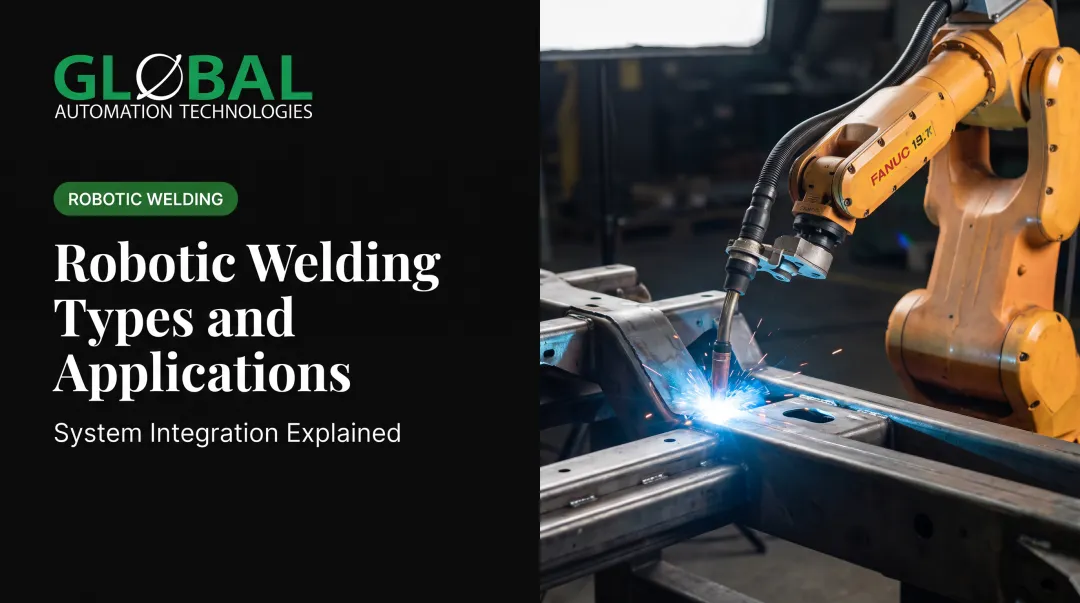
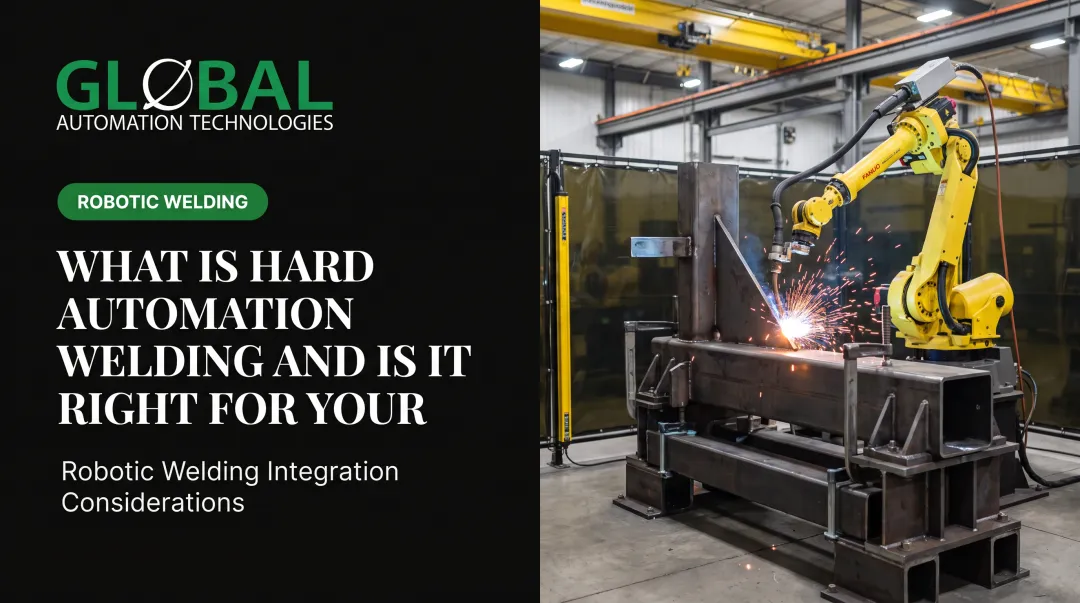
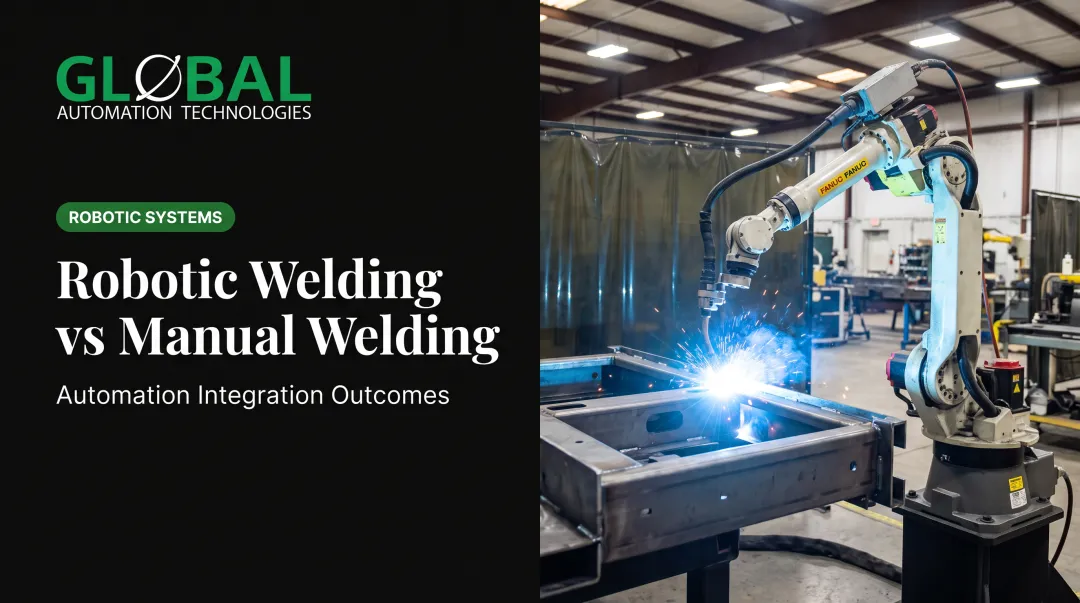
Robotic MIG welding automates that same process. The torch mounts on a robotic arm programmed to follow a precise, repeatable path across the part. The robot controls travel speed, torch angle, and positioning, while the wire feeder and power source handle the actual arc.
This is a semi-automatic process, not a fully autonomous one. The robot executes torch movement and wire feed exactly as programmed, but engineers still set the parameters, weld paths, and process logic behind the scenes.
Why MIG Is the Workhorse of Robotic Welding
MIG's continuous wire feed and tolerance for minor joint fit-up variation make it one of the most automation-friendly welding processes available. That's a big reason robots handle so much of the industry's arc welding volume.
Deposition rate is another factor. Solid-wire GMAW runs at averages of 8-9 lb/h (roughly 3.6-4.1 kg/h), compared to 2-3 lb/h (0.9-1.4 kg/h) for GTAW (TIG), according to The Fabricator. That's roughly three to four times faster, which is why MIG dominates high-volume robotic cells.
How the Robotic MIG Welding Process Works
A robotic MIG welding cell relies on five core components working together:
- Robotic arm – carries the torch along the programmed weld path
- Wire feeder – supplies consumable filler wire at a controlled rate
- Welding power source – generates and regulates the arc
- Shielding gas supply – protects the weld pool from contamination
- Torch with electrified contact tip – transfers current to the wire as it feeds

Programming and Control
Engineers set the weld path, travel speed, torch angle, and contact-tip-to-work distance (CTWD) using a teach pendant or offline programming software. Getting these parameters right the first time is critical, because small errors compound across thousands of cycles.
Modern power sources also use synergic control. The operator sets wire feed speed, and the system automatically adjusts voltage to maintain stable, consistent arc characteristics, according to ESAB's welding education resources. This one-knob approach removes a huge source of manual variability.
At GLOBAL Automation Technologies, engineers use AI-assisted simulation to model, test, and optimize robot programs before a single weld hits steel. That practice sharply compresses programming timelines across GLOBAL's automation projects, reducing startup surprises when the cell finally goes live.
Compensating for Part Variation
Seam tracking, whether laser-based or through-arc, helps robots adjust in real time when incoming parts don't match perfectly. High-volume production always has some part-to-part variation, and sensing technology closes that gap without slowing the line down.
Fixturing accuracy matters just as much as sensing. Tight, repeatable part presentation, often held to fractions of a millimeter, is what allows the robot's programmed path to actually land where it should.
Robotic MIG Welding vs. Manual Welding and Other Robotic Processes
Robotic MIG vs. Manual MIG Welding
Manual welding still has a place. It offers flexibility that robots can't match on one-off parts, irregular joints, or low-volume custom fabrication where a skilled welder can adapt on the fly.
Robotic MIG wins when the job calls for:
- Consistency across thousands of identical welds
- Higher throughput without breaks or fatigue
- Reduced operator exposure to fumes, spatter, and arc heat
The tradeoff is upfront investment. Robotic cells cost more to install than a welder and a booth, but that cost typically pays back through labor savings and reduced rework over time.
Robotic MIG vs. TIG and Spot Welding
TIG (GTAW) produces cleaner, more precise welds, but at roughly one-quarter to one-third the deposition rate of MIG. It's the better choice for thin materials or cosmetic welds where appearance outweighs speed.
Spot welding serves a different purpose entirely. It's used for lap joints in sheet metal, most commonly in automotive body-in-white assembly. It isn't a substitute for MIG's versatility across joint types, thicknesses, and materials.
Key Benefits of Robotic MIG Welding
Robotic MIG welding strengthens quality, throughput, safety, and long-term cost performance on the production floor:
- Repeats the same torch angle, travel speed, and contact-tip-to-work distance (CTWD) on every part, eliminating the weld-to-weld variability that creeps into manual production over an eight-hour shift
- Runs consistent cycles without the fatigue and slowdowns that build up over a manual shift; GLOBAL engineers its welding systems around faster cycle times and higher sustained output for high-volume programs
- Removes workers from direct exposure to arc radiation, spatter, and welding fumes
- Cuts over-welding, spatter cleanup, and scrap through programmed parameters, so fewer parts return through the line for rework
- Pays back in roughly one to three years for many welding investments, depending on shift structure and part volume

Safety carries real weight in that list. NIOSH reports that more than 700,000 U.S. workers are involved in welding or allied processes, and evidence suggests welders face a 40% higher relative risk of lung cancer, according to the CDC/NIOSH welding fumes overview.
As a comparable benchmark, similar automation cells like robotic machine tending often pay for themselves in 12 to 18 months, driven by more parts per shift with fewer direct labor hours.
Industries That Rely on Robotic MIG Welding
Robotic MIG welding is most common where production volume and structural integrity both matter.
- Automotive and EV manufacturing: frame, chassis, and body structures that need high-volume, repeatable welds on every vehicle
- Heavy equipment and commercial vehicles: thick-material welds on frames, buckets, and booms for construction, ag, and mining equipment
- Tier 1 suppliers and industrial fabrication: structural steel, brackets, and subassemblies built at scale for OEM supply chains
GLOBAL integrates robotic MIG welding systems for automotive OEMs, Tier 1 suppliers, and heavy equipment manufacturers in these environments.
Is Robotic MIG Welding Right for Your Operation?
Before committing to a robotic MIG welding cell, weigh these factors:
- Production volume – Robots pay off fastest on repeatable, high-volume runs, not one-off jobs
- Part complexity and repeatability – Consistent geometry makes programming and fixturing far simpler
- Current welder availability – A persistent staffing gap is often the clearest signal automation makes sense
- Quality and rework costs – High scrap or rework rates point to a strong automation case
Here's the part most shops underestimate: the biggest implementation risk isn't the robot itself. It's under-investing in weld process development, fixturing precision, and programming before commissioning day arrives. A robot can only be as accurate as the fixture holding the part and the program guiding the torch.
That is where the right partner matters. GLOBAL Automation Technologies builds full turnkey robotic welding systems—layout, fixture design, simulation, commissioning, and training—with 17+ years of experience as a Level 5 FANUC Authorized System Integrator.
GLOBAL goes further than the build alone. Through its separate technical staffing, it can also place the engineers who program the cell, maintain it, and keep it running long after install day.
Frequently Asked Questions
Can MIG welding be automated?
Yes. MIG's continuous wire feed and tolerance for fit-up variation make it one of the most automation-friendly welding processes, so it dominates robotic welding cells in manufacturing.
What is robotic MIG welding?
It's a robotic arm-mounted MIG torch that automates the GMAW process, feeding wire and shielding gas under programmed control to produce consistent, repeatable welds without manual intervention.
What's the difference between robotic MIG welding and TIG welding?
Robotic MIG welds faster with a higher deposition rate, while TIG produces cleaner, more precise welds at slower speeds. Choose based on your volume needs and quality requirements.
Do I need a skilled welder to operate a robotic MIG welding cell?
Yes, but their role shifts. Skilled personnel are still essential for programming, process setup, and maintenance, even though the physical welding itself runs automatically.
How much does a robotic MIG welding system cost, and what's the typical payback period?
Costs vary widely based on cell complexity, part geometry, and fixturing needs. Most shops see payback within one to three years.
What industries benefit most from robotic MIG welding?
Automotive, heavy equipment, and structural fabrication see the greatest gains, since all three depend on high-volume, repetitive welding to keep production moving.