
OEMs and Tier 1 suppliers now treat powder coating as performance-critical, not decorative. Wheels, brackets, chassis parts, and under-hood components need finishes that survive road salt, heat cycling, and years of vibration. Liquid paint can't always deliver that at scale.
This guide breaks down the process, the materials, real cost tradeoffs, where powder coating actually shows up on a vehicle, and how robotics are changing how coating lines run.
Key Takeaways
- Powder coating delivers strong corrosion resistance and near-zero VOC emissions versus liquid paint
- Best fit for wheels, trim, brackets, and under-hood parts — not full body panels
- Robotic application improves film consistency and cuts material waste over manual spraying
- Part geometry, powder chemistry, and pretreatment quality drive cost and coating lifespan
What Is Automotive Powder Coating?
Powder coating is a dry, electrostatically-charged finish that's cured under heat rather than air-dried like solvent-based liquid paint. Charged powder particles cling to a grounded metal part, then bake into a hard, continuous film in an oven.
Manufacturers favor it for durability, sustainability, and transfer efficiency. With no solvent carrier, application releases no VOCs, and unused powder can often be reclaimed. The cured film also resists chips, chemicals, and abrasion better than many liquid coatings.
Automotive-grade powders fall into a few resin families:
- Epoxy — excellent chemical and scratch resistance, but chalks and fades under UV. Best for parts that never see sunlight.
- Polyester — UV-stable, suited to exterior parts and outdoor exposure.
- TGIC polyester — extended exterior durability, commonly specified for wheels and trim.
- Epoxy-polyester hybrid — generally an indoor system, used on under-hood parts where oil or fluid resistance matters more than UV stability.
Picking the wrong resin for the exposure condition is a classic mistake. Ford's early powder-coated Pintos developed corrosion issues tied to inadequate pretreatment and coverage—proof that chemistry alone does not guarantee a good finish.

The Powder Coating Process for Automotive Parts
Surface Prep and Pretreatment
Every part starts with cleaning and degreasing, followed by media blasting to strip rust, oil, and mill scale. Skip this step or rush it, and adhesion fails no matter how good the powder is.
Next comes pretreatment: typically a phosphate-free or zirconium-based conversion coating. These chemical layers etch the metal at a microscopic level, giving the powder something to grip.
PPG's zirconium-based Zircobond system, for example, produces at least 80% less pretreatment sludge than traditional zinc phosphate—important for waste handling on high-volume lines.
Electrostatic Application
Powder is applied with corona guns, which ionize air around the powder, or tribo guns, which charge particles through friction inside the gun. Charged powder seeks the grounded part and wraps edges and recesses better than wet spray.
That wraparound is what helps complex brackets, frames, and body hardware get even coverage without a second manual pass.
Curing
Parts move into an oven where heat fuses the powder into a solid film. Most automotive powders cure at 350-400°F for 5-20 minutes at substrate temperature, depending on the product. One Axalta TGIC-polyester sheet, for example, specifies 400°F for 10 minutes at a film build of 2.5-3.5 mils.
Thermoset powders chemically crosslink in the oven, so the cure is permanent. Thermoplastics only melt and re-solidify, which is why shops rarely use them when long-term heat resistance matters.
Quality Control
Before parts move downstream, two checks matter most:
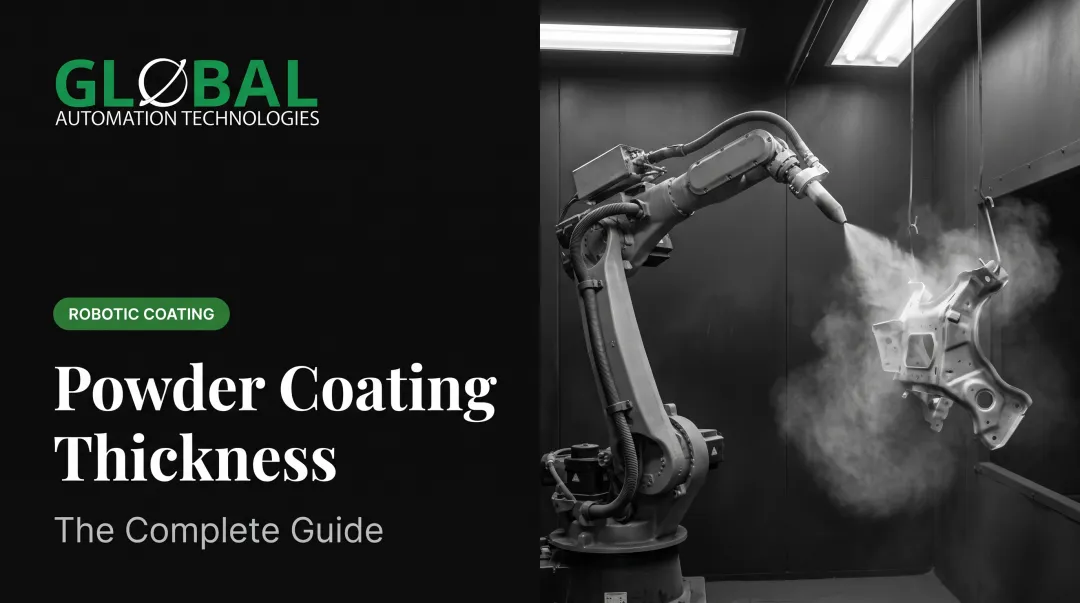
- Film thickness (mil) measurement: confirms the coating meets the specified range
- Adhesion testing: verifies the film won't chip or peel under mechanical stress
Skipping either check is how corrosion problems show up months later, not on the line.

Powder Coating vs. Liquid Paint: Cost, Durability & Finish Quality
Is Powder Coating Cheaper?
The Powder Coating Institute notes that one-coat powder systems with efficient recovery can achieve 95-98% total material utilization, compared to roughly 60% utilization for electrostatic liquid systems. That's a meaningful difference at high volumes, even though powder equipment costs more upfront.
Powder coating is generally more cost-effective per part at volume, but that is not universal. The Powder Coating Institute's own cost calculator requires plant-specific inputs (transfer efficiency, film thickness, material pricing, labor) before you can call it cheaper for a given operation.
Durability and Finish Comparison
| Factor | Powder Coating | Liquid Paint |
|---|---|---|
| Chip/impact resistance | Strong | Moderate |
| Corrosion resistance | Strong (with proper pretreatment) | Moderate |
| Color matching precision | Limited | Excellent |
| Ultra-thin, high-gloss finishes | Harder to achieve | Preferred method |
| VOC emissions | Near-zero | Higher |
Powder coating wins on toughness. Liquid paint still wins where automakers need ultra-fine, high-gloss color matching on body panels : Class A automotive finishes, where a fraction of a shade difference is noticeable.
Environmental and Safety Impact
Finish choice also affects compliance and shop-floor exposure. EPA testing found powder emissions were 97.7-98.4% lower than comparable waterborne, high-solids, or solvent-based systems. No solvent recovery systems are needed, and operators face less exposure to isocyanates and airborne particulates during application.

Where Powder Coating Is Used on a Vehicle
Powder coating shows up across a surprising range of components, though not where most people assume.
Common exterior/functional parts:
- Aluminum and steel wheels
- Suspension components
- Engine brackets
- Battery trays
- Chassis, frames, and rails
Interior and trim applications:
- Grilles and emblems
- Door handles
- Roof racks
- Seat and door frame structures
What it's not used for: full exterior body panels, at least not as a primary finish today. Oven size and part-handling logistics make coating an entire body-in-white impractical for most plants.
Some manufacturers have used powder for primer-surfacer layers. BMW commissioned a powder-clear line in Dingolfing in 1998, and GM and Chrysler both explored powder primer-surfacer applications. These remain the exception.

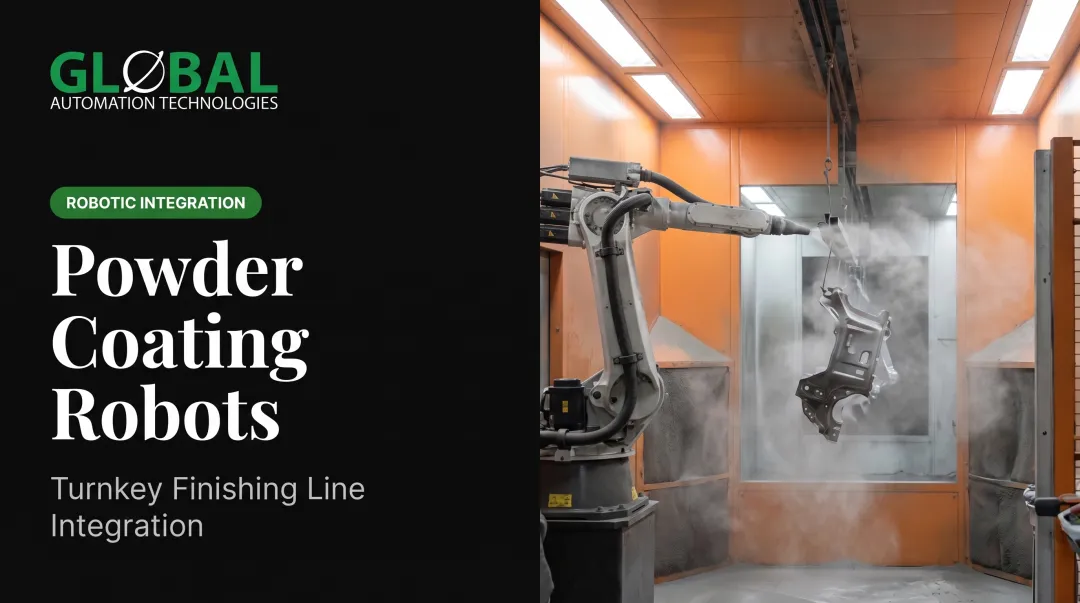
How Robotic Automation Is Transforming Powder Coating Lines
Manual powder coating has real limits at scale. Operator fatigue leads to inconsistent film build across parts. Spray booths expose workers to airborne particulates and combustible dust that OSHA regulates closely under 1910.107. And cycle times slow down when every part depends on a human hand holding the gun steady.
Robotic spray systems remove that variability. A programmed path repeats the same motion, distance, and trigger timing on every part, so film build does not drift with operator fatigue over an 8-hour shift.
What Automation Actually Improves
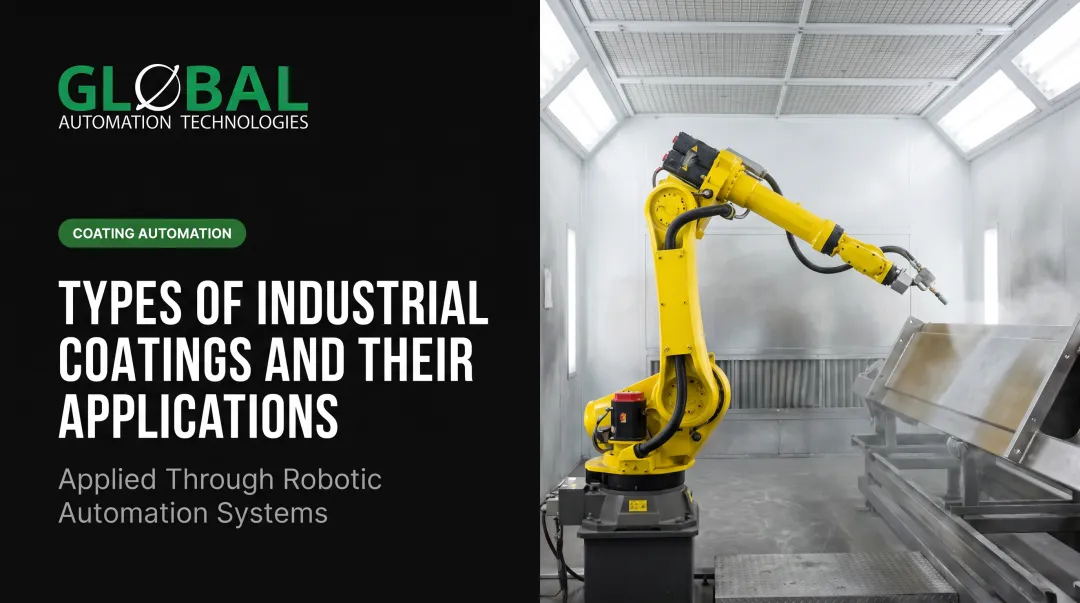
- Film build accuracy — GLOBAL Automation Technologies' robotic coating systems hold film build within specification using FANUC robots with spray-pattern and edge-buildup controls
- Reduced overspray and material waste — repeatable paths mean less powder misses the part and goes to reclaim
- Operator safety — pulling people out of the booth eliminates exposure to airborne particulates and combustible dust
- Unattended operation — robotic cells run coating cycles without a person at the gun
Manufacturers evaluating a shift from manual to automated lines shouldn't underestimate the programming lift, though. Traditional robot programming for a new part mix can take weeks. GLOBAL, a Level 5 FANUC Authorized System Integrator, uses AI-assisted simulation to model booth layout, spray patterns, and film-build targets before code runs on the floor, compressing that programming timeline from weeks to days in many cases.
This is also where having both the system and the people to run it matters. A turnkey powder-coating automation scope typically covers booth layout, robot selection, path programming, process validation, and machine-vision inspection, plus installation, commissioning, and training.
Manufacturers converting a manual line often need engineering talent on-site during that transition, not just equipment dropped off. Pairing automation solutions and services with a technical staffing bench (controls engineers, robot programmers, commissioning engineers) shortens the runway from decision to production.
Frequently Asked Questions
Is it cheaper to powder coat or paint?
At volume, powder coating typically costs less per part due to high material utilization (95-98%) and single-coat application. Upfront equipment investment is higher, so the breakeven point depends on your production volume and part mix.
How long will powder coating last?
Service life depends heavily on resin chemistry, UV exposure, and substrate prep quality. Premium exterior-grade polyester formulations can withstand several years of harsh weathering exposure when pretreatment and cure are done correctly.
Is powder coating better than paint?
It depends on the application. Powder coating wins on durability and chip resistance for functional parts like wheels and brackets, while liquid paint still leads for ultra-fine, high-gloss color matching on exterior body panels.
Can you powder coat an entire vehicle?
Not practically. Oven size and part-handling constraints generally limit powder coating to individual components and panels rather than a fully assembled vehicle, though some OEMs have used powder for body-line primer processes.
What temperature is needed to cure automotive powder coating?
Most thermoset automotive powders cure between 350-400°F for 5-20 minutes at substrate temperature. Specific products vary, so always confirm against the manufacturer's technical data sheet.
Can robots improve powder coating quality on a production line?
Yes. Robots remove the variability of manual spraying, hold film build to tight tolerances, and cut overspray—improving finish consistency and lowering material cost per part.