
EtherCAT has become the go-to answer. It's now the backbone for robotics cells, CNC machines, and packaging lines that need axes moving in lockstep, down to the microsecond.
This guide breaks down what EtherCAT actually is, how EtherCAT motion controllers function, the hardware you need, where it's used, and how to pick an integration partner who won't leave you with a network that underperforms on day one.
Key Takeaways
- EtherCAT is an open, IEC 61158-standardized protocol that uses "processing on the fly" for real-time control
- Runs on standard Ethernet (Cat5e, RJ45) with no proprietary switches required
- Synchronizes high axis counts at sub-millisecond, and even sub-microsecond, performance
- Controller and integration partner choice directly affects uptime and total cost of ownership
What is EtherCAT and How Does an EtherCAT Motion Controller Work?
EtherCAT stands for Ethernet for Control Automation Technology. Beckhoff Automation developed it and introduced it in 2003; the EtherCAT Technology Group (ETG) formed shortly after to govern the standard. It became an official IEC 61158 standard in December 2007, alongside IEC 61784-2 and IEC 61800-7.
The "Processing on the Fly" Mechanism
Here's what makes EtherCAT different from a typical Ethernet network: instead of each device waiting for its own message, one telegram travels through the entire line of devices.
- The MainDevice (master) sends a single frame
- Each SubDevice reads its addressed data and writes its own data as the frame passes through
- Only hardware propagation delay gets added, with no store-and-forward switching
- The last SubDevice reflects the frame back over full-duplex Ethernet
Regular TCP/IP traffic is non-deterministic: packets can queue, collide, or retry. EtherCAT operates at the data-link layer, using EtherType 0x88A4 to bypass the TCP/IP stack entirely for cyclic process data. That's why it's deterministic.
An EtherCAT motion controller is the MainDevice on that network. Each cycle it writes position, velocity, or torque setpoints into the frame for every axis and reads back actual position, status, and fault data on the return path. Because the full exchange rides in one telegram, the controller can close multi-axis loops at cycle times measured in hundreds of microseconds.

Distributed Clocks Keep Everything in Step
Multi-axis coordination only works if every drive agrees on "now." EtherCAT's Distributed Clocks mechanism synchronizes nodes with jitter reported by ETG's technology overview at roughly ±20 nanoseconds in test conditions, well under a microsecond.
The performance numbers back this up. That same ETG benchmark cites 1,000 digital I/O points across 100 nodes processed in 30 microseconds, and 100 servo axes handled in 100 microseconds. Those are lab benchmarks, not guarantees for every install, but they illustrate the ceiling EtherCAT is built to reach.
Core Components: Controllers, Drives, and Hardware Requirements
An EtherCAT network has two roles: the MainDevice (motion controller/master) that issues commands, and SubDevices (servo drives, I/O blocks, sensors) that execute them. An EtherCAT network has two roles: the MainDevice (motion controller/master) that issues commands, and SubDevices (servo drives, I/O blocks, sensors) that execute them. In motion cells, servo and stepper drives are the SubDevices that close the loop on each axis.
Do You Need Special Hardware?
Not for the master. The MainDevice typically runs on a standard NIC or industrial PC, with no proprietary interface card required, according to ETG documentation. SubDevices are a different story: each needs an EtherCAT SubDevice Controller (ESC), which can be an ASIC, FPGA, or embedded microcontroller that processes the frame in hardware.
Most EtherCAT servo drives ship with an ESC built in, so the real hardware decision is which drive family and controller stack you standardize on.
PC-Based vs. Standalone Controllers
| Factor | PC-Based Soft Motion Controller | Standalone Hardware Controller |
|---|---|---|
| Flexibility | High: easy to reprogram, integrates with SCADA/IoT | Lower: fixed function |
| Ruggedness | Depends on enclosure/IPC rating | Built for harsh floor environments |
| Cost | Often lower upfront | Can carry a premium for reliability |
| Best fit | R&D, flexible cells, frequent changeovers | High-uptime production lines |

Controller choice shapes commissioning and long-term support. Network layout is the other constraint that drives the bill of materials.
Topology Rules
EtherCAT avoids standard managed switches in most line configurations. Devices daisy-chain instead, each one forwarding the frame to the next. When a plant layout demands a star configuration, a specialized EtherCAT junction handles the branching while preserving the logical ring the frame travels through.
A single EtherCAT segment supports up to 65,535 devices. That capacity covers large multi-axis robotic cells with dozens of synchronized servo drives on one network.
Key Benefits of EtherCAT for Motion Control
EtherCAT's advantages explain why it's displaced older fieldbuses on so many new lines:
- Deterministic speed: Sub-microsecond synchronization makes closed-loop control tight enough for robotics and CNC machining
- Lower infrastructure cost: Standard Ethernet cabling and connectors mean no proprietary switches, plus lower space and power needs (Beckhoff EtherCAT documentation)
- Open, multi-vendor ecosystem: Manufacturers mix drives, controllers, and I/O from different suppliers without brand lock-in
- Built-in functional safety: Safety over EtherCAT (FSoE) carries safety-critical and standard data on the same wire (IEC 61508 / IEC 61784-3, through SIL 3)
That safety benefit shows up on the plant floor. Running safety and standard control data on one network, instead of separate safety wiring, cuts installation complexity.
Who Uses EtherCAT and Where It's Applied
EtherCAT shows up wherever synchronized, high-speed motion matters most. The EtherCAT Technology Group (ETG) names robotics, packaging, machine tools, electronics, and battery manufacturing as core adopters, and semiconductor manufacturing has its own EtherCAT-based standard: SEMI E54.20.
Robotics Work Cells
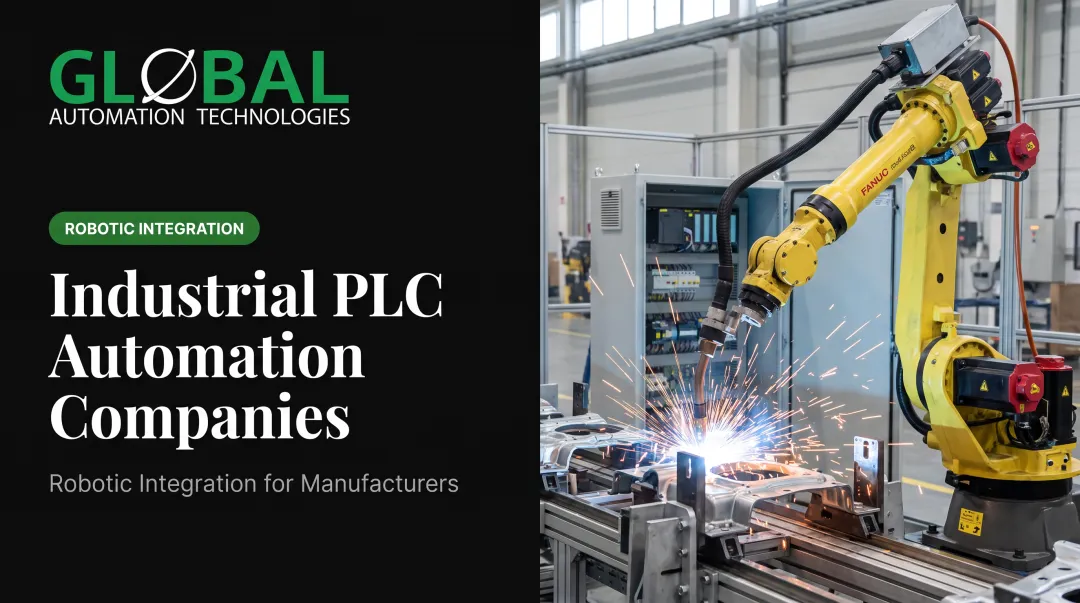
Robotic machine tending, welding, and dispensing cells lean on EtherCAT-based controllers to keep multiple axes and peripheral devices (grippers, sensors, vision systems) moving in coordination without drift.
GLOBAL Automation Technologies, a top-tier Level 5 FANUC Authorized System Integrator, integrates EtherCAT-networked robotic systems, primarily built on FANUC platforms, into automotive, Tier 1, and heavy industry production lines. That includes turnkey layout, programming, and commissioning: the full path from concept to a running cell on the floor.
Automotive and Beyond
- Automotive & Tier 1: Body shop welding, paint lines, powertrain assembly
- Heavy industry: Agricultural and construction equipment manufacturing
- CNC/machine tools: Multi-axis coordination for precision machining
- Packaging: High-speed synchronized motion across pick-and-place stations
- Electronics & semiconductor: High-precision placement and wafer-handling motion under SEMI E54.20
- Battery manufacturing: Synchronized electrode handling and cell-assembly lines

Choosing the Right EtherCAT Integration Partner
Buying the right controller is only step one. Getting the network topology right, tuning servo drives, and commissioning the cell without weeks of troubleshooting requires engineers who've done it before.
What to Look for in a Partner
- Network design expertise: Plan daisy-chain vs. junction-based topology before cabling goes in, not after
- Drive tuning experience: Get servo response right the first time and avoid costly rework
- Commissioning discipline: Follow a structured process from simulation through production launch
- Flexible engineering support: Access talent beyond the initial install for troubleshooting and line changes
GLOBAL addresses this directly. GLOBAL handles turnkey robotic systems integration — layout, programming, and commissioning — and separately supplies on-demand engineering talent through contract, contract-to-hire, or direct placement, so clients still have controls engineers when a line needs support months after startup.
GLOBAL also applies AI-assisted simulation to model and test robot programs before deployment, which has cut programming time from weeks to days on past projects — helping crews walk into commissioning with fewer surprises.
Before finalizing controller and topology decisions, talk to an integrator. A network designed without production-floor experience tends to reveal its weaknesses only after it's running, and by then fixes cost far more than they would have upfront.
Frequently Asked Questions
What is EtherCAT and how does it work?
EtherCAT is an open, real-time industrial Ethernet protocol that uses "processing on the fly": each device reads and writes data as a single frame passes through the network. This eliminates the delays typical of standard switched Ethernet.
What does EtherCAT stand for?
EtherCAT stands for Ethernet for Control Automation Technology. Beckhoff Automation developed it and introduced it in 2003; the EtherCAT Technology Group has governed the standard since then.
Is EtherCAT the same as Ethernet?
EtherCAT uses standard Ethernet hardware (cables, connectors, and network interfaces) but adds a deterministic, real-time protocol layer on top. Standard Ethernet's TCP/IP traffic is non-deterministic; EtherCAT's cyclic data bypasses that stack.
Does EtherCAT require special hardware?
The master can run on a standard NIC or industrial PC with no special card required. SubDevices need an EtherCAT SubDevice Controller (ESC) chip, and networks typically skip standard switches in favor of daisy-chain topology.
Who uses EtherCAT technology?
Primary adopters include robotics, CNC and machine tool builders, packaging companies, semiconductor fabs, automotive manufacturers, and electronics and battery production.
Does Allen-Bradley use EtherCAT?
Rockwell Automation states directly that no Rockwell products natively support EtherCAT. Its integrated motion runs on EtherNet/IP and CIP Motion instead. Third-party gateways can bridge EtherCAT devices into Rockwell environments, though native performance isn't guaranteed.