
Introduction
The welding workforce shortage continues to intensify across North American manufacturing. According to the American Welding Society, approximately 80,000 welding jobs need to be filled annually between 2025 and 2029, while the Bureau of Labor Statistics projects 45,600 annual openings for welders, cutters, solderers, and brazers through 2034.
That pressure hits hardest in the middle of the automation spectrum: jobs producing 50 to 500 parts per week. These runs are too repetitive for manual welding, yet too varied for fixed, high-volume robot cells.
Cobot welding cells bridge this gap. Traditional industrial welding robots demand dedicated floor space, deep programming expertise, and weeks of setup. Collaborative systems are different: intuitive to program, compact on the floor, and flexible enough to switch part families in hours rather than days. They deliver consistent weld quality while freeing skilled welders for complex assemblies that still need human judgment.
This guide covers what cobot welding cells are, how their components work together, when they beat traditional automation, and what to expect from investment through ROI and scaling.
Key Takeaways
- Bridge the automation gap for high-mix, low-to-medium volume work
- Program new weld paths in hours with hand-guiding, not weeks of offline engineering
- Integration quality (power source, fixturing, software) matters more than robot brand
- Turnkey cells start near $105,000; one Ohio shop hit ROI in under 12 months
- Cobot features cut guarding needs but not arc flash, fume, or hot-part hazards
What Are Cobot Welding Cells?
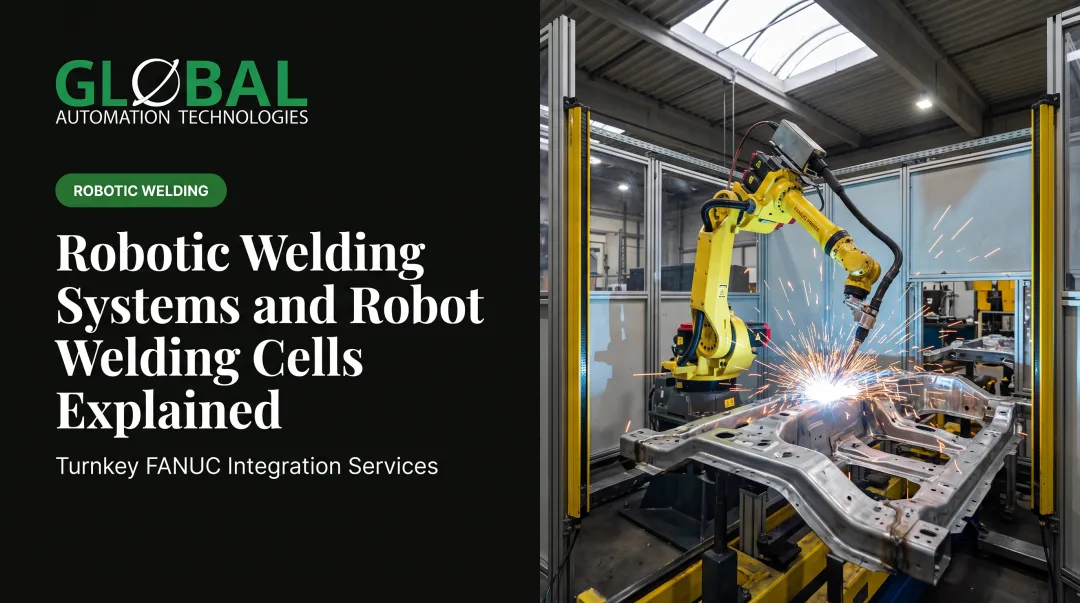
Cobot welding cells combine collaborative robotic arms with welding equipment, safety controls, and fixturing designed to work safely near human operators. The term "collaborative" refers to power and force limitations, real-time collision detection, and motion-speed controls that allow the robot to share workspace with welders. The welding process itself still produces arc flash, spatter, fumes, and hot metal that require appropriate protection.
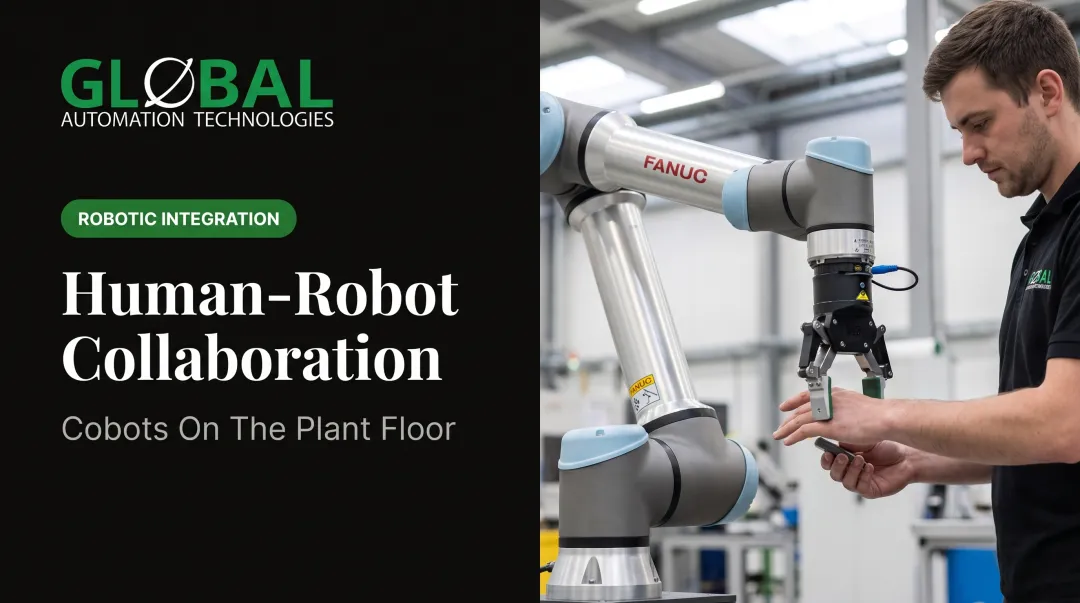
How collaboration works in practice: The robot arm uses force-limited joints and sensors that detect unexpected contact and stop motion before injury occurs. Current US safety requirements are defined in ANSI/A3 R15.06-2025, harmonized with ISO 10218-1/-2:2025, which treats collaboration as an attribute of the complete application, not just the robot. The standard requires a documented risk assessment covering the robot, tooling, workpiece, and workspace layout.
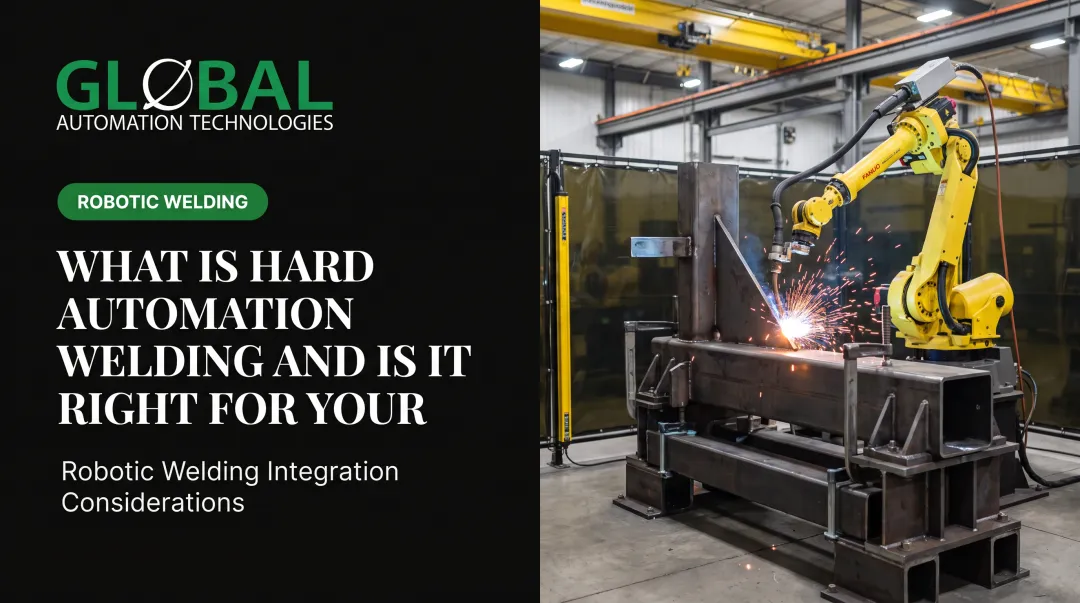
Ideal applications: Cobot welding cells excel in high-mix environments where manufacturers produce multiple part families in small to medium batches. A typical suitable job might produce 100 units per week across several different designs, each requiring similar but not identical weld sequences. Large one-off assemblies with extensive out-of-position welds remain better suited to skilled manual welders.
Compared to traditional robot cells: Conventional industrial welding robots offer higher speed and payload capacity, making them the best choice for stable, high-volume production runs. Cobots trade some of that raw performance for flexibility: faster programming, simpler fixturing, and easier redeployment to new parts. The International Federation of Robotics notes that traditional industrial robots remain faster in pure cycle time, but cobots win when changeover frequency matters more than maximum throughput.
Target users:
- Small to medium fabricators
- Contract manufacturers handling diverse customer orders
- Shops struggling to hire skilled welders
- Operations with short product life cycles and frequent changeovers

Components of a Cobot Welding Cell
Robotic Arm and Motion Control
Cobot welding arms are typically 6-axis articulating designs. Payloads usually fall between 5 and 20 kg, depending on the model and torch weight.
Representative specs include:
- Universal Robots UR10e: 10–12.5 kg payload, 1,300 mm reach, ±0.05 mm pose repeatability (ISO 9283)
- FANUC CRX-10iA/L: 10 kg payload, 1,418 mm reach
- ABB GoFa: 5–12 kg payload, reach up to 1.62 m, 0.02 mm repeatability
Collaborative safety features commonly include:
- Force-limited joints that reduce impact forces on unintended contact
- Collision detection that stops motion when resistance exceeds set thresholds
- Adjustable speed limits that slow the arm when operators enter defined zones
These features allow closer human proximity. They do not replace welding curtains, fume extraction, or PPE.
Welding Power Source and Process Control
Power source selection matters as much as the arm. A robotic welding supply should talk directly to the robot controller so arc start/stop, voltage, and wire feed stay in sync, with parameter logging for traceability.
Capabilities to look for:
- Alloy-specific weld modes and industrial comms (for example, Lincoln Electric Power Wave R450 with ArcLink and weld monitoring)
- Controlled-heat waveforms such as pulsed MIG / RMD on systems like Miller Auto Deltaweld 350/500
- Offline path tools that cut teach time on complex joints (Fronius cites up to 80% programming-time reduction with Pathfinder)
What matters most is real-time feedback between the power source and controller. That adaptive arc control improves weld quality and cuts rework.

Torch, Wire Feeder, and End-of-Arm Tooling
Early cobot cells favored air-cooled MIG guns to save payload and cable weight. Air-cooled robotic torches in the 360–500 A class still fit many smaller fabrications. Modern cobots can also run water-cooled torches at 300–600 A, 100% duty cycle for higher-amperage work.
Choose based on weld current, duty cycle, gas type, and thermal load—not a single amperage cutoff. Water-cooled guns use more payload but support longer arc-on time without overheating.
Cable routing is just as critical. Torch leads, wire feeder cables, gas hoses, and control lines must limit wrist moment and stay clear of the motion envelope. Spring-balanced reels or articulated carriers help keep mass near the robot centerline.
Fixturing, Safety Infrastructure, and Workspace Design
Simple, repeatable fixtures make operator-led programming practical. Toggle clamps, locating pins, and modular nest plates let operators load parts, teach paths, and change over part families without calling engineering. Hydraulic or pneumatic clamps can cut cycle time at higher volume, at the cost of more complexity.
A collaborative arm rating does not waive arc-flash protection, fume control, or access rules. Most cells still need curtains or light-guarded enclosures, source-capture exhaust, and interlocks that pause the robot when someone enters the weld zone. The risk assessment must cover every hazard, not only mechanical contact.
Footprint grows fast beyond the cart. A Cooper CRX-10iA/L-style cart is roughly 59 × 35 × 38.5 inches with a 44 × 35 inch work surface. Curtains, extraction, part staging, and safe operator access can double or triple the installed area.
Control Software and Programming Interfaces
Intuitive programming separates cobots from traditional robots. Common methods include:
- Hand-guiding: Operators physically move the arm to each weld point; the robot records positions
- Teach pendants: Tablet-style interfaces with drag-and-drop programming and graphical weld libraries
- Touch-to-teach: The robot uses touch sensing to locate part edges and seam start points automatically
FANUC welding cobot packages can add touch sensing, through-arc seam tracking, and laser vision for path correction when joints vary. In the Raymath job-shop case, operators programmed 20 weld points in four hours after only 1–3 days of training—far shorter than traditional robot teach cycles.
Pre-built weld libraries cover common weaves, uphill/downhill travel, and multi-pass strategies. Operators pick and tune a routine instead of coding from scratch.
Matched well, arm, power source, torch, fixtures, and software form one cell—not a pile of parts. Integrators size each piece to the joint mix, duty cycle, and floor constraints before the first arc.

Benefits of Cobot Welding Cells
Cobot welding cells give shops automation without the rigidity of traditional robot cells. Gains show up in daily operations, workforce planning, and total cost.
Flexibility for high-mix manufacturing: Rapid program changes and quick fixture swaps make it economical to automate diverse part families. Shops can justify automation for jobs producing 50-200 parts per week across multiple SKUs, a range where traditional robot cells sit idle during frequent changeovers.
Ease of programming and deployment: Welders with minimal robotics training can program new parts using hand-guiding and teach pendants. Lincoln Electric's formal Cooper cobot programming course runs five days, compared to months of training for offline programming of conventional industrial robots.
Addressing the skilled welder shortage: Cobots handle repetitive production welds (frame welds, brackets, enclosures), freeing experienced welders for complex assemblies, repair work, and out-of-position jobs that need human skill. That shift also extends career longevity by cutting monotonous work and difficult postures.
Improved ergonomics and workplace safety: Robotic welding removes overhead positions, confined-space welds, and prolonged arc exposure. Cobots do not eliminate arc-flash or fume hazards, but they move those hazards away from the operator during the weld cycle and reduce cumulative exposure.
Consistent weld quality and reduced rework: Great Lakes Stainless reported smoother finishes and seamless welds after deploying a FANUC cobot welder. Welding and finishing time on one escalator component fell from about 3 hours to 15 minutes, a 95% cycle-time cut. Repeatability keeps bead size, penetration, and appearance uniform, which lowers scrap and rework cost.
Fast ROI and lower total cost of ownership: The Raymath deployment achieved ROI in under 12 months, cut operator headcount in half, and delivered a fourfold productivity gain across four welding cells. Results vary by job, but the case shows real payback when utilization is high and manual welding labor is tight.
Cobot vs. Traditional Welding Robots: When to Choose Each
Cobots and traditional welding robots solve different production problems. Use the comparison below to match cell type to volume, mix, and payload—not brand preference.
| Criterion | Cobot Welding Cell | Traditional Welding Robot |
|---|---|---|
| Production volume | Small batches, 50-500 parts/week, frequent changeovers | Stable high-volume runs, 500+ parts/week, long production cycles |
| Programming | Hand-guiding, teach pendant, hours to program new parts | Offline programming, CAD simulation, days to weeks per new part |
| Speed & payload | Lower cycle speed, 5-20 kg payloads, collaborative operation | Higher speed, 20-300 kg payloads, optimized for throughput |
| Footprint & guarding | Compact cart or base, reduced guarding for arm motion, but still requires weld-specific safety infrastructure | Larger floor space, full guarding/fencing, integrated safety zones |
| Flexibility | Easy redeployment to new parts and locations | Fixed installation, costly to relocate or reconfigure |
| Upfront cost | Starting around $105,000 for turnkey systems | $200,000+ for fenced cells with positioners and multi-robot coordination |
Choose a cobot welding cell when you need:
- Frequent changeovers and small batches (roughly 50–500 parts/week)
- Fast teach-by-demonstration programming measured in hours, not weeks
- A compact footprint and easier redeployment across cells or sites
Choose a traditional welding robot when you need:
- Stable, high-volume runs (500+ parts/week) with locked-in part designs
- Maximum speed or heavy payloads (often 20–300 kg) for throughput
- Long production cycles where fixed fencing, positioners, and engineering cost pay back quickly
Neither option is universally “better.” Match the cell to your mix, rate, and payload, and size safety infrastructure to the welding process either way.

Choosing the Right Cobot Cell Integration Partner
The robot arm is one component. Real-world success depends on the full stack around it:
- Power source compatibility and adaptive arc control
- Fixturing that supports quick changeover
- Software operators can actually use
- A validated risk assessment that closes safety gaps
A poorly integrated premium robot will underperform a well-integrated mid-tier system every time.
Choose systems designed to expand. Can you add a servo positioner later? A linear track to extend reach? Coordinated motion between two robots? A cell architected for growth protects your investment as production requirements evolve.
Deploying a cobot welding cell is half the challenge. Operating it effectively is the other half.
GLOBAL Automation Technologies, a top-tier Level 5 FANUC Authorized System Integrator, combines automation solutions, services and technical staffing, providing both the turnkey welding cell and access to controls engineers, robot programmers, and commissioning specialists who can support installation, training, and ongoing production. This approach means the system builder understands what staffing the operation requires, while the staffing team knows exactly what the system needs to succeed.
Cobot Welding Cell Costs and ROI
Published pricing
Hirebotics lists a starting price of $105,000 for its Cobot Welder package. That figure is one supplier’s entry-level package, not a full installed cost.
Actual project cost depends on reach, process package, sensing, fixturing, safety infrastructure, and how much integration the cell needs.
Cost factors to verify in quotes
- Robot payload, reach, and base type (mobile cart, fixed base, or linear track)
- Work table size and positioner options
- Power source model and process features (pulse, RMD/regulated metal deposition, waveform control)
- Torch package (air- or water-cooled), plus touch sensing, seam tracking, and vision
- Offline programming software, weld curtains or enclosures, and fume extraction
- Fixturing, installation, commissioning, training, documentation, and support agreements
ROI calculation method
- Annual net benefit = redeployed labor cost + contribution from added throughput + avoided rework and scrap − (consumables + maintenance + training + support)
- Simple payback = total installed cost ÷ annual net benefit
Real-world example
Raymath’s four-cell deployment let two operators run two welding cells each—half the prior headcount—with reported 4X productivity. One weld fell from 15 minutes to 5–6 minutes; another dropped from 3–4 minutes to 30–40 seconds. Payback came in under 12 months.
Hidden costs to plan for
- Fixture development for each new part family
- Wire, gas, contact tips, nozzles, anti-spatter, and torch cleaning consumables
- Electrical, compressed air, and network infrastructure modifications
- Risk assessment validation and safety compliance documentation
- Ramp-up scrap during the operator learning curve
- Software licenses and update fees

Real-World Applications and Use Cases
High-mix fabrication
Cobot welding cells sit between low-volume manual welding and high-volume conventional robot cells. In MEC’s high-mix cellular layout, one operator runs two adjacent stations—fixturing, tacking, programming, loading, and recovery—so medium-quantity and lower-volume parts can move through automated welding without a full hard-automation line.
Small to medium job shops
Diamond Doors onboarded a FANUC cobot for hinge welding using tablet drag-and-drop programming. Consistent weld quality let the shop onshore work from offshore suppliers, with plans to add more cobots as volume grows.
Heavy and specialty equipment
When parts are too large or too infrequent for a fixed cell, shops bring the cobot to the work:
- A New Mexico ag-equipment maker runs a mobile cobot cart on oversized components
- Another operation welds 15-ton workpieces in place from a forklift-compatible skid
- A Swedish bucket-repair shop cut process time 30% with a portable cobot system
Mobile and portable setups make sense when fixtures stay put, parts move rarely, or the weld zone sits outside a traditional cell envelope.
Implementing Your First Cobot Welding Cell
A successful first cell starts with the right application, a workable floor plan, and buy-in from the people who will run it. Get those three right before you order hardware.
Assessment and Planning
- Identify the right first application: Choose boring, repetitive welds on parts with stable fit-up and accessible joint geometry. Avoid one-off assemblies or heavily out-of-position work for the pilot.
- Evaluate workspace layout: Measure available floor space, verify utilities (electrical, compressed air, network), and plan curtain/enclosure placement and fume-extraction routing.
- Determine fixturing requirements: Design or specify simple, repeatable fixtures that operators can load and unload quickly. Locating pins, toggle clamps, and modular plates reduce complexity.
- Calculate expected ROI: Model labor redeployment, incremental throughput, rework reduction, and total installed cost. Test conservative, base, and optimistic utilization scenarios before committing.
Training and Change Management
Address welder concerns directly. Collaborative automation does not replace welders. It reallocates their time from repetitive production welds to complex assemblies, repairs, and setups that need human judgment. Frame the cobot as a tool that extends career longevity by cutting ergonomic strain and fume exposure.
Separate training by role:
- Welders keep process knowledge and quality judgment
- Operators handle loading and programming
- Maintenance staff manage consumables and preventive care
Expect 1–5 days of initial training depending on system complexity and operator experience.
Scaling from One Cell to Multiple
After the first cell proves out, freeze a repeatable part-family strategy. Standardize fixture designs, save and qualify weld programs, and track good-parts-per-hour and rework rates. Then replicate the model that worked.
Diamond Doors planned several additional cobots after the first installation; Raymath scaled to four coordinated welding cells. Build organizational expertise one cell at a time rather than deploying multiple cells at once.

Frequently Asked Questions
What are welding cobots?
Welding cobots are collaborative robots built for welding, with force-limited joints, collision detection, and safety controls that let them work near human welders. Unlike traditional industrial robots, they prioritize easy programming and flexible deployment over raw speed.
How does cobot welding work?
Operators program the weld path with hand-guiding, teach pendants, or tablet interfaces. The cobot then runs repeatable welds while the operator handles loading, fixturing, and inspection nearby, holding consistent travel speed, wire feed, and voltage for uniform quality.
How much does a welding cobot cost?
Turnkey cobot welding cells start around $105,000 and can exceed $150,000 based on robot reach, power source, cooling method, fixturing, vision systems, and integration scope. Request detailed quotes that itemize components, installation, training, and support.
What's the difference between a cobot and a traditional welding robot?
Cobots use force-limited joints and safety sensors for closer human work, offer intuitive programming, and deploy faster at lower cost. Traditional robots deliver higher speed and payload for high-volume production but need extensive guarding, dedicated programmers, and longer setup.
How long does it take to program a welding cobot?
Simple welds can be programmed in hours with hand-guiding or teach pendants. One documented case programmed 20 weld points in four hours after 1–3 days of training, while traditional robots often need days to weeks for offline programming and validation.
Can cobots handle high-amperage welding applications?
Yes. Modern cobots support water-cooled torches rated 300–600 amperes at 100% duty cycle, well beyond early air-cooled limits. Very high-speed or high-payload processes may still favor traditional industrial robots built for maximum throughput.