
Manufacturers evaluating automation upgrades often mix up SCADA with PLCs, ICS, or DCS. That confusion gets expensive when you're scoping a project or writing a capital request. This guide breaks down what SCADA actually is, its core components, the different types you'll encounter, and the security issues manufacturers can't afford to ignore.
Key Takeaways
- Centralizes plant monitoring and control in a single operator interface
- Fits inside the broader ICS stack with PLCs, RTUs, and HMIs
- Connects modern plants to IT systems, AI analytics, and predictive maintenance
- Remains the standard across manufacturing, energy, water, and automotive
What Is SCADA and Why Does It Matter for Manufacturing?
SCADA (Supervisory Control and Data Acquisition) is a system architecture that combines computers, networked data communications, and human-machine interfaces to supervise machinery and processes at a high level.
According to NIST's Guide to Operational Technology Security, SCADA integrates data acquisition, data transmission, and HMI software to deliver centralized, near-real-time monitoring and control across dispersed assets.
In practice, SCADA pulls data from sensors and equipment scattered across a plant floor or multiple facilities into a single dashboard.
Here's a simple example: a temperature sensor on a production line detects a fault. SCADA flags the anomaly, pushes an alarm to the operator's HMI screen, and the operator intervenes before the issue cascades into a full line stoppage. No SCADA layer means someone finds the problem manually, usually after it's already cost time and material.
Why Plant-Floor Visibility Pays Off
Downtime isn't cheap. Industry data puts the stakes in plain numbers:
- Automotive: Unplanned downtime costs $2.3 million per hour (Siemens, 2024)—double the 2019 figure
- Broader industry: Average closer to $125,000 per hour (ABB, 2023), with more than two-thirds of businesses reporting outages at least monthly

That's the financial case for real-time visibility. As robotic automation and machine tending expand across production lines, SCADA coordinates PLCs, robots, and production data into one coherent picture. Without it, you get isolated islands of automation that don't talk to each other.
Core Components of a SCADA System
Every SCADA system relies on a handful of core building blocks, each with a distinct job.
PLCs and RTUs
Programmable Logic Controllers (PLCs) and Remote Terminal Units (RTUs) sit at the field level, connecting directly to sensors, actuators, and machinery. RTUs typically control a local process at a geographically distributed site and relay information back to the control server. PLCs perform similar functions but are often used at a single site or machine level.
Human-Machine Interfaces (HMIs)
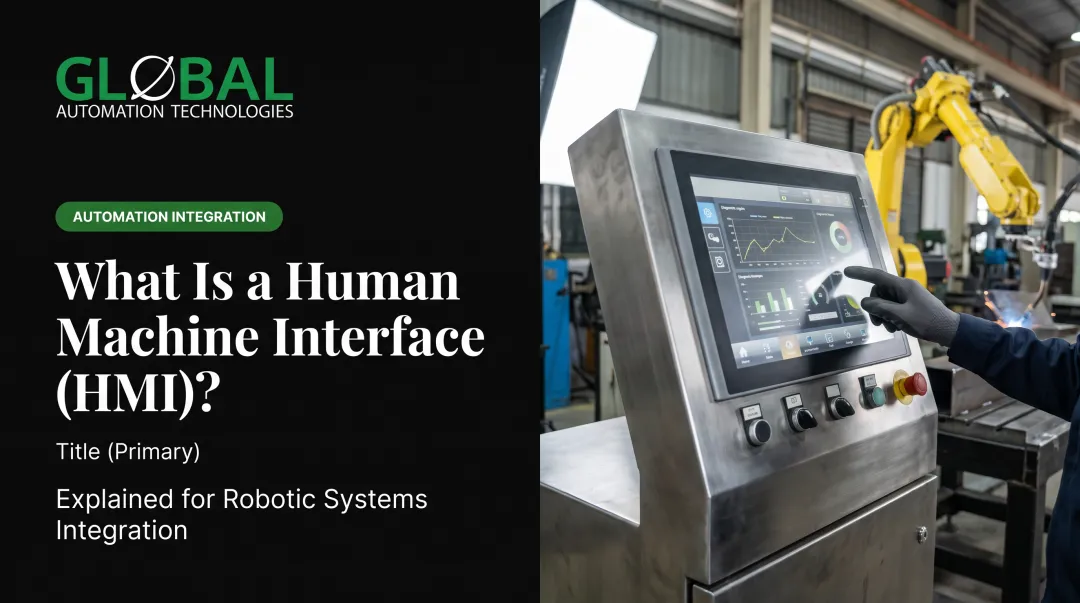
HMIs give operators the visual dashboards, alarms, and control screens they interact with daily. They show process status and historical trends, and they let operators adjust set points or controller parameters without touching the underlying code.
Supervisory Computers and Communication Infrastructure
Supervisory computers aggregate data from RTUs and PLCs, polling field devices and issuing high-level commands. Wired, wireless, or industrial Ethernet networks carry that traffic so every layer of the system stays in sync.
Data Historians
Data historians sit above the live control loop and preserve what the plant actually did over time:
- Log process values for trend analysis, reporting, and audits
- Feed analytics platforms and compliance documentation
- Help engineers spot drift and failure patterns before downtime hits

SCADA vs. PLC vs. ICS vs. DCS: Clearing Up the Confusion
Here's the hierarchy manufacturers often get wrong:
| Term | What It Actually Is |
|---|---|
| ICS | The umbrella category covering all industrial control systems |
| SCADA | A subset of ICS focused on centralized supervision across dispersed assets |
| DCS | Another ICS subset, typically for single-site, continuous process plants |
| PLC | Individual field-level control hardware, not a complete system |
The key distinction: PLCs control individual machines in real time, while SCADA supervises and visualizes data across many PLCs and RTUs at a broader scale.
Per NIST, SCADA generally uses wide-area network communications for geographically dispersed operations, while DCS coordinates localized controllers within a single facility's supervisory loop.
Put simply, a PLC is the worker on the floor. SCADA is the manager watching every worker across every floor from one office.
The Four Generations of SCADA Systems
SCADA architecture has evolved through four distinct generations, according to a 2023 peer-reviewed review in Computers & Security.
- Monolithic - Standalone mainframes connected to RTUs through wide-area networks, using proprietary protocols. Air-gapped and secure from outside access, but expensive to maintain and lacking redundancy options.
- Distributed - Mini-computers, operator stations, RTUs, and HMIs connected via local area networks. Better reliability, though still locked into proprietary vendor systems.
- Networked - Off-the-shelf hardware, IP networking, and Ethernet. More affordable and scalable, but internet connectivity widens the attack surface considerably.
- IoT/Cloud-Integrated - Cloud platforms, IoT devices, web-based access, and AI-assisted analytics. Most flexible and scalable generation, but highest cyber exposure without proper security.

Most manufacturers running legacy equipment today are somewhere between generation two and three, with newer installations pushing into generation four.
Benefits of SCADA for Manufacturing Operations
SCADA's value comes down to visibility and speed of response. In manufacturing operations, that typically shows up in three ways:
- Earlier intervention on equipment faults, before a minor issue becomes a full stoppage
- Centralized throughput, quality, and compliance data instead of manually reconciled machine logs
- Real-time supervisory feeds that keep robotic cells running unattended
By flagging issues early, SCADA lets maintenance teams act while the problem is still small. Integrated SCADA data paired with analytics enables real-time decisions and helps identify productivity potential across a plant.
Centralized data also supports throughput tracking, quality checks, and compliance reporting from one system. Teams stop reconciling logs from separate machines and work from a shared operational record instead.
As machine tending, welding, and dispensing cells scale up, they depend on that supervisory layer to keep spindles running. Intelligent scheduling, buffer stations, and cycle analysis only work when accurate data flows back to the system in real time.
At GLOBAL Automation Technologies, a top-tier Level 5 FANUC Authorized System Integrator, machine tending cells are engineered so a single robot can serve multiple machines at high utilization. That coordination assumes a reliable SCADA foundation underneath.
The same data layer supports predictive maintenance. AI-driven health assessments monitor equipment on an ongoing basis and flag developing issues before they cause downtime, extending the early-warning visibility SCADA already provides.
SCADA Security Considerations for Manufacturers
Legacy SCADA systems weren't built with cybersecurity in mind. Many still rely on outdated protocols designed for isolated, air-gapped environments, not the connected networks running plants today.
Common risks include:
- Unauthorized network access through poorly secured remote connections
- Malware exploiting outdated software and unpatched systems
- Vulnerabilities from IT/OT convergence as corporate networks connect to operational technology
NIST SP 800-82 OT security guidance recommends these baseline practices:
- Segment networks - Isolate IT and OT systems using zones, tiers, and boundary firewalls
- Control access - Apply role-based access control so users only get the privileges their job requires
- Update systems regularly - Maintain a documented patch process, tested offline before deployment on live equipment

As plants pull more value from SCADA data through IT/OT connections, every new link expands the attack surface. Segmentation, access control, and patching should be in place before those connections go live.
Frequently Asked Questions
What is SCADA and why is it used?
SCADA (Supervisory Control and Data Acquisition) is a centralized system for monitoring and controlling industrial processes in near-real-time. It's used to give operators visibility across dispersed equipment and facilities from a single interface.
What are the four types of SCADA systems?
The four generations are monolithic (standalone mainframes), distributed (LAN-connected), networked (Ethernet and IP-based), and modern IoT/cloud-integrated systems. Each generation added more connectivity and more security exposure.
How is SCADA different from PLC?
A PLC controls an individual machine or process in real time at the field level. SCADA supervises and visualizes data across many PLCs and RTUs, giving operators a plant-wide or multisite view.
What are common SCADA applications?
Common applications include water treatment, electrical power grids, and manufacturing plant floors. In plants, SCADA coordinates assembly lines, batch processes, and facility energy monitoring.
Is SCADA still used today?
Yes, SCADA remains widely used and continues evolving. Modern implementations increasingly integrate with industrial IoT, cloud platforms, and AI-driven analytics for predictive maintenance and process optimization.