
Introduction
Picture a manufacturing line running at 2 a.m. with no one on the floor. Parts move, robots weld, conveyors index, and quality checks happen automatically. Something is making every one of those decisions in real time.
That something is usually a PLC — and it's the backbone of what most people call "industrial automation."
Many manufacturers use these terms interchangeably, but they're not the same thing. A PLC is a specific piece of hardware. Industrial automation is the entire ecosystem that hardware helps run.
Understanding the difference matters if you're evaluating a new production line, a retrofit, or a robotic cell.
This article breaks down what a PLC actually is, how it works, and the main types available today. You'll also see how it fits into the larger automation picture, including where robots, HMIs, and SCADA systems come in.
Key Takeaways
- PLCs are rugged industrial computers that read sensors, run control logic, and drive machine outputs in real time.
- Industrial automation relies on PLCs to coordinate robots, conveyors, sensors, and safety systems on the plant floor.
- Choose among four PLC types—compact/fixed, modular, rack-mounted, or software-based—based on scale and flexibility needs.
- Hardware alone is not enough: the right automation partner drives successful startup, uptime, and long-term ROI.
What Is PLC Programming?
What Is a PLC?
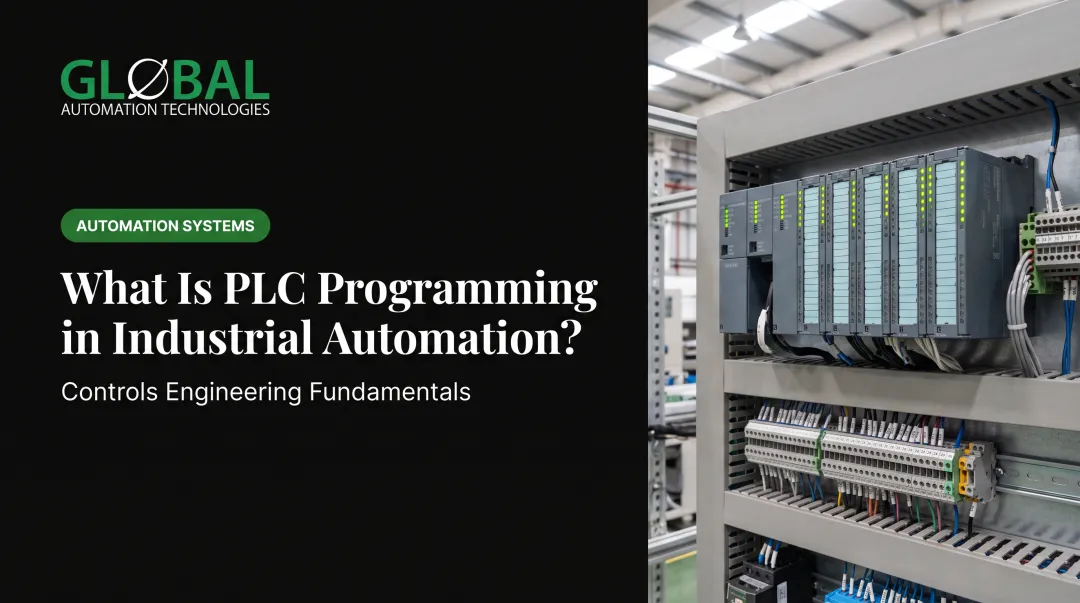
A PLC (Programmable Logic Controller) is an industrial computer built to survive conditions that would fry a regular laptop: heat, dust, constant vibration, and electrical noise from nearby motors and welders.
Rockwell Automation describes it simply as a controller that stores instructions, monitors inputs, and controls outputs to automate manufacturing processes and machinery, including robotic systems.
PLC programming is the process of translating human logic into instructions the controller can execute. Something like: "If this part-present sensor triggers, close the clamp, then start the weld cycle." That plain-language logic becomes code the PLC scans and acts on continuously.
Key Components of a PLC System
Every PLC system is built from four core pieces:
- CPU — processes the logic program and makes decisions
- I/O modules — connect physical sensors (inputs) and actuators like motors or valves (outputs)
- Rack or chassis — houses and organizes the modules
- Power supply — keeps the whole system running
The scan cycle is the heartbeat of a PLC. It reads all inputs, runs the logic program against those inputs, updates the outputs, then starts over. Depending on the controller model and program complexity, this cycle can complete in under a millisecond to a few milliseconds. That means a PLC checks conditions and reacts thousands of times every second, not just once.

Common PLC Programming Languages
PLC programming has historically used five languages under the IEC 61131-3 standard: Ladder Logic, Structured Text, Function Block Diagram, Sequential Function Chart, and Instruction List. The newest edition of that standard narrows its core scope, but most PLCs in the field today still support all five for compatibility with existing programs.
Ladder Logic remains the dominant choice by a wide margin. In a Control Engineering survey of 545 working engineers, Ladder Diagram was rated the most important PLC language 85% of the time, largely because it visually mirrors relay wiring diagrams. That makes it intuitive for electrically trained technicians.
One catch worth knowing: PLC programs aren't universally interchangeable across manufacturers. Allen-Bradley, Siemens, and FANUC-integrated systems each use different addressing schemes and instruction sets, so a program written for one brand won't simply drop into another.
How PLCs Power Industrial Automation Systems
From Relay Panels to Robotic Cells
Before PLCs, machine logic lived in relay panels: walls of physical switches wired together. Changing the process meant rewiring the panel, which could take days.
That changed starting in 1968, when General Motors' Hydra-matic division specified requirements for a reprogrammable, modular controller.
Around the same time, Dick Morley's Bedford Associates team developed a similar concept. It became the Modicon 084, delivered in 1969 to replace a relay panel on a gear-grinding machine.
That shift from hard-wired to reprogrammable logic is what made flexible, scalable automation possible. Without it, the robotic cells running today's automotive and heavy equipment plants wouldn't exist in their current form.
Real-World Applications on the Plant Floor
PLCs run dozens of processes across a typical manufacturing plant:
- Conveyor indexing and part transfer
- Robotic welding cell sequencing
- Machine tending (CNC loading, press tending, injection molding)
- Adhesive and sealant dispensing
- Robotic painting line coordination
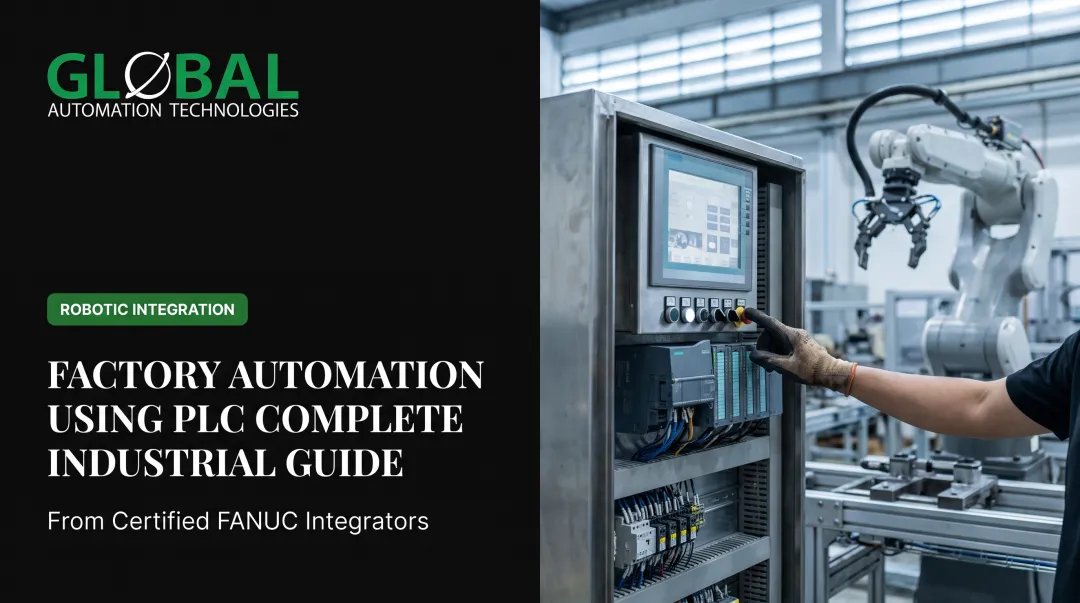
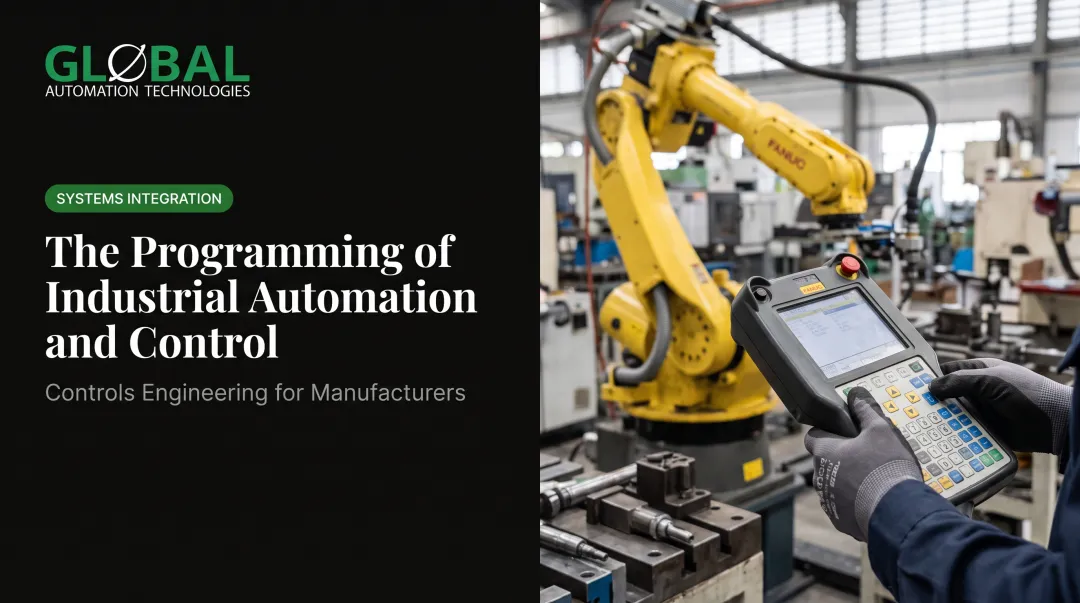
In a robotic manufacturing cell, the PLC and the robot controller split responsibilities rather than doing the same job. The PLC typically manages safety interlocks, part-presence sensors, and overall cycle timing. The robot controller (a FANUC controller, for example) handles motion path and program selection. The two systems work together rather than substituting for each other.
GLOBAL Automation Technologies builds this division of labor into every machine tending cell it engineers. The PLC manages door commands, cycle starts, and machine-ready handshaking with the CNC or press. The FANUC controller drives the robot's motion and process sequencing.
PLCs, SCADA, and HMI: The Automation Stack
A PLC doesn't operate in isolation. It sits at the base of a layered control stack:
- PLC: direct machine control, reading inputs and driving outputs
- HMI: the operator-facing screen for control and diagnostics at the machine level
- SCADA: plant-wide software that combines hardware and software to send commands and acquire data across many machines or lines
These layers feed each other. A PLC pushes real-time status to an HMI so an operator can intervene, and the same data rolls up into SCADA for plant managers tracking output across the whole facility.

Increasingly, that data also feeds AI-assisted predictive maintenance tools. GLOBAL builds AI-driven health assessments into its engineering work to flag equipment issues using PLC and sensor data before they cause unplanned downtime. More integrators now treat this as standard practice rather than an add-on.
Types of PLCs You Should Know
Not every application needs the same controller. Four categories cover most industrial use cases:
| Type | Best For | Key Trait |
|---|---|---|
| Compact/Fixed | Small standalone machines | Preset I/O count, lower cost |
| Modular | Large or evolving production lines | Expandable racks with swappable I/O modules |
| Rack-Mounted/Large Process | Multi-zone processes, automotive assembly | High I/O counts, complex chassis configurations |
| Software-Based/Virtual | Remote monitoring, cloud control, pre-deployment testing | Runs PLC logic on general-purpose or edge hardware |
Compact/Fixed PLCs come with a set number of inputs and outputs built in. They're the lowest-cost entry point and work well for a single standalone machine that won't need much expansion.
Modular PLCs trade that simplicity for flexibility. You can add or swap I/O modules as a line grows or changes — ideal for facilities that expect to scale.
Rack-Mounted/Large Process PLCs handle the heaviest workloads: high I/O counts spread across multiple zones, like a full automotive body shop or paint line.
Software-Based/Virtual PLCs are the newest category. They run PLC logic on general-purpose hardware instead of dedicated controller units, which is useful for cloud-based monitoring, remote diagnostics, and testing programs before they ever touch the physical floor.
Key Benefits of PLC-Driven Automation for Manufacturers
Switching from relay panels or legacy PLCs to modern, well-programmed controls delivers measurable gains:
- Lower wiring and material costs compared to hard-wired relay systems
- Fewer manual decisions on the floor, reducing human error
- Faster changeovers when a product or process shifts
- Shorter commissioning timelines when programs are simulated and validated before startup
That last point matters more than it sounds. In one documented case, Siemens and Wipro PARI used virtual commissioning to validate PLC code, robot programs, and HMI logic before physical startup, cutting on-site commissioning time by 70% and reducing rework by 40-50%.
GLOBAL applies a similar philosophy through AI-assisted simulation, modeling, and testing robot programs before deployment. That pre-validation approach is why GLOBAL's robotic machine tending cells typically pay for themselves in 12 to 18 months. Higher spindle utilization and less manual labor add up once a cell runs unattended through breaks and shift changes.
The same programmed consistency shows up in finishing work. GLOBAL's robotic painting systems follow the same programmed path every cycle, holding film build within specification shift after shift, a level of repeatability manual spray operators struggle to match.

Who Builds and Programs These Systems? Talent and Turnkey Support
PLC programming isn't a generalist skill. It requires specific expertise in ladder logic, systematic troubleshooting, and integrating controllers with HMI and SCADA layers. That expertise is getting harder to find.
Deloitte and The Manufacturing Institute project a net need for 3.8 million manufacturing workers in the US between 2024 and 2033, with 1.9 million of those positions at risk of going unfilled if skills gaps persist. Controls engineering sits squarely inside that gap.
This is why an automation project's success depends on two things at once: the engineered system, and the people qualified to program, commission, and support it long term. Buying a PLC-driven robotic cell without a plan for who runs it just shifts the bottleneck.
GLOBAL Automation Technologies addresses this by keeping three distinct offerings under one roof:
- Automation solutions: designing, building, and commissioning turnkey robotic cells
- Engineering services: GLOBAL's own engineers placed on customer contracts
- Technical staffing: recruiting controls engineers, PLC programmers, and project managers into customer roles on a contract, contract-to-hire, or direct-placement basis
With 17+ years in operation, a proven global base of robotic deployments, and Level 5 FANUC Authorized System Integrator status, GLOBAL pairs turnkey automation systems with the engineers who program and support them. That single-source model reduces risk for manufacturers modernizing a line without an in-house controls team ready to go.
Frequently Asked Questions
What is PLC programming and automation?
PLC programming means writing logic instructions that tell an industrial controller how to respond to sensor inputs. Industrial automation is the broader system: PLCs, robots, sensors, and control software working together to run a manufacturing process with minimal manual intervention.
What are the 4 types of PLCs?
The four main categories are compact/fixed, modular, rack-mounted for large process lines, and software-based/virtual PLCs. Each fits a different scale of application, from single standalone machines to full multi-zone assembly plants.
What is the difference between a PLC and a regular computer?
A PLC is built for harsh industrial environments and optimized for fast, deterministic, repetitive control tasks. A regular computer is built for general-purpose computing and isn't designed to survive plant-floor heat, vibration, or electrical noise.
What programming language is most commonly used in PLCs?
Ladder Logic is the most widely used PLC language because it visually resembles relay wiring diagrams, making it intuitive for electrically trained technicians. Structured Text and Function Block Diagram are common alternatives for more complex logic.
How do PLCs work together with robots in an automation cell?
The PLC typically manages safety interlocks, sequencing, and peripheral equipment like conveyors or clamps, while the robot controller handles motion and process programs. Handshake signals and shared I/O keep both systems coordinated so the cell runs safely.
How can manufacturers get help implementing PLC-driven automation?
Working with an experienced automation integrator gives manufacturers both the engineered system and the skilled engineers needed to program, commission, and support it. GLOBAL Automation Technologies offers this by combining turnkey automation solutions, engineering services, and technical staffing.