
That shift isn't hype. US industrial robot installations rose 11% to 38,000 units in 2025, and the International Federation of Robotics ties that growth directly to reshoring and persistent skilled-labor shortages. Deloitte projects US manufacturing could need 3.8 million workers between 2024 and 2033, with as many as 1.9 million of those jobs going unfilled.
Add quality inconsistency, hazardous work environments, and rising throughput demands, and you get a manufacturing sector under real pressure to automate.
This article breaks down what fabrication robots actually do, where they deliver the most value, and how to choose the right automation partner.
Key Takeaways
- Labor shortages and safety risks, not just cost-cutting, are driving robotic fabrication adoption
- Welding, machine tending, painting, and inspection deliver the most value on fabrication floors
- Machine-tending cells typically pay for themselves in 12-18 months
- AI-assisted simulation and predictive maintenance cut deployment time and flag failures before downtime hits
- Picking the right integrator matters as much as picking the right robot
What Are Fabrication Robots?
Fabrication robots are programmable industrial machines built to automate cutting, welding, forming, and material-handling tasks. According to the IFR's ISO 8373 standard, an industrial robot is an automatically controlled, reprogrammable, multipurpose manipulator programmable in three or more axes.
Common configurations include:
- Articulated arms: the most common in welding and material handling, offering six-axis flexibility
- SCARA robots: fast, precise, and best suited for vertical assembly tasks
- Delta and Cartesian robots: used for high-speed pick-and-place work
The arm type alone doesn't define what a robot does, though. Tooling, sensing, guarding, and programming determine whether that same articulated arm ends up welding, painting, or tending a CNC machine.
Programming Has Changed
Robots used to require manual teach-pendant programming, line by line, on the shop floor. Today, CAD/CAM-driven programming combined with AI-assisted simulation lets engineers model, test, and optimize a robot's entire path digitally before it ever touches production.
That digital workflow is one reason GLOBAL Automation Technologies primarily deploys FANUC robots. FANUC produced its one-millionth industrial robot in 2023 and offers more than 200 robot and cobot variants, many purpose-built for hazardous environments like paint booths, where intrinsically safe designs and hollow-wrist routing matter.
As a Level 5 FANUC Authorized System Integrator, GLOBAL builds custom welding, painting, and machine-tending cells around this platform rather than off-the-shelf configurations.
Key Applications of Robotics in Fabrication
Robotic fabrication now touches nearly every stage of production. These are the areas where it delivers the most measurable value.
Welding
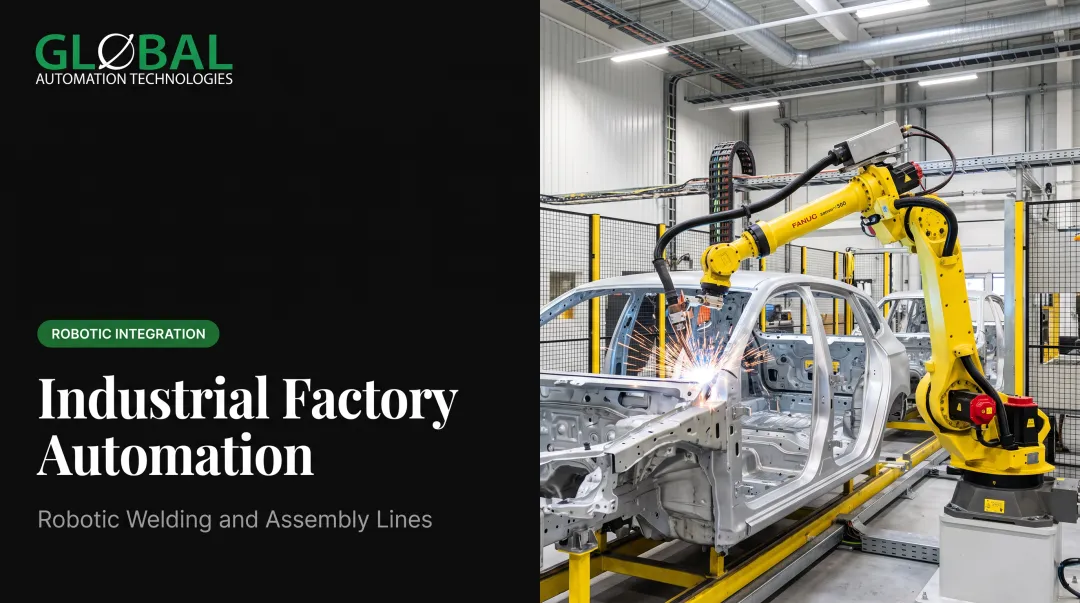
Robotic arc and spot welding dominate automotive and heavy equipment fabrication. US automotive robot installations hit 13,700 units in 2024, up 10.7%, representing roughly 40% of all new US robot installations that year. Metal and machinery manufacturing added another 3,800 units, underscoring demand beyond auto body shops.
The appeal is consistency at volume. A robot doesn't get fatigued halfway through a shift, and weld quality doesn't drift between operators.
Machine Tending
Robots loading and unloading CNC machines, presses, and injection molding equipment keep spindles running through breaks, shift changes, and overnight hours. Manual tending simply stops in those windows.
The goal, as GLOBAL's engineering team frames it, is keeping every spindle as close to 100% utilization as possible.
This is one area where the payback math is well-established: machine-tending cells typically pay for themselves in 12 to 18 months, driven by more parts per shift and reduced direct labor hours.

Material Handling & Cutting
Automated guided vehicles (AGVs) and autonomous mobile robots (AMRs) move parts between stations, while robotic arms handle plasma and laser cutting with repeatable precision. This combination reduces manual transport and keeps cutting tolerances consistent across long production runs.
Painting & Dispensing
Robotic painting systems hold film build within specification in well-tuned installations. Repeatable spray patterns remove the variability of a human hand.
Older industry guidance from A3 estimates 15-30% paint savings from reduced overspray. Treat that range as a starting point and validate it with a current coating trial rather than as a guarantee.
For dispensing (seam sealers, structural adhesives, cavity wax), machine vision paired with flow monitoring validates bead width, placement, and continuity in real time. Missed paths and thin beads get caught before parts move downstream.
Inspection & Quality Control
Machine vision integrated directly into robotic cells catches defects at the point of production rather than three stations downstream, where rework costs multiply. Dimensional checks, weld-seam verification, and surface defect detection can all run in-cycle without slowing the line.
Benefits of Robotic Fabrication for Manufacturers
The case for robotic fabrication rests on five pillars.
Precision and consistency. Manual processes introduce operator-to-operator variability. Robots don't. Every weld, spray pass, and pick follows the same programmed path.
Speed and extended-shift throughput. Lights-out or unattended running between scheduled maintenance windows, through nights and weekends, multiplies output without adding headcount.
Worker safety. OSHA identifies material handling, welding, and painting among tasks where robots can remove workers from dangerous, repetitive operations. Welding fume exposure is a real concern: NIOSH warns that prolonged manganese exposure above 1 mg/m³ can cause manganism, a serious neurological condition. Taking operators out of that environment entirely solves the problem rather than managing it.
Cost savings and ROI. Machine tending's 12-18 month payback window is the clearest example, driven by higher spindle utilization and reduced labor hours per part.
Scalability and flexibility. Reprogrammable robots adapt to product variation without new capital investment — a critical advantage for fabricators running mixed product lines.

Robots bring their own risks, including unexpected movement, crushing, and electrical hazards. OSHA's guidance calls for proper guarding, interlocks, and lockout/tagout procedures alongside any robotic deployment.
Emerging Trends: AI and Smart Automation
AI is changing how fabrication shops program robots, maintain equipment, and connect the plant floor—work that used to consume weeks of engineering labor.
- Simulation-first programming: AI-assisted models test robot programs before deployment, cutting programming from weeks to days and reducing startup surprises
- Predictive maintenance: Health assessments flag developing equipment issues before they cause downtime, protecting schedules and maintenance budgets
- Industry 4.0 connectivity: IIoT links robots, sensors, and line data so teams can act in real time—Deloitte’s 2025 survey of 600 manufacturing executives found 46% now use IIoT at the facility or network level, and 29% use AI/ML
Predictive maintenance is not an automatic win. McKinsey documented a poorly tuned system with a 10% false-positive rate that triggered roughly 1,000 unnecessary maintenance calls a year and wiped out the projected savings. Validation matters as much as the algorithm.
Challenges in Implementing Robotic Fabrication
Robotic fabrication isn't plug-and-play. McKinsey's industrial robotics survey found three barriers dominate decision-making:
- Capital cost — cited by 71% of respondents as a primary concern
- Limited automation experience — 61% lack in-house expertise to evaluate options confidently
- Difficulty finding end-to-end providers — 42% struggle to find a single partner who can handle the full scope
Cost is only part of the picture. Robots need engineers who can program, operate, and maintain them. The BLS projects roughly 1,300 annual job openings for this skill set nationwide through 2034.
Integration with existing plants is a second hurdle. New robotic cells must work with legacy infrastructure, older PLCs, and current safety systems—work most fabricators underestimate until they're mid-project.

Choosing the Right Automation Partner
The provider you choose matters as much as the robot brand. Look for:
- Full turnkey capability — process study, engineering, fixture design, programming, installation, commissioning, and ongoing support under one roof
- Combined integration and staffing — a partner who can also supply controls engineers and technicians solves the "who runs this thing" problem before it becomes one
- Verified integrator certification — A3's Certified Robot Integrator program requires an on-site audit and personnel assessment, renewed every two years
GLOBAL Automation Technologies built its model around the integration-plus-staffing gap McKinsey's research flagged. With 17+ years in operation, 700+ FANUC robots installed across 22 countries, and offices in four countries, GLOBAL pairs FANUC-based system design with the people who run those systems after launch.
Its engineering division handles design and commissioning. Its staffing division supplies the controls engineers, technicians, and project managers who keep cells productive. Builders who understand staffing needs, and staffing teams who understand system requirements, give fabricators the combined partner most still can't find under one roof.
Frequently Asked Questions
What are fabrication robots?
Fabrication robots are programmable industrial machines used to automate welding, cutting, material handling, and inspection tasks in metal fabrication. They range from six-axis articulated arms to SCARA and Cartesian configurations, depending on the application.
What industries benefit most from robotic fabrication?
Automotive OEMs and Tier 1 suppliers lead adoption, representing about 40% of new US robot installations. Heavy equipment manufacturers, aerospace, and data center infrastructure producers are also growing adopters.
How much does it cost to implement fabrication robots?
Cost varies by complexity: part geometry, cycle time, and whether the cell serves one machine or several. Machine-tending cells typically pay for themselves within 12 to 18 months.
What is the difference between a cobot and an industrial fabrication robot?
Collaborative robots (cobots) work alongside humans without full caging, governed by ISO/TS 15066 safety standards. Traditional industrial robots run at higher speeds in caged, high-volume settings where human proximity isn't part of the design.
Can robots be reprogrammed for different fabrication tasks?
Yes. Reprogrammability is one of the core advantages of industrial robots. The same arm can be reconfigured for different part geometries or production runs without new capital equipment.
What maintenance do fabrication robots require?
Robots need routine servicing per OEM specifications, covering mechanical, electrical, and lubrication components. Increasingly, AI-driven predictive maintenance supplements this by flagging developing issues before they cause unplanned downtime.