
The pressure is real. US manufacturers face a projected shortfall of 1.9 million unfilled positions by 2033 out of a total need for 3.8 million new workers, according to Deloitte and The Manufacturing Institute. Add rising quality demands and global competition, and automation stops being optional.
This guide covers what industrial factory automation actually is, the types available, where robotics deliver the fastest returns, and how to pick a partner who won't leave you stranded after installation.
Key Takeaways
- Robotics, controls, and software cut labor dependency and keep production running with minimal human intervention
- Projects scale from single-machine cells to lights-out floors based on readiness and ROI
- Safety, consistency, cost savings, and throughput improve only when systems are integrated correctly
- Pairing automation solutions, services and technical staffing closes the "who runs it" gap that stalls many projects
What Is Industrial Factory Automation?
Factory automation is the use of robotics, control systems (PLCs, sensors, drives), and software to run and monitor manufacturing processes with reduced human oversight. The International Society of Automation (ISA) defines automation broadly as the creation and application of technology to monitor and control production and delivery of products and services.
That definition matters because it draws a line most people miss: automation performs a task. Integration makes an entire process work as one validated system.
Bolting a robot next to a CNC machine is automation. Designing the fixtures, writing the controls code, connecting the vision system, and validating the full cycle before it ever runs a real part. That's integration.
GLOBAL Automation Technologies builds its delivery model around this distinction: its engineering division designs and programs systems from concept through completion, rather than only supplying hardware.
Demand for that kind of integrated system is rising fast. The global industrial control and factory automation market is projected to grow from $274.99 billion in 2025 to $435.24 billion in 2030, a 9.6% CAGR.
Factory automation isn't limited to welding robots on an assembly line, either. It extends into:
- Inventory tracking and warehouse automation
- Real-time quality control and vision inspection
- Predictive maintenance systems
- SCADA and IoT connectivity across the plant floor
None of this works well without skilled engineers running it. GLOBAL closes that gap by pairing automation solutions, services and technical staffing, so a client isn't left with expensive equipment and no one qualified to operate it.
Types of Factory Automation
Not every plant needs (or can justify) full lights-out production. Automation scales in stages.
Partial Process Automation
Plants automate specific tasks, such as material handling or dispensing, while leaving other steps manual. This is often the entry point for testing automation on a single bottleneck before committing further.
Single Automated Machines / Robotic Cells
Standalone robotic cells, such as machine tending or welding stations, perform one function with precision. They stay self-contained, so the financial case is easier when scope stays narrow.
Automated Production Lines
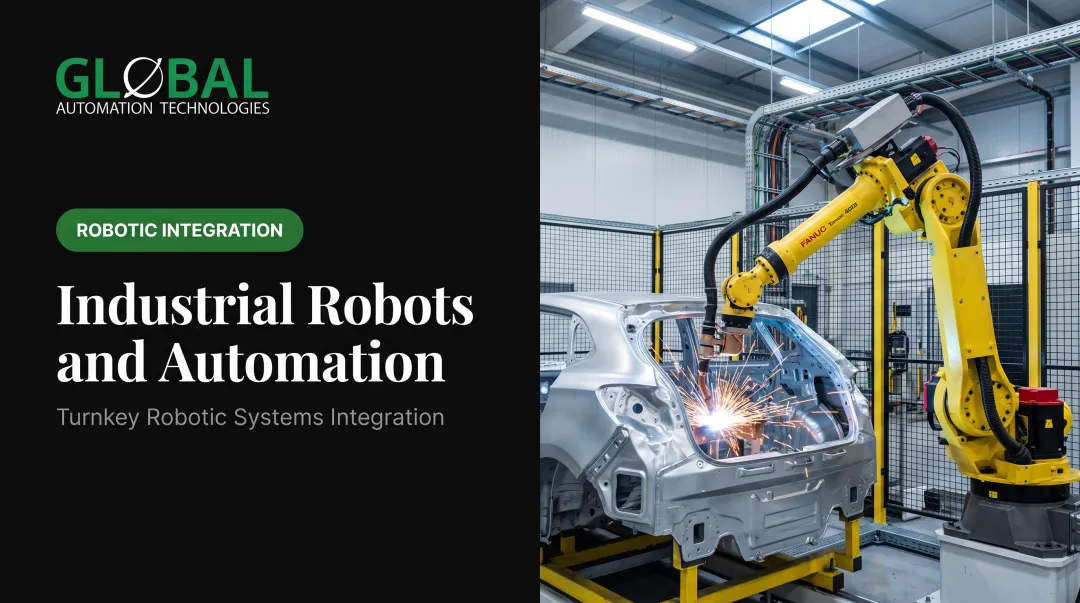
Synchronized multi-station lines use robots and conveyors to move parts through a defined sequence. Automotive body shops commonly run welding, dispensing, and material handling stations this way in tandem.
End-to-End / Lights-Out Automation
Fully automated facilities run continuously across shifts with minimal human oversight. Few plants reach this stage, but it's the natural endpoint for high-volume, repetitive production.

Core Applications of Industrial Robotics on the Factory Floor
Industrial robots earn their place on the factory floor by taking on work that is repetitive, hazardous, or precision-critical. These are the applications where manufacturers usually see the fastest gains in throughput, quality, and safety.
Machine Tending and Welding
Robots loading and unloading CNC machines extend unattended operation and raise spindle utilization. Machines keep running through breaks, shift changes, and overnight hours instead of sitting idle between manual cycles. Machine-tending cells typically pay for themselves within 12 to 18 months, driven by higher output and fewer direct labor hours. Exact payback still depends on part geometry, gripper design, and whether one robot serves a single machine or several.
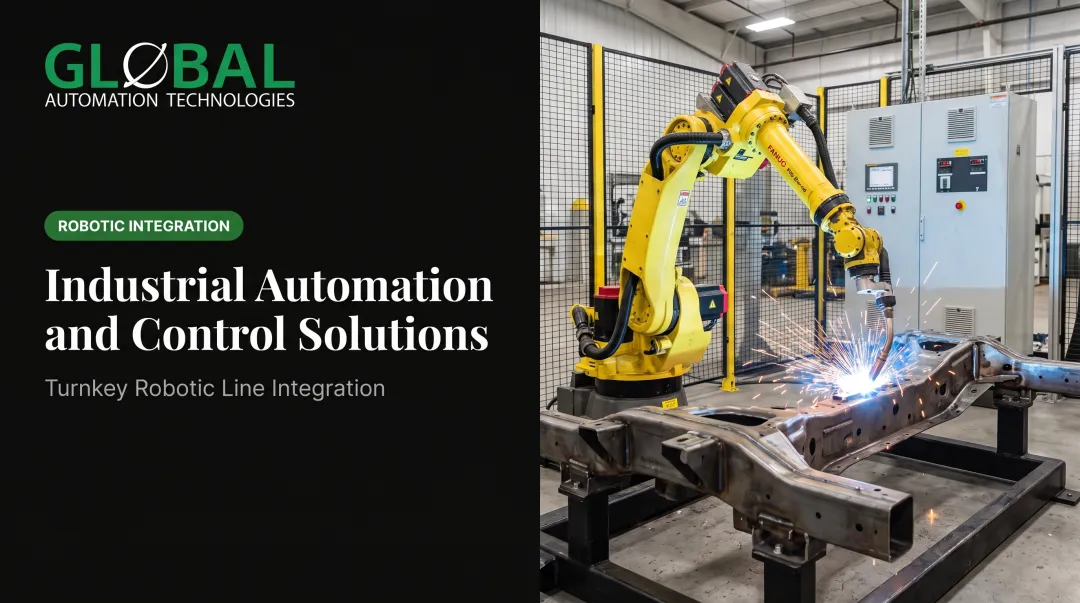
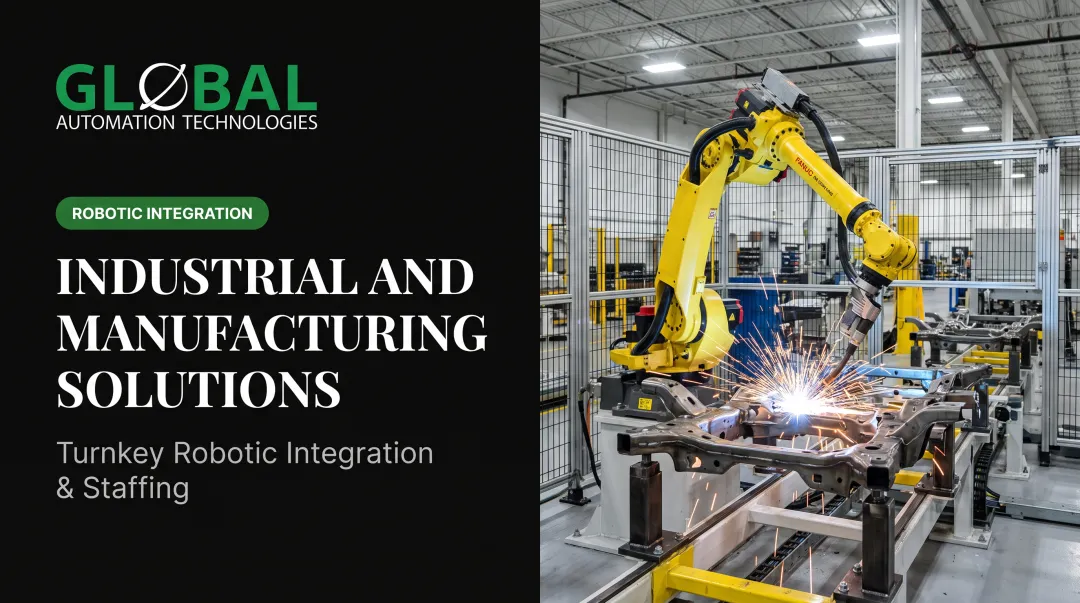
Articulated robots also handle repetitive, high-precision joining across automotive and heavy equipment lines. OSHA lists arc and resistance welding among its established industrial robot applications. Weld placement stays consistent shift after shift, which cuts rework and keeps cycle times predictable on high-volume production.

Painting, Dispensing, and Inspection
Robotic painting systems hold film build within specification, cutting overspray and material waste versus manual spray. Automation also pulls operators out of hazardous booths. OSHA's isocyanate fact sheet notes that exposure can cause occupational asthma and respiratory irritation, a real risk in manual spray environments.
On dispense and sealer lines, real-time vision inspection and flow monitoring catch defects before parts move downstream. Systems validate bead width, placement, and continuity live, flagging thin beads or discontinuities before they turn into scrap or rework.
AI-Assisted Simulation and Predictive Maintenance
Simulation tools let engineers model and test robot programs before deployment instead of debugging live on the floor. GLOBAL's simulation tooling has cut programming time from weeks to days in practice, which reduces startup surprises and speeds commissioning on machine-tending and material-handling cells.
Predictive maintenance uses historical machine data to forecast failures before they cause downtime. McKinsey found this approach typically reduces machine downtime by 30-50% and extends machine life by 20-40%. Health-assessment tools flag equipment issues early, protecting uptime and maintenance budgets.

Benefits of Industrial Factory Automation
Manufacturers automate factory work to improve safety, throughput, quality, and long-term cost structure. The strongest returns show up when robots take on the right tasks.
- Removes workers from hazardous, repetitive jobs and toxic exposure zones such as paint booths and welding stations
- Runs lines beyond a single shift, between scheduled maintenance windows, with faster, more consistent cycle times than manual operations
- Holds repeatable quality on welds, spray film, and dispense beads by cutting manual variability
- Lowers downtime, scrap, and labor cost over the equipment life; well-targeted cells like machine tending often pay back in 12-18 months
OSHA notes that industrial robots can replace workers in dangerous tasks requiring high accuracy. Safety training still matters: most robot-related incidents happen during programming, maintenance, or setup, not normal operation.
Choosing the Right Automation Partner
Full turnkey capability matters more than piecemeal vendor solutions. A project that spans design, build, programming, validation, installation, training, and ongoing support needs one accountable partner — not five vendors pointing at each other when something breaks.
Here's the gap most manufacturers hit: many automation firms only offer integration, or only offer staffing. You get a working cell and then have to scramble to find engineers who understand it. Or you hire skilled staff with no system-design partner backing them up.
GLOBAL Automation Technologies built its business around closing that gap. A few specifics:
- 17+ years of operation with 110+ team members across offices in 4 countries
- 700+ FANUC robots installed across 22 countries
- Level 5 FANUC Authorized System Integrator status, and #1 purchaser of FANUC robots among North American integrators in 2025
- One provider for both the robotic system and the engineers who run it
Cross-industry expertise matters too. GLOBAL approaches problems through an applications lens rather than an industry lens. A welding solution proven on an automotive body shop line can apply just as effectively to aerospace or heavy equipment.
That kind of partner has already solved similar problems across automotive, agricultural equipment, and general industrial manufacturing — not a single vertical.
Frequently Asked Questions
What is the industrial automation industry?
Industrial automation is the design, integration, and maintenance of robotic and control systems that run manufacturing lines. The global market is projected to grow from roughly $275 billion in 2025 to over $435 billion by 2030.
What is the difference between industrial automation and factory automation?
Factory automation is the plant-wide application of robotics, software, and processes on the production floor. Industrial automation more often means the underlying control technology, such as PLCs and sensors.
How much does industrial automation cost for a manufacturing plant?
Costs vary widely based on scope, robot count, and application type. Well-targeted projects like robotic machine tending often see payback within 12 to 18 months.
Will automation replace factory workers?
Not outright. Automation typically shifts labor toward higher-skill roles like programming, maintenance, and supervision, while removing workers from repetitive or hazardous tasks.
What industries benefit most from factory automation?
Automotive, heavy equipment, and data center infrastructure manufacturing see some of the strongest returns, thanks to high-volume, repetitive processes that reward precision and consistency.
How do I get started with factory automation for my plant?
Start with a targeted pilot cell, such as machine tending or a single dispensing station. Partner with an integrator that also provides engineering staffing support, so you're covered once the system is running.