
Regulatory and customer pressure drives adoption. GM's October 2025 IATF requirements mandate final inspection of finished products before shipping, while manufacturers pursuing zero-defect production recognize EOL as their last chance to prevent field failures, warranty claims, and costly recalls. This guide explains what EOL testing is, how it works in practice, where manufacturers apply it, and how to implement it effectively.
Key Takeaways
- EOL testing verifies completed products meet functional, safety, and performance specs at the final quality gate before shipment
- Automated test equipment, sensors, fixtures, and software detect defects, validate calibration, and log traceability data
- Typical tests include electrical safety checks, leak/pressure testing, functional validation, vision inspection, and data logging
- Automotive (e-axles, battery packs, modules), machine manufacturing, heavy equipment, and electronics depend on it at scale
- MES/ERP integration turns EOL test data into continuous improvement through analytics
What Is End-of-Line Testing?
End-of-line testing is an automated quality assurance process performed on fully assembled products to confirm they function correctly, meet design specifications, and are safe for customer use. Unlike in-process inspection, which checks subassemblies during production, EOL evaluates the complete, assembled unit as a working system.
Why EOL Testing Exists
EOL testing is the last opportunity to catch defects before products reach customers. Assembly errors, calibration drift, intermittent faults, and software mismatches can hide within individual components yet surface only when the complete system operates under load. Catching these failures at the factory gate prevents costly recalls, warranty claims, and brand damage.
Modern products carry hidden failure modes that earlier inspection stages miss. Electric vehicles, connected devices, and precision machinery depend on software, calibration, and communication protocols that only reveal problems under full system operation. When those defects escape to the field, warranty and recall costs can run into the billions.
What EOL Testing Is Not
EOL testing does not replace upstream process control or design validation. It verifies that the as-built unit conforms to the approved design; it does not prove the design itself is correct. Manufacturers who rely solely on EOL without controlling upstream variation face high scrap rates, slow throughput, and false failures that erode operator trust.
Types of EOL Testing
- Functional testing - Verifies the product operates correctly under normal and edge-case conditions
- Electrical safety testing - Confirms insulation resistance, dielectric strength, and shock-hazard protection
- Performance testing - Measures output under load, including torque, speed, efficiency, temperature, vibration, and acoustics
- Leak and pressure testing - Detects seal failures, incorrect assembly, and fluid or gas path defects
- Traceability and data logging - Records pass/fail results, test values, timestamps, and serial numbers in MES/ERP systems

EOL processes vary by product complexity. Appliances may require simple power-on checks and safety tests. Automotive control modules demand multi-step sequences: communication handshakes, diagnostic scans, calibration verification, and functional validation across operating modes.
How Does End-of-Line Testing Work?
EOL testing operates through a defined, repeatable sequence: identify the unit, apply the correct test recipe, execute functional and safety checks, evaluate results against limits, log data for traceability, and trigger corrective action if failures occur.
Initiation
The process begins when the finished product enters the EOL station. A barcode, QR code, RFID tag, or serial number is scanned to identify the unit's variant, configuration, software version, and matching test parameters.
Initiation is typically automated and tied into MES or ERP systems so the correct test recipe loads automatically. That matters when one line runs product mix, option packages, and regulatory variants side by side.
In hydraulic cylinder manufacturing, the barcode retrieves ERP data and automatically sets test pressure and traverse speed based on the product variant. This eliminates manual recipe selection and prevents testing a high-pressure unit at low-pressure limits.
Core Operation
The EOL system powers the product, applies controlled inputs—electrical signals, mechanical loads, fluid pressure, software commands—and measures outputs: voltage, current, temperature, flow, torque, speed, communication responses. Measured values are compared to predefined pass/fail limits in real time.
What happens during execution:
- Automated fixtures clamp the product and make electrical and fluid connections
- Sensors position themselves for accurate measurement
- Test sequences run through normal and edge-case operating modes
- Data acquisition systems capture high-resolution measurements
- Vision systems verify assembly completeness, label placement, or component alignment
Performance constraints shape both cycle time and trust in the results:
- Test sequences must fit within takt time or they become the bottleneck
- Measurement accuracy depends on calibrated sensors and stable fixtures
- Pass/fail limits need to catch real defects without flooding the line with false failures
In automotive powertrain EOL applications, systems run approximately 25-second cycles, calculate 30–40 metrics per unit, and handle up to 1,000 parts per day. Early-fail and retest logic can increase average throughput by 5% by identifying failures quickly and routing marginal units to diagnostic testing without stopping the main line.
GLOBAL, which holds Level 5 status in FANUC’s Authorized System Integrator program, builds this into robotic dispensing and assembly cells: robots present the part, vision and flow monitoring check bead width, placement, and continuity, and results log before the unit moves downstream. Off-spec material or missed paths get caught at the station instead of in the field.
Regulation and Control
Automated test equipment executes sequences without manual intervention, ensuring consistent results across shifts and lines. Closed-loop control adjusts for environmental variation—temperature, humidity—that would otherwise skew measurements. Calibration schedules maintain sensor accuracy over time, preventing measurement drift that creates false passes or false failures.
Consistent execution also cuts operator-induced variability and produces the auditable, traceable records automotive OEMs, FDA device rules, and quality-management standards require.
Output and Result
The EOL system produces three outputs:
- Pass/fail decision for each unit based on real-time limit evaluation
- Complete data record capturing test results, timestamps, operator ID, software version, and serial number
- Traceability link stored in MES/ERP for warranty management and quality analytics
Passing units move to packaging and shipment. Failing units go to rework, quarantine, or scrap based on defect severity.
Test data then feeds continuous improvement—surface failure-mode trends, process drift, and supplier quality issues. Manufacturers typically watch:
- First-pass yield and rework/scrap rates
- Cycle time and test coverage
- False-failure rates and recurring failed parameters
Those metrics help tune both the EOL station and the upstream processes that create the defects in the first place.

Where End-of-Line Testing Is Used
EOL testing occurs after final assembly, just before packaging and shipment, serving as the last quality gate. It differs from in-process inspection, which checks subassemblies during production, and design validation, which proves the design works before production begins.
Industries and applications where EOL testing is critical:
| Sector | Product | EOL Application |
|---|---|---|
| Automotive | Complete vehicles | Wheel geometry, headlamp setting, ADAS adjustment, roller-dynamometer vehicle-dynamics testing |
| Electric Vehicles | Battery packs/trays | Seal, inject compressed air, measure pressure drop to detect leaks |
| Automotive | E-axles, electric drives | Measure electric power, torque, speed, temperature, vibration, acoustic noise |
| Automotive Electronics | Radar, lidar, control modules | Functional quality tests, diagnostic scans, communication checks |
| Heavy Equipment | Agricultural transmissions | Automatic function, efficiency, acoustics, ratio, shift quality, leak-tightness tests |
| Hydraulic Systems | Cylinders, intensifiers | 100% post-assembly functional test; ERP-selected pressure/speed; archived certificate |
| Consumer Electronics | Game controllers, devices | Communication checks, data-packet validation, voltage, current, functional messages |
| Machine Manufacturing | CNC machines | More than 300 quality/control tests, including hours of actual test running before shipment |
Variations in usage:
- High-volume automotive lines use fully automated EOL cells with robotic handling and integrated MES to achieve seconds-level cycle times
- Heavy industry may combine automated functional tests with manual inspection steps for complex assemblies
- Low-volume, high-mix environments rely on flexible test fixtures and modular automated test equipment (ATE) to handle product diversity without retooling
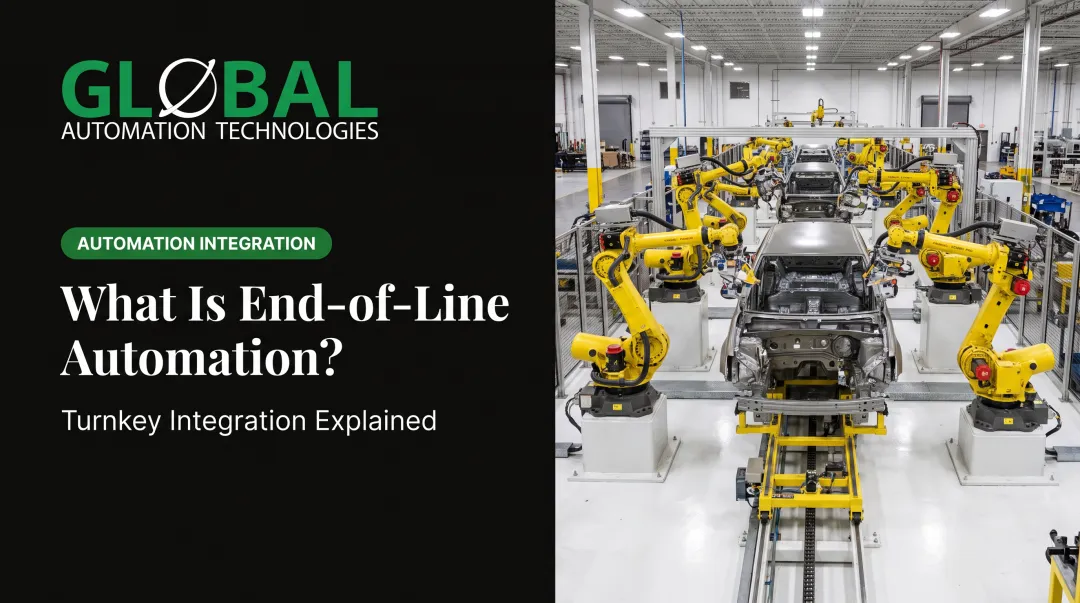
Across those setups, EOL checks often sit inside the same automated cell that assembles or seals the part. GLOBAL builds assembly and dispensing cells where robots position parts, vision systems confirm quality, and test data logs in real time before units move downstream.

Conclusion
EOL testing is a data-driven quality gate that verifies every product works as designed, meets safety standards, and stays fully traceable before it ships.
Modern systems combine automated test equipment, sensors, fixtures, and software to catch defects upstream controls miss: intermittent faults, calibration drift, software mismatches, and communication failures that only show up when the complete system runs under load.
Manufacturers who design EOL around risk, feed test data into continuous improvement, and balance thoroughness with cycle time cut warranty costs, field failures, and production disruptions. Automotive powertrain lines have seen 5% throughput gains while testing 1,000 parts per day. In consumer electronics, parallel test execution doubled station throughput while logging more than 110 parameters per unit.
Effective EOL testing rests on three elements:
- Automated execution that removes operator variability
- Calibrated measurement systems that deliver accurate results
- Traceability links to MES/ERP for warranty analysis and continuous improvement
When these align with product risk and process capability, EOL testing is the last line of defense against costly field escapes.
Frequently Asked Questions
What is end-of-line testing?
End-of-line (EOL) testing is the final quality check in manufacturing. Fully assembled products go through automated functional, safety, and performance tests to confirm they meet specs before shipment, so defects never reach customers.
What is an end-of-line testing machine?
An EOL testing machine (or test stand) is an automated system built from fixtures, sensors, instruments, and software. It runs repeatable test sequences, measures performance against pass/fail limits, and logs traceability data for quality assurance.
What is the end of line in automotive?
In automotive manufacturing, end-of-line is the final station for completed vehicles or subsystems such as e-axles, battery packs, and modules. Teams run diagnostic scans, functional checks, calibration verification, and safety validation before release to customers or downstream assembly.
What are the main types of EOL tests in manufacturing?
Common EOL test types include:
- Functional testing (product operation)
- Electrical safety testing (insulation, continuity, leakage)
- Leak and pressure testing (fluid/gas integrity)
- Performance testing (torque, speed, efficiency under load)
- Vision inspection (assembly completeness, label placement)
How does EOL testing differ from in-process inspection?
In-process inspection checks subassemblies or single operations during production to catch defects early. EOL testing evaluates the fully assembled product as a complete system at the final quality gate, confirming all components work together before shipment.
What role does automation play in EOL testing?
Automation runs repeatable, high-speed tests with minimal operator intervention. Robotic handling, automated fixtures, real-time data capture, and pass/fail logic raise throughput and consistency, improve traceability, and cut human error and cycle time.