
Introduction
A robotic arm can weld, paint, or palletize all day, but it has no idea when to start unless something tells it. That "something" is usually a Programmable Logic Controller, or PLC — the industrial brain that has directed factory equipment since the late 1960s.
Manufacturers evaluating a new robotic cell often ask the same question: is PLC programming the same as robot programming? Not quite. And does a plant need in-house expertise in both to keep a cell running? Often, yes — which is why the split between the two roles matters on the plant floor.
This guide covers what PLC programming for robotics means, how it keeps robots synchronized with the rest of the line, which languages controls engineers use, and how to decide whether your application needs a standalone PLC or can run on a robot's built-in controller.
Key Takeaways
- PLCs handle line-wide sequencing; robot controllers handle a single robot's motion.
- Ladder logic dominates PLC programming and transfers across brands under IEC 61131-3.
- Single-robot cells can often skip a standalone PLC; multi-robot lines usually need one.
- PLC programmers and robot techs are separate skill sets—staffing both is a common bottleneck.
What Is PLC Programming for Robotics?
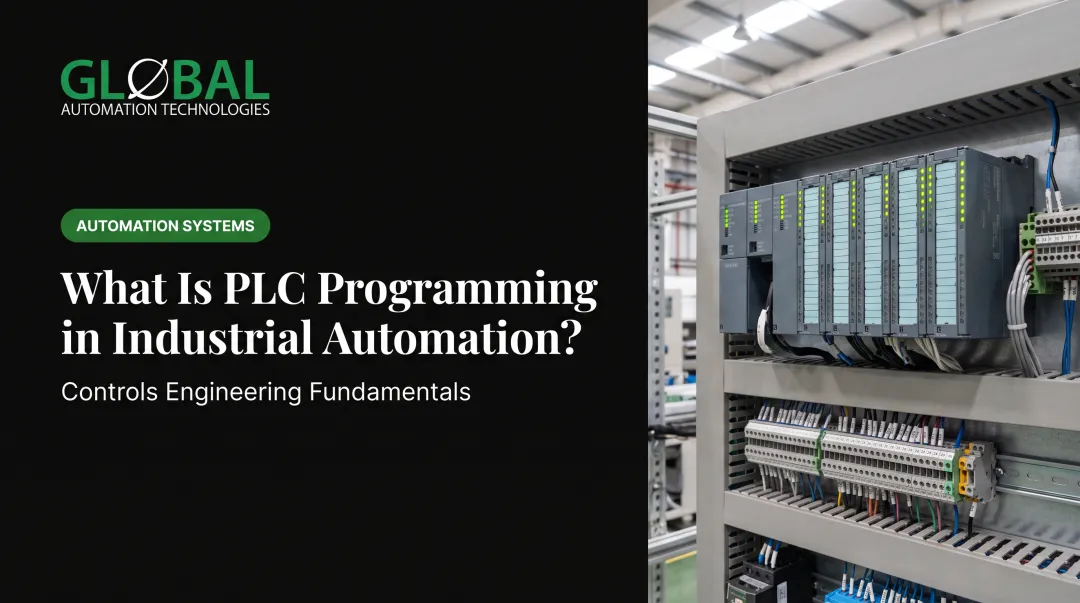
On a robotic line, one mistimed signal can stall a cell, scrap a part, or create a safety fault. PLC programming for robotics is the practice of writing logic that tells a Programmable Logic Controller how to read inputs (sensors, part-presence switches, emergency stops) and set outputs: trigger a robot's next move, start a conveyor, or fire an actuator. The goal is to keep every device on the line moving in sync.
Think of the PLC as a conductor and the robots, conveyors, and machines as an orchestra. Each instrument can play its own part perfectly, but without a conductor setting the tempo, nothing lines up. The PLC's job is timing: telling a welding robot when the part has arrived, telling the conveyor when to advance, and telling a second robot when it's safe to begin its cycle.
PLCs emerged in the late 1960s to replace hardwired relay panels, cabinets that could hold 50 or more individual relays and take up as much space as a small closet. Today's units are rugged, microprocessor-based controllers built to survive heat, vibration, and dust on a factory floor.
The Built-In PLC Nuance
Here's where it gets confusing for a lot of buyers. Robot manufacturers like FANUC, KUKA, and Yaskawa Motoman now build PLC-like functions directly into their robot controllers. FANUC's Integrated PMC, KUKA.PLC, and Motoman's Concurrent I/O all let a robot handle its own sequencing without an external PLC in simple applications.
So "PLC programming for robotics" can mean two things:
- Programming a standalone PLC that governs an entire cell or line
- Programming the embedded PLC functions inside a single robot's own controller
An automotive body shop is a good example of where standalone PLCs still dominate. A single PLC often sequences multiple welding robots, part-detection sensors, and conveyor sections to hit a specific takt time (the exact rhythm production has to maintain to meet daily volume targets).
The market reflects that staying power. Global PLC revenue grew from $9.7 billion in 2017 to $11.5 billion in 2022, according to Interact Analysis's industrial controls research, with automotive and food and beverage as the largest end-user industries.
This guide breaks down how PLC logic works with robots, when you need a standalone controller versus embedded functions, and what skills and languages matter on the plant floor.

How PLC Programming Controls Industrial Robots
The Input-Process-Output Scan Cycle
Every PLC runs on a repeating loop called the scan cycle: read inputs, process logic, update outputs, communicate, repeat. That loop runs continuously in milliseconds, so the PLC can keep robot motion and machine timing coordinated in real time.
In practice, that means:
- A sensor detects a part has arrived on the conveyor
- The PLC's logic evaluates whether it's safe and correct to proceed
- The PLC signals the robot to begin its programmed cycle
- The cycle repeats for the next part
PLC-to-Robot Communication
A PLC and a robot controller need a shared protocol to exchange signals and status data. Common industrial options include:
| Method | Function |
|---|---|
| Discrete/Digital I/O | Simple on/off signals confirming part presence or robot status |
| EtherNet/IP | Standard Ethernet plus CIP, widely supported for I/O and safety data |
| DeviceNet | Legacy fieldbus still supported on many robot controllers |
| PROFIBUS | Fieldbus protocol common in European-built equipment |
FANUC's R-30iB Plus controller, for instance, supports EtherNet/IP, DeviceNet, and PROFIBUS, letting a PLC tell the robot which program to run and confirm it's clear to move.
Safety PLCs and Emergency Response
Dedicated safety PLCs monitor guard doors, light curtains, and e-stop circuits. When a fault hits, they can stop or hold robot motion before a person or part is put at risk.
In one documented FANUC configuration, the robot controller talks to a Rockwell safety PLC over EtherNet/IP CIP Safety and exchanges safety data at a 32-millisecond interval.
That layered setup keeps roles clear: a process PLC runs production logic, a safety PLC handles emergency response, and the robot controller handles motion. Together, they support cell operation beyond a single shift—lights-out running between scheduled maintenance windows—without exposing people or product to avoidable risk.
Common PLC Programming Languages Used in Robotics
Most PLC logic is written in one of a handful of standardized languages. Ladder logic remains the most common by a wide margin. Automation World reports that more than 90% of control programming in North America is done in ladder diagram, largely because its visual, rung-based structure mirrors the relay circuits electricians already understand.
For more complex tasks, engineers turn to:
- Function block diagrams (FBD) — useful for repeatable, modular logic blocks
- Structured text (ST) — a text-based language better suited to complex math or data processing
- Sequential function charts (SFC) — ideal for step-by-step cell sequences and state-based robot coordination
All of these are standardized under IEC 61131-3, which matters more than the standard number suggests. A controls engineer trained on one brand's PLC can generally read and write logic on another.
Robot languages don't work that way. FANUC's TP (Teach Pendant) language and KUKA's KRL (KUKA Robot Language) are proprietary to their respective OEMs, so switching robot brands often means learning a new language from scratch.
Key Benefits of PLC Programming in Robotic Automation
On the plant floor, PLC programming pays off in timing accuracy, faster diagnostics, multi-OEM flexibility, and fewer unplanned stops.
Key benefits include:
- Precision and repeatability. Tight, programmable control over timing and sequencing keeps tolerance-sensitive work like dispensing or coating consistent. A few milliseconds of drift can throw off a bead pattern or paint layer.
- Centralized troubleshooting. One PLC and HMI environment lets a technician diagnose a fault from a single screen instead of hunting through robot-specific interfaces across the cell.
- Cross-brand flexibility. Standardized PLC languages let manufacturers mix robot OEMs on the same line without retraining every technician on a new proprietary language.
- Predictive maintenance. Modern PLCs log cycle counts, cycle times, and fault frequency, feeding tools that flag developing issues before a shutdown.

Downtime makes that last point concrete. Siemens estimates one hour of downtime costs automotive manufacturers roughly $2.3 million, and heavy-industry downtime costs jumped 319% between 2019 and 2023.
GLOBAL Automation Technologies, a Level 5 FANUC Authorized System Integrator, builds the same uptime-first approach into its engineering process. Its team uses AI-assisted simulation to model and validate control and robot programming logic offline before a system hits the production floor, cutting programming time from weeks to days and lowering the cost of debugging live on the line.
PLC vs. Built-In Robot Controller: Do You Need a Separate PLC?
Not every cell needs a standalone PLC. This is one of the most common questions manufacturers get wrong when scoping a project.
Skip the standalone PLC when:
- The cell has one or two robots
- I/O count is low (a handful of sensors, a gripper, a simple conveyor)
- The robot's built-in controller (FANUC's Integrated PMC or similar) already handles the sequencing you need
Those conditions cover many simple cells. Scale and coordination push you the other direction.
Add a standalone PLC when:
- Multiple robots and machines need to run in lockstep
- Process complexity grows (dispensers, conveyors, multiple data feeds)
- Your plant standardizes on a common controls platform across many cells
Single-robot, single-purpose applications can often live entirely inside the robot's own controller.
Multi-robot, multi-machine production lines (automotive body shops, high-volume assembly) typically warrant a dedicated PLC for reliability and scalability as the system grows.

Who Handles PLC Programming for Robotic Systems?
PLC programming and robot programming are related disciplines, not the same job.
- PLC programmers / controls engineers write the logic that sequences an entire line — coordinating robots, conveyors, and safety systems.
- Robot technicians / programmers set up, teach, and debug an individual robot's motion and process programs.
Many manufacturers hit a staffing wall here. They need integration expertise to design a PLC-driven robotic system upfront, then qualified engineers on-site to program and maintain it for years afterward. Those aren't always the same hire.
GLOBAL Automation Technologies structures its offerings around exactly this gap. Through its automation solutions work, GLOBAL designs and integrates turnkey robotic and PLC-controlled cells; its engineering services place GLOBAL's own controls and PLC engineers on customer contracts; and its technical staffing recruits controls engineers, PLC programmers, and robotics technicians into customer roles on contract, contract-to-hire, or direct-hire terms.
If a manufacturer needs both the system and the people to run it, that's a single conversation rather than two separate vendor searches.
Frequently Asked Questions
What is a PLC in robotics?
A PLC is an industrial computer that monitors inputs like sensors and switches, then controls outputs to direct the timing and sequencing of robots and related equipment on a production line.
What is the difference between a PLC and a robot controller?
A PLC oversees logic for an entire cell or line, while a robot controller manages that specific robot's motion and programs. Modern robot controllers increasingly include PLC-like functions of their own.
What programming language is used for PLC robotics?
Ladder logic is the most common choice, alongside function block diagrams and structured text. All three are standardized under IEC 61131-3, making skills transferable across PLC brands.
Do all industrial robots need a PLC?
No. Simple, single-robot cells with low I/O counts can often run entirely on the robot's built-in controller. Complex multi-robot or multi-machine lines typically require a dedicated PLC.
How long does it take to learn PLC programming for robotics?
Basic ladder logic competency is achievable in weeks to a few months, depending on background. True mastery of complex sequencing and troubleshooting develops over years of hands-on experience.
Can one PLC control multiple robots?
Yes. A single PLC can sequence and synchronize multiple robots alongside conveyors and other machines, which is standard practice on high-volume production lines like automotive body shops.