
Introduction
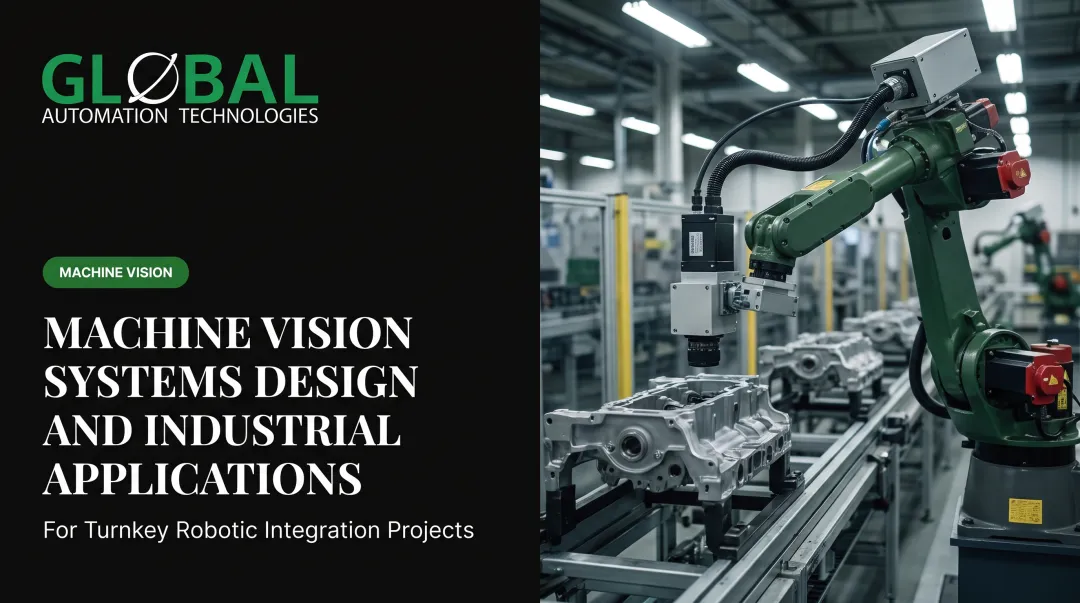
Laser vision systems used to have one job: burning a barcode or serial number onto a part. That's ancient history now. Today, the same underlying technology guides robotic arms through cluttered bins, tracks weld seams in real time, and checks adhesive beads before a part ever leaves the station.
That versatility matters because quality failures are expensive. IndustryWeek reports that human inspectors typically catch only about 80% of manufacturing defects, meaning roughly 20% slip through untouched. On a high-volume line, that gap turns into scrap, rework, and warranty claims fast.
This article breaks down what laser vision systems actually are, how they process data in milliseconds, the different system types available, and where they show up across modern manufacturing floors.
Key Takeaways
- Laser triangulation captures precise geometric data that stays unaffected by color, surface markings, or ambient lighting.
- One system supports weld seam tracking, robotic bin picking, painting, and adhesive bead validation.
- 2D, 3D, and AI-enabled vision systems each fit different precision, speed, and part-complexity needs.
- Vision-guided machine tending cells commonly pay for themselves within 12 to 18 months.
What Are Laser Vision Systems?
A laser vision system combines three things: a laser light source, an optical sensor (CCD or CMOS), and software that converts what the sensor sees into usable geometric data. Put together, they let a machine "measure" a part the way a caliper would, except at production speed and without touching anything.
The core mechanism is triangulation. A laser projects a dot or stripe onto the object's surface. As the surface geometry changes, the reflected light shifts position on the sensor.
ZEISS describes this plainly: the system calculates distance by measuring the angle of the reflected laser light, the same geometric principle behind a triangle's angles and sides.
This is a different approach from standard 2D machine vision, which reads contrast and color to identify patterns, text, or codes. Laser vision measures physical shape. That distinction matters on a shop floor where parts arrive dusty, painted inconsistently, or lit unevenly.
Core Hardware Components
Every laser vision setup relies on a handful of core parts:
- Laser emitter – projects a single line, dot, or multi-line pattern onto the target
- CCD or CMOS sensor – captures the reflected light and its positional shift
- Focusing lens/optics – sharpens the image for accurate triangulation
- Bandpass filters – block ambient light wavelengths so only the laser signal registers
Those same building blocks show up in very different classes of equipment. "Vision systems" is an umbrella term—from a basic 2D camera checking part presence, to a 3D laser scanner mapping a weld bead's profile, to AI-driven systems that classify defects on their own. Choosing the right one starts with understanding what each is actually built to measure.
How Laser Vision Systems Work
Every laser vision measurement runs through a four-step pipeline:
- Acquisition – the sensor captures raw reflected light data from the laser stripe or dot
- Pre-processing – software filters noise and enhances the usable signal
- Feature extraction – algorithms convert the cleaned data into measurable geometry (height, width, offset)
- Communication – the system sends results to the robot controller, PLC, or laser system for action

This entire cycle needs to happen fast enough to keep pace with a moving production line, which is why most systems operate on millisecond-level trigger intervals rather than full seconds.
CMOS vs. CCD: Which Sensor Fits Where
Not all sensors behave the same under factory conditions. Basler's comparison of the two technologies shows the tradeoffs:
| Factor | CMOS | CCD |
|---|---|---|
| Speed | Faster readout, pixels read individually | Slower, charge shifted row by row |
| Power draw | Lower | Higher |
| Best fit | High-speed lines, vibration-heavy environments | Demanding lighting conditions requiring maximum image quality |
Modern CMOS sensors now match or exceed older CCD designs in sensitivity and dynamic range. That is why CMOS is the default for most new installations. Global shutter options also help prevent motion distortion on fast lines.
Laser-Stripe and Lighting Considerations
Single-line lasers are cheaper and simpler, but multi-line projection captures more surface geometry per frame, which speeds up 3D profiling. Wavelength selection matters too. Systems typically pair a specific laser wavelength with a matching bandpass filter, so the sensor ignores overhead factory lighting and welding arc flash entirely.
That filtered signal is what makes closed-loop correction reliable. Controllers sync the vision output over industrial protocols so the robot can shift path or tweak process parameters mid-cycle without stopping the line.
Types of Laser Vision Systems
Not every application needs the same level of measurement complexity. The right system depends on part geometry, required precision, and line speed.
| Type | Best For | Tradeoff |
|---|---|---|
| 2D vision | Flat-surface centering, presence checks, fast cycles | No depth data |
| 3D/laser triangulation | Profile, height, and complex geometry measurement | Slower per-frame processing than 2D |
| AI-enabled vision | Variable lighting, occlusion, geometric variation | Requires quality training data |
2D systems excel at high-speed presence and centering checks on flat surfaces. When you need height, profile, or complex geometry data, 3D laser triangulation is the usual next step, with more processing per frame as the tradeoff.
Eye-to-Hand vs. Eye-in-Hand Mounting
Where the camera sits changes what it can do:
- Eye-to-hand – a fixed camera mounted above the workspace, offering simpler calibration and a broad field of view
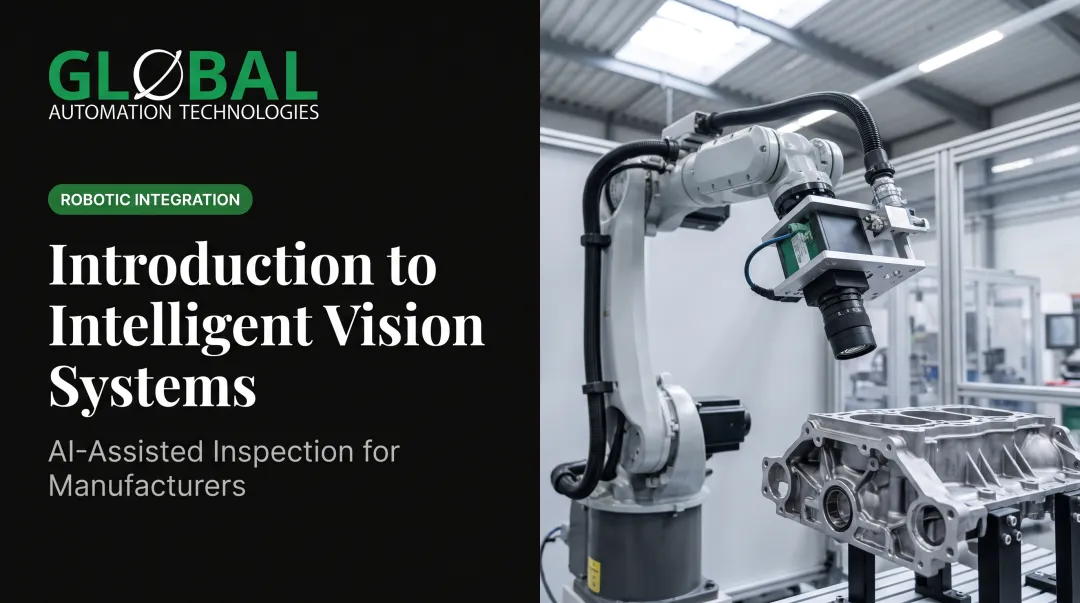
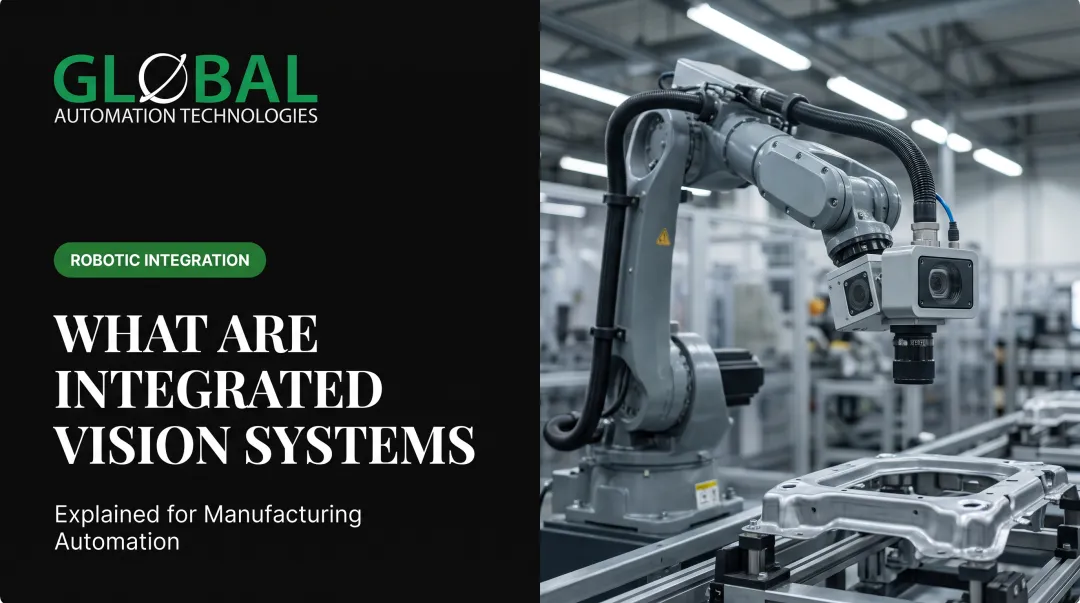
- Eye-in-hand – a camera mounted on the robot arm, trading calibration simplicity for multi-angle inspection as the robot moves
Neither configuration is universally better. Fixed cameras work well for consistent part presentation; arm-mounted cameras earn their keep when parts arrive in random orientations or need close-up inspection at multiple stages.
Mounting and sensor type get you the raw measurement. AI decides how reliably you interpret it when conditions are messy.
AI-Enabled Vision Systems
Deep-learning vision adds a classification layer on top of raw laser or camera data. Rather than relying only on fixed geometric thresholds, a trained model can flag defects when lighting shifts, parts are partly occluded, or geometry varies slightly between units.
That matters most in advanced defect detection, where rule-based systems alone struggle with real-world variability.
Exploring the Versatility: Industrial Applications of Laser Vision Systems
Laser vision earns its reputation here: the same core technology adapts to very different jobs across a plant floor.

Weld Seam Tracking and Bevel Measurement
In pipe and tube mills, laser sensors measure joint geometry in real time and feed that data back to adjust wire feed speed, travel speed, and voltage on the fly. Rather than programming a fixed path and hoping the seam stays put, the system tracks the actual seam location as it moves.
Robotic Guidance for Pick-and-Place and Machine Tending
Vision locates and orients parts so robots can grab them with minimal fixturing. GLOBAL builds this into machine tending cells so robots handle variation without hard tooling for every part.
Vision-guided locating also supports longer unattended runs. A single robot can keep multiple spindles fed through breaks, shift changes, and overnight production—one reason these cells typically pay back within 12 to 18 months.
Bead and Dispensing Quality Validation
Real-time vision inspection catches adhesive or sealant defects before parts move downstream. One Vision Systems Design example documented a system generating 360-degree 3D bead profiles at 400 profiles per second, fast enough to check every inch of bead without slowing the line.
GLOBAL applies the same approach on dispense lines, verifying bead width, placement, and continuity in real time on:
- Seam sealers
- Structural adhesives
- PurFoam
- Cavity wax
Off-spec material gets flagged immediately instead of turning up further down the line.
Vision-Guided Robotic Painting
Precise positioning supports consistent film build. GLOBAL's robotic painting systems follow the same programmed path every cycle, holding film build within specification shift after shift instead of varying with operator technique and fatigue. That repeatability cuts overspray, reduces material waste, and keeps operators away from isocyanates, VOCs, and airborne particulates common in manual spray work.
Coating and Post-Process Inspection
Laser vision also measures thickness variance across welds and coated surfaces after the fact, confirming compliance with manufacturing standards before parts advance further down the line.
Quality Control and Traceability
Beyond dimensional checks, inline vision verifies marks, welds, and codes against required standards before defects reach finished assemblies. That closes the loop between production and traceability—especially on automotive and heavy equipment lines where every part needs a verifiable history.
Benefits of Vision-Guided Automation & Choosing the Right Partner
Vision-guided automation delivers clear operational gains:
- Reduced scrap and rework from catching defects at the source
- Higher throughput with fewer manual inspection bottlenecks
- Improved traceability across welds, coatings, and dispensed materials
- Safer working conditions by removing operators from hazardous spray or inspection zones
Payback timelines vary by application, but machine tending cells with vision guidance commonly recoup their investment in 12 to 18 months, driven by more parts run per shift with fewer direct labor hours.
Choosing the Right System
Selecting between 2D, 3D, or AI-enabled vision comes down to a few concrete questions:
- What precision does the application demand? Flat-surface checks rarely need 3D triangulation.
- How complex is the part geometry? Curved or variable surfaces usually call for 3D or AI-assisted systems.
- How fast does the line run? Cycle time constraints narrow the field of viable sensor options.
- How complex is the integration? Retrofits into existing cells often require different mounting and protocol choices than greenfield builds.
Choosing the Right Partner
Answering those questions well depends on an integrator who has lived the constraints on real production lines. GLOBAL Automation Technologies is a Level 5 FANUC Authorized System Integrator with a proven global base of robotic deployments.
GLOBAL builds vision-guided robotic systems with FANUC iRVision and 3D area sensors for material handling, welding, painting, and dispensing. AI-assisted simulation compresses robot programming timelines and catches commissioning surprises before equipment reaches the floor.
GLOBAL also provides technical staffing, so manufacturers get the vision-guided system and the engineers to run and maintain it—without separate vendors for hardware and headcount.
Frequently Asked Questions
What are vision systems?
Vision systems combine hardware (cameras or laser sensors) with software to acquire, process, and interpret visual or dimensional data. They're used for inspection, robotic guidance, and quality control across manufacturing.
Is LiDAR machine vision?
No. LiDAR maps surroundings in 3D by timing laser pulse returns. It overlaps conceptually with laser triangulation but is considered separate from traditional camera-based machine vision.
What's the difference between laser vision and standard machine vision?
Laser vision uses structured light and triangulation to capture dimensional data unaffected by color or ambient light. Standard machine vision typically relies on 2D cameras for pattern recognition, contrast checks, and code reading.
How much do laser vision systems cost?
Cost depends on sensor resolution, scan speed, number of inspection points, and how deeply the system ties into robots, PLCs, and line controls. A project-specific review with an automation integrator is the reliable way to get a real number.
Can laser vision systems be integrated with robots for automated inspection?
Yes. Laser vision commonly pairs with robotic arms for guided inspection, part picking, and adaptive process control, using either eye-in-hand or fixed-camera configurations depending on the application.
What industries use laser vision systems the most?
Automotive, heavy equipment, pipe and tube manufacturing, and electronics lead adoption. These sectors rely on precision guidance, weld control, and inline quality checks to hold cycle time and scrap in check.