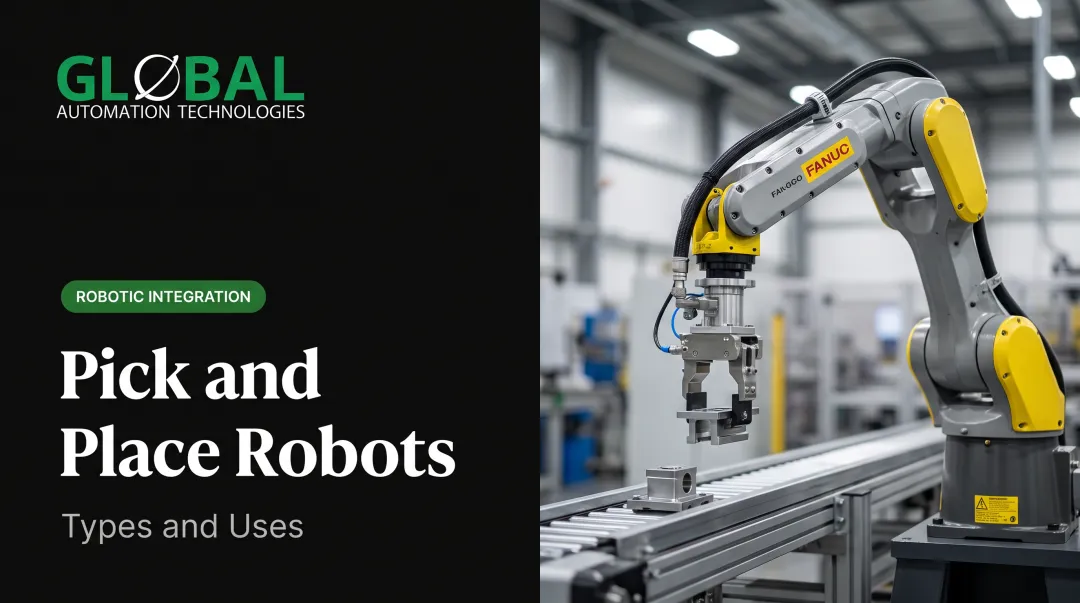

That's what end-of-arm tooling does. It's the hand. And it's often the difference between an automation project that hits its ROI targets and one that sits underperforming on the shop floor.
Many manufacturers evaluating robotic automation focus almost entirely on the robot brand, payload, and reach. EOAT gets treated as an afterthought — something to figure out after the arm is already ordered. That's backwards. The tooling you attach determines whether the robot can actually grip your parts, weld your joints, or dispense your adhesive at the tolerances your process demands.
This guide covers EOAT types, how to choose the right one, real applications across manufacturing, what it actually costs, and where the technology is headed.
Key Takeaways
- EOAT on the robot wrist sets cell capability—gripping, welding, dispensing, or inspection.
- Match tooling to application, payload, power source, and control integration before you buy.
- Sensors, AI-assisted control, and predictive maintenance are now common on modern tooling.
- An integrator fluent in both robots and tooling cuts deployment risk and startup delays.
What Is End-of-Arm Tooling (EOAT)?
EOAT — also called an end effector — is the interface between a robot arm and whatever it's working on. Without it, a robot is just a moving structure with nowhere to put its energy.
Here's the part that trips people up: the robot arm itself is largely generic. The same FANUC arm can weld, paint, grip, or inspect depending entirely on what's bolted to its wrist. The arm provides motion and positioning. The tooling provides function.
EOAT tasks generally fall into three buckets:
- Material handling — picking, placing, palletizing, machine loading
- Machining and processing — welding, drilling, grinding, dispensing, bonding
- Quality inspection — vision-guided checks, defect detection, dimensional verification
Tooling has come a long way since the single-purpose fixtures of 1960s robotics, when a robot was built to do exactly one motion forever. The Unimate 1900, credited as the first mass-produced factory robotic arm in 1961, ran fixed routines with no adaptability.
Modern EOAT incorporates sensors, cameras, and force feedback that let a robot adjust in real time to part variation. That adaptability matters because EOAT choice directly affects overall equipment effectiveness (OEE): availability, performance, and quality — the factors that decide whether automation pays off.
Tool problems show up in every OEE pillar:
- A gripper that drops parts hurts availability
- One that's too slow hurts performance
- One that damages product hurts quality
All three trace back to the tool, not the arm.

Types of End-of-Arm Tooling
Grippers
Grippers dominate material handling, and they come in three main flavors:
- Mechanical (finger-based) grippers use linkages, cams, or rack-and-pinion drives to close fingers around a part. Rigid models suit consistent parts; adaptive polymer fingers handle varied shapes and sizes.
- Vacuum/suction grippers suit flat, non-porous surfaces (sheet metal, glass, cardboard). They're compact and fast, but need compressed air and can struggle with porous or irregular objects.
- Adhesive grippers use gecko-inspired adhesion for flat, smooth, or perforated parts, and require no electricity or compressed air.
Pneumatic grippers still dominate the installed base. One industry estimate put them at roughly 85% of the market as of 2022, largely because they're lighter, cheaper, and deliver higher grip force with faster cycles.
Electric grippers are gaining ground fast. They offer programmable force, speed, and position without a plant air supply, and support software-based changeover instead of re-plumbing air lines. For high-mix production, that changeover speed alone can justify the higher upfront cost.

Process Tooling
This is where a robot stops handling parts and starts transforming them:
- Welding torches for spot and arc welding
- Dispensing/bonding heads for adhesives, sealers, and foams
- Powered screwdrivers for fastening
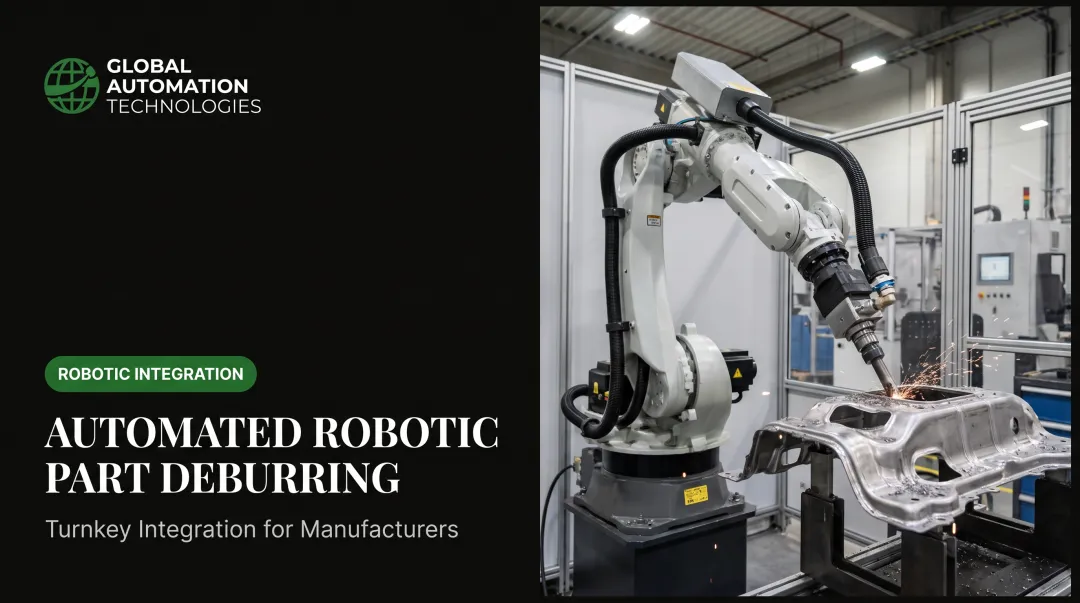
- Material removal tools: grinders, deburring heads, sanders
GLOBAL's dispensing systems show how far process tooling has evolved. They pair FANUC robotic platforms with real-time vision inspection and flow monitoring, validating bead width, placement, and continuity as the robot moves, not after the part leaves the line.
That catches thin beads, skips, and voids before they become downstream scrap, on applications from seam sealers and structural adhesives to PurFoam and cavity wax.
Sensors and Specialty Tools
Modern EOAT increasingly includes:
- Force/torque sensors: six-axis units that give a robot a sense of touch for sanding, deburring, assembly, and collision detection
- Collision sensors: protect tooling and parts when something goes wrong
- Vision-integrated tooling: guides grippers to locate and orient parts automatically
Tool changers let a single robot arm swap between multiple EOAT types automatically, mid-shift, without human intervention. For high-mix production, that turns one robot into several: welding one hour, dispensing the next.

How to Choose the Right EOAT for Your Application
Start with the task, not the catalog. Delicate electronics handling, heavy castings, precision welding: each narrows your EOAT options immediately, before you even think about brand or power source.
Power Source Trade-Offs
| Power Source | Strengths | Best For |
|---|---|---|
| Pneumatic | Fast, powerful, simple, low cost | Harsh environments, high-force gripping |
| Electric | Precise, programmable, quick changeover | High-mix, precision assembly |
| Hydraulic | Heavy-duty force | Extreme-load applications |
Payload and Grip-Force Matching
Undersized EOAT damages robots and drops parts. Oversized EOAT adds unnecessary weight, cost, and cycle time. As a rule of thumb, always account for the heaviest part plus the gripper's own weight, with a safety margin, not just the nominal part weight.
Control System Integration
Options range from basic discrete I/O (simple on/off signals) to IO-Link communication, which enables grip-force adjustment, finger pre-positioning, and diagnostic feedback for predictive maintenance. If uptime data matters to your operation, IO-Link is worth the extra integration effort.
Involve an integrator early. Simulating tooling-robot compatibility before purchase catches interference, reach, and payload problems before they become expensive change orders. GLOBAL's AI-assisted simulation lets engineers model and test robot programs before anything touches the production floor, compressing what used to be weeks of trial-and-error evaluation into days.
EOAT Applications Across Manufacturing Industries
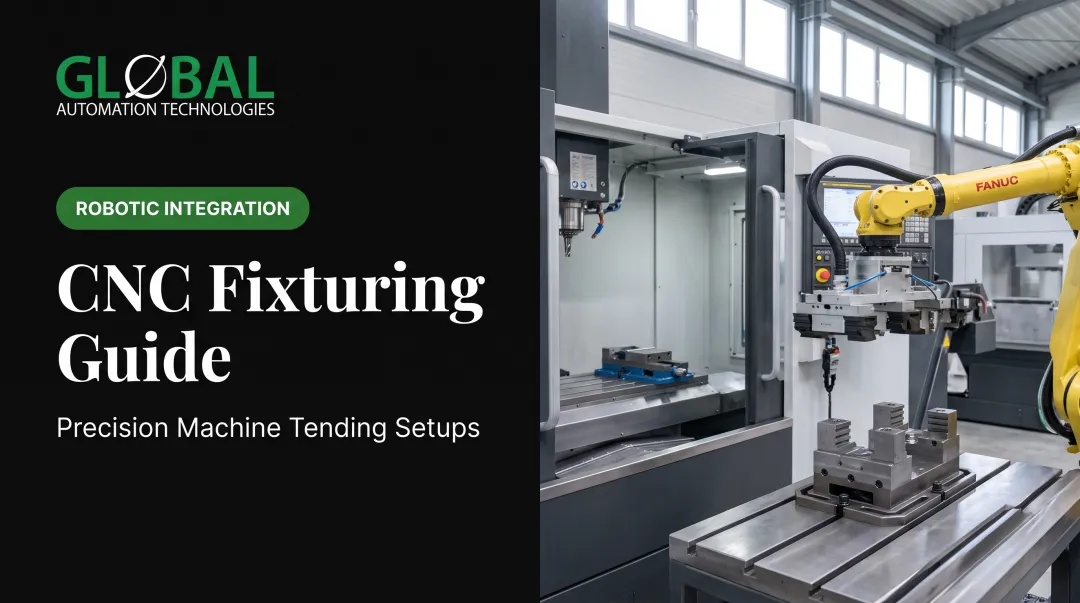
Machine tending is one of the most common entry points into automation. Grippers load and unload CNC machines, lathes, and injection molders, enabling extended unattended operation through breaks, shift changes, and overnight runs. Industry vendor data points to payback timelines of 12 to 18 months for well-designed cells, driven by more parts per shift with fewer direct labor hours.
Robotic painting and coating demands precise film-build control, since inconsistent coating thickness means rework or scrap. Robots also pull operators out of hazardous spray environments entirely, cutting direct exposure to isocyanates, VOCs, and overspray particulates. For electrostatic powder coating, that means keeping workers out of high-voltage spray zones.
Welding, dispensing, and assembly EOAT spans automotive body shops, heavy equipment manufacturing, and data center infrastructure production—server racks, electrical enclosures, and cooling systems.
Solutions proven in automotive, such as complex 3D bead-path dispensing for structural adhesives, are moving into aerospace composites and heavy-industry assembly. Mixed materials and lightweight structures there demand tighter mix-ratio validation and inspection.
Those same handling-heavy cells show up at global scale. The International Federation of Robotics recorded 541,000 industrial robot installations in 2023, with handling the largest application worldwide. EOAT-driven material handling is no longer a niche add-on; it sits at the center of modern manufacturing throughput.

What Does EOAT and Robot Automation Cost?
EOAT typically represents a smaller slice of total system cost. The robot arm itself, plus integration and programming engineering, are usually the bigger line items.
How much does a robot arm cost?
Robot arm pricing varies widely by payload class, reach, and brand, and manufacturers rarely publish list prices publicly. Total system cost—arm, EOAT, integration, and programming combined—is a far more useful number for budgeting than the arm price alone.
Off-the-shelf EOAT is more affordable and faster to deploy than custom-engineered tooling. That helps smaller shops and high-mix operations that can't justify a fully custom build.
The real integration cost drivers are rarely the tool itself:
- Incompatible mounting profiles
- Custom wiring
- Custom application code
Request a full turnkey quote instead of pricing components separately. A complete quote should cover:
- Design and build
- Programming
- Installation
- Training
Itemized component pricing hides the integration work that drives total investment and makes ROI comparisons across vendors nearly impossible.
Emerging Trends in EOAT Technology
Three shifts are reshaping what EOAT can do:
- AI-supported adaptive gripping: Tooling that adjusts force and movement from real-time part variation instead of a fixed program. ABB has shown force-controlled cobots auto-adjusting sanding pressure at recent industry showcases.
- Collaborative-robot-specific tooling: As cobots work closer to people, EOAT prioritizes safety sensors and ergonomic design for human-robot proximity, guided by standards such as ANSI/A3 R15.06-2025.
- Predictive maintenance: Sensors and analytics flag tooling wear before it causes downtime. GLOBAL, which holds Level 5 status in FANUC’s Authorized System Integrator program, builds AI-driven health assessments into its engineering workflows so manufacturers can catch issues early and avoid unplanned stops.
Frequently Asked Questions
What is the difference between EOAT and an end effector?
There isn't a meaningful difference. Robotics teams use both terms interchangeably for the tooling attached to a robot's wrist.
How do I know what payload capacity I need for my EOAT?
Add the weight of your heaviest part to the gripper's own weight, then add a 20–30% safety margin. Undersizing risks dropped parts and premature wear.
Can one robot use multiple types of EOAT?
Yes. Tool-changer systems let a single robot automatically swap between grippers, welding torches, or dispensing heads mid-shift, valuable in high-mix production.
How much of a robotic system's cost is the EOAT?
It varies by application, but EOAT is generally a smaller share of total system cost compared to the arm and integration engineering. Despite that, it has an outsized impact on uptime and quality.
Is electric or pneumatic EOAT better for my application?
Electric suits precision work, programmability, and energy efficiency. Pneumatic suits applications needing raw force, fast cycles, and simple, rugged operation in harsh environments.
How long does it take to integrate new EOAT into an existing robotic cell?
Standard, off-the-shelf tooling can often integrate in days. Custom EOAT requires engineering and simulation time, though AI-assisted simulation is shortening that evaluation window.