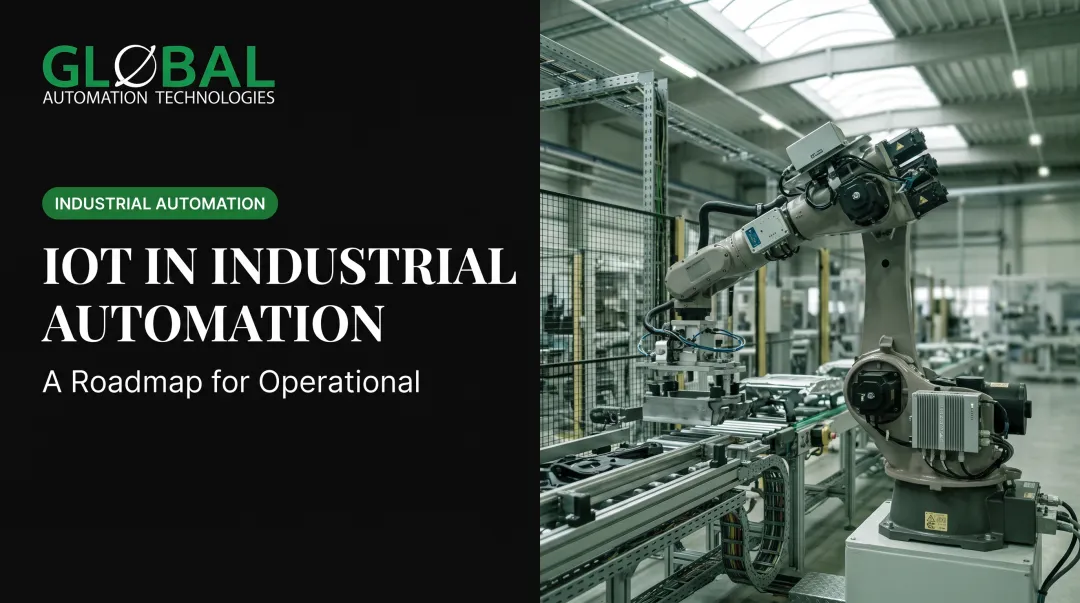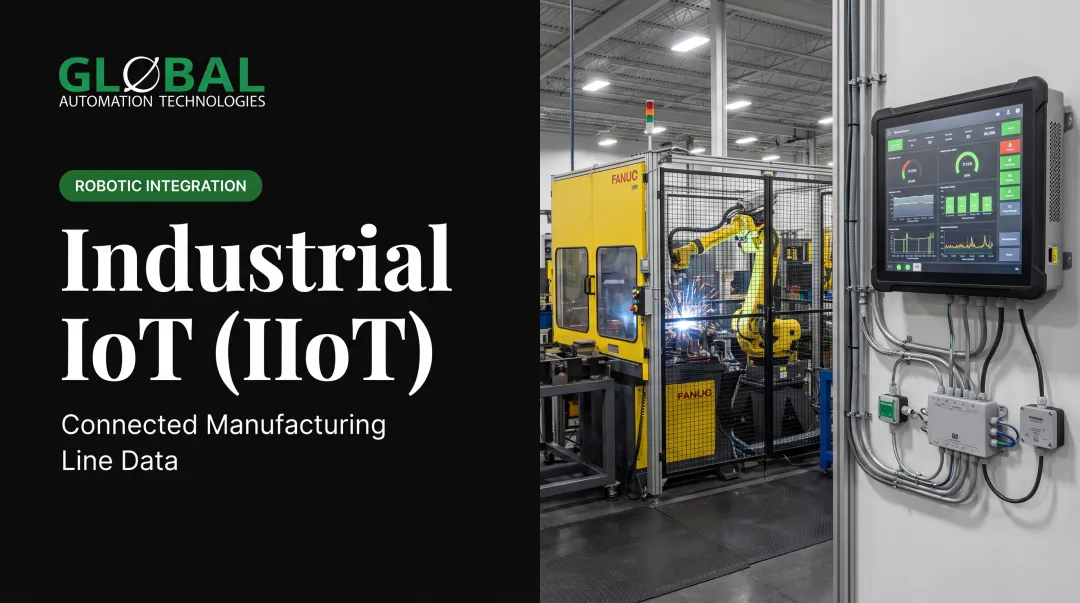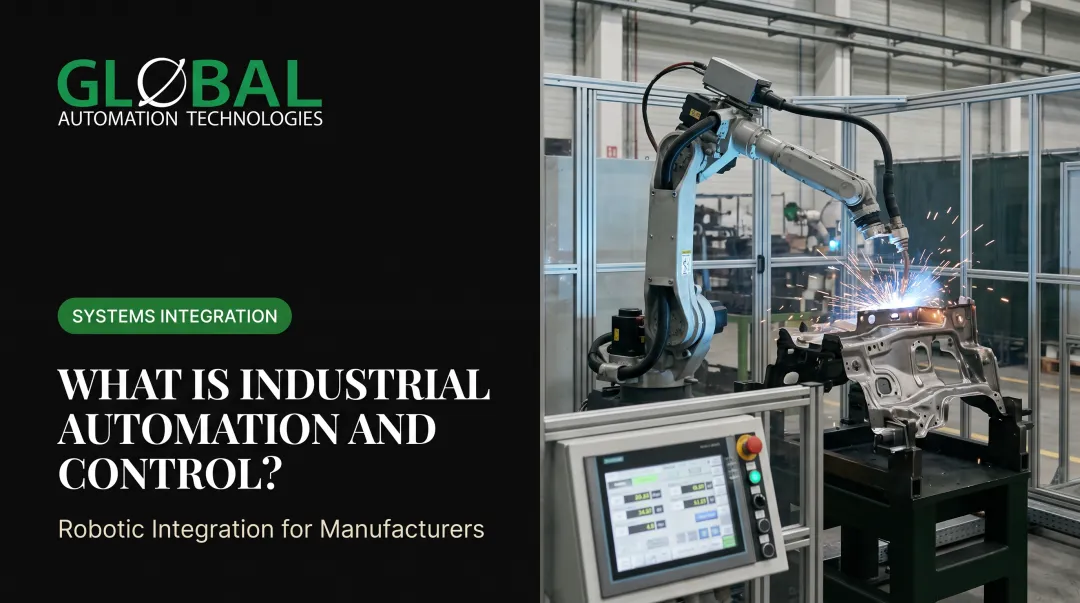

Here's the confusion: "industrial automation" and "IoT" get used as if they're the same thing. They're not. Automation is about executing tasks. IoT is about collecting and sharing data. When you combine them, you get something bigger.
This article breaks down both terms, explains how they intersect through IIoT, and covers the technologies, benefits, and real applications reshaping factory floors today.
Key Takeaways
- Industrial automation executes physical tasks; IoT collects and shares data — IIoT combines both
- Manufacturers using predictive maintenance report 18.5% less unplanned downtime and 87.3% fewer defects
- Edge computing handles time-sensitive decisions; cloud platforms handle broader analytics
- Legacy equipment integration and skills shortages remain the top adoption barriers
What Is Industrial Automation?
Industrial automation uses control systems, robots, programmable logic controllers (PLCs), and sensors to run manufacturing processes with minimal human intervention. The International Society of Automation (ISA) defines it as technology that monitors and controls production. No internet connection required.
Industrial automation typically falls into four categories:
- Fixed automation — dedicated, repetitive sequences for high-volume production
- Programmable automation — sequences changed via reprogramming between batches
- Flexible automation — rapid or automatic changeover between product types
- Integrated automation — multiple production and information functions coordinated as one system
Common Industrial Automation Products
Most automated production lines rely on a similar toolkit:
- PLCs for logic-based machine control
- SCADA systems for supervisory control and data acquisition
- HMIs (human-machine interfaces) for operator interaction
- Industrial robots for welding, painting, dispensing, and material handling
- Sensors and actuators that detect conditions and execute physical responses

At GLOBAL, this is the foundation of every turnkey robotic project, from CNC machine tending to press-tending cells, built around FANUC platforms and integrated with existing plant controls.
What Is the Internet of Things (IoT)?
IoT is a network of physical devices embedded with sensors and connectivity that collect and share data. NIST defines an IoT device as anything with at least one transducer (a sensor or actuator) and at least one network interface, like Ethernet or Wi-Fi.
The scale is enormous. IoT Analytics counted 18.5 billion active connected IoT devices in 2024, with an estimated 21.1 billion in 2025. That figure spans everything from smart doorbells to factory-floor sensors.
Consumer IoT vs. Industrial IoT
Not all IoT serves the same purpose:
- Consumer IoT connects products for individuals — think smart thermostats, fitness trackers, voice assistants
- Industrial IoT (IIoT) connects production assets: sensors, controllers, gateways, and software for monitoring, maintenance, quality, and operations
McKinsey places IIoT among the core advanced manufacturing technologies tied to Industry 4.0. The distinction matters: a smart speaker failing doesn't shut down a production line. A machine sensor going dark might.
How Industrial Automation and IoT Work Together (IIoT)
This is where the two concepts converge. Automation supplies the physical action: robots, actuators, motion. IoT supplies the data layer: sensors, connectivity, cloud analysis. Put them together and you get Industrial IoT.
The Basic IIoT Data Flow
- Sense or actuate: a sensor or actuator interfaces with the physical process
- Connect or aggregate: a network interface, sometimes through a gateway, carries device data
- Process: edge systems handle low-latency decisions; cloud systems handle broader analysis
- Analyze and alert: data feeds predictive models and condition-based maintenance alerts
- Act: automated systems or engineers change behavior based on the insight

Consider a robotic machine tending cell loading parts into a CNC machine. GLOBAL, a top-tier Level 5 FANUC Authorized System Integrator, designs these cells with SCADA and IoT connectivity built in, so spindle utilization, cycle counts, and machine status can be monitored in real time.
The result is higher spindle utilization and longer unattended runtime, freeing operators for higher-value inspection and process work.
Edge vs. Cloud Processing
Not every decision needs the cloud. Rockwell Automation notes that edge computing fits best when real-time processing and reduced latency matter most (Rockwell Automation). Cloud platforms, meanwhile, handle broader analysis, storage, and lifecycle services.
Think of it as division of labor: edge computing stops the line before a bad part gets made; cloud computing tells you why your defect rate crept up over the last quarter. Connecting machines, data, and automated action into one ecosystem is what NIST and most manufacturers call Industry 4.0, or the smart factory model.
Key Technologies Powering Industrial IoT Automation
A handful of technology layers make IIoT function on a real factory floor:
- Sensors and actuators collect environmental and machine data (temperature, vibration, position) and execute physical actions in response
- Industrial robots and PLCs carry out automated tasks such as welding, painting, dispensing, and part transfer based on sensor input
- Connectivity technologies link machines together across the plant
- Cloud and edge platforms store, process, and analyze the data these sensors generate
- AI and machine learning turn that data into simulation, optimization, and predictive maintenance
Industrial Ethernet made up 76% of new industrial network nodes in 2025, up from 71% the year before (HMS Networks, 2025). Wi-Fi, 5G, and LPWAN fill in where wired connections aren't practical.
GLOBAL integrates AI-assisted simulation into its engineering practice, modeling and testing robot programs before deployment. That work has moved programming timelines from weeks down to days. On the maintenance side, GLOBAL uses AI-driven health assessments to monitor equipment and flag emerging issues before they cause downtime.
Benefits of Combining Automation and IoT in Manufacturing
The value proposition here isn't abstract. It shows up in uptime, cost, and safety numbers.
- Continuous monitoring and automated fault detection raise uptime and support production well beyond a single shift, between scheduled maintenance windows
- Predictive maintenance catches issues before failure; NIST found predictive-heavy manufacturers saw 18.5% less unplanned downtime and 87.3% fewer defects than preventive-heavy peers (NIST, 2021)
- Real-time production and inventory visibility cut waste and improve operational efficiency
- Robots take people out of hazardous work: robotic painting eliminates exposure to isocyanates, VOCs, and overspray particulates
- Robotic machine tending cells generally pay for themselves in 12 to 18 months, driven by higher spindle utilization and reduced direct labor

That NIST predictive-maintenance finding is observational, not a guaranteed outcome for every plant. But it's directionally consistent with what integrators see: catching a bearing failure early costs far less than an unplanned line stoppage.
Real-World Applications and Common Challenges
IIoT is already delivering measurable gains on manufacturing floors, from paint shops to welding cells.
Where It's Working
- Automotive paint shops — one documented Siemens case saw a 15% throughput gain using connected data and digital-twin simulation (Siemens)
- Robotic welding — connected systems with vision-guided seam tracking and quality verification
- Robotic dispensing and sealing — real-time vision inspection validates bead width, placement, and continuity before parts move downstream
- Remote equipment monitoring — robot-health platforms flag maintenance needs before failures occur
Common Adoption Roadblocks
Three challenges keep showing up:
- Data security — 65% of Deloitte's surveyed manufacturers ranked operational risk (unauthorized access, IP theft, disruption) as a top-two concern
- Legacy equipment integration — older PLCs and machines often can't support current communication protocols, according to NIST
- Skills shortages — between 69% and 72% of Deloitte respondents reported moderate-to-significant hiring challenges across IT, OT, and engineering roles

This last point is where a lot of IIoT projects stall. You can spec out the perfect sensor network, but if there's nobody to install, program, and maintain it, the project sits on a shelf. That skills gap is why GLOBAL built an approach from the start. The same team designing the robotic system also has access to the controls engineers, PLC programmers, and commissioning staff needed to run it. Rather than treating hardware and headcount as separate problems, one call covers both.
Frequently Asked Questions
What is IoT automation?
IoT automation uses connected sensors and devices to trigger automated actions without human intervention. Data flows from sensors through a network to a control system, which then acts based on programmed logic.
What are some examples of IoT automation projects?
Common examples include predictive maintenance systems, smart energy management, and automated inventory tracking. In manufacturing, this often looks like sensor-equipped machine tending cells or robot-health monitoring platforms.
What are 5 examples of IoT devices?
Smart thermostats, industrial sensors, RFID tags, smart cameras, and connected wearables are all common IoT devices. Some are consumer-facing; others, like industrial sensors, serve manufacturing environments specifically.
Is a smart speaker the same as an industrial IoT device?
No. A smart speaker is a consumer IoT device: it connects to a network and responds to voice input. Industrial IoT devices monitor machines, lines, and production processes, and feed data into plant control and maintenance systems.
What is the difference between Industry 4.0 and IoT?
IoT is a core enabling technology — the connected-device and data layer. Industry 4.0 is the broader movement combining IoT, automation, AI, and analytics into a smart, connected factory model.
Is industrial automation the same as IoT?
No. Automation executes physical tasks, like welding or part transfer. IoT collects and shares data from sensors. IIoT is what happens when the two combine into one connected system.