
But here's the problem. Most manufacturers collect mountains of data and still get blindsided by downtime. Sensors flag anomalies nobody acts on. Dashboards fill up while machines keep failing on schedule anyway.
This article breaks down what IIoT actually is, how it differs from consumer IoT, how it works layer by layer, and where it delivers real results, plus how automation partners like GLOBAL turn that data into robotic action on the floor.
Key Takeaways
- Connect sensors, machines, and software for real-time monitoring and predictive decisions
- Cut downtime 30%–50% and extend machine life 20%–40% with predictive maintenance alone
- Integrate IIoT with legacy PLCs instead of replacing them
- Pair IIoT data with actual automation for the biggest ROI—dashboards alone fall short
What Is Industrial IoT (IIoT)?
IIoT is a network of connected sensors, devices, and software that collect and analyze real-time data from industrial equipment. The Industry IoT Consortium defines it as connected machines, devices, sensors, and people supporting intelligent operations and advanced analytics.
IIoT sits inside the broader Industry 4.0 movement. NIST notes that Industry 4.0 encompasses IIoT and smart manufacturing as its data-and-connectivity layer.
From PLCs to the Cloud
Industrial control systems didn't start connected. PLCs and DCS platforms ran isolated for decades. Over time, DCS systems began communicating with corporate IT, and some applications moved toward virtualization and cloud deployment. IIoT extends that path by linking shop-floor assets to analytics at scale.
GE's R&D team coined "industrial Internet" in 2012 for the convergence of industrial machinery with computing, sensors, and connectivity. That lineage is documented; GE's authorship of the acronym "IIoT" itself is less clear.
The market matches the technical shift:
- IoT in manufacturing is valued at $87.98 billion in 2026 and projected to reach $142.63 billion by 2031 (10.1% CAGR) per MarketsandMarkets
- Deloitte's 2025 survey found 46% of manufacturers already using IIoT at the facility or network level
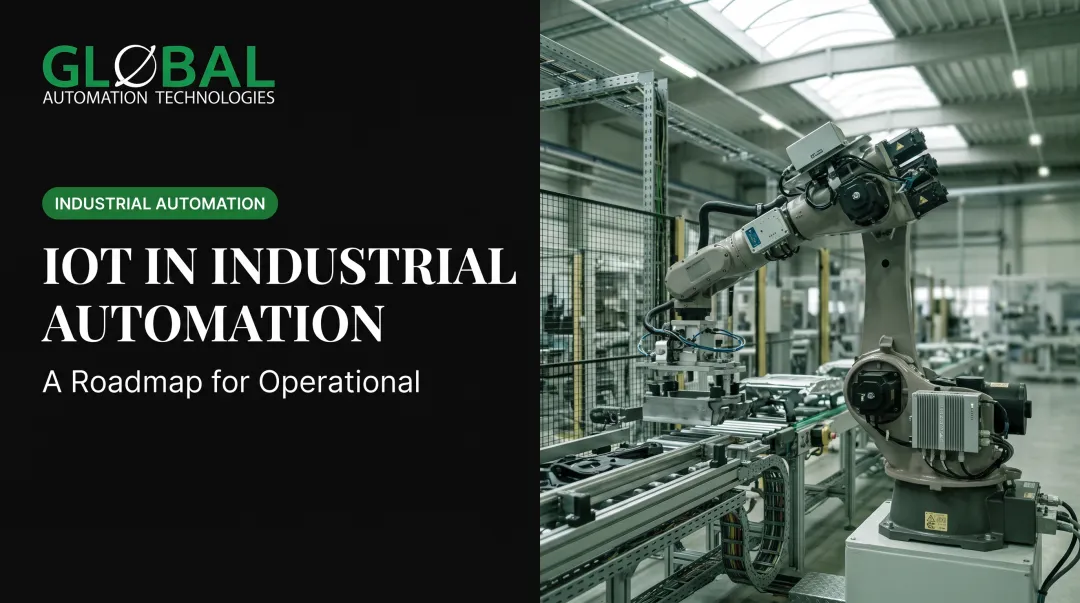
For plants running robotic and automated lines, IIoT matters because robots generate constant streams of cycle, torque, and performance data. Without a system to capture and act on it, that data goes nowhere.
IIoT vs. IoT: What's the Difference?
Consumer IoT tracks your thermostat. Industrial IoT keeps a stamping press from crushing someone's hand. The stakes aren't comparable.
| Factor | Consumer IoT | Industrial IoT |
|---|---|---|
| Failure consequence | Inconvenience | Injury, financial loss, production halt |
| Device lifespan | 2-5 years | Years to decades (some OT systems exceed 20 years) |
| Security needs | Basic | Layered, lifecycle-based (ISA/IEC 62443) |
| Replacement approach | Swap freely | Must integrate with legacy equipment |
The Industry IoT Consortium points out that IIoT demands greater interoperability and complexity than consumer devices. NIST's guidance on operational technology backs this up: unexpected outages on a continuous production line are unacceptable.
That "must integrate, not replace" principle shows up every day on the plant floor. Manufacturers rarely rip out working PLCs to install IIoT. They layer sensors and connectivity on top of what's already running.
How Industrial IoT Works
IIoT architecture typically follows a layered model based on ISA's framework:
- Device/sensing layer — Smart sensors and machines capture raw data (vibration, temperature, cycle counts)
- Network layer — Protocols like MQTT and OPC UA transport that data reliably between devices and systems
- Service/application layer — Software analyzes the data, running it through analytics, historians, or digital twins
- Content/interface layer — Dashboards, tablets, and HMIs display results for operators and engineers

Digital Twins and Pre-Deployment Simulation
A digital twin is a high-accuracy virtual model of a physical system, used for machine-health analysis, anomaly detection, and virtual commissioning before anything touches the shop floor.
AI-assisted simulation makes that model useful on real projects. GLOBAL, a Level 5 FANUC Authorized System Integrator, for example, models and tests robot programs virtually before deployment, cutting programming time from weeks to days. Fewer surprises during commissioning means faster line startups.
The same data stack that feeds digital twins also supports day-to-day equipment health once the line is running.
Predictive Maintenance in Practice
Live sensor feeds flag deviations before they become failures. NIST frames this as maintenance triggered by observed data patterns rather than a fixed calendar schedule.
McKinsey found predictive maintenance typically reduces machine downtime by 30%–50% and extends machine life by 20%–40%. In one offshore compressor case study, outage duration fell from 14 days to 6.

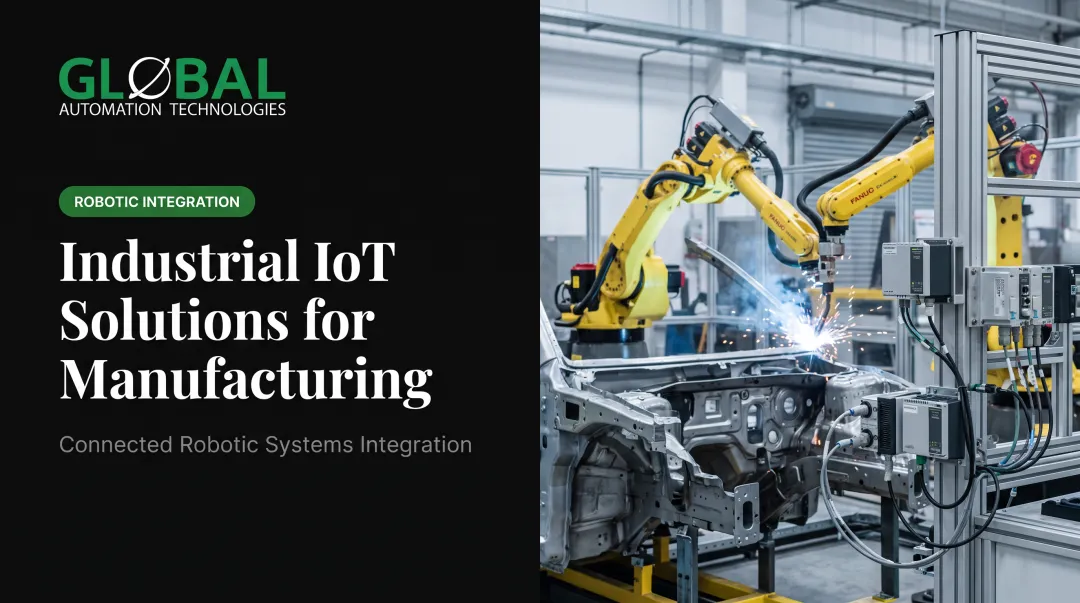
None of this requires ripping out existing controls. IIoT sensors and connectivity, including SCADA integration, layer onto existing PLCs and OEM equipment, which is exactly how automation retrofits get done without a full-line teardown.
What Are the Four Types of IoT?
IoT falls into four categories based on use case:
- Consumer IoT — smart home devices, wearables, appliances
- Commercial IoT — smart buildings, retail tracking, healthcare devices
- Industrial IoT — manufacturing sensors, robotics, predictive maintenance systems
- Infrastructure IoT — smart grids, traffic systems, utility monitoring
Industrial IoT operates under different stakes. Failures put high-value equipment, worker safety, and continuous production at risk, often inside plants that run the same assets for decades.
Examples and Applications of Industrial IoT
IIoT shows up on the plant floor as connected sensors, robots, and software that cut downtime, waste, and blind spots in material flow. These applications are where manufacturers see measurable results.
Predictive Maintenance
Sensors catch early signs of bearing wear, motor strain, or thermal drift, flagging problems long before a breakdown halts the line. Teams can schedule repairs in planned windows instead of reacting to unplanned stops.
Robotic Machine Tending and Process Automation
Connected robots track cycle times and part quality continuously. GLOBAL's robotic machine tending cells are engineered around specific part geometry and cycle-time requirements. They typically pay for themselves in 12 to 18 months through higher spindle utilization and reduced manual labor hours.
Asset Tracking and Inventory Management
RFID and IIoT sensors give real-time visibility into materials and equipment location. Renault's Curitiba plant uses RFID to track 290,000 vehicles a year, cutting shipping time by 30%.
Energy Management
IIoT systems monitor consumption patterns across equipment. Canadian Forest Products used real-time alerts for abnormal energy use and reported a 15% reduction in consumption.
Quality and Safety Monitoring
Vision inspection catches defects in real time. GLOBAL's robotic painting systems hold film build within specification. Dispensing systems validate bead width and continuity before parts move downstream, catching defects that would otherwise slip through.
Benefits and Challenges of Implementing IIoT
Benefits
- Reduced downtime through predictive alerts
- Improved worker safety by removing people from hazardous zones
- Better decisions backed by real production data
- Throughput gains, with WEF Lighthouse factories reporting 40%-140% improvements in some cases
Challenges
- Integrating with legacy equipment that wasn't built for connectivity
- Cybersecurity risk as IT and OT systems converge — Deloitte found 65% of manufacturers rank operational risk as a top-two concern
- Data silos across facilities that block a unified view
The gap between collecting IIoT data and acting on it is where most manufacturers stall. That's the space turnkey automation partners fill.
Instead of leaving a dashboard full of alerts, an integrator engineers the robotic response: a machine tending cell, a retrofit, or a controls upgrade that turns sensor data into physical action.
Frequently Asked Questions
What is industrial IoT?
Industrial IoT is a network of connected sensors, machines, and software that collect and analyze real-time data to improve manufacturing operations. It supports predictive maintenance, quality control, and process optimization across production lines.
What are some examples of industrial IoT?
Common examples include predictive maintenance sensors, robotic machine tending, RFID asset tracking, and energy monitoring systems. Each uses connected data to reduce downtime or waste.
What are the four types of IoT?
The four types are Consumer, Commercial, Industrial, and Infrastructure IoT. Industrial IoT is distinguished by its focus on high-reliability, high-stakes manufacturing environments rather than convenience.
Is Industrial IoT the same as Industry 4.0?
No. IIoT is the connectivity and data technology layer, while Industry 4.0 is the broader operating model that includes automation, analytics, and organizational strategy alongside IIoT.
Does adopting IIoT require replacing existing equipment?
No. Well-designed IIoT and robotic automation solutions layer onto existing PLCs and machinery through retrofits and controls integration, minimizing downtime and capital investment.
How does IIoT relate to robotic automation on the factory floor?
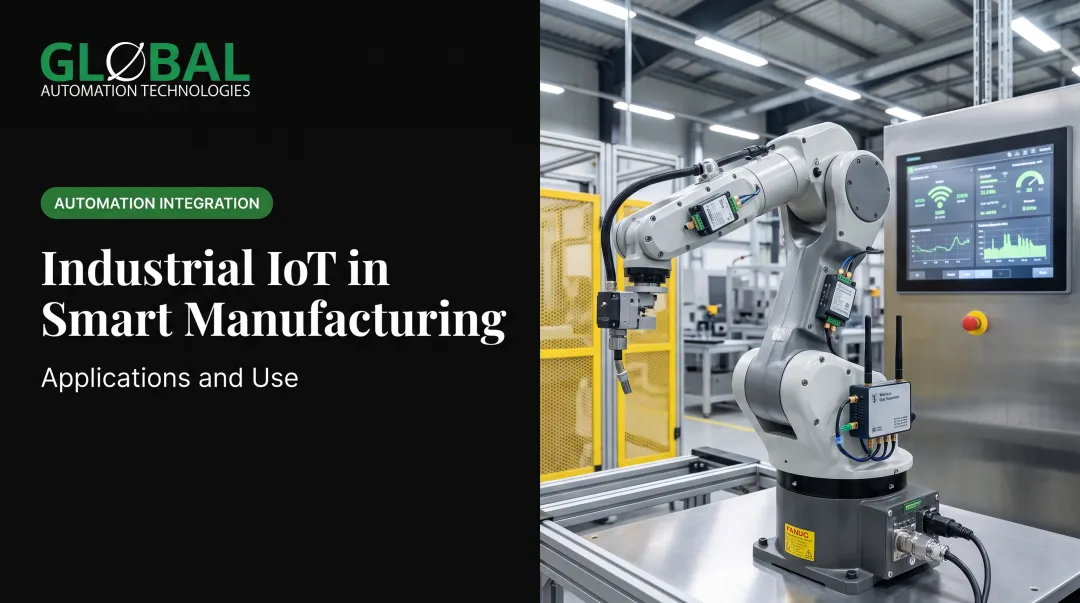
IIoT supplies the real-time data layer that drives performance monitoring and predictive maintenance on robotic cells. GLOBAL uses that data with AI-assisted simulation before deployment and AI-driven health assessments that flag issues before they cause downtime.