
Aerospace manufacturers are juggling multi-material parts, titanium and composites and aluminum alloys often in the same assembly, tighter tolerances than almost any other industry, and regulatory scrutiny that never lets up. The pressure is showing up in capital spending: aerospace manufacturers increased machinery orders by 45.1% in 2025 compared to 2024, according to AMT's manufacturing technology order data, a clear sign that plants are racing to automate faster than they can hire.
This post walks through the trends driving that shift, what's fueling the urgency, how it's changing operations and staffing, and where the industry is headed next.
Key Takeaways
- Robotic machine tending and AI-assisted simulation compress programming time and extend runs beyond a single shift
- Predictive maintenance cuts unplanned downtime where one stoppage can stall the full schedule
- Vision-based inspection supports AS9100, FAA, and EASA traceability requirements
- Automation shifts labor demand toward engineers and programmers—not out of the plant
- Dark factories and generative AI show where aerospace automation goes next
Key Trends Shaping Automation in Aerospace Manufacturing
Robotic Machine Tending & Continuous CNC Production
Robots are taking over the repetitive, high-risk work of loading and unloading CNC machines that cut titanium, composites, and aluminum alloys into aerospace parts. This isn't a novelty anymore. It's how forward-thinking machine shops keep spindles running past a single shift.
Pointe Precision's aerospace grinding cell is a good illustration of what's possible. The operation runs continuously between scheduled maintenance windows, produces a finished part every 2 to 5 minutes, and has logged zero customer rejects since automating grinding, in-process gauging, and robot tending together, according to FANUC's case study on the deployment.
GLOBAL Automation Technologies, a top-tier Level 5 FANUC Authorized System Integrator, builds custom machine tending cells for CNC loading and multi-machine setups. The ROI math is straightforward: machine tending cells typically pay for themselves in 12 to 18 months, driven by more parts per shift and fewer direct labor hours on repetitive load-unload cycles.
Why this matters:
- Extends production well beyond a standard 8-hour shift without adding headcount
- Addresses the skilled-labor shortage that's hitting machine shops hardest
- Frees operators for inspection, programming, and process improvement instead of repetitive cycles
AI-Assisted Simulation & Digital Twins for Robot Programming
Digital twins let engineers build, test, and refine a robotic cell entirely in software before a single piece of steel gets fabricated. Mistakes get caught on a screen, not on the shop floor where they cost real money.
GLOBAL's engineering team uses a model-test-optimize workflow: robot programs get simulated and refined virtually before deployment, a process that has compressed programming timelines from weeks down to days. ABB reports that its digital twin platform cut commissioning from days to hours and changeovers from hours to minutes in general manufacturing settings.
The payoff isn't just speed:
- Robot paths and cycle times get validated before floor deployment
- Process changes can be tested risk-free without halting production
- Commissioning surprises drop sharply because the kinks are worked out in simulation
Predictive Maintenance & Data-Driven Process Control
AI-driven health assessments now monitor equipment condition continuously, flagging wear and abnormal patterns before they cause a breakdown. Paired with SPC data flowing through MES and SCADA systems, plants get a real-time view of process health instead of a rearview mirror.
The numbers back up why this matters. McKinsey's research on manufacturing analytics found predictive maintenance programs typically deliver 30-50% less machine downtime and 20-40% longer machine life, based on McKinsey's analysis of manufacturing analytics deployments.
For aerospace specifically, the stakes are higher than most industries. A single equipment failure mid-sequence on a mission-critical part can halt an entire production line, not just one station. That's a cost most aerospace suppliers can't absorb repeatedly.
Automated Inspection & Vision-Based Quality Assurance
Vision inspection systems now log dimensional checks directly into quality databases as parts move down the line, catching defects the moment they happen rather than during a batch review days later.
In one aerospace inspection deployment, a complex part's check dropped from as much as 12 hours to under 10 minutes, with yield up 40%. In another case, an operator finished 44 measurements in under two minutes on work that once took more than 44 hours by hand.

This matters because aerospace quality systems require documented proof at every step:
- AS9100 clause 8.5.2 requires product traceability throughout production
- FAA rule 14 CFR 21.137 mandates quality system records retained for 5 years, or 10 for critical components
- EASA Part 21 requires records to stay traceable, retrievable, and legible
Automated logging makes hitting these standards routine instead of a scramble before an audit.
Collaborative Robots & Safety-Critical Process Automation
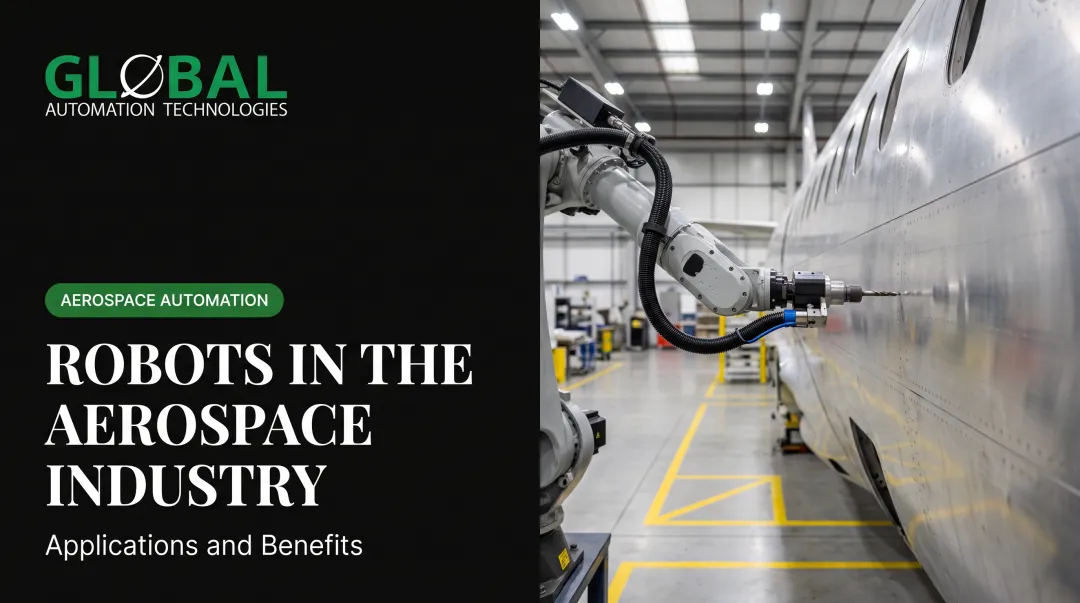
Cobots and robotic systems are steadily taking over the aerospace processes that put people at the greatest risk: welding, drilling, fastening, and painting.
GLOBAL's robotic painting systems, for instance, remove operators entirely from spray booths. That cuts direct exposure to isocyanates, VOCs, and overspray particulates while holding film build within specification shift after shift.
Robotic drilling and fastening cells show similar gains elsewhere in the industry. Boeing's fuselage automated upright build concept targeted roughly 50,000 fasteners per fuselage with accuracy within ±0.25 mm.
This trend keeps growing for a simple reason: it lowers injury risk and liability exposure while maintaining or improving throughput.
What's Driving These Automation Trends
Several forces are converging to push aerospace automation adoption faster than most manufacturers anticipated even a few years ago.
- Technology maturity: AI, industrial robotics, and IIoT connectivity are now accessible enough for mid-size suppliers, not just primes, to deploy
- Production targets climbing: Airbus is ramping A320-family output and Boeing is raising 737 rates—pressure that hits every supplier tier
- Labor pressure: Attrition in aerospace and defense manufacturing runs well above the US industry average, per a joint AIA and McKinsey talent study, so automation is often required just to keep lines staffed
- Regulatory weight: AS9100, FAA, and EASA frameworks demand built-in traceability that manual recordkeeping simply can't sustain at scale
Capital spending reflects all of this. That 45.1% jump in aerospace machinery orders mentioned earlier isn't a one-year blip. It's a structural shift in how the industry is investing.
How These Trends Are Impacting Aerospace Manufacturing
These trends aren't staying confined to the shop floor. They're reshaping how aerospace plants operate, invest capital, and staff their teams.
Operational Impact
Manual, single-station processes are giving way to integrated automated cells that handle multiple operations in sequence.
Operational gains show up quickly:
- Shorter changeovers — robots skip the retooling breaks manual stations need
- More predictable cycle times, since automated handoffs remove human pacing variability
- Fewer misfeeds and positioning errors with vision-guided systems

Business Impact
Manufacturers are increasingly prioritizing automation partners who can deliver both the system and the ongoing support behind it, rather than juggling separate vendors for design, build, and maintenance.
GLOBAL's turnkey model reflects this shift. One team covers:
- Consulting and feasibility work
- Engineering and simulation
- Controls programming
- Installation
- Post-launch health assessments
That single-source setup cuts the handoff gaps that slow projects down and drive up cost.
Workforce Impact
Automation isn't cutting headcount in aerospace manufacturing. It's changing what kind of headcount plants need. Demand is shifting toward controls engineers, robot programmers, and predictive-maintenance specialists, roles that require a different skill set than the manual labor they're replacing.
This is where a combined automation solutions, services and technical staffing model earns its keep. GLOBAL's technical staffing places controls engineers, robot programmers, mechanical designers, and project managers on contract, contract-to-hire, or direct-hire terms — directly into the environments where its own systems get deployed.
As the company puts it: "The system builder knows what the staffing client needs. The staffing team knows what the system requires." For manufacturers facing a workforce transition, that closed loop shortens ramp-up time considerably.
Future Signals for Automation in Aerospace Manufacturing
These trends are still early in their trajectory. Here's what's worth watching over the next one to three years:
- Dark factories gain ground. Full lights-out aerospace production remains rare, but momentum is building. Deloitte's 2025 smart manufacturing survey found 88% of manufacturing executives expect smart manufacturing investment to keep growing, with process and physical automation among top priorities.
- Generative AI enters robot programming. Tools like ABB's RobotStudio AI Assistant now provide natural-language, step-by-step programming guidance. Setting up a robotic cell will take less specialized coding knowledge.
- Cybersecurity becomes a certification requirement. SCADA and MES systems are bigger attack targets, so OT security is moving from afterthought to requirement. Frameworks like NIST SP 800-82 and CISA's Cross-Sector Cybersecurity Performance Goals are driving that shift into automation deployments.

Conclusion
From machine tending to AI-assisted simulation to predictive maintenance, these trends are reshaping precision, safety, and throughput across aerospace manufacturing. None of them are hype. They're already running on production floors today.
Manufacturers who move early gain a measurable edge, and that edge usually comes from partnering with a provider who delivers both the robotic systems and the engineering talent to run them. That's the gap GLOBAL was built to close.
The plants that lead this shift treat automation as an operating strategy—backed by the systems and people to execute it—while others stay stuck playing catch-up.
Frequently Asked Questions
What is automation in aerospace manufacturing?
Automation in aerospace manufacturing uses robotics, AI-driven systems, and integrated controls for tasks like drilling, fastening, inspection, and material handling. These systems deliver precision and consistency beyond what manual processes can sustain.
What is the ROI of automation in aerospace manufacturing?
ROI typically comes from reduced scrap, fewer compliance delays, and smoother throughput. Machine tending cells, for example, often pay for themselves within 12 to 18 months depending on system complexity.
What types of robots are used in aerospace manufacturing?
Common options include robotic arms for drilling, fastening, and riveting, plus machine-tending robots for CNC work. Collaborative robots (cobots) are also used where people and machines share the same cell safely.
How does automation improve quality control in aerospace manufacturing?
Vision inspection systems and closed-loop process controls catch defects in real time and log the results directly into MES and quality systems, supporting full traceability at every stage.
What is a dark factory in aerospace manufacturing?
A dark factory is a production facility designed to run with minimal human presence, relying on robotics, automation, and predictive analytics to keep production going continuously.
How much does aerospace manufacturing automation cost?
Costs vary widely based on project scope, part complexity, and required integration with existing equipment. Most manufacturers justify the investment over time through efficiency gains, fewer errors, and compliance savings.