
Introduction
Manual processes can't keep up anymore. Not in high-mix, high-volume plants where throughput, quality, and safety targets shift every quarter.
Production bottlenecks cap output. Quality drifts from shift to shift. Hazardous work—paint booths, CNC machine tending—keeps people in harm's way. Add a shrinking labor pool, and staffing those lines gets harder every year.
The numbers back this up. Deloitte and The Manufacturing Institute project a net need for roughly 3.8 million manufacturing workers between 2024 and 2033, with 1.9 million of those roles potentially going unfilled.
This guide breaks down what automated systems design involves, how the engineering process works step by step, and where it shows up on real production lines. You'll also get a clear framework for choosing a partner who won't leave you stuck mid-project.
Key Takeaways
- True automated systems design unites mechanical, electrical, controls, and software—not a robot on a pedestal.
- Strong designs move through seven phases, from needs assessment through commissioning and ongoing optimization.
- Well-designed machine tending cells often pay for themselves in 12 to 18 months.
- Partners that offer automation solutions, services and technical staffing cut project risk and speed long-term results.
What Is Automated Systems Design?
Automated systems design is the multidisciplinary engineering practice of planning, building, and integrating mechanical, electrical, controls, and software systems that perform manufacturing tasks with little to no human input. It brings together robotics, PLCs, sensors, actuators, HMIs, and safety systems as a single coordinated unit.
The International Society of Automation (ISA) describes automation broadly as the creation and application of technology to monitor and control production, spanning everything from controls and robotics to systems integration and testing.
That definition is broad by design. Buying a robot isn't the same as designing an automated system. A robot arm sitting on a shop floor without proper layout planning, process engineering, controls architecture, and validation testing is just expensive hardware. Real automated systems design includes:
- Cell layout and floor space planning
- Process engineering matched to part geometry and cycle time
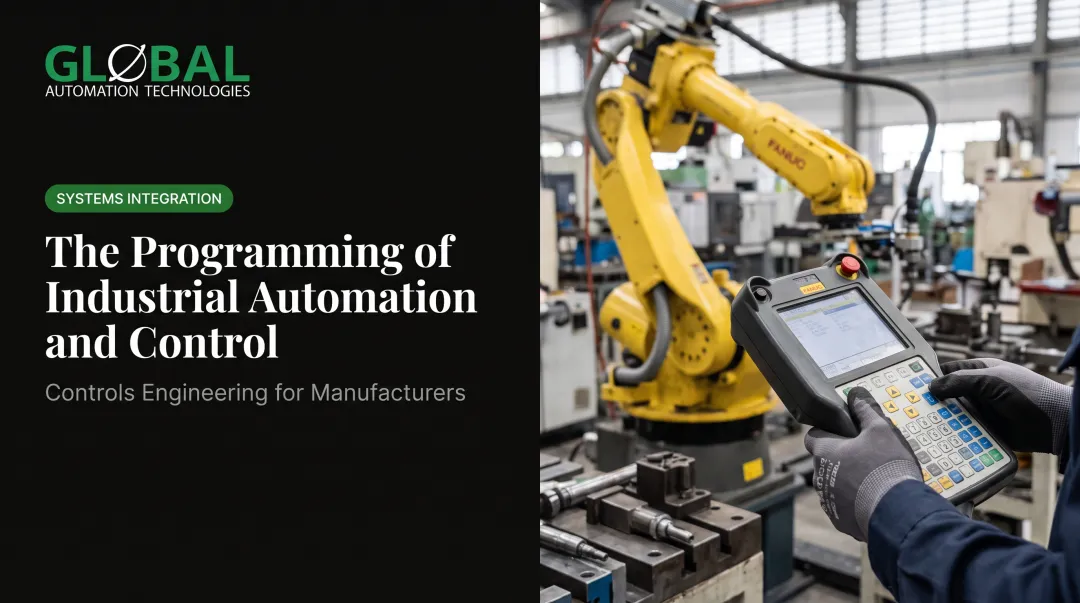
- Controls architecture connecting robots to PLCs, conveyors, and plant systems
- Safety guarding and risk assessment
- Validation testing against defined performance benchmarks

Industries that invest most heavily in this work include automotive OEMs, Tier 1 suppliers, heavy equipment manufacturers, and data center infrastructure producers. These are the sectors where GLOBAL Automation Technologies has built a proven global base of robotic deployments.
What Is an Example of an Automated System?
Common examples include:
- Robotic machine tending cells that extend spindle operation beyond a single shift, through breaks, shift changes, and overnight runs between scheduled maintenance windows
- Robotic painting systems holding film build within specification with a repeatability manual spray can't match shift after shift
- Robotic dispensing systems with in-line bead validation, catching width, placement, and continuity issues at the point of application before parts move downstream
- Palletizing and material handling systems that move parts between stations without manual lifting
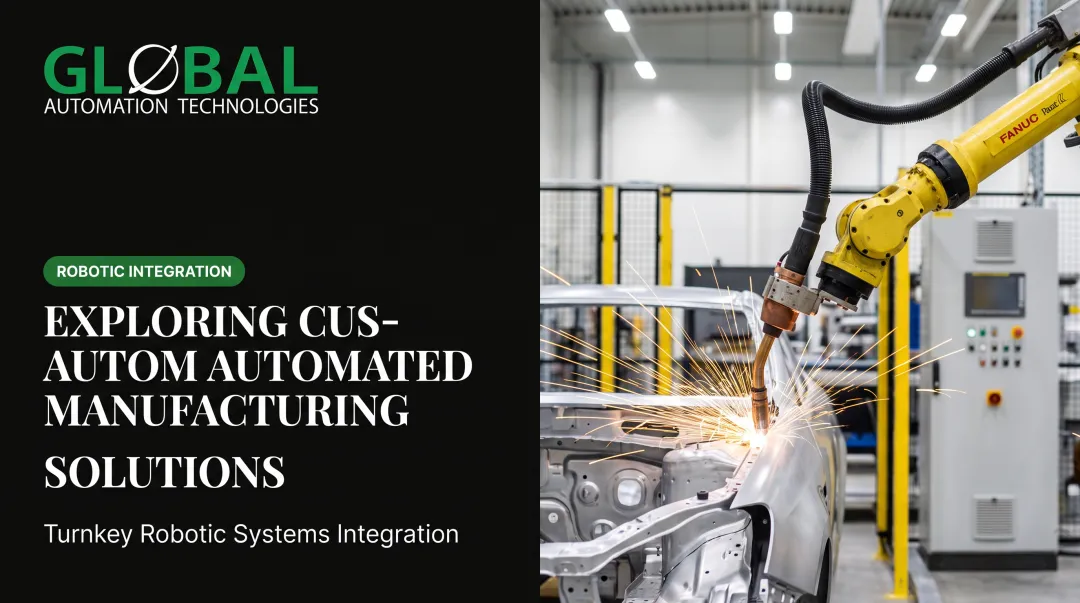
- Robotic welding cells for heavy equipment and automotive fabrication
- Automated inspection lines using machine vision to flag defects instantly
The Automated Systems Design Process: Step by Step
Every credible automated systems design project follows a structured sequence. Skipping steps is usually where projects go sideways.
Needs assessment. Engineers audit current production flow, identify bottlenecks, and define measurable goals such as cycle time reduction or defect rate targets. This step establishes the baseline everything else gets measured against.
Concept design and feasibility. Teams build initial layouts, estimate ROI, and check feasibility against plant constraints, floor space, and existing equipment.
Simulation and virtual validation. AI-assisted simulation tools compress what used to take weeks of manual robot programming into days. That virtual validation catches startup issues before a single component is fabricated.
Detailed engineering. Engineers select robot type, end-of-arm tooling, controls architecture, and safety systems based on part geometry, cycle time, and environmental conditions — including intrinsically safe designs for hazardous paint environments.
Build, integration, and testing. The team fabricates the cell, integrates software and hardware, and runs validation testing against agreed performance benchmarks before the system ever reaches the plant floor.
Installation, commissioning, and training. The team installs and commissions the system on-site, then trains operators and maintenance staff for a smooth production ramp-up.
Ongoing optimization. AI-driven predictive maintenance health assessments flag equipment issues before they cause unplanned downtime, keeping the system tuned long after launch.

This sequence mirrors what the Control System Integrators Association outlines through Automation World as the accepted industry framework, moving from discovery through training and long-term support.
Key Benefits of Effective Automated Systems Design
Good design delivers measurable gains across three areas: throughput and quality, safety, and cost.
Throughput and quality gains show up in precision-dependent applications. Robotic painting systems that follow the same programmed path every cycle hold film build within specification shift after shift, removing the variability that comes with manual spray operators. Dispensing systems with in-line bead validation catch width, placement, and continuity issues at the point of application before parts move downstream, cutting scrap before it happens.
Safety improvements matter more than most ROI spreadsheets capture. OSHA identifies painting, spraying, and machine-tool loading as high-risk industrial robot applications precisely because they expose workers to unsafe or unpleasant conditions.
NIOSH separately documents that paint overspray exposes workers to lead, chromium, polyisocyanates, and organic solvents — materials linked to respiratory, neurologic, and skin effects. Removing operators from that environment eliminates those exposure risks.
Cost and ROI follow from the same gains. McKinsey reports that manufacturing automation payback periods have compressed from five-to-eight years in past decades to one-to-three years today.
Machine tending follows the same pattern: cells often pay for themselves within 12 to 18 months, driven by more parts per shift with fewer direct labor hours.
Common Challenges in Automated Systems Design
Automation projects rarely fail because the technology doesn't work. They fail because of three predictable friction points.
- Integration complexity — new cells must coexist with legacy equipment, older PLCs, and plant infrastructure never built for robotics
- Capital and change management — upfront cost needs buy-in from teams skeptical of new workflows or worried about job displacement
- Engineering talent shortage — many plants own the equipment but lack engineers to program, run, and maintain it
That talent gap is well documented. A3 notes that experienced automation engineers are retiring faster than they're being replaced, leaving too few people who can stand up and run industrial robots.
Supplemental technical staffing (contract, contract-to-hire, or direct-hire) is now a standard part of automation planning, not an afterthought.
Choosing the Right Partner for Automated Systems Design
Not every integrator can carry a project from concept to production floor. When evaluating partners, look for turnkey capability: layout, design, build, programming, validation, installation, commissioning, and ongoing support delivered under one roof, not stitched together across three vendors.
A partner that pairs automation solutions, services and technical staffing reduces risk: the same organization that builds your robotic system can also supply the engineers who run it. That closes the coordination gap that typically opens up when an integrator hands off a finished cell and disappears.
GLOBAL Automation Technologies operates on this exact model:
- 17+ years of automation design and integration experience
- A proven global base of robotic deployments across automotive, Tier 1 supplier, and heavy industry applications
- Level 5 FANUC Authorized System Integrator, building primarily on FANUC robot platforms
- AI-assisted simulation and predictive maintenance built into standard engineering practice, not sold as an add-on
- Technical staffing that places controls engineers, PLC programmers, and commissioning engineers on a contract, contract-to-hire, or direct-hire basis at customer facilities
If you're weighing a machine tending, painting, dispensing, or material handling project, a conversation with GLOBAL's engineering team is worth having. Reach GLOBAL at info@globalat.com or +1 (810) 877-0329 for a project consultation.
Frequently Asked Questions
What is automated systems design?
Automated systems design is the engineering process of planning and integrating mechanical, electrical, and software systems so manufacturing tasks run with minimal human intervention. It covers layout, controls, and validation—not only equipment selection.
What are examples of automated systems?
Robotic machine tending cells, robotic painting systems, and dispensing systems with real-time bead validation are common examples used across automotive and industrial manufacturing.
How much does automated systems design cost?
Cost varies based on application complexity, robot type, and project scope. Many manufacturers justify the investment through ROI timelines, with machine tending cells often paying back within 12 to 18 months.
How long does it take to design and implement an automated system?
Timelines depend on complexity. Most projects run about 3 to 9 months from needs assessment through simulation, build, installation, and commissioning.
What industries use automated systems design?
Automotive OEMs, Tier 1 suppliers, heavy equipment manufacturers, and data center infrastructure producers rely on it most heavily, though general industrial manufacturers use it widely too.
What's the difference between automation and robotics?
Robotics is a subset of automation focused on robotic arms and related systems. Automation is the broader category: sensors, controls, software, and any other technology that reduces manual intervention.