
Robots have long been the go-to for welding and material handling, not cutting or finishing parts. According to the International Federation of Robotics, welding, dispensing, and processing tasks (including grinding, deburring, milling, and polishing) accounted for just 25% of total industrial robot applications in 2018.
That share is growing. Better sensors, smarter software, and falling costs are pushing robots into work once reserved for CNC machines or manual labor. Here's what's driving that shift, and what manufacturers should watch next.
Key Takeaways
- Robots now handle CNC-adjacent work—deburring, polishing, grinding—that dedicated machines can't justify
- AI-assisted simulation is cutting robot programming time from weeks to days
- Compensation software and vision guidance are closing the precision gap for mid-tolerance work
- Machine tending boosts spindle utilization without touching CNC's cutting role
- Cost pressure and labor shortages—not a push to replace CNC—are the real drivers
Key Trend 1: Robots Are Taking Over CNC-Adjacent Tasks Machines Can't Do Efficiently
Deburring, polishing, grinding, and rust removal have always fallen into an awkward middle ground. They're too inconsistent and part-specific to justify a dedicated machine tool, but too repetitive and physically demanding to leave to manual labor long-term.
Robots fit this gap well because of their limitations, not in spite of them.
Compliance Beats Rigidity for Finishing Work
CNC machines need extreme stiffness for micron-level cutting. But finishing uneven or contoured surfaces actually benefits from a bit of give. A robot arm's lower rigidity lets it follow irregular geometry without gouging the material, something a rigid machine tool struggles to do.
This shows up in large-part finishing:
- Wind turbine blades: The National Renewable Energy Laboratory demonstrated robots trimming, grinding, and sanding a 5-meter blade segment, using surface scans to program the toolpath after molding.
- Aircraft components: Robotic sanding systems now handle control surfaces and fuselage sections, replacing manual processes that carried real strain-injury risk for operators.
- Composite fastener holes: BAE Systems and the Advanced Manufacturing Research Centre use robots to countersink fastener holes in composite aircraft parts, with non-contact metrology correcting position in real time.
None of this competes with CNC on precision, and it doesn't need to. These tasks were either done by hand or not automated at all. Robots are taking on work CNC machines were never built to handle.
Key Trend 2: AI-Assisted Simulation Is Collapsing Robot Programming Time From Weeks to Days
Programming a robot used to mean tying up engineering time and floor space for trial-and-error testing. That's changing fast, largely because simulation software has caught up to what robots can actually do.
Offline programming lets engineers build, test, and refine a robot's toolpath entirely on a computer, before the robot ever touches a workpiece. AI-assisted tools push this further. They can:
- Auto-generate toolpaths from part geometry
- Flag collision risks before anything reaches the cell
- Optimize cycle times in a fraction of manual programming time
ABB reports that automatic path planning through its RobotStudio platform can cut robot programming time by 80% compared to manual methods. Platforms are also closing the CAD/CAM gap. KUKA's KUKA.CNC interface, for example, lets robots execute standard G-code programs, so manufacturers can reuse existing CNC programming data instead of starting from a blank slate.
At GLOBAL Automation Technologies, a top-tier Level 5 FANUC Authorized System Integrator, this shift plays out directly in how projects get built. GLOBAL's engineers model, test, and optimize robot programs in simulation before the robot runs on the shop floor. That pre-deployment work compresses what used to be a weeks-long commissioning process into days, with fewer surprises once the robot is live.
Why does this matter beyond convenience? Slow, engineering-heavy programming used to be the main reason manufacturers stuck with CNC over robots for borderline applications. As that barrier drops, robots become a realistic option for shops that previously ruled them out.
Key Trend 3: Robots Are Closing the Precision Gap With CNC Machines
CNC machines still win on raw stiffness and precision. Industrial robots typically have stiffness below 1 N/µm, while machine tools regularly exceed 50 N/µm, according to peer-reviewed research on robotic machining and stiffness modeling. That difference matters most at the micron level.
Lower stiffness does not rule robots out of machining work. Several technical advances have narrowed the gap considerably:
- Compensation software that corrects for arm deflection and sensor error in real time
- Vision-guided tool measurement, including stereo-camera systems that have achieved 0.1mm dynamic positioning accuracy in research settings
- Vibration-reduction techniques that address micro-vibrations caused by joint torque during cutting

These advances have pushed robotic accuracy into the 0.1-0.5mm range for suitable applications. That falls short of CNC-level precision, but it covers a growing list of production jobs.
Where Robots Win on Application Fit
Automotive prototype work is a good example. Robots now machine parts like seats and instrument panels, where CNC's extra precision was never necessary in the first place. Using a high-stiffness machine tool for a job that doesn't need micron tolerances is overkill, and it ties up expensive capacity.
Robots are not replacing CNC for high-precision, high-stiffness cutting anytime soon. The real shift is the expanding overlap between what each platform does well. As that zone grows, more mid-tolerance work becomes fair game for robotic automation.
Key Trend 4: Robotic Machine Tending Is Extending Production Beyond a Single Shift
Not every gain in robotic machining comes from robots doing the cutting themselves. A lot of it comes from robots feeding and supporting the CNC machines that already do.
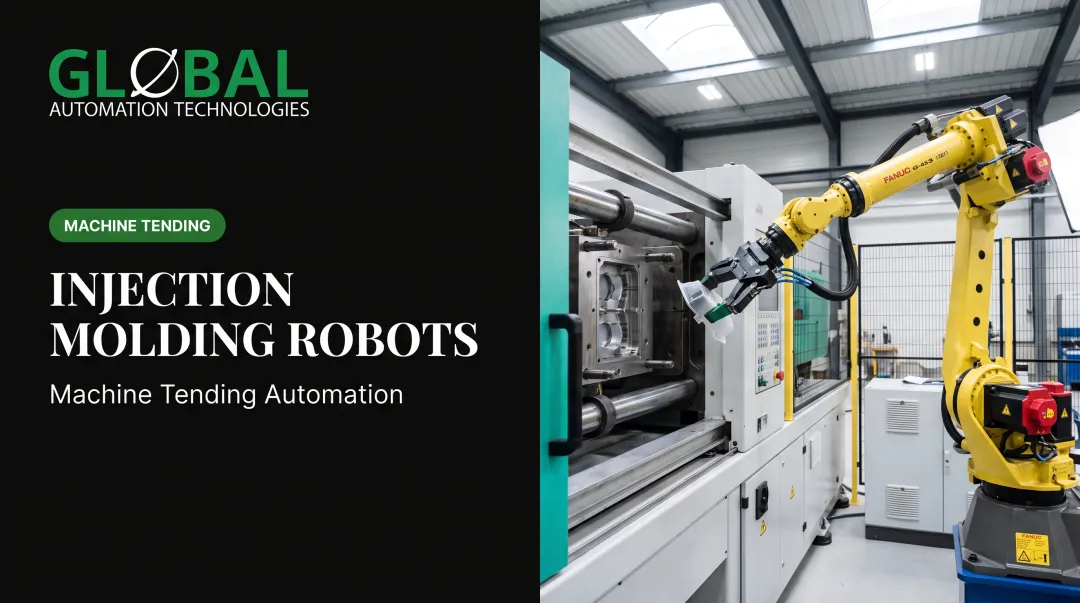
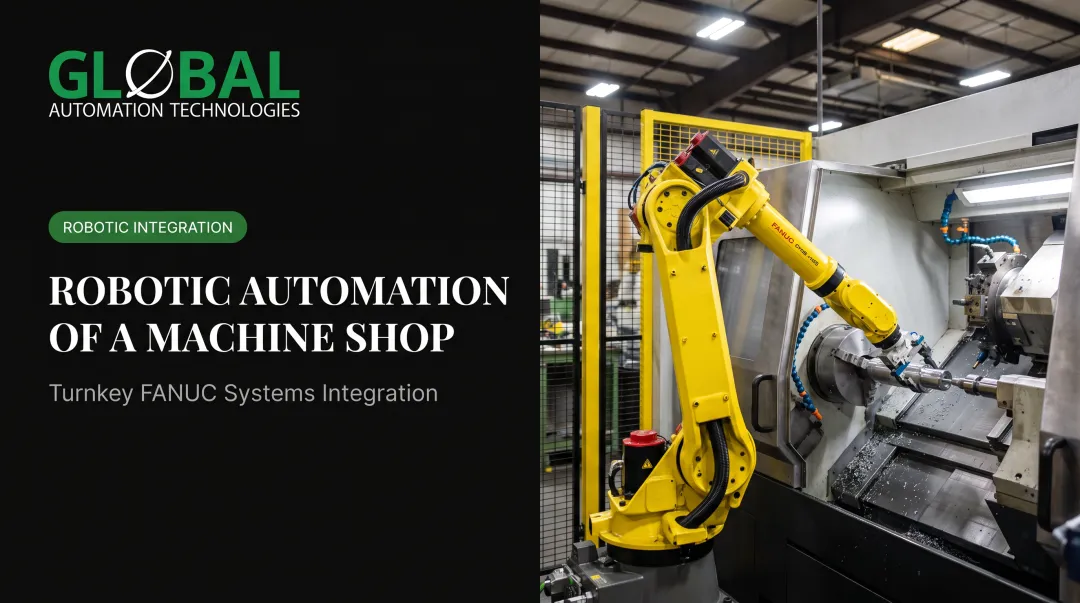
Machine tending (robots loading and unloading CNC machines) sidesteps the entire precision debate. The robot's job isn't to cut the part; it's to keep the spindle running. That distinction matters, because it means shops don't have to choose between robot and machine. They get both working together.
FANUC has documented a case where automating CNC load/unload for a manufacturer boosted production by 33%. Gains came largely from extended runs beyond a single shift, including overnight and weekend shifts that would otherwise sit idle, with lights-out operation running between scheduled maintenance windows.
Hybrid cells push this idea further. They combine drilling, reaming, assembly, and inspection so a part stays clamped through multiple operations instead of moving between separate stations.
At GLOBAL, robotic machine tending is one of the most requested applications, spanning:
- CNC loading and unloading for machining centers, lathes, and mills
- Multi-machine cells where one robot serves several machines with buffer staging
- Secondary operations like deburring, cleaning, and gauging between machining steps
- Cobot-assisted tending for lower-volume, quick-changeover environments
These cells typically pay for themselves in 12 to 18 months, driven by higher throughput and reduced dependence on manual labor for repetitive tending work.
What's Driving This Shift and What It Means for Manufacturers
Driving Forces Behind the Trend
Three forces are pushing robotic machining forward at the same time:
- Falling robot costs, rising ROI: Per McKinsey, average robot prices have fallen by roughly half in real terms over three decades. Integration now drives most project cost — and demand for turnkey partners.
- Persistent skilled-labor shortages: The U.S. Bureau of Labor Statistics projects roughly 87,900 annual openings for metal and plastic machine workers through 2034, driven mostly by people leaving the field.
- Simpler programming: AI-assisted simulation and hand-guided teaching have lowered the technical bar that once required a dedicated robot programmer for every project.

Business and Workforce Impact
The operational shift is real. Single-purpose machine tools are giving way to flexible robotic cells that can be reprogrammed for new parts or short production runs without a full retooling cycle.
That shift changes buying behavior too. Manufacturers increasingly look for automation partners who provide both the system and the engineers to run it, rather than buying equipment and figuring out staffing separately.
Workforce impact follows the same pattern. Operators move from repetitive finishing or tending into supervisory and reprogramming roles, which raises demand for controls engineers, robot programmers, and technicians.
Most manufacturers can't close that talent gap through hiring alone. GLOBAL's technical staffing exists for this reason, recruiting controls, mechanical, and project management talent into the customer roles that run these systems.
Future Outlook: What to Watch in the Next 1-3 Years
Three developments will shape the next wave:
- Better absolute accuracy compensation and sensing, which will keep pushing robots into tighter-tolerance applications over time
- AI-driven predictive maintenance, which the IFR names as a top robotics trend for 2024, aimed at flagging equipment issues before they cause downtime
- Hybrid manufacturing cells combining additive processes, milling, and inspection, still mostly at the demonstration stage, but expanding across aerospace and heavy industry research programs
Conclusion
Robotic machining extends what shops can do beyond traditional CNC. Robots take on large parts, multi-process cells, and flexible short runs CNC machines were never built for, while closing the precision gap on mid-tolerance work.
Manufacturers who match the right process to the right technology now, rather than waiting, are building a durable cost and flexibility advantage. Getting there takes more than buying a robot. It takes an integrator who understands both the systems and the engineering talent needed to keep them running.
Frequently Asked Questions
Why is CNC not a robot?
CNC machines are rigid, single-purpose machine tools with fixed axes, built for superior stiffness and micron-level precision. Robots are multi-axis arms designed for flexibility across many tasks rather than one high-precision operation.
What is robotic machining used for?
Common applications include deburring, polishing, grinding, drilling, and milling for lower-tolerance parts, plus pre-production tasks like rust removal and machine tending to support CNC operations.
Can robots achieve the same precision as CNC machines?
Top-end CNC still outperforms robots in micron-level precision and stiffness. But compensation software and vision guidance have brought robotic accuracy into the 0.1-0.5mm range for suitable applications.
How much does a robotic machining cell cost compared to CNC?
Robots are generally less capital-intensive than high-end CNC machines, especially for large or complex parts. Machine tending cells typically pay back within 12 to 18 months through higher throughput.
What industries benefit most from robotic machining?
Automotive, aerospace, heavy equipment, and general fabrication lead adoption, particularly for large-part finishing, prototype machining, and high-mix, short-run production.
Is robotic machining suitable for high-volume production?
Yes. Robots excel in high-volume, repetitive applications like machine tending and finishing, especially when paired with fast changeover tooling and offline-programmed cycle optimization.