
Industrial engineering solutions combine proven methodologies, automation, and modern technology to reduce waste, cut costs, and boost throughput. Some fix a specific bottleneck. Others reshape how an entire plant operates.
This article breaks down the top industrial engineering solutions manufacturers are using right now, how each one works, and how to pick the right combination for your facility.
Key Takeaways
- Industrial engineering spans Lean, Six Sigma, layout and supply chain design, robotics, and predictive maintenance
- Match the mix to your bottleneck: waste, defects, downtime, or labor costs
- Automation and AI monitoring are core to competitive manufacturing, not optional extras
- Tie every solution to a measurable outcome: cycle time, scrap rate, or uptime
Overview of Industrial Engineering Solutions in Manufacturing
Industrial engineering solutions are the combined methodologies, technologies, and process redesigns used to optimize how people, machines, and materials work together on the production floor. They range from paper-based process mapping to fully integrated robotic cells.
The pressure to adopt them is growing. Manufacturers are modernizing legacy lines, integrating automation, and competing against global producers with lower labor costs. The workforce data reflects this shift. The U.S. Bureau of Labor Statistics projects industrial engineering employment to grow 11% between 2024 and 2034, well above the average for all occupations, with roughly 25,200 openings expected each year.
On the automation side, adoption is accelerating. Factories worldwide installed 542,000 new industrial robots in 2024 alone, pushing the global operational stock to 4.664 million units — up 9% year over year, according to the International Federation of Robotics.

The solutions below represent the most widely adopted, highest-impact approaches manufacturers use today to close efficiency gaps. Each was selected based on:
- Proven track record across multiple industries
- Measurable ROI with documented case results
- Adaptability to different plant sizes and budgets
- Relevance to current manufacturing pressures like labor cost and supply volatility
Top Industrial Engineering Solutions to Optimize Manufacturing Efficiency
Solution 1: Lean Manufacturing
Lean traces back to the Toyota Production System, built around one core idea: eliminate anything that doesn't add value for the customer. That means targeting transportation waste, excess inventory, unnecessary motion, waiting time, overproduction, and defects.
Lean’s advantage is its cost profile. It requires minimal capital investment, yet delivers measurable results when paired with Kaizen (continuous improvement) and Just-in-Time production. A small manufacturer doesn't need a robotics budget to start seeing gains.
Oregon-based Egg Press proved this out. After adopting lean fundamentals, value-stream mapping, and flexible inventory rules, the company cut inventory by 35%, saved more than $32,000, and reduced production and packaging time by 15%, according to a NIST Manufacturing Extension Partnership case study.
| Criterion | Details |
|---|---|
| Key Focus Areas | Waste elimination, continuous improvement (Kaizen), Just-in-Time production |
| Best Suited For | Facilities with visible bottlenecks, excess inventory, or inconsistent flow |
| Typical Impact | Double-digit inventory reduction and meaningful processing time savings, based on documented cases |
Solution 2: Six Sigma
Six Sigma takes a different angle. Developed by Motorola, it's a data-driven methodology built around the DMAIC framework (Define, Measure, Analyze, Improve, Control) used to minimize process variation and drive out defects.
Its strength is statistical rigor. Where lean focuses on flow and waste, Six Sigma zeroes in on consistency, making it a natural fit for high-precision industries like automotive and aerospace where tolerances leave no room for error.
A 2023 case study involving an Indian automotive components supplier applied DMAIC to a rubber weather-strip production line. Rejection rates dropped from 5.5% to 3.08% and the process sigma level rose from 3.9 to 4.45 within just three months, as documented in a peer-reviewed Heliyon study.
| Criterion | Details |
|---|---|
| Key Focus Areas | Defect reduction, process variation control, statistical process control |
| Best Suited For | High-volume production with strict quality tolerances |
| Typical Impact | Rejection rate cuts of 40%+ and improved sigma levels within a few months, per documented cases |
Solution 3: Robotic Automation & Systems Integration
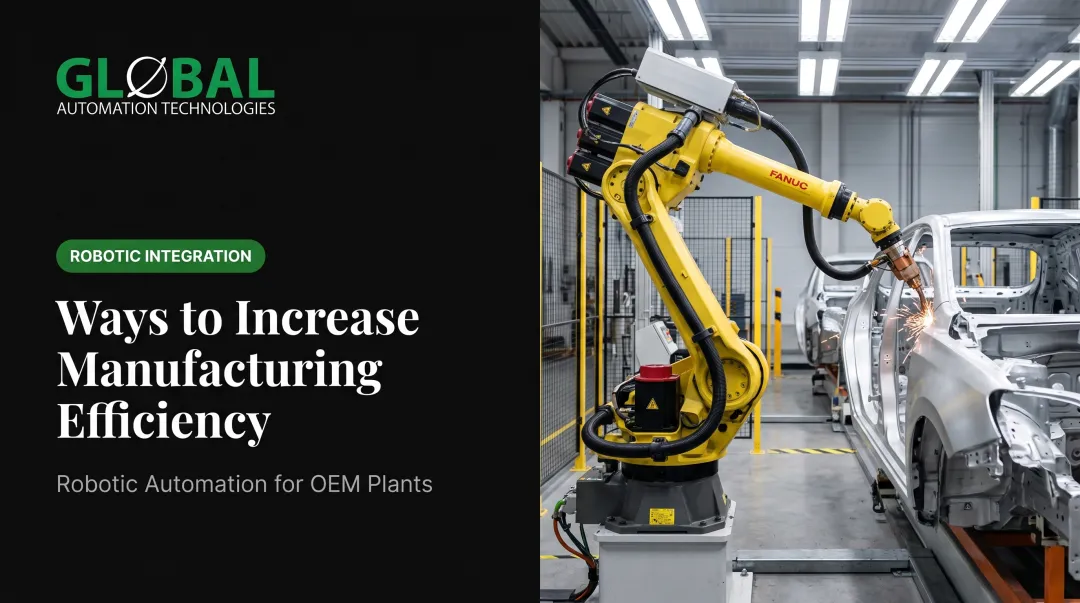
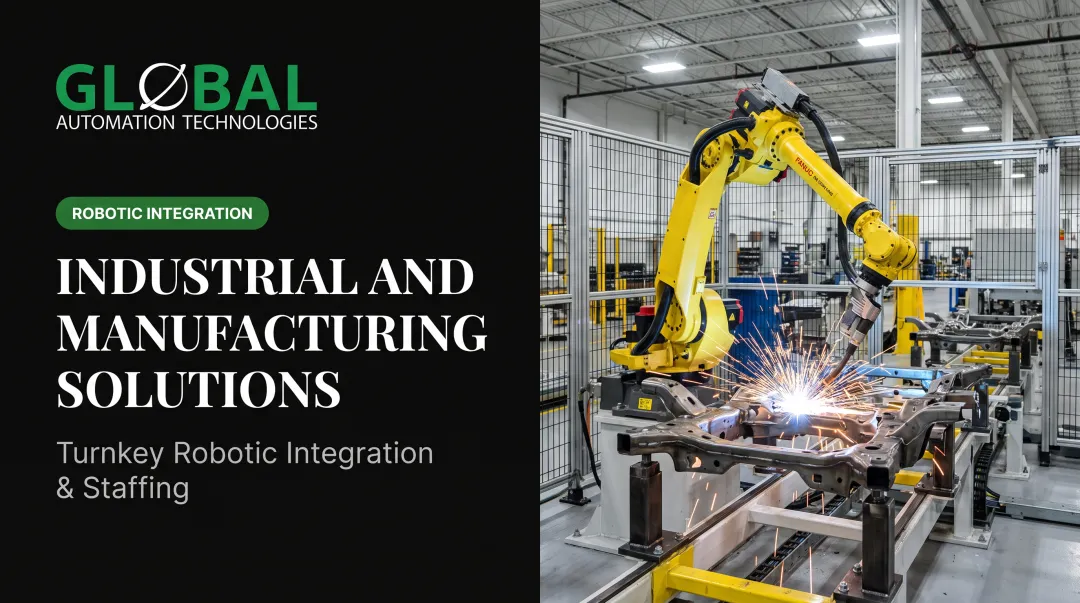
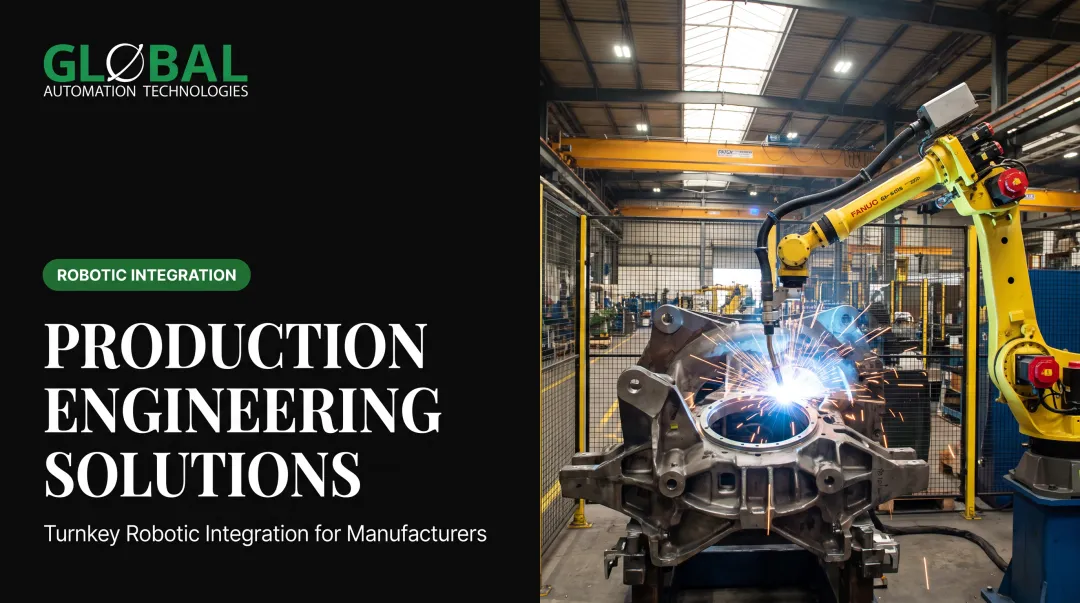
Robotic automation replaces manual, repetitive, or hazardous tasks with robotic arms, machine tending cells, and integrated systems that keep running through breaks and shift changes, extending production well beyond a single shift with lights-out operation between scheduled maintenance windows.
Modern automation goes further than the robots themselves. AI-assisted simulation now lets engineers model, test, and optimize robot programs before a single line of code touches the production floor. GLOBAL Automation Technologies, a Level 5 FANUC Authorized System Integrator, uses a simulation-first approach that has cut robot programming time from weeks to days, with fewer surprises during commissioning.
GLOBAL also delivers both FANUC-based robotic systems and the engineers who run them, so clients are not forced to source equipment and talent from separate vendors. For machine tending applications specifically, cells typically pay for themselves within 12 to 18 months, driven by higher spindle utilization and reduced direct labor hours.
Globally, this kind of investment is becoming standard practice. Manufacturers can generally expect a one-to-three-year payback period on automation, according to McKinsey's 2024 analysis of U.S. manufacturing.
| Criterion | Details |
|---|---|
| Key Focus Areas | Continuous production, precision, hazardous task removal, throughput |
| Best Suited For | Automotive, Tier 1 suppliers, heavy equipment, and high-volume manufacturers |
| Typical Impact | Faster startups via simulation, plus a 12-18 month payback on machine tending cells |
Solution 4: Facility Layout Optimization
Facility layout optimization redesigns workstations, machinery, and material flow to cut travel time, congestion, and wasted floor space. No new equipment purchase required — just smarter spatial design.
Few high-impact solutions cost so little beyond engineering time, yet still cut handling costs and cycle times directly.
Bicycle-rack manufacturer Rudy Rack is a strong example. After a plant layout transformation guided by process mapping, shop throughput time dropped from three weeks to just four days — a 300% improvement in weekly output, according to a NIST-documented case.
| Criterion | Details |
|---|---|
| Key Focus Areas | Material flow, bottleneck elimination, space utilization |
| Best Suited For | Facilities expanding capacity or retrofitting existing plants |
| Typical Impact | Throughput time reductions from weeks to days in documented layout redesigns |
Solution 5: Supply Chain Optimization
Supply chain optimization tackles inventory management, demand forecasting, and supplier coordination — preventing upstream disruptions before they cause downstream production delays.
The real leverage is upstream: problems get fixed before they hit the plant floor. Nearly nine in ten supply executives reported supply chain challenges in McKinsey's 2024 survey, and the pressure to fix upstream issues has never been higher.
Materials-science manufacturer W.L. Gore & Associates applied high-level value-stream mapping across its supply chain and cut one production lead time by three weeks, with combined benefits from its first four initiatives expected to approach $5 million annually, according to ASCM.
| Criterion | Details |
|---|---|
| Key Focus Areas | Inventory management, demand forecasting, supplier coordination |
| Best Suited For | Manufacturers with complex, multi-supplier production chains |
| Typical Impact | Multi-week lead time reductions and seven-figure annual savings potential |
Solution 6: Predictive Maintenance & AI-Driven Monitoring
Predictive maintenance uses sensor data, IoT connectivity, and machine learning to forecast equipment failure before it causes unplanned downtime, shifting maintenance from reactive or scheduled to condition-based.
That shift extends equipment life and cuts repair costs on assets that are expensive and slow to replace. GLOBAL applies this through AI-driven health assessments that flag equipment issues early, before they escalate into budget overruns or line stoppages. Rather than a generic sensor package, GLOBAL's engineers study each customer's floor and process to build assessments that fit the actual equipment in use.
Industry trend research from the International Federation of Robotics points the same way: predictive AI that flags condition risks early helps manufacturers avoid the steep cost of unplanned downtime.
| Criterion | Details |
|---|---|
| Key Focus Areas | Condition monitoring, failure prediction, proactive repair scheduling |
| Best Suited For | Capital-intensive lines with expensive, hard-to-replace equipment |
| Typical Impact | Reduced unplanned downtime and lower emergency repair costs through early detection |

How to Choose the Right Industrial Engineering Solution
The most common mistake? Adopting a trending methodology (often Six Sigma) without first diagnosing the actual bottleneck through data.
Before selecting anything, evaluate your facility against measurable factors:
- Defect and waste rates: Are quality issues or excess inventory driving costs up?
- Downtime frequency: How often does equipment failure interrupt production?
- Labor cost pressure: Is manual, repetitive work eating into margins?
- Capital budget: What can you realistically invest in automation or technology?

GLOBAL's engineering team applies this same logic before recommending anything, walking the client's floor and studying the process rather than pushing a one-size-fits-all fix. They evaluate automation opportunities, cycle-time issues, and facility constraints together, not in isolation.
The strongest results rarely come from a single methodology. Pairing lean principles with robotic automation and predictive maintenance, rather than relying on one approach, compounds the gains. Lean identifies where waste lives; automation removes the manual burden; predictive maintenance protects the new equipment's uptime.
Conclusion
Manufacturing efficiency comes from the right mix of methodologies, layout design, and technology matched to your facility's goals — whether that's cutting scrap, reclaiming floor space, or eliminating unplanned downtime.
Before committing budget to any solution, weigh scalability and long-term ROI, not just the upfront price tag. A cheap fix that doesn't scale with your production volume isn't actually cheap.
If your facility is ready to combine automation solutions with the engineering talent to run it, GLOBAL Automation Technologies builds both under one roof. Talk to our team about what a tailored automation strategy could look like for your line.
Frequently Asked Questions
What problems do industrial engineering solutions solve?
They address waste, process variability, equipment downtime, poor facility layout, and labor inefficiency to improve production performance and reduce costs.
What is the difference between Lean Manufacturing and Six Sigma?
Lean focuses on eliminating waste and improving flow, while Six Sigma uses statistical methods to reduce defects and process variation. Many manufacturers combine both as "Lean Six Sigma" for broader impact.
How long does it take to see results from industrial engineering solutions?
Process changes like layout redesign can show results in weeks. Automation and predictive maintenance investments typically show ROI within 12 to 18 months.
Can automation and robotics be combined with lean manufacturing?
Yes. Automation removes manual waste and hazardous tasks, while lean principles help identify exactly where automation delivers the highest value first.
How do I know which industrial engineering solution my facility needs first?
Start with a data-driven bottleneck assessment. Measure downtime, defect rates, and cycle times before choosing a methodology or technology investment.
What ROI can manufacturers expect from robotic automation or predictive maintenance?
Machine tending cells typically pay for themselves in 12 to 18 months through higher spindle utilization and fewer labor hours. Predictive maintenance adds value by reducing unplanned downtime and emergency repair costs.