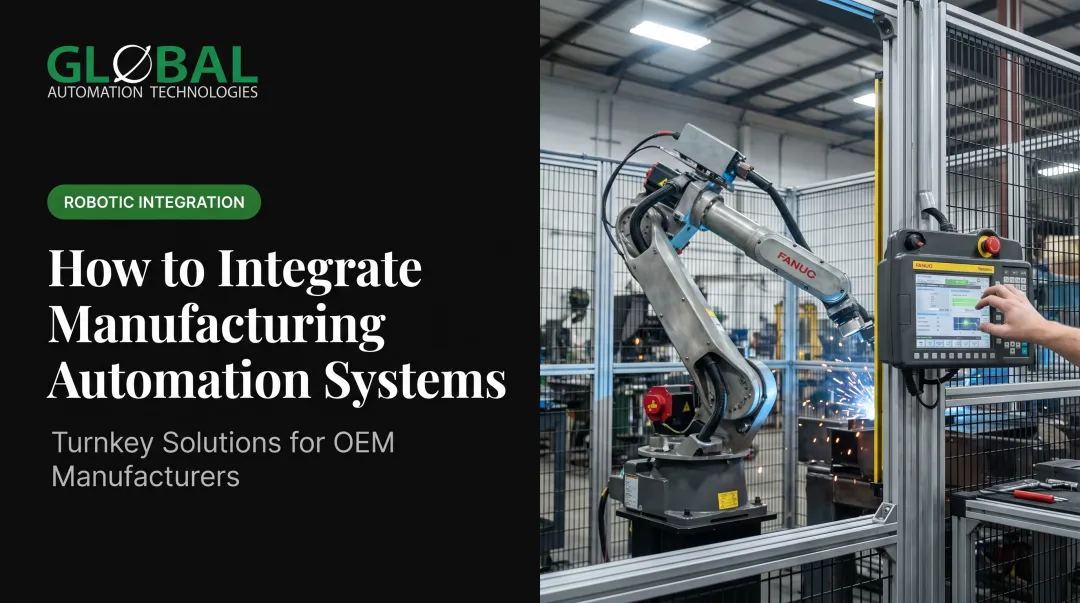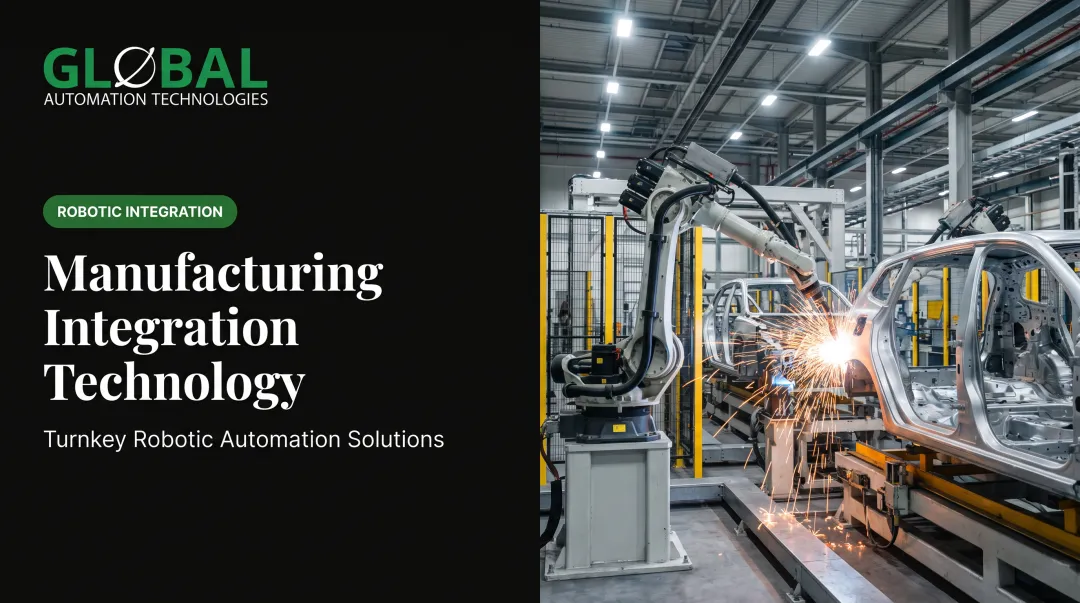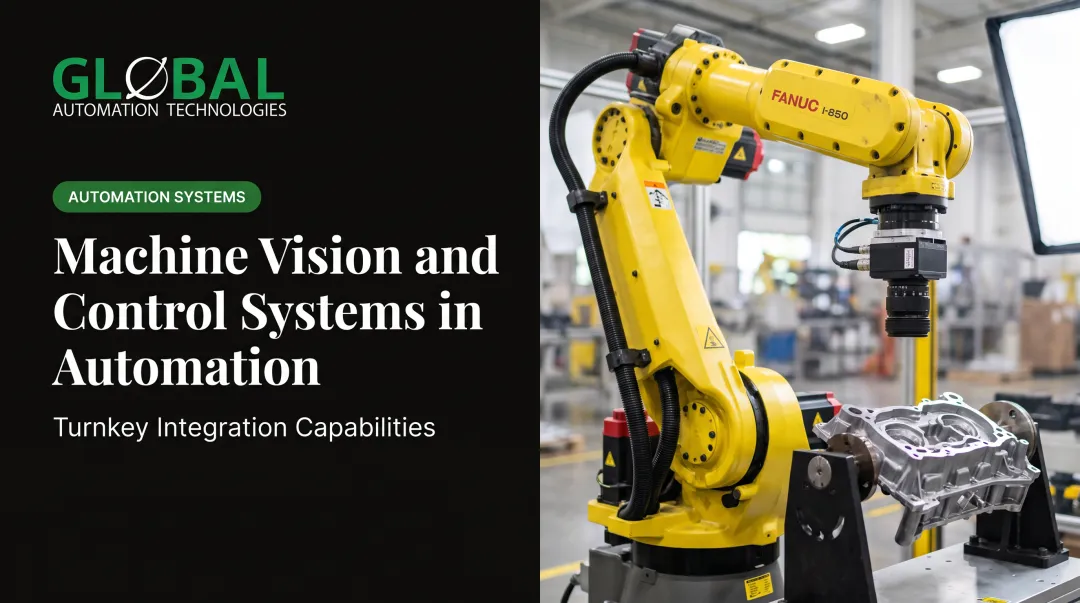

Robots, controls, and machine vision now have to run as one system with the equipment already on the floor, not as isolated cells. Manufacturers who treat that integration as an afterthought are left with disconnected data, inconsistent quality across shifts, and fewer hands to catch what automation misses. Software platforms like ERP, MES, and SCADA sit alongside this work as context, but the first real wall is usually physical: getting new robotic cells to talk to existing PLCs and conveyors without stopping a line.
The labor math makes this urgent. The Manufacturing Institute and Deloitte project U.S. manufacturers will need 3.8 million additional workers between 2024 and 2033, with up to half of skilled openings going unfilled. Fewer people means every machine, sensor, and software platform has to pull more weight, and that only works if they're actually talking to each other.
This guide breaks down what manufacturing systems integration really means, the types you'll run into, and the best practices that separate successful rollouts from expensive, stalled-out projects.
Key Takeaways
- Integration now spans hardware, software, and people, not just an IT upgrade
- Match horizontal, vertical, end-to-end, or robotic integration to the specific problem you need to solve
- Start with measurable KPIs and small pilots to avoid costly rework later
- Build cybersecurity and talent strategy into the plan from day one
- Machine tending, painting, and dispensing integrations often pay back in 12 to 18 months
What Is Manufacturing Systems Integration?
Manufacturing systems integration connects the hardware, software, and people on your production floor into one coordinated environment: robots, PLCs, and CNC machines; ERP, MES, and QMS platforms; IoT sensors; and the operators reading dashboards and reacting to alerts. Run separately, these pieces create silos. Integrated, they behave as one system.
The industry framework for this, ISA-95, maps five levels, from the physical production process at Level 0 up through business planning and ERP at Level 4. Most integration work happens at the boundary between shop-floor operations and business systems, where visibility tends to break down.
The real payoff is real-time decision-making. A machine that logs its own downtime is useful. A machine that logs downtime, feeds that data into your MES, and triggers a maintenance alert before the next shift starts, that's integration doing its job.
Integration spans two distinct worlds:
- Digital systems — software talking to software, like ERP pulling live production data from MES
- Physical systems — robots, tooling, and machines coordinated to work together on the floor without manual handoffs
That second category, physical and robotic integration, is where a lot of manufacturers hit their first real wall. Getting a new welding cell, machine tending robot, or paint system to talk to existing PLCs and conveyor controls without shutting down a line takes a different kind of expertise than connecting two software platforms.

It's also where GLOBAL's turnkey robotic integration work lives, from process study through commissioning.
Key Types of Manufacturing System Integration
Horizontal Integration
Horizontal integration connects machines and processes across the factory floor, linking machining cells, robotic workstations, testing equipment, and packaging lines into a single flow. Instead of a part getting picked up by hand between a CNC cell and a testing station, the two hand off automatically.
The goal is eliminating manual handoffs that introduce delays, damage, or inconsistent handling. Every handoff removed is one less place for a part to sit idle.
Vertical Integration
Vertical integration bridges the shop floor with the front office. Operational data—cycle times, scrap counts, machine states—flows up into ERP and supply chain systems, giving leadership real-time visibility into production without a walk-through. A plant manager can see machine-level performance from a laptop in another building instead of waiting for an end-of-shift report.
End-to-End (Digital Thread) Integration
End-to-end integration, often called the digital thread, connects product design (CAD/PLM) through production, logistics, and delivery. A complete thread means defect and delay data from the floor feeds back into design decisions instead of disappearing after the fact. That loop supports shorter cycle times and fewer first-run mistakes.
Physical/Robotic Systems Integration
For a lot of manufacturers, this is where integration gets tangible. Bringing a new robotic welding, machine tending, painting, or dispensing cell online is only half the job. Getting it talking to existing lines, PLCs, and conveyor controls—without stopping production—is its own engineering challenge.
It requires:
- Synchronizing new cells with press controls, conveyor PLCs, and CNC interfaces
- Matching speed, trigger signals, and fault handling between the robot and existing equipment
- Feeding new cell data into SCADA and plant-level monitoring systems already in place
This is the category where GLOBAL works directly—engineering robotic cells that tie into live production so new automation does not force a line restart.

Best Practices for Manufacturing Systems Integration Success
Whether you're integrating one robotic cell or rewiring a plant's entire digital backbone, the same blueprint applies. These six practices separate projects that deliver measurable results from the ones that stall out mid-rollout.
Start With Measurable Business Objectives
Tie integration to specific KPIs (OEE improvement, lead time reduction, scrap reduction) before selecting any technology. Projects that start with a defined value target consistently outperform those that start with a technology wish list.
McKinsey's research backs this up. At one manufacturer, a network scan found that five sites represented about 80% of the total value at stake, letting leadership focus investment instead of spreading it thin. Skip this step and you're integrating for integration's sake.
Adopt Open Standards to Avoid Vendor Lock-In
Protocols like OPC UA, MQTT, and Modbus let your ERP, MES, and robotic controllers talk to each other regardless of vendor. OPC UA in particular spans everything from embedded controllers to cloud infrastructure, with built-in encryption and authentication.
Locking into one vendor's proprietary protocol feels convenient today and gets expensive in three years, when you need to add equipment that doesn't speak the same language.
Pilot Small Before Scaling Plant-Wide
Validate data flows and technical assumptions on one line or one cell before committing capital to a full rollout. A pilot surfaces problems while the cost of fixing them is still small: wrong sensor placement, unexpected latency, a PLC that doesn't cooperate with your MES. Scaling a flawed assumption across an entire plant is how integration budgets double.
Build in Cybersecurity From Day One
Connecting OT and IT systems expands your attack surface. Address cybersecurity at the start of the investment, not after deployment:
- Zero-trust access controls
- Encrypted data transmission
- Regular vulnerability assessments
Unauthorized OT access, intellectual property theft, and operational disruption are the main risks that grow as more equipment gets connected. Bolting on security after the fact is always harder than building it in.
Use AI-Assisted Simulation to De-Risk Deployment
AI-assisted simulation lets engineers model, test, and optimize a robot program before a single line of code runs on the actual floor. Collision risks, cycle-time bottlenecks, and reach issues get caught in a virtual environment, not during commissioning with a production line waiting.
GLOBAL applies this approach to compress robot programming timelines, catching surprises that used to eat into startup schedules before equipment ever hits the floor.
Align Talent Strategy With Technical Rollout
Even a perfectly engineered integration fails if nobody's trained to run it. Controls, OT, and data engineering roles are among the hardest to hire for, and they're exactly the skill sets integration projects depend on most.
This is the gap GLOBAL helps close. GLOBAL builds and integrates the robotic system through its automation solutions and engineering services work, and its technical staffing places controls, mechanical, and project management engineers on a contract, contract-to-hire, or direct-hire basis to run it. One call solves both the system and the "who runs this" problem.

Common Integration Challenges and How to Overcome Them
Three challenges account for most stalled integration projects.
Legacy equipment and inconsistent data formats. Many plants run decades-old PLCs alongside newer sensors and software that don't share a common data language. Audit your current systems, protocols, data formats, and controller ages before designing any integration architecture. You can't connect what you haven't mapped.
Resistance to change on the plant floor. Integration projects that arrive as a top-down IT mandate tend to stall. Operators who weren't consulted don't trust the new dashboard and revert to old habits the moment something looks off.
- Involve operators early in the design process, not just at training
- Train on dashboards and alerts in the context of their actual job
- Let floor feedback shape the rollout, not just the vendor's default settings
Skilled labor shortages. Every challenge above gets harder without enough controls engineers or PLC programmers to execute it. Flexible engineering support, brought in for the peak implementation phase rather than as permanent headcount, bridges that gap without a long-term commitment.
That's why GLOBAL pairs its integration projects with contract and contract-to-hire technical staffing: the team that understands the system requirements also supplies the people who already know how to run it.
Real-World Results: What Effective Integration Delivers
Here's what integrated robotic systems typically deliver across core application areas.
Machine tending: Robotic machine tending keeps spindles cutting instead of idling between manual load cycles, and cells built for unattended operation extend production well past a single shift. These systems typically pay for themselves within 12 to 18 months, one of the fastest payback windows in industrial automation.
Painting and coating: Integrated robotic painting systems follow the same programmed path every cycle, holding film build within specification shift after shift instead of varying with operator technique and fatigue. That repeatability also reduces overspray and material consumption, and improves coverage consistency on complex geometry.
Dispensing and sealing: Real-time vision inspection built into dispensing cells checks bead width, placement, and continuity on every cycle. Catching a missed seam sealer path or an under-applied adhesive bead at the point of application prevents rework or a scrapped part much later in the line.
Worker safety and throughput: Pulling operators out of paint booths removes them from isocyanates, VOCs, and overspray particulates entirely. That's a safety win first. It also extends production well beyond a single shift, enabling lights-out or unattended running between scheduled maintenance windows.
These aren't isolated wins. Across smart-manufacturing implementations, Deloitte's 2025 survey of 600 manufacturing executives found average post-implementation gains of 10% to 20% in production output and 7% to 20% in employee productivity. Remove friction at each connection point, and the gains compound across the line.

Choosing the Right Systems Integration Partner
Not every automation vendor can take a project from first sketch to full commissioning. That gap is where a lot of integration projects lose momentum.
Look for full turnkey capability, not a patchwork of vendors:
- Layout and engineering design
- Robot simulation and offline programming
- Controls engineering, machine vision, and SCADA/IoT connectivity
- Installation, commissioning, and operator training
- Ongoing support and health assessments
Piecing this together across three or four vendors multiplies your points of failure. One team that owns the full lifecycle can catch a design flaw before it becomes an installation problem.
Cross-industry experience matters more than it might seem. A welding fix proven on a high-volume automotive line often transfers directly to aerospace or heavy equipment manufacturing. The underlying engineering challenges—fixture design, seam tracking, cycle time—overlap more than industry labels suggest.
GLOBAL built its model around this kind of full-lifecycle ownership. As an 17-plus-year, Level 5 FANUC Authorized System Integrator with a proven global base of robotic deployments, GLOBAL runs projects from process study through ongoing support.
GLOBAL pairs that work with technical staffing that places the controls engineers, mechanical engineers, and project managers who keep systems running after commissioning. For manufacturers weighing partners, that combination (the system and the people to run it) answers a question most integrators leave for the client to solve alone.
You don't need a defined project to start a conversation. Tell us about your products, your processes, and your automation goals, and start the conversation to learn how GLOBAL approaches automation.
Frequently Asked Questions
What is system integration in manufacturing?
System integration connects machines, software, and data flows into one coordinated system. Manufacturers get real-time visibility and automated decision-making across production instead of isolated pockets of data.
What are the four types of system integration?
Four common types show up in most plants:
- Horizontal integration connects floor-level machines and processes
- Vertical integration links shop-floor data to ERP
- End-to-end (digital thread) integration connects design through delivery
- Physical/robotic integration brings new automation cells online with existing lines
How long does a manufacturing systems integration project typically take?
A single robotic cell moves much faster than a plant-wide rollout; timelines depend on scope. Piloting on one line first shortens the project by catching issues before they multiply.
What is the difference between systems integration and automation?
Automation replaces manual tasks with machines. Integration connects those machines, and the data they generate, so they work together as one coordinated system rather than isolated islands of automation.
How much does manufacturing systems integration cost?
Cost depends on a handful of variables: the number of stations, cell complexity, end-of-arm tooling, safety guarding and conveyance, and how much existing equipment and controls the new cell has to tie into. A single-station machine tending cell and a multi-station integrated line are very different projects. Payback is often in the 12- to 18-month range for machine tending applications, particularly with short cycle times or where one robot tends multiple machines. The fastest way to get a real number is a short conversation to define scope.
What industries benefit most from manufacturing systems integration?
Automotive OEMs, Tier 1 suppliers, and heavy equipment manufacturers lead adoption thanks to high-volume, precision-driven production. Aerospace and general industrial manufacturers are close behind as automation costs continue to drop.