
Three forces are driving the shift: persistent labor shortages, rising real estate and wage costs, and customer expectations for round-the-clock throughput. The numbers back this up. Deloitte and The Manufacturing Institute estimate US manufacturers will need 3.8 million new employees between 2024 and 2033, with as many as 1.9 million of those jobs going unfilled if current skills gaps persist.
This guide breaks down what robotics in logistics actually means, the main robot types on the market, where they get deployed across the supply chain, the benefits and challenges of adoption, and how to pick an automation partner that can deliver both the hardware and the people to run it.
Key Takeaways
- Match robot type to your layout — AGVs, AMRs, arms, cobots, and cube-storage systems each fit different facilities
- The global warehouse automation market is projected to grow from $19.2 billion to $59.5 billion by 2030
- Robotic picking systems have doubled unit-per-hour throughput in documented deployments
- Machine tending cells typically pay back their investment in 12 to 18 months
- Plan for both the robotic system and the engineers to run it — deployment fails without either
What Is Robotics in Logistics Automation?
Robotics in logistics automation refers to machines that handle the movement, storage, sorting, and delivery of goods across the supply chain, without constant human intervention. That covers everything from a robotic arm palletizing boxes at the end of a production line to a fleet of mobile robots ferrying totes across a distribution center floor.
The goal is straightforward: increase the flow of goods, improve pick and put-away accuracy, and protect workers from repetitive or hazardous tasks.
Grand View Research values the global warehouse automation market at $19.2 billion as of 2023, with growth projected to $59.5 billion by 2030 at an 18.7% compound annual growth rate. That scale marks a structural shift in how goods get handled.

Logistics Robotics vs. Manufacturing Material Handling
There's a meaningful line between logistics robotics (moving goods through the external supply chain) and manufacturing material handling (moving parts inside a plant, like machine tending). But the two fields borrow from each other constantly.
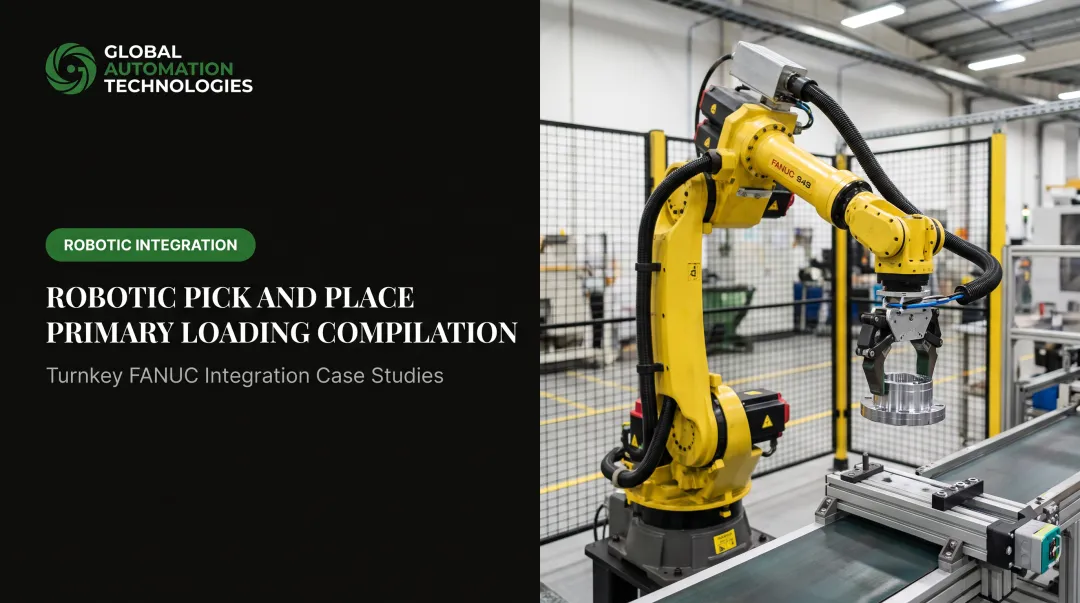
End-of-line palletizing and vision-guided bin picking started on factory floors, and both transfer cleanly into distribution center workflows. GLOBAL Automation Technologies works across both worlds. Its robotic material handling systems, built primarily on FANUC platforms, cover:
- Pick-and-place
- Palletizing
- Conveyor integration
Those capabilities bridge manufacturing and logistics-adjacent operations without a separate toolkit.
Types of Logistics Robots You Should Know
Choosing the right robot depends on facility layout, load type, and how often your operation changes. Some environments need rigid, predictable paths. Others need robots that can adapt on the fly.
Here's how the main categories stack up:
| Robot Type | Navigation | Best For |
|---|---|---|
| AGVs | Fixed paths (magnetic strips, wires, lasers) | High-volume plants with stable layouts |
| AMRs | Sensor and AI-based dynamic routing | Facilities with changing layouts or SKU mixes |
| Robotic arms | Fixed-base, programmed motion | Picking, packing, palletizing, precision handling |
| Cobots | Shared workspace with humans | Mixed manual/automated tasks |
| Sortation / cube-storage | Grid or conveyor-based routing | High-volume parcel and part distribution |
AGVs (Automated Guided Vehicles) follow a predetermined route using magnetic strips, embedded wires, or laser guidance. They're reliable workhorses in manufacturing plants and large distribution centers where the floor plan rarely changes.
AMRs (Autonomous Mobile Robots) use onboard sensors, mapping software, and AI to navigate dynamically. They reroute around obstacles and adjust to layout changes without reprogramming, which makes them the go-to choice for facilities running variable picking and transport operations.
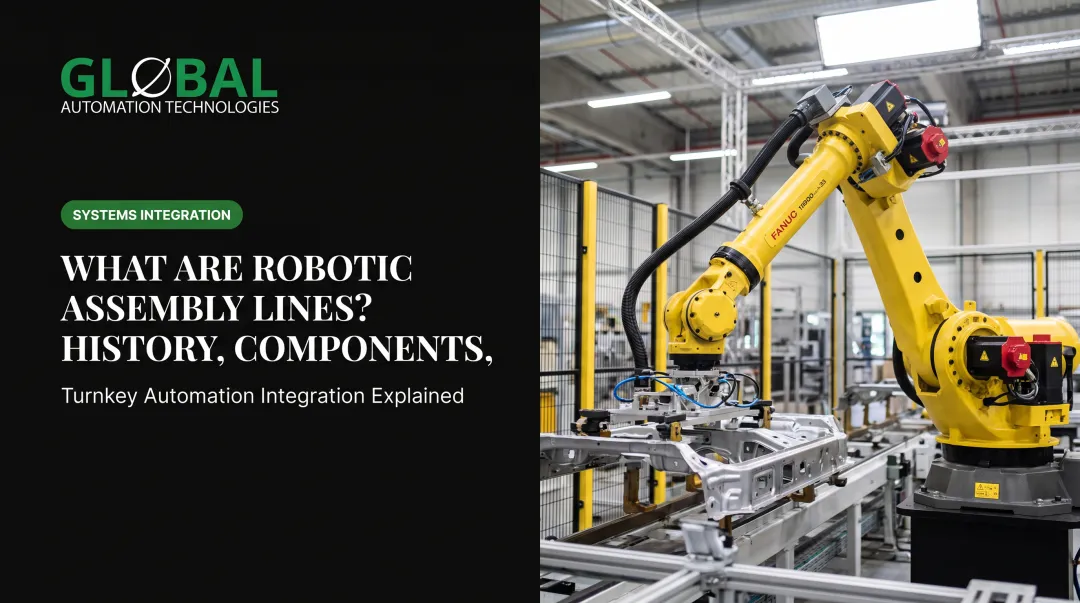
Robotic arms handle picking, packing, palletizing, and precision material handling on fixed stations. They suit high-precision work and tasks that pull operators out of hazardous zones.
GLOBAL typically deploys FANUC arms for these jobs across manufacturing lines and logistics-adjacent cells. As a Level 5 FANUC Authorized System Integrator, the team pairs hardware access with deep programming expertise on each deployment.
Cobots share workspace with human staff on mixed manual and automated tasks—packing assists, light machine tending, and inline handoffs where full isolation isn’t practical.
Sortation and cube-storage robots move high volumes of parcels and parts through grids or conveyor networks. They shine when throughput matters more than route flexibility.
Across logistics, mobile robotics adoption keeps rising. AMRs especially are gaining on fixed-path AGVs as more facilities choose flexibility over heavy infrastructure.
Key Applications of Robotics Across the Logistics Chain
Robotics touches nearly every stage of the logistics chain now, from the moment inventory arrives to the moment it leaves the dock.
- Storage and retrieval: Stacker cranes, cube-storage robots, and AS/RS systems automate goods-in and goods-out cycles, improving slotting accuracy and cutting the labor needed for high-density storage.
- Internal transport and material handling: AGVs and AMRs move goods between zones without manual forklift trips, cutting empty travel time and freeing operators for higher-value work.
- Order picking and packing: Goods-to-person systems and robotic arms fitted with vision guidance speed up fulfillment dramatically. A Locus Robotics case study documented one operation, GEODIS, increasing throughput from roughly 100 units per hour to 175-200 units per hour after deploying AMR-assisted picking.
- Truck loading and unloading: Automatic truck loading systems (ATLS) can cut dock time from the 30-45 minutes a forklift crew typically needs down to under five minutes, while also reducing product damage from repeated handling.
- Inventory management: RFID and barcode-equipped robots scan pallet locations continuously, catching discrepancies before they turn into stockouts or overstock situations.

These aren't isolated wins. Each application feeds the next. Faster retrieval means faster picking, which means faster loading, which means trucks leave on schedule.
The same material-handling logic applies on the plant floor, where machine tending and part-transfer cells typically pay for themselves in 12 to 18 months through higher spindle utilization and fewer direct labor hours per part.
Benefits of Deploying Robotics in Logistics
The case for robotics comes down to three things: throughput, labor, and predictability.
- Throughput — robots move goods faster and more consistently than manual flows
- Labor — people shift from repetitive lifting and transport to judgment-based work
- Predictability — fleets scale on demand, and AI flags failures before downtime hits
Efficiency and Labor Relief
Throughput gains like the near-doubling seen in AMR-assisted picking (referenced above) aren't outliers. They reflect a consistent pattern: robots handle repetitive movement so human workers can focus on judgment-based tasks.
That matters more given the labor shortage figures cited earlier. Fewer available workers means every hire needs to go where people add the most value, not repetitive lifting or transport.
Removing workers from repetitive or hazardous tasks also cuts injury exposure. Operations that put robots in high-repetition roles consistently report fewer strain and lifting injuries among remaining staff.
Scalability and Predictive Maintenance
Robotic fleets scale in ways manual labor can't. Adding capacity for a demand spike means deploying more units, not scrambling to hire and train seasonal staff on a compressed timeline.
Predictive maintenance keeps that capacity online. AI-driven health-assessment tools, like those GLOBAL builds into its engineering practice, monitor equipment continuously and flag issues before they cause unplanned downtime. Instead of reacting to a failed sorter or jammed conveyor, maintenance teams get ahead of failures and keep the facility running.
Challenges and Considerations Before Implementing
Robotics adoption isn't plug-and-play. A few realities to plan around:
- High upfront investment vs. RaaS: Capital costs can block mid-sized operations. RaaS bundles hardware with engineering, maintenance, and monitoring—often billed per unit of work—to lower the entry point.
- Integration and workforce transition: Connecting robots to existing WMS and ERP systems takes real engineering work, not a simple plug-in. Staff need training, and change management matters as much as the technical side.
- Reliability and vendor support: Hardware and software issues happen. Strong deployments depend on an integrator who stays for training and ongoing support after commissioning—not only install day.

Plan the rollout carefully and choose an integrator with proven commissioning, training, and lifecycle support—not a partner who disappears after go-live.
Choosing the Right Automation Partner for Logistics Robotics
A robotic system is only half the equation. Someone still has to program it, run it, and maintain it. That gap is where many integrator relationships fall apart.
GLOBAL Automation Technologies pairs automation solutions, services and technical staffing under one roof. One call gets a manufacturer both the robotic system and the engineers to keep it running. That model is backed by 17+ years in business and a proven global base of robotic deployments.
When evaluating an automation partner, look for:
- Turnkey capability - design, build, programming, installation, commissioning, and long-term support as one continuous scope, not handoffs between vendors
- Logistics-relevant experience - material handling, palletizing, and high-volume manufacturing each bring different throughput, layout, and uptime demands
- On-demand engineering talent - contract, contract-to-hire, or direct-hire engineers for scaling projects or troubleshooting after go-live
Factories don't stop running once a robot is installed, and neither should the support behind it.
Frequently Asked Questions
What is robotics in logistics?
Robotics in logistics refers to automated systems that handle the movement, storage, sorting, and delivery of goods to improve speed, accuracy, and safety across the supply chain. It spans everything from mobile robots to robotic arms.
What are the major use cases of robots in the logistics industry?
Core use cases include internal transport, order picking and packing, sorting, inventory management, truck loading, and last-mile delivery. Each application targets a specific bottleneck in the goods-movement cycle.
What types of robots are used in warehouses?
The most common warehouse robot types are AGVs, AMRs, robotic arms, and cube-storage robots. Facility layout and load variability usually determine which type fits best.
How can robotics help logistics operations?
Robotics improves efficiency and cuts picking and sorting errors. It also keeps workers out of repetitive or hazardous tasks and frees staff for higher-value work like quality inspection.
What are the challenges of implementing logistics automation?
The main hurdles are high upfront costs, the complexity of integrating robots with existing WMS or ERP systems, and the staff training and change management needed to support the transition.
How do companies get started with robotics in logistics automation?
Start by mapping current operations and defining clear automation goals, then partner with an experienced integrator like GLOBAL that can design, build, and support the right system from day one.