
Meanwhile, human inspection has real limits. One controlled study found manual inspectors correctly caught 85% of defective parts but also flagged 35% of good parts as bad, wasting material and time.
Machine vision systems solve both problems at once. They act as the "eyes" of automated production, handling inspection, guidance, and quality control without fatigue or inconsistency. This article covers how these systems work, the types available, where they're used, what they cost, and how to pick an integration partner who won't leave you stranded after installation.
Key Takeaways
- Vision systems combine cameras, lighting, optics, and software to automate inspection, measurement, and robot guidance
- Accuracy spans sub-millimeter to micron-level based on hardware choice and application demands
- Automotive, food/beverage, pharma, and electronics plants use vision for quality control, guidance, and throughput
- Integration expertise matters as much as the camera specs you buy
What Is a Machine Vision System?
A machine vision system combines imaging hardware and software to automate visual inspection and decision-making on the production line. It captures an image, evaluates it against defined rules or models, and triggers a pass/fail, measurement, or motion command in real time.
Core components include:
- Camera/sensor — captures the raw image
- Lens/optics — determines field of view and focus
- Lighting — creates the contrast needed for reliable detection
- Image-processing software — turns pixels into decisions
Lighting, lenses, and compatible hardware matter as much as the camera. A high-end sensor with poor lighting still produces unreliable data.
Smart Cameras vs. PC-Based Systems
A vision camera is a device with built-in or connected processing capability. Smart cameras house the processor and software inside the camera body itself, making them compact and simple to deploy for single-function tasks.
PC-based systems run processing on a separate computer. That setup supports multi-camera cells, higher resolution, and custom algorithms, with more integration work in return.
In both architectures, vision software converts raw images into defect flags, dimensional measurements, or robot coordinates.
Machine Vision vs. Computer Vision: What's the Difference?
Machine vision is a specific industrial application of the broader computer vision field. It's tied to hardware, real-time decisions, and factory floor conditions.
Computer vision is the umbrella category. It covers AI-driven tasks such as facial recognition and autonomous vehicle navigation. Machine vision stays task-specific on the line: inspect this weld, read this barcode, guide this robot arm.
How Do Machine Vision Systems Work?
Every machine vision system follows roughly the same four-step process:
- Image acquisition — A triggered sensor captures the image while controlled lighting creates usable contrast
- Feature extraction — Algorithms evaluate edges, shapes, patterns, and textures
- Detection/segmentation — Rule-based logic checks defined geometry, or AI models flag variable anomalies
- High-level processing/decision — The system compares results to criteria and outputs a pass/fail, measurement, or robot coordinate

On moving lines, lighting and camera triggering have to be dialed in precisely. Inconsistent lighting is one of the most common reasons vision systems produce false rejects.
Once a decision is made, the system communicates it to PLCs, robots, or data logs: reject this part, log this measurement, or send coordinates to the robot arm.
Shops increasingly use AI-assisted vision software to cut false rejects versus purely rule-based systems, especially where "normal" appearance varies part-to-part. Rule-based tools still win for predictable, well-defined tasks.
A practical example: GLOBAL, which holds Level 5 status in FANUC’s Authorized System Integrator program, integrates real-time vision inspection into robotic dispensing processes, where a FANUC robot applies material along programmed 3D bead paths. The vision and flow-monitoring system checks:
- Bead width
- Bead placement
- Bead continuity
- Off-spec material delivery
- Missed or incomplete paths
If the bead falls outside spec or the robot misses part of the path, the system flags it before the part moves downstream. That catches defects in real time instead of at final inspection.
Types of Machine Vision Systems
Not all vision hardware is built the same way. Three architecture classes dominate the market:
| Type | Best fit | Tradeoff |
|---|---|---|
| PC-based | Complex, multi-camera, high-resolution inspection | More integration expertise required |
| Smart camera | Compact, single-function deployment | Less customizable |
| Compact vision sensor | Presence/absence checks, barcode reading | Limited built-in tools |
2D vs. 3D Vision
2D systems handle surface appearance, presence checks, edge detection, and code reading. 3D systems add depth: critical for volumetric measurement, part pose detection, and robot guidance where height or orientation matters.
Pay for 3D only when your application genuinely requires depth data: random-bin part picking, raised-feature inspection, or robotic placement where orientation isn't fixed.
Functional Categories
Beyond hardware architecture, vision systems are also grouped by function:
- Measurement — dimensional tolerance checks
- Defect detection — surface flaws, cracks, contamination
- Verification — presence/absence, correct component installed
- Code/label reading — barcodes, date codes, traceability
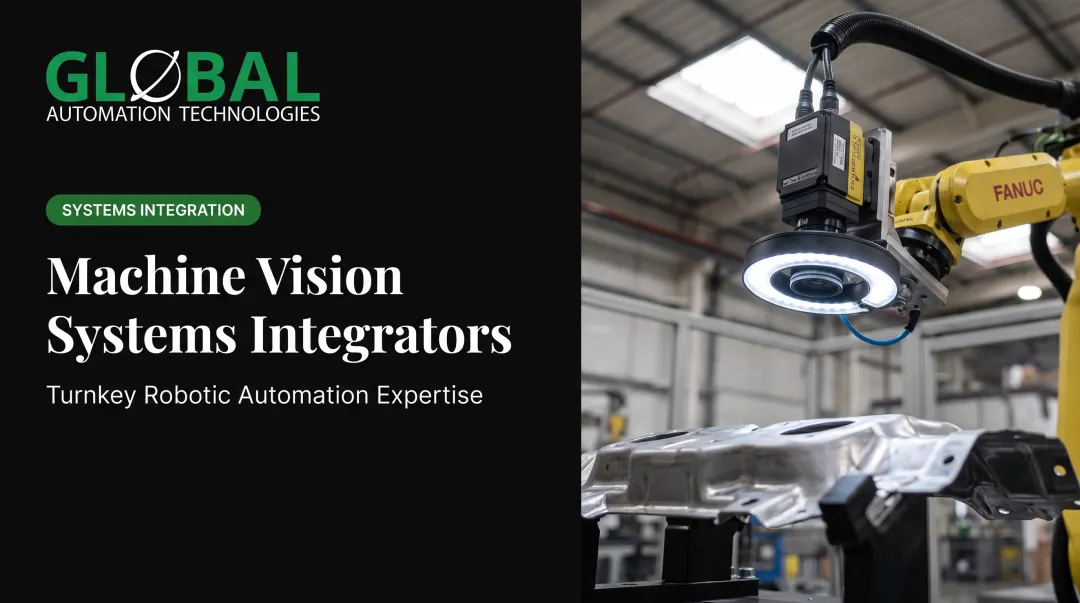
Robot-guided vision pairs a camera with a robotic arm for precision part picking, placement, and machine tending, even when parts arrive in random orientations.
GLOBAL's engineering division builds these systems on FANUC platforms. Vision handles part location, random bin picking, and orientation verification so robots can work with variable part presentation without hard tooling.

Where Are Machine Vision Systems Used?
Machine vision shows up across nearly every manufacturing vertical:
- Automotive/EV manufacturing: BMW's Dingolfing plant uses vision to compare live vehicle images against order data during final inspection
- Tier 1 suppliers: weld seam inspection, component verification, assembly tracking
- Food and beverage: packet presence checks, OCR for date and lot codes
- Pharmaceuticals: Unique Device Identification (UDI) code verification, vial and blister inspection (one line runs 10 cameras at 30 vials per minute)
- Electronics: PCB checks for missing components, solder joints, and connector seating
- Heavy equipment: AI-assisted weld inspection for porosity, undercut, and cracks
Common application types across these industries:
- Barcode and label verification
- Weld seam inspection
- Dimensional tolerance checks
- Surface defect detection
Data center infrastructure manufacturers are adopting vision-guided robotics for enclosure and rack assembly quality control as well. Those systems verify component placement, connector seating, and serial-number tracking as server production scales up.

What Does a Machine Vision System Cost — and What's the ROI?
Costs vary widely by scope. Component-level pricing for industrial 2D vision often lands in the low thousands to around $25,000+, with 3D systems commonly ranging from roughly $3,000 to $60,000+ for cameras and sensors alone. Those figures rarely include software, controls, or integration labor—the bulk of a production-ready install.
Main cost drivers:
- Number of cameras required
- Resolution and accuracy requirements
- Lighting complexity
- Software and integration labor
A fully integrated multi-camera PC-based system with robot guidance can run well over six figures once engineering, controls, and commissioning are included.
That upfront cost is why payback matters as much as the quote. GLOBAL’s documented figure is that automated cells, including vision-integrated machine tending, typically pay for themselves in 12 to 18 months. The math rests on more parts per shift with fewer direct labor hours, plus runtime through breaks, shift changes, and overnight periods.
Vision integration adds to that return by cutting misfeeds, scrap, and rework. Still, model payback against your own labor costs, scrap rates, and throughput targets rather than treating 12–18 months as a universal number.

Choosing the Right Machine Vision Integration Partner
A camera spec sheet won't tell you whether a vision system will actually work on your line. Lighting design, software tuning, and integration expertise determine whether a system performs in the real world or gets shelved after six months of false rejects.
What to look for in a partner:
- Proven experience across multiple industries, not just one niche
- Ability to design lighting and optics for your specific part geometry, not generic setups
- Software tuning capability: rule-based logic where it fits, AI where variability demands it
- Support for calibration, maintenance, and troubleshooting after go-live
A3's Certified System Integrator program checks for years of experience, certified staff, and a verified industry track record. It's a useful screening tool, not a performance guarantee.
One factor buyers often overlook: who runs the system once it's installed.
GLOBAL pairs automation solutions, services and technical staffing. The same organization that designs and deploys the vision-guided robotic cell can supply the controls engineers, robot programmers, and commissioning staff to operate and maintain it long-term.
That continuity matters more than most buyers expect once the integrator's install team packs up and leaves.
Frequently Asked Questions
How much is a vision system?
Costs range from a few thousand dollars for basic smart-camera setups to well over $100,000 for fully integrated multi-camera systems with robot integration. The final price depends on camera count, resolution needs, and integration labor.
How do vision systems work?
Vision systems capture an image, extract features like edges and patterns, then classify or measure against defined criteria. The result triggers a decision: accept, reject, or send coordinates to a robot.
What's the difference between computer vision and machine vision?
Machine vision is an industrial subset of computer vision, focused on real-time decisions in factory settings. Computer vision is the broader AI field, covering tasks like facial recognition or autonomous driving.
How accurate is machine vision?
Accuracy depends on optics, lighting, and software quality. Specialized setups can achieve sub-millimeter or even micron-level precision.
What industries use machine vision?
Automotive, food and beverage, pharmaceuticals, electronics, and heavy equipment manufacturing are top adopters, with growing use in data center hardware production.
What is a vision camera?
A vision camera is a smart or industrial camera with built-in or connected image-processing capability, used to automate inspection, measurement, or guidance tasks on a production line.