
Automated storage and retrieval systems (ASRS) are how a growing number of facilities are answering that pressure. This guide covers what ASRS actually is, the main system types, real benefits and costs, and how to pick the right fit for your operation.
One thing worth flagging up front: the hardware is only half the equation. The robotics and engineering talent that connect an ASRS to the rest of your production line often determine whether the investment pays off — a point we'll come back to later in this guide.
Key Takeaways
- ASRS replaces manual picking with computer-controlled cranes, shuttles, or robots for storage and retrieval
- Facilities can cut floor space by up to 85% and labor by two-thirds, per vendor data
- Costs range from $70,000 for a single vertical carousel to $3 million+ for large integrated systems
- Payback typically lands between 1 and 3 years, driven by labor, space, and accuracy gains
- Success depends as much on robotic integration and engineering support as on the ASRS hardware itself
What Is an Automated Storage and Retrieval System (ASRS)?
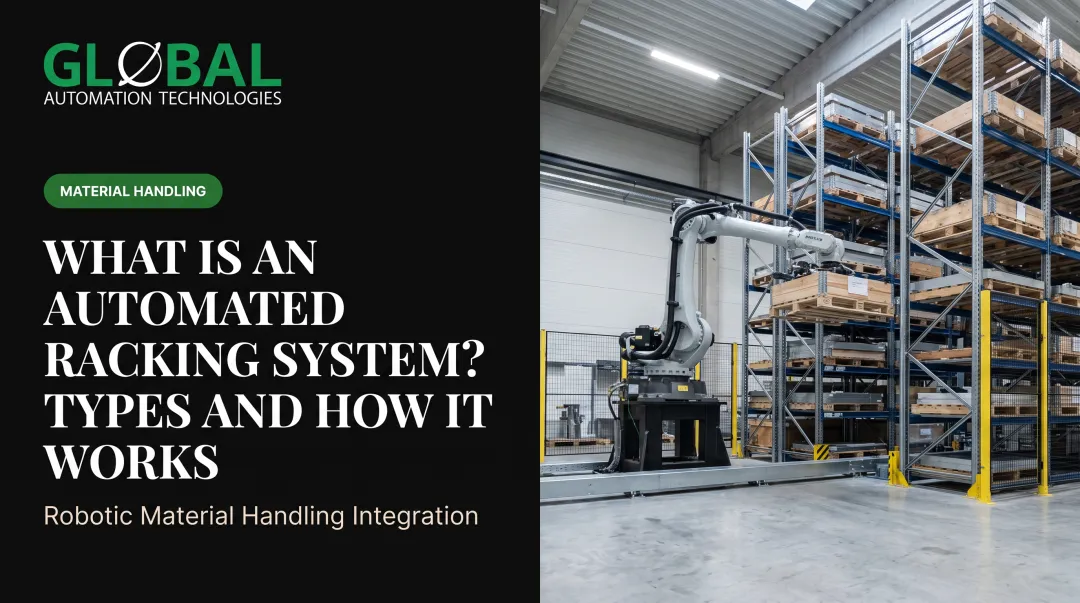
An ASRS is a computer-controlled system that stores and retrieves inventory from fixed storage locations automatically, using cranes, shuttles, or robots instead of a person walking the aisles. Software directs every move, and the machine executes it, whether that's a pallet crane traveling a narrow aisle or a tray-based extractor delivering parts to a worker.
Core Components
Every ASRS shares three fundamental elements:
- Storage structure – The rack or shelving system, engineered for specific load types and heights
- Storage/retrieval machine – The crane, shuttle, or robot that physically moves goods (this includes the mast, carriage, and load-handling device)
- Software control layer – A warehouse management system (WMS) that handles inventory and order logic, paired with a warehouse control system (WCS) that directs the equipment in real time

A Brief History
ASRS technology isn't new. Dematic traces the first storage and retrieval machine to a 1962 installation at Bertelsmann in Germany. What started as heavy pallet handling has since evolved into small-parts, goods-to-person systems that can move a tote to a picker in seconds.
ASRS vs. AGVs and AMRs
The distinction is straightforward. ASRS is fixed and enclosed: cranes and shuttles operate within a defined rack structure. AGVs (automated guided vehicles) and AMRs (autonomous mobile robots) are mobile floor vehicles that navigate open space, sometimes feeding an ASRS but never replacing its rack-bound structure.
ASRS doesn't operate alone. It typically works alongside conveyors, robotic arms, and warehouse software to move goods from receiving through storage to shipping.
Types of Automated Storage and Retrieval Systems
Not all ASRS technology solves the same problem. Choosing the right type starts with your load size, SKU count, and throughput needs.
| Type | Typical Capacity | Best Fit |
|---|---|---|
| Unit-load crane | 1,000+ lb pallets, up to 100 ft high | Heavy pallet warehousing |
| Mini-load crane | Under 1,000 lb, 10-40 ft high | Totes, cartons, small parts |
| Shuttle-based | ~800 moves/hour per rack line | High-throughput fulfillment |
| Vertical carousel | Up to 1,430 lb per carrier, 32 ft tall | Tight footprint, stable SKUs |
| Horizontal carousel | Up to 2,000 lb per carrier | Low ceilings, changing product mix |
| Vertical lift module (VLM) | Trays to counter height, high-bay | High ceilings, limited floor space |
| Micro-load stocker | Under 100 lb packages | Light parts, compact storage |
| Cube/grid robotic | 100,000+ bins in a single grid | Very dense small-item storage |
Unit-Load and Mini-Load ASRS
Unit-load cranes handle palletized loads of 1,000 pounds or more in fixed or movable aisles, making them the workhorse for heavy pallet storage. Mini-load systems handle the same basic mechanics but at a fraction of the weight, moving totes, cartons, and bins for operations with high SKU counts and smaller unit sizes.
Shuttle-Based ASRS
Robotic shuttles run on rails at each rack level rather than a single crane serving the whole aisle. One documented rack line achieved roughly 800 storage and retrieval movements per hour, which is why shuttle systems tend to win when throughput matters more than raw storage density.
Carousel-Based ASRS
Horizontal carousels spread across 19 to 153 feet, which suits low-ceiling buildings and shifting product mixes. Vertical carousels stack 4 to 5 feet deep and up to 32 feet tall, delivering parts to an ergonomic pick window in a smaller footprint.
Vertical Lift Modules and Micro-Load Stockers
VLMs use two columns of trays with a central extractor that delivers each tray to a worker at counter height — a strong fit for high-ceiling buildings with limited floor space. Micro-load stockers serve a similar role for lighter packages, generally under 100 pounds.
Cube Storage and Floor Robots
Grid-based cube systems stack bins densely, with robots traveling on top of the grid to dig out and deliver inventory. TTI's AutoStore installation, for example, runs roughly 135,000 subdividable bins with dedicated picking and putaway ports. Floor robots (AGVs/AMRs) complement these systems by transporting shelving or totes across open floor space, rather than operating within a fixed rack.
Benefits & Signs You Need an ASRS
Key Benefits of ASRS
ASRS performance data is specific enough to benchmark against your own operation. According to Kardex's ASRS benchmarks, well-implemented systems deliver:
- Up to 85% less floor space than traditional shelving, because vertical density replaces wide aisles
- Two-thirds less operating labor, since machines handle travel and retrieval instead of people
- 99.9% pick accuracy with automated pick-to-light guidance, compared to error-prone manual picking

Treat these as vendor benchmarks worth testing against your own SKU count, order volume, and staffing data. They are not guaranteed outcomes.
8 Signs It's Time to Automate
Watch for these operational red flags:
- Facility at max capacity with no room to expand shelving
- Replenishment overload: teams constantly restocking instead of fulfilling orders
- Rising mispicks or lost inventory eating into margins
- Increasing injury risk from repetitive lifting or reaching
- Picker travel time consuming most of the labor budget
- Difficulty hiring for warehouse or material handling roles
- Inconsistent order accuracy across shifts
- Growing SKU count that manual systems can no longer track efficiently
These signs rarely show up alone. A facility short on space usually also faces mispicks and replenishment overload, and each problem makes the others worse.
Delaying automation typically means paying more later, both in dollars and in safety risk.
Where Is an ASRS Used? Common Applications
ASRS isn't limited to distribution centers. Manufacturers use it just as heavily, often in ways that look nothing like a traditional warehouse.
Common manufacturing applications include:
- Point-of-use feeding: single-SKU systems deliver parts or kits straight to an assembly or machining station, cutting operator walk time
- Goods-to-person picking: the ASRS brings each item to a stationary operator and removes most travel time. TTI's AutoStore deployment reported a 50% picking-speed improvement over its prior goods-to-person setup
- Buffer and WIP storage: mini-load or unit-load ASRS stages components between production steps, keeping automotive and heavy-industry lines synced with the robotic cells that feed them
The Role of Robotic Integration & Engineering Talent in ASRS Success
Buying an ASRS doesn't guarantee ROI. Most implementations need robotic arms or AMRs working at the output end: palletizing finished cases, depalletizing inbound stock, or feeding a machine tending cell that's synced to the ASRS.
That's where a lot of projects stall.
Why Integration Is the Hard Part
Getting robotics to work in sync with an ASRS and its WMS/WCS software isn't a plug-and-play exercise. It requires:
- Controls engineers who can program the handoff between crane, conveyor, and robot
- Simulation work to validate cycle times before equipment ever moves
- Commissioning expertise to catch timing conflicts between systems
A shortage of qualified controls and robotics engineers is a common bottleneck for manufacturers trying to close this gap, particularly when the robotic integration and staffing come from two different vendors who aren't talking to each other.
How GLOBAL Approaches This
GLOBAL Automation Technologies, a Level 5 FANUC Authorized System Integrator, was built to close that gap. The company combines automation solutions, services and technical staffing, so manufacturers get both the automation system and the engineers to run it through a single call.
On the technical side, GLOBAL uses AI-assisted simulation to model and optimize robot programs before deployment, sharply compressing programming time. Material handling work runs primarily on FANUC robotics with FANUC iRVision support:
- Palletizing and depalletizing
- Pick-and-place
- Machine tending
- Flexible part picking from bins, racks, and conveyors
Owning both sides matters most when things go wrong. When one company designs the system and supplies the engineers who run it, there's no handoff gap between the people who built it and the people fixing it.
That closed loop cuts implementation risk and downtime versus sourcing integration and staffing separately. If robotic integration is part of your ASRS project, talk to GLOBAL's engineering team early—not after equipment is already on order.
Choosing the Right ASRS: Cost, ROI & Key Factors
Cost Ranges
ASRS pricing varies widely by technology and scale. Published starting prices include:
| Technology | Starting Price |
|---|---|
| Vertical carousel | $70,000+ |
| Vertical lift module | $95,000+ |
| Vertical buffer module | $180,000+ |
| Mini-load ASRS | $750,000+ |
| Unit-load ASRS | $1,000,000+ |
| Multi-shuttle system | $1,000,000+ |
| Robotic cube storage | $1,500,000+ |
According to Kardex's cost analysis, a full mini-load system managing over 80,000 SKUs can exceed $3 million. The main cost drivers are:
- System type and technology
- Storage volume and cubic capacity
- Software and controls complexity
- Facility modifications or retrofitting needs
- Integration with existing WMS/ERP platforms
ROI Timelines
AutoStore's 2022 investor report puts typical payback at 1 to 3 years. That clock starts when operational savings offset your capital outlay.
The levers that get you there fastest:
- Labor savings from reduced picking headcount
- Floor space reclaimed for higher-value activity
- Fewer picking errors and the rework they cause
Selection Factors
Before comparing vendors, nail down:
- Warehouse layout and ceiling height — determines whether vertical or horizontal systems make sense
- Inventory type and SKU characteristics — dictates crane, shuttle, or carousel fit
- Throughput requirements — sets the pace your system needs to sustain
- Scalability — capacity to expand as order volume grows
- WMS/ERP compatibility — integration gaps here cause most post-launch headaches
Ongoing maintenance shouldn't be an afterthought either. Systems running long hours across multiple shifts need qualified technical support on call, not just an installation crew that leaves once commissioning is done.
Frequently Asked Questions
How much does an automated storage and retrieval system (ASRS) cost?
Costs range from around $70,000 for a single vertical carousel to $3 million or more for a large-scale mini-load or cube system. Scale, SKU count, and software complexity are the biggest price drivers.
What is an automated storage and retrieval system (ASRS) used for?
ASRS supports point-of-use storage at production lines, goods-to-person order fulfillment, and buffer/WIP staging between manufacturing stages. It's used across both warehouses and manufacturing plants.
What is the difference between an ASRS and an AGV or AMR?
ASRS is a fixed, enclosed storage structure with cranes or shuttles operating in defined rack aisles. AGVs and AMRs are mobile floor robots that navigate open space and often work alongside an ASRS rather than replacing it.
How long does it take to install an ASRS?
Small vertical lift modules can install in days. Larger, integrated ASRS projects typically take around 18 months, while complex cube or crane-based systems can take up to three years.
Which industries benefit most from ASRS?
Automotive, general manufacturing, e-commerce, pharmaceuticals, and food and beverage are the top adopters. Automotive has historically led ASRS demand growth.
Can an ASRS be integrated with robotic arms for material handling?
Yes. Robotic arms and AMRs are commonly integrated at ASRS output points for palletizing, depalletizing, and machine tending. That work usually needs specialized controls and robotics engineering to program and commission.